Books & Reading
7 Life-Changing Books Every College Student Should Read
Feb 22
2026
7 life-changing books every college student should read — picked for honest impact on the way you think, study, and live.
Some books, read at the right age, rearrange some of the furniture in your head. You're never quite the same person afterward — you just find yourself thinking about the world a little differently, treating yourself a little better, or making the small decisions of your life with a slightly different compass.
College is, in many ways, the perfect window for those books. You're old enough to understand them. You're young enough that the rearranging still has time to compound. And you're surrounded — for one of the only periods in your adult life — by other people reading and thinking about big ideas too.
This is a list of seven books that have done that work for me, for the women I write for, and for the dozens of friends I've talked to about reading over the years. It is not a list of the most prestigious or most cited or most likely to appear on a syllabus. It is a list of books that change you.
Save this. Buy one of them this month. Read it slowly. Let it work on you.
1. Bird by Bird by Anne Lamott
If I could only recommend one book on this list, it would be this one. Anne Lamott wrote it as a writing book — and it is, technically, a writing book — but it's actually a book about doing any hard thing one small piece at a time.
The title comes from a story about Lamott's older brother as a ten-year-old, paralysed at the kitchen table the night before a school report on birds was due. He had three months to do it. He'd done nothing. Their father sat down next to him, put a hand on his shoulder, and said: "Bird by bird, buddy. Just take it bird by bird."
That's the whole philosophy of the book. Every dissertation, every degree, every overwhelming project gets done by being broken into birds. One bird at a time. Don't think about the whole flock.
I read this book in the second year of an undergraduate degree I was halfway convinced I should quit. I finished the degree. I credit Lamott for at least a third of that finishing. The book is also genuinely funny — laugh-out-loud funny in places — which is more than I can say for most books that change your life.
Read this if: you're overwhelmed by something big. (You are. Everyone is.)
Best quote
"You don't have to see where you're going, you don't have to see your destination or everything you will pass along the way. You just have to see two or three feet ahead of you."
2. Atomic Habits by James Clear
The most over-recommended book of the last decade for a reason. James Clear took a hundred years of behaviour-change research and distilled it into a single readable book about how habits actually work — and, more importantly, how to design your environment so that the right habits happen by default.
The single most useful concept in the book — for me — was the Two-Minute Rule: any new habit should be possible to do in under two minutes. Want to read more? The new habit isn't "read 30 pages a day", it's "open the book". Want to journal? The habit isn't "write a page", it's "write one sentence". You scale up later. The point of the two-minute version is to remove the friction of starting.
I have read this book three times in five years. Every reread, I underline something different. The framework genuinely works — for studying, for fitness, for finances, for any behaviour you've struggled to make stick.
Read this if: you keep starting habits and abandoning them after a week.
Best quote
"You do not rise to the level of your goals. You fall to the level of your systems."
3. The Defining Decade by Meg Jay
Meg Jay is a clinical psychologist who specialises in twenty-somethings, and The Defining Decade is the book she wrote because she got tired of watching young women coast through their 20s thinking they had all the time in the world. The book's central argument: your 20s are not a throwaway decade. They are, statistically, the most consequential decade for your identity, your career, your relationships, and your finances.
What I love about this book is that it isn't a hustle manifesto. Jay isn't telling you to grind. She's telling you that the small decisions you make in your 20s — who you date, what you study, where you live, what you commit to — compound. She backs every claim with case studies from her own practice, which makes the advice land harder than the average self-help book.
I read this in my second year of college and made three major decisions within a month of finishing it. All three turned out well. Correlation, maybe — but I'd take that correlation again.
Read this if: you feel like you have all the time in the world, or you feel like you have none of it. Both groups need this book.
Best quote
"Claiming your twenties is one of the simplest, yet most transformative, things you can do."
4. Big Magic by Elizabeth Gilbert
If The Defining Decade is the strategic book about your 20s, Big Magic is the emotional one. Elizabeth Gilbert wrote it after Eat Pray Love exploded, and it's the most generous book I have ever read about creative living — not just "being an artist", but living any life that has any creativity in it.
Gilbert's argument is that fear and creativity are inseparable. You don't get to make anything new without fear coming along for the ride. The trick isn't to eliminate the fear (you can't), or to wait until you stop being afraid (you'll be waiting forever). The trick is to let the fear sit in the passenger seat while creativity drives.
The book is structured as a series of short, almost-essays — each one about a different relationship with creative work. Read it in the bath. Read it on the train. Read one essay at a time and let it work on you slowly.
Read this if: you have ever wanted to make something — write, paint, design, build a business, start a podcast — and let the fear talk you out of it.
Best quote
"Your fear will always be triggered by your creativity, because creativity asks you to enter into realms of uncertain outcome, and fear hates uncertain outcome."
5. Wild by Cheryl Strayed
The genre-defying memoir of a young woman who, after the death of her mother and the collapse of her marriage, decided to hike eleven hundred miles of the Pacific Crest Trail alone. Cheryl Strayed had no backpacking experience. She did almost everything wrong. The book is about what she found out there — about grief, about strength, about who she was when there was nothing left to perform for.
I read this in my third year of college. I had been having a wobbly few months. Wild didn't make my problems smaller — but it did make me feel, for the first time in a long while, that being lost was a survivable condition. Cheryl Strayed walks through her grief one trail-mile at a time and arrives, at the end of the book, somewhere recognisable as herself.
The book also reads like a novel — better than most novels — because Strayed is one of the great American prose writers and just happens to be working in non-fiction.
Read this if: you are grieving anything. The breakup, the dead grandparent, the relationship with your mother that isn't what you wished, the version of yourself you thought you'd be by now.
Best quote
"It was my life — like all lives, mysterious and irrevocable and sacred. So very close, so very present, so very belonging to me."
6. Quiet by Susan Cain
If you have ever felt like you were doing your personality wrong — too introverted for college parties, too anxious about networking events, too drained by hours of group work — Quiet is the book that explains, with rigorous citations and beautiful prose, why your nervous system isn't broken. It's just a different nervous system from the loud one our culture has decided is correct.
Susan Cain's central argument is that we have built every modern institution — open-plan offices, group-project schools, networking-heavy careers — around the assumption that extroversion is normal and introversion is a problem to be solved. It is not. Introverts make up roughly a third of the population, and the world is shaped wrong for them. Cain walks you through the science, the history, and the practical implications.
For me, reading this book was the first time I'd ever encountered the phrase "introverts are not failed extroverts". I think I cried for about ten minutes. If you have ever felt that there was something quietly wrong with you for not being the loudest person in the room, please read this.
Read this if: you have ever wished you were more outgoing, more talkative, more "fun at parties". (You're already fine. The room is wrong.)
Best quote
"There's zero correlation between being the best talker and having the best ideas."
7. The Body Keeps the Score by Bessel van der Kolk
This one is heavier than the rest of the list, and it earns its place anyway. Dr. Bessel van der Kolk is one of the leading trauma researchers of the last fifty years, and The Body Keeps the Score is his lifetime's work compressed into a readable, deeply humane book about how trauma — the small versions and the big — gets stored in the body and what we can actually do about it.
This is not a book to read on a beach holiday. It is a book to read slowly, over a season, with a therapist or a thoughtful friend somewhere in the picture if any of it brings up your own material.
But it is — without exaggeration — the single most important book I have read in my 20s. It changed how I understand my own body, my own family, my own anxieties, and what's actually possible in terms of healing. The chapter on yoga and somatic practices alone is worth the whole book.
Read this if: you have ever wondered why you carry tension in your shoulders, why certain situations make you feel ten years old again, why some old hurts seem to live in your body more than your head. You're not imagining it. There's a science to it. Van der Kolk is the man who wrote it down.
Best quote
"Being able to feel safe with other people is probably the single most important aspect of mental health."
A Few Honourable Mentions
These nearly made the main seven. They aren't quite as transformative for the average college student — they require a slightly more specific reader — but if any of them sound like the book you've been waiting for, get it.
- Educated by Tara Westover — for the first-generation college students. The single best memoir of self-made education I have ever read.
- Just Mercy by Bryan Stevenson — for the law students, the activists, and anyone who needs reminding that justice is a slow, careful, lifelong project.
- Untamed by Glennon Doyle — for the women whose nervous systems lit up every time we mentioned "permission slips".
- The Year of Magical Thinking by Joan Didion — for the grieving. The most precise sentences ever written about losing someone.
- Becoming by Michelle Obama — for the women who, deep down, would like the soft permission to want their own version of a big life.
How to Actually Read These Books
Three years ago, I went on a hot streak of buying books I never finished. Beautiful hardback copies of important titles, stacked guiltily on my shelf, three chapters in. I had to design a small system that fixed this. It now works for me. It might work for you.
- Buy one at a time. Resist the bulk-purchase impulse. You'll read the one in your hand more reliably than the seven on the shelf.
- Read in the morning, not the evening. Phones and TV win the evening fight. Read fifteen minutes before checking your email and you'll finish in three weeks instead of three months.
- Underline, dog-ear, scribble. A book that has been read should look like it. Use a pencil. Mark the lines that move you. Future you will want to find them again.
- Keep a one-line-per-book list. When you finish a book, write the single most important sentence you took away from it in a small notebook. After ten books, you have a personal philosophy. After fifty, you have a worldview.
How to Build a Reading Habit That Actually Sticks
A book list is only useful if the books actually get read. Here's the framework I've used for the last four years to read 30-40 books a year while studying full-time.
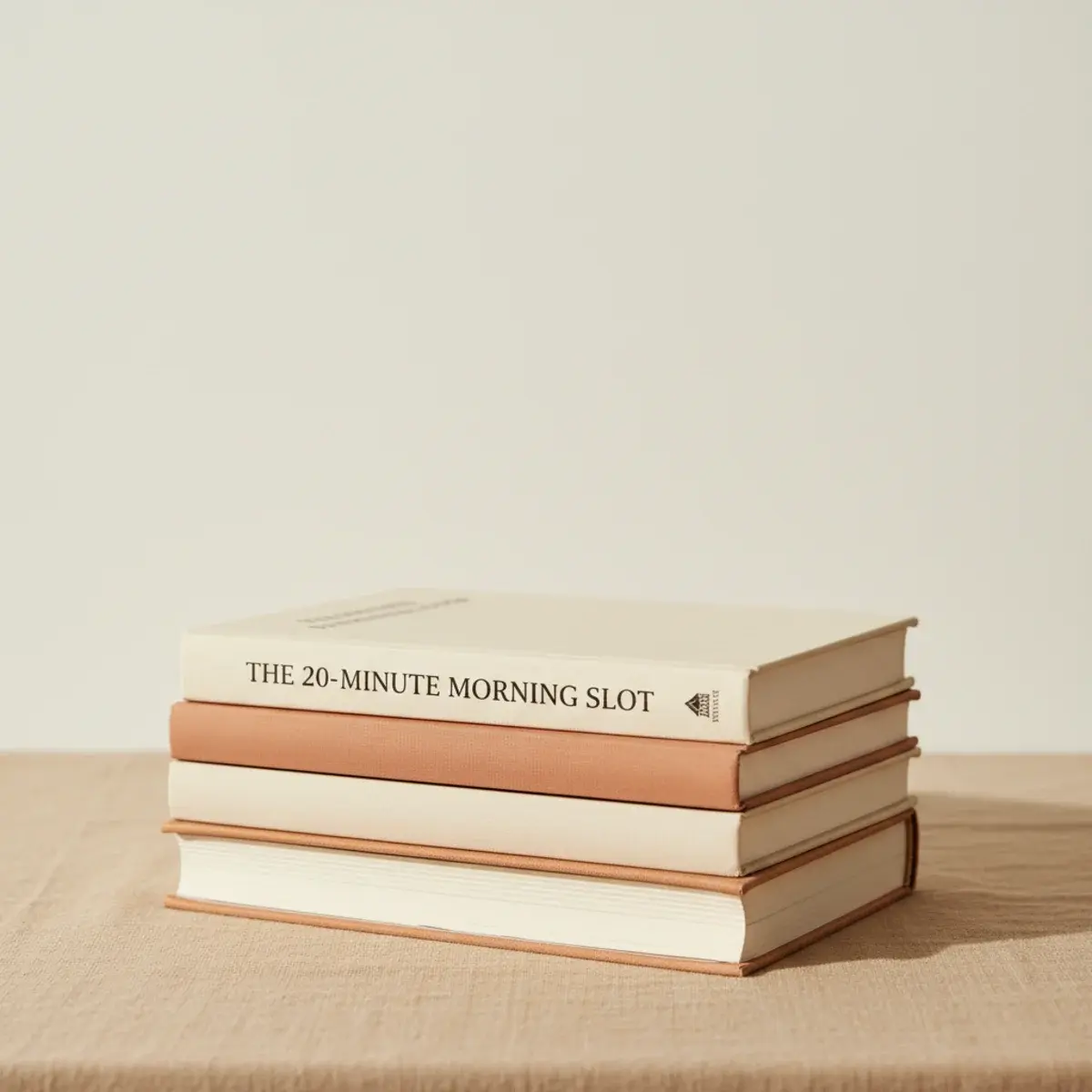
The 20-minute morning slot
Twenty minutes of reading before checking your phone in the morning. Not after breakfast, not after the commute, not in the evening — before the phone. The phone wins every fight after it's been opened. The book has to go first.
Twenty minutes a day at average reading pace works out to roughly 25 books a year. Most of the books on this list take 6–8 hours each. Do the maths: 20 minutes a day finishes any book on this list in 18–24 days. You can finish two of the seven before this term ends.
The "book that's already in the bag" rule
Always have a book in your bag. The wait at the GP, the unexpected delay on the train, the friend who's running fifteen minutes late — all of these are reading time if you have a book on you. They're scrolling time if you don't.
The Friday reflection
Once a week, write down one sentence about what you read that week. Not a review. Just a sentence. "This week I read about how James Clear distinguishes between identity-based habits and outcome-based habits." Future you will thank you for keeping the receipts.
Final Thoughts
The books on this list have one thing in common: they make their readers a slightly different person on the way out. That is the highest compliment I can pay a book.
You will not love all seven. You shouldn't. The point isn't to read them all — it's to find the one (or two, or three) that arrive at exactly the right moment for the woman you are right now. Some of them will sit on your shelf for years before you're ready. That's fine. The right book finds the right reader on the right week.
Pick one. Buy it this week. Read fifteen minutes a day. Let the book do its quiet work on you.
Your 20s will be over faster than you think. The books you read during them stay with you for the rest of your life.
Leave a Reply
Want to write back? Comments aren't open yet — but you can reply to this article on Pinterest, save it to a board, or share it with a friend.