Study Tips & Skills
How to Make Easy and Effective Revision Flashcards

Feb 8
2026
How to make easy and effective revision flashcards — a research-backed step-by-step method that actually helps you remember what you're studying.
I used to be the kind of student who, over four years of school, accumulated four full shoeboxes of flashcards I never reviewed. I was that student. The cards looked beautiful. The system was wrong. The hours of cutting paper into rectangles and writing single words on them did almost nothing for my exam performance.
The science of flashcards is genuinely good. The execution most students apply is genuinely bad. This article is the gap between the two — a step-by-step guide to flashcards that actually work, plus an honest list of the mistakes that make most flashcard piles useless.
Save this. Build the next set the right way.
Why Most Flashcards Don't Work
Three reasons most flashcard stacks fail to improve grades:
Reason 1: Made once, reviewed never. The act of making the cards creates a feeling of progress that masks the fact that no actual studying has happened. Making cards is not learning. Reviewing cards is learning.
Reason 2: Too much information per card. A card that asks "explain the causes of the French Revolution" is not a flashcard — it's an essay prompt. The card has failed before you've flipped it.
Reason 3: No spaced repetition. Reviewing every card every day is inefficient. The cards you know should appear less; the cards you don't should appear more. Without this, you waste hours.
The fix for all three is structural. Read on.
The 5-Step Template
The framework I use for every flashcard set I build now. Tested across language learning, medical revision, and law exams.
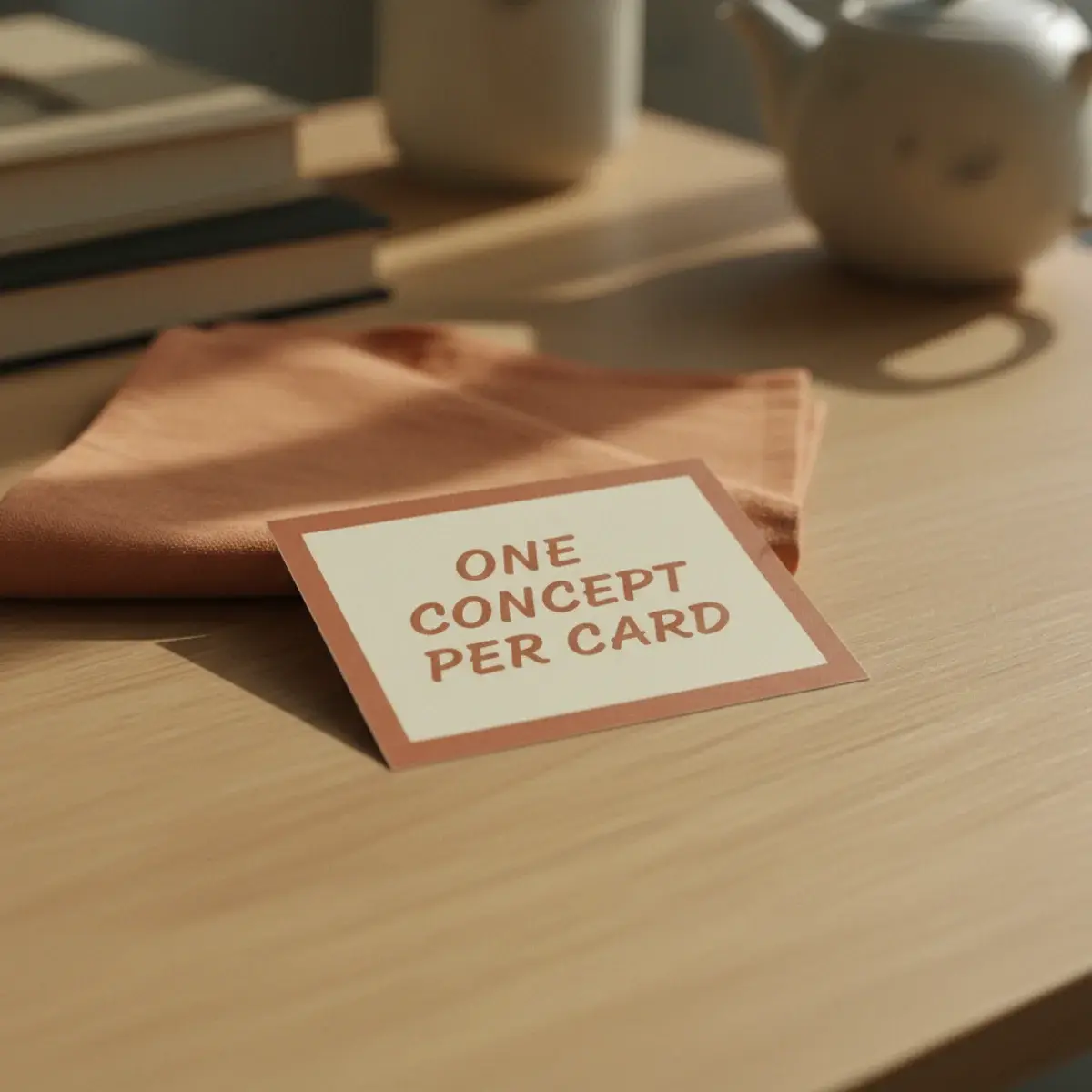
Step 1: One concept per card
A single card asks one single question. Define "mitochondria". Translate "ephemeral". State the second law of thermodynamics.
If you can't answer in under 15 seconds, the card is too big. Split it into two cards.
Step 2: Question on one side, answer on the other (with context)
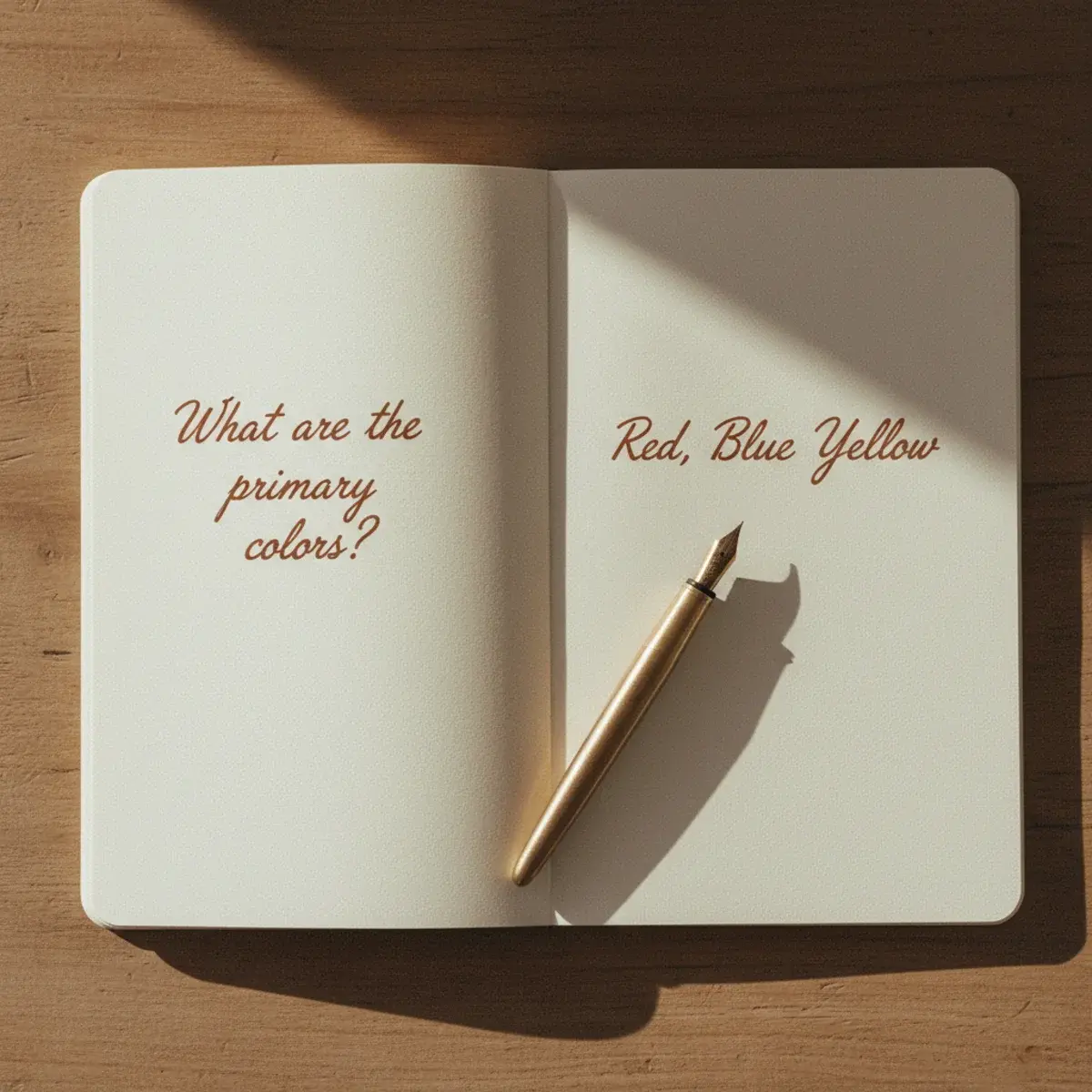
The front of the card is a clear question or prompt. The back is the answer — plus one sentence of context.
Example:
- Front: What does "ubiquitous" mean?
- Back: Present everywhere. From Latin "ubique" meaning "everywhere". Often used in academic writing to describe a phenomenon that appears across many cases.
The context sentence is what turns a flashcard from a memorisation tool into a learning tool.
Step 3: Use your own words
Never copy a definition verbatim from a textbook. The act of paraphrasing the answer in your own words is itself half the learning.
If you find yourself unable to paraphrase, that's a sign you don't understand the concept yet. Read more, then write the card.
Step 4: Use spaced repetition (Anki or paper)
Spaced repetition is the single most evidence-backed study technique in modern cognitive science. The idea: cards you get right are shown less often; cards you get wrong are shown more often.
The free Anki app does this automatically with a brilliant algorithm. It's worth the 90 minutes it takes to learn the interface.
If you prefer paper cards, use the Leitner system: three boxes labeled "daily", "every three days", and "weekly". Cards you get right move to the next box; cards you get wrong move back to "daily".
Step 5: Test, don't review
The single biggest mistake of flashcard use: looking at the question, immediately flipping to the answer, going "yes I knew that", and moving on.
That is not learning. That is re-recognition. Real learning is closer to: see the question, try to answer it out loud or in writing, then flip the card and check. The retrieval is what builds the memory.
When to Make Flashcards (And When Not To)
Flashcards work brilliantly for some kinds of learning and badly for others. Be honest about which kind of material you're studying.
Flashcards work brilliantly for
- Vocabulary and definitions. Foreign language words, technical terminology, legal terms.
- Discrete facts. Dates, names, formulas, country capitals, drug dosages.
- Translations. Words in one language to words in another.
- Anatomy and identification. Bones, organs, leaf shapes, mineral types.
Flashcards work badly for
- Conceptual understanding. Why something works, how systems interact, theoretical frameworks.
- Essay-style answers. Anything that requires building an argument over paragraphs.
- Procedural skill. How to actually do something — coding, lab technique, mathematical problem-solving.
For conceptual material, use a different tool. The Feynman Technique (explain it in your own words to an imaginary 10-year-old) is the gold standard.
Paper Cards vs Digital Cards
The honest comparison.
Paper cards win on: the act of writing the card (genuinely improves retention vs. typing), the satisfaction of physical objects, zero screen time, no battery to worry about.
Digital cards win on: spaced repetition algorithms (Anki's is genuinely brilliant), searchability, portability (10,000 cards in your pocket), no risk of losing the box.
The hybrid that works: Write the cards by hand initially (for retention). Then digitise them into Anki for ongoing review. Best of both worlds for an extra 30 minutes of work.
What to Put on Each Card (Specifically)
Good cards
- "Define photosynthesis" (one concept, clear answer)
- "What does 'ephemeral' mean?" (vocabulary, single word)
- "Translate: 'I would like a coffee, please' to French" (translation, single phrase)
- "What year was the Magna Carta signed?" (discrete fact)
Bad cards
- "Explain the causes of WWI" (essay prompt, not a flashcard)
- "All the bones in the human body" (50 facts, not one)
- "Photosynthesis" (no question — what about it?)
- "What's the answer to question 3 on page 47?" (too context-dependent)
The 30-Day Flashcard Plan
A realistic four-week plan for using flashcards properly.
Week 1: Build 50-80 cards covering the most foundational material in your subject. Spend 15 minutes a day reviewing them.
Week 2: Add 30-50 more cards. Continue 15-minute daily reviews. By now, the easiest cards should be appearing rarely.
Week 3: Add another 30-50 cards. Increase review time to 20 minutes. By now you'll notice some cards you genuinely know cold.
Week 4: No new cards. 20-30 minutes of focused review. Identify your 10 weakest cards and rewrite them in clearer language. The week of consolidation.
After four weeks: you have a working deck of 150-200 cards, daily review takes 20-30 minutes, and you'll know the material in a way passive re-reading never produces.
Three Mistakes to Avoid
Mistake 1: Pretty cards instead of useful ones. Hours of calligraphy and washi tape. Zero hours of review. The card has to work, not photograph well.
Mistake 2: Front overload. A card that says "What are the three main causes of X, the two consequences, and the one exception?" is asking for five things. Split into five cards.
Mistake 3: Skipping the cards you don't like. The cards you dread are usually the cards you most need. The spaced repetition algorithm exists exactly to make you face them. Trust it.

Building Your First Anki Deck (Step-by-Step)
If you've decided to go digital, here's the 30-minute setup that gets you from "I downloaded the app" to "I have a working spaced-repetition system".
Install Anki and create a deck
Download Anki from ankiweb.net (free on desktop, £19 one-time on iOS, free on Android). Create your account. On the home screen, click "Create Deck" and name it after a single subject — "Spanish Vocabulary", "Anatomy", "EU Law", whichever.
The single-subject deck rule is important. Don't create one giant "Studies" deck. Each subject gets its own deck so you can review them at different rates.
Add your first 20 cards
Click "Add" at the top. The default note type is "Basic" — a front and a back. Type your question on the front, your answer on the back. Press Enter to add and continue.
Twenty cards is the right starting number. Resist the urge to make a hundred in your first session — burnout is real with flashcards, and starting smaller protects your habit.
Set your daily review limit
In Settings → Deck Options, set your daily new-card limit to 10 and your daily review limit to 50. These numbers are gentle enough to sustain for a term without burning out.
Review every day, even briefly
The algorithm only works if you show up. Five minutes a day is enough on slow days. The discipline is the consistency, not the duration.
A Specific Anki Workflow for Lectures
The system that turned my own note-taking into something that lasted. Three steps, repeated for every lecture I attended.
During the lecture: take notes by hand on paper. Don't try to make Anki cards live. The note-taking is the listening-and-processing step.
That evening (15-20 minutes): read through your handwritten notes. Identify 5-10 specific facts, definitions, or concepts that need memorising. Convert each into an Anki card.
Daily for the next 6 weeks: Anki shows you the cards on its own schedule. You answer them. The algorithm handles the spacing.
By the end of the term, you have a deck of 200-300 well-curated cards covering everything testable in the course. Two days before the exam, you do one large review session. The recall is dramatically better than re-reading the textbook.
The Three Most Common Subject Types (And How to Card Them)
A small case-by-case guide for the most common college subjects.
Foreign language
The flashcard subject par excellence. Front: a single word or short phrase in the target language. Back: the English translation plus one sentence using the word in context.
For best results, also make reverse cards — English on the front, target language on the back. The bidirectional knowledge is what real fluency requires.
Add an audio recording to the front of each card if you can (Anki supports this natively). Hearing the pronunciation while reading the word is dramatically more effective than reading alone.
Anatomy or medical terminology
Each card: a single structure. Front: the term, optionally with a small unlabelled image. Back: the definition plus one sentence of clinical relevance.
Group cards by body system rather than by lecture. The brain learns better when related cards appear together — it builds the semantic network that helps recall during exams.
Legal or historical cases
Each card: a single case or event. Front: the name. Back: the year, the holding/significance, and one sentence on why it matters in the wider doctrine.
Resist the urge to put every fact about a case on one card. Three or four small focused cards beat one giant card every single time.
Final Thoughts
Flashcards are a tool — one of the best ones modern learning science has produced. But they only work if you use them properly: one concept per card, your own words, real retrieval practice, and spaced repetition.
Build 50 cards this week. Use them daily. Watch what your retention does over a month. The next four shoeboxes you make will be the ones that actually earn the grade.
More from this category



Leave a Reply
Want to write back? Comments aren't open yet — but you can reply to this article on Pinterest, save it to a board, or share it with a friend.