Study Tips & Skills
11 Best Bullet Journal Spreads for College Students

Feb 18
2026
11 best bullet journal spreads for college students — minimalist weekly layouts, study trackers, and aesthetic planners you can copy this Sunday.
It always happens in the second week of a new term: I decide I'm going to become a bullet-journal person. I buy a fresh Leuchtturm. I watch hours of bullet-journal videos on YouTube. I plan elaborate weekly spreads with hand-drawn banners and pastel highlighters.
Then I'm bullet-journalling for nine days, the tenth day I forget, and by week three I've fallen off entirely and the £18 Leuchtturm is sitting on my shelf, accusing me.
This is the article I wish someone had handed me before I bought my first bullet journal. Eleven actually-sustainable bullet journal spreads for college students — the spreads I have used for years, that take minutes (not hours) to set up, and that have survived my worst weeks of term.
No hand-drawn banners. No expectations of perfect handwriting. No twenty-step setups. Just the spreads that work — and the honest framework for choosing which ones are right for the specific shape of your life.
Save this article. Pin the spreads you actually want to try. Don't try all eleven — that's how every bullet journal fails by week four.
The Foundation Spreads (Set These Up Once, Use All Term)
These are the structural spreads. The bones of the whole system. If you only set up these three, you have a working bullet journal.
1. The Index Page (The Spread That Makes Everything Else Searchable)
The first two pages of every bullet journal should be an index. A bullet journal without an index becomes useless within a month, because you cannot find anything.
The setup is simple: each page in the journal gets numbered (most Leuchtturms come pre-numbered; Muji journals you'll have to number yourself in pencil). On the first two pages, leave space for entries that look like this:
August semester overview ............ 8
Weekly spread (week of 5 Sept) ...... 12
Reading log: term 1 ................. 24
Habit tracker (Sept) ................ 30
Each time you start a new spread, add it to the index. Two seconds at the start of each spread. Saves your sanity for the whole term.
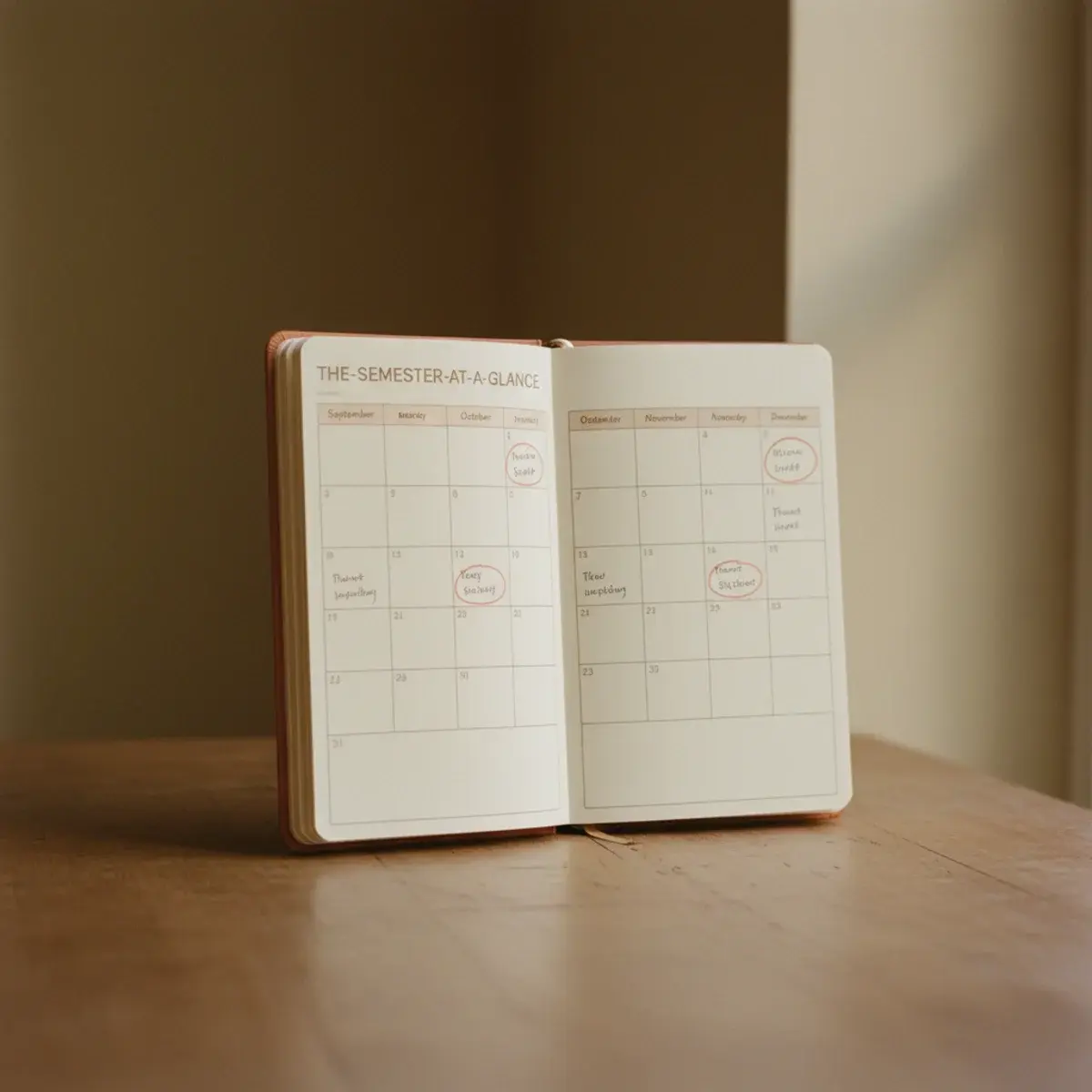
2. The Semester at a Glance
A single two-page spread that lays out every important date for the entire term: exam dates, deadline dates, holidays, the dates you're travelling home, the dates of important social plans.
I do mine in a grid — twelve weeks across the top, with a small box for each week to write the major events. The whole semester fits on two facing pages. When stressed, I open this page and remember what's actually coming up versus what just feels like it's coming up.
3. The Master Deadlines List
A running list of every essay, exam, presentation, and project for the entire term — sorted by date due, not by subject. Each entry has: due date, subject, type (essay/exam/etc), and a small checkbox.
This is different from the semester-at-a-glance. The semester view is a calendar. The deadlines list is a to-do list. The two complement each other — I cross items off the deadlines list as I submit them, and the satisfaction of watching that list shorten is genuinely the most motivating thing in my whole journal.

The Weekly Spreads (The Heart of the System)
The weekly spread is where the real action happens. It's also where most students over-engineer themselves into burnout. Here are three sustainable versions, in order of how much time they take to set up.
4. The Minimal Vertical Weekly (5-Minute Setup)
The fastest, most-sustainable weekly spread I know. Open a fresh page. Divide it into seven horizontal sections — one for each day. Label each section with the day and date. Done.
Each day's section gets: the day's main task at the top, time-specific items (lectures, classes) listed below, and a small free-form space at the bottom for notes about how the day went.
This is the spread I have used for three years straight, with zero exceptions. It takes five minutes on Sunday evening. It contains everything I need. It is the boringest possible bullet journal spread and the only one I have ever actually stuck with.
5. The Two-Page Spread with Goals + Days
The slightly-more-decorative version. The left page is the seven days laid out vertically. The right page is split into three quadrants: weekly goals (top left), self-care intentions (top right), notes and gratitude (bottom).
This is the spread to use if you're someone who likes to have your week's structure on full display. Takes about twelve minutes to set up. Genuinely useful for the goal-setters and the reflectors.
6. The Aesthetic Weekly with Doodles (For the Slow-Sunday Types)
The Pinterest-famous version. A more decorative weekly spread with hand-drawn banners, small doodles in the margins, and a colour palette consistent across the week.
I include this one with a warning: this spread takes 25-40 minutes to set up. It is genuinely beautiful, it is genuinely satisfying, and it is genuinely the wrong choice for 80% of students. If you find slow-Sunday journaling is the part of your week you most enjoy, this spread is for you. If you don't, the minimal vertical above will serve you ten times better.
The Tracking Spreads (For Habits, Health, and Self-Awareness)
The spreads that give you data about yourself over time. Used right, these become the most valuable part of the whole journal.
7. The Monthly Habit Tracker
A grid: dates down the left, habits across the top. Each box gets ticked or coloured-in when the habit happens. Standard college student habits worth tracking: sleep before midnight, water (eight glasses), movement (any), reading (twenty minutes), and one creative practice (writing, sketching, anything).
Keep the number of habits small — five is the maximum that survives the term. Anything more becomes a chore. The whole point of a habit tracker is to make the habits frictionless to notice; it stops working the moment it itself becomes friction.
8. The Mood Tracker
A small grid or visual at the back of each month — one box per day, coloured in based on how the day went. Five colour codes: terrible, bad, neutral, good, great.
The point isn't the daily entry. The point is what you see when you look back at the whole month — the patterns you didn't notice in real time. The clusters of bad days that always happen the week before your period. The streak of good days that always come after a weekend away. Information you can only see in the rear-view.
9. The Reading Log
The most beautiful spread on this list and the most satisfying long-term. A two-page spread per term with rows for each book: title, author, date started, date finished, a one-sentence response, and (optionally) a star rating.
The reading log is the spread you'll be most grateful for in five years. The book you read in the spring of your second year. The book that ruined you for everything else for three months. The small body of evidence that you have, in fact, been reading.
10. The Self-Care Tracker (For the Burnout-Prone)
A small spread tracking the basics: did I eat three meals today, did I move my body for twenty minutes, did I get outside, did I sleep at least seven hours, did I talk to someone I love. Five questions. Five small ticks.
This is the spread for the women who, when stressed, forget to do the basic things. (That's most of us.) It takes thirty seconds a day and prevents the slow grey slide into burnout that happens when you've been studying so hard you've stopped looking after yourself.
The Project Spreads (For the Big Things)
The spreads that turn overwhelming projects into manageable steps.
11. The Dissertation / Major Project Spread
If you have a thesis, dissertation, or major capstone project this year, this spread is the single biggest gift you can give yourself. A four-page section at the back of the journal, set up like this:
- Page 1: Project overview. One paragraph describing the project, the deadline, the final word count or output. The "why" of the project in your own words.
- Page 2: The chapter outline or section breakdown. Each section listed with its target word count and target completion date.
- Page 3: The reading and research list. Every source you need to read, with checkboxes.
- Page 4: The weekly check-in space. Each Friday, write three sentences about what you got done and what next week looks like.
This spread saved my dissertation. I am not exaggerating. The discipline of writing three sentences every Friday for fifteen weeks meant I never woke up two months from the deadline panicking about how behind I was — because I had a clear visible record of exactly how on-track I was each week.
The Reflection Spreads (For the End of the Term)
The spreads you fill in once. Worth their weight in gold.
12. The Monthly Review
The last page of each month. Five questions, hand-written answers:
- What went well this month?
- What didn't go well?
- What did I learn about myself?
- What am I grateful for?
- What's one thing I want to change next month?
Twenty minutes on the last Sunday of each month. Twelve monthly reviews per year. By the end of the year, you have a small autobiography of your growth.
13. The End-of-Term Wrap-Up
A single page at the end of each term, summarising: what I learned (academically), what I learned (about myself), what I'm proud of, what I'd do differently, what I want to bring into next term.
This spread is what makes the next term work. You don't repeat the same mistakes if you've written them down honestly. You don't lose the lessons of the term that's just ended.

How to Pick the Right Spreads for Your Life
Eleven spreads is too many to use simultaneously. Here's the framework I use to decide which ones to include each term.
The minimum viable bullet journal (4 spreads)
For the busy term, for the first time, for the woman who doesn't want this to become a hobby:
- Index (page 1)
- Semester at a glance (page 2)
- Master deadlines (page 3)
- One weekly spread per week (the minimal vertical)
That's it. Four spread types. Total weekly setup time: five minutes on Sunday. This is the version that actually survives the term.
The standard bullet journal (7 spreads)
For the term when you have a bit more capacity:
- Index, semester, deadlines (the foundation three)
- Weekly spread (vertical or two-page)
- Monthly habit tracker
- Reading log
- Monthly review (last Sunday of each month)
This is what I run most terms. Weekly setup: ten minutes Sunday. Monthly: thirty minutes the last Sunday of each month. Genuinely sustainable.
The maximalist version (everything)
For the term when bullet journalling is part of your hobby life, not just your productivity life:
Everything above, plus the aesthetic weekly spread, plus the mood tracker, plus the self-care tracker, plus the dissertation spread if applicable.
This version takes about thirty minutes a week to maintain. Worth it if you genuinely enjoy the process; quietly destructive if you don't.
Supplies You Actually Need
Don't fall into the £200-stationery trap. The functional kit:
- One Leuchtturm1917 or Muji A5 dotted notebook. £18 or £8 respectively. Either is fine. The dotted grid is non-negotiable — it's the universal bullet-journal page format.
- One reliable pen. A Muji 0.38 gel, a Pilot G-2, or a Lamy Safari fountain pen. £4-20.
- Two highlighters. Zebra Mildliners in soft pastels. £4 for a pack of two.
- One ruler. A 15cm steel one from any stationer. £2.
- One pencil + eraser. For the index numbering and any layouts you want to draft before committing.
Total kit: under £35. Most students spend three times that and use a quarter of it.
The Three Mistakes That Kill Most Bullet Journals
Honesty: most bullet journals are abandoned by week four. Here are the three reasons.
Mistake 1: Comparing to Pinterest. The bullet journals on Pinterest are 5% of all bullet journals, curated for visual perfection, often staged for photography. Your bullet journal does not need to look like that. The functional bullet journal — boring, scribbled, unbeautiful — is the one that actually works.
Mistake 2: Setting up too many spreads on day one. The instinct, with a fresh notebook, is to design every possible spread. Resist. Set up only the foundation three (index, semester, deadlines) on day one. Add other spreads as you actually need them. Half the spreads you designed on day one will turn out to be useless by week three — adding them as needed prevents the wasted pages.
Mistake 3: Treating it as all-or-nothing. Missing two days of bullet journalling is not failure. It is a normal Tuesday. The bullet journal works as a flexible system, not a streak you must protect. Pick the journal back up on the next day you want to. The whole point is that it adapts to your life, not the other way around.

Final Thoughts
The best bullet journal is the one you actually use. That is the whole secret of bullet journalling and the part that the beautiful Pinterest images obscure.
Pick three spreads from this article. Set them up this weekend. Use them for a month before adding anything else. If a spread isn't earning its place, drop it without ceremony. If a spread is genuinely serving you, keep it and consider adding one more.
The point of a bullet journal is to make your life feel a bit more held, a bit more intentional, a bit more yours. The moment it stops doing that — the moment it becomes another source of guilt or another performance — close the notebook and walk away.
You can always start a new one. The lessons stay with you. The journal is just the small, lovely tool that holds them while you grow.
More from this category



Leave a Reply
Want to write back? Comments aren't open yet — but you can reply to this article on Pinterest, save it to a board, or share it with a friend.