Study Tips & Skills
How to Use Active Recall for Studying (5-Step Template)
Jan 31
2026
How to use active recall for studying — a 5-step template that uses the most research-backed memory technique to make your study sessions actually stick.
There is a single moment, somewhere in the middle of a long revision session, when I close the textbook to take a sip of tea and realise — with a small jolt of horror — that I cannot remember a single thing I just read. The hour was technically spent reading. None of it stuck. The information went through my eyes and back out through my fingertips into the highlighter and that was the entire transaction.
This is the most common mistake in college studying, and it has a specific name: passive re-reading. The fix has an equally specific name: active recall. The two approaches produce wildly different results — measurably, replicably — and the gap is so large that the cognitive science research community considers it one of the cleanest findings in the entire field.
This article is the practical, 5-step guide. The exact method I use. The exact mistakes to avoid. The evidence behind why it works.
Save this. Try it for two weeks on a single subject. Watch your retention double.
What Active Recall Actually Is
The shortest possible definition: active recall is the practice of retrieving information from memory, rather than re-reading or recognising it.
The difference is mechanical:
- Passive re-reading: you read the textbook chapter again. Your eyes pass over the words. Recognition happens ("yes, I remember this"). The brain does almost no work.
- Active recall: you close the textbook. You write down everything you can remember about the chapter. The brain does the difficult work of retrieval. The act of retrieval is what builds the memory.
The published research is unambiguous. Students who use active recall outperform students who re-read by margins of 30–80% on subsequent recall tests. It is the most evidence-backed technique in the study-skills literature.
Why Passive Re-Reading Feels Productive (And Isn't)
The cruelty of the situation: passive re-reading feels productive in the moment in a way active recall doesn't.
Re-reading feels good because of recognition. You see the sentence and your brain says "yes, I've seen this before." The feeling is satisfying. The feeling is also lying — recognition is not the same as recall. The skill you need on the exam is recall (producing the answer from nothing). The skill you've practiced is recognition (matching the question to the right page).
Active recall, by contrast, feels bad in the moment. You sit there trying to remember the answer, drawing blanks, getting frustrated. That uncomfortable feeling is the brain working. The discomfort is the learning.
The students who get this difference internalised — that the comfortable study session is the wasted one — are the students who pull ahead by year two.
The 5-Step Template
The exact method I use, refined across a dissertation, two qualifying exams, and a year of language learning.
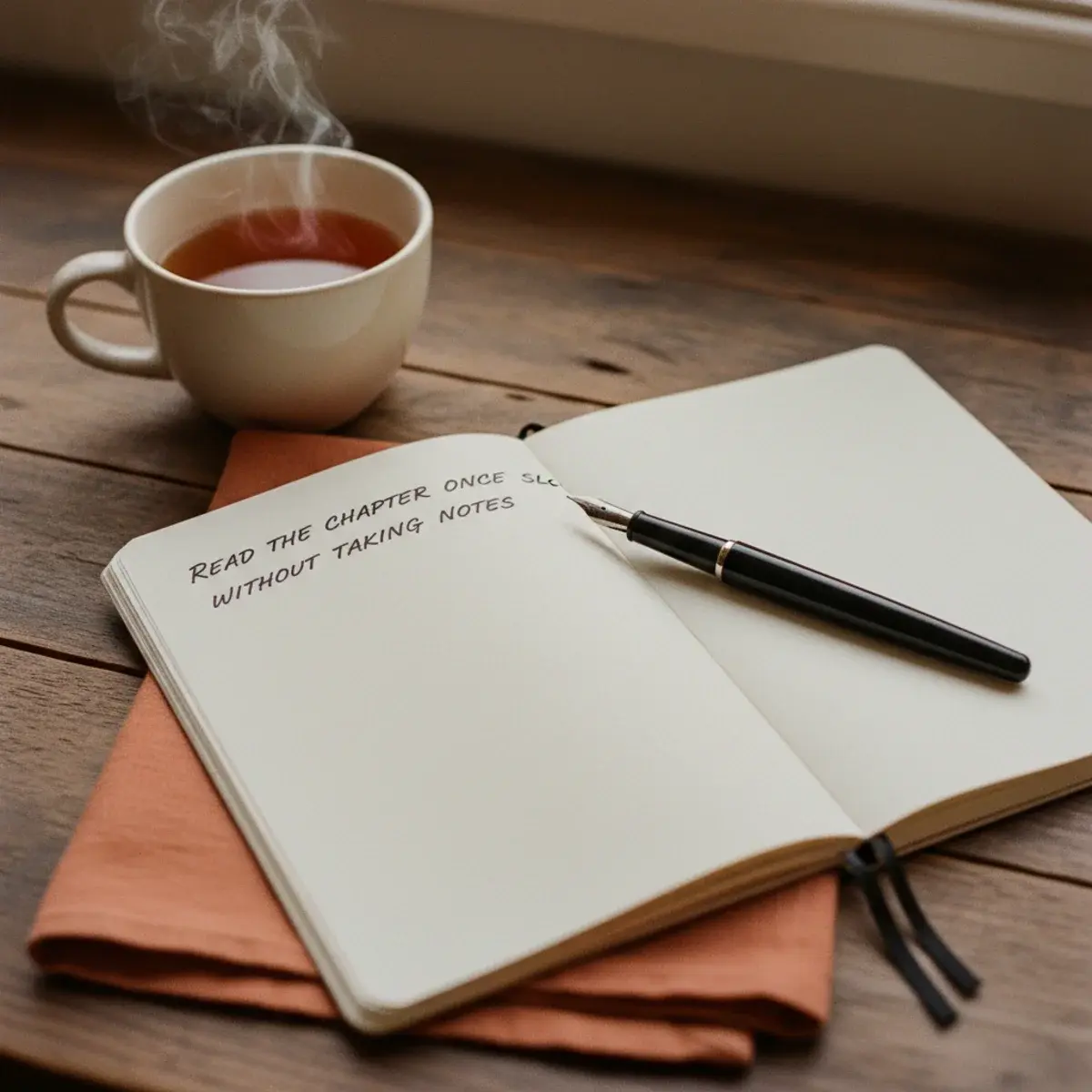
Step 1: Read the chapter once, slowly, without taking notes
The first pass is intake. Read the entire section or chapter through, with full attention, without trying to memorise anything. Just understand it on the surface.
This step is shorter than you'd think — 20-40 minutes for most textbook chapters. Don't underline. Don't highlight. Don't take notes. Just read.
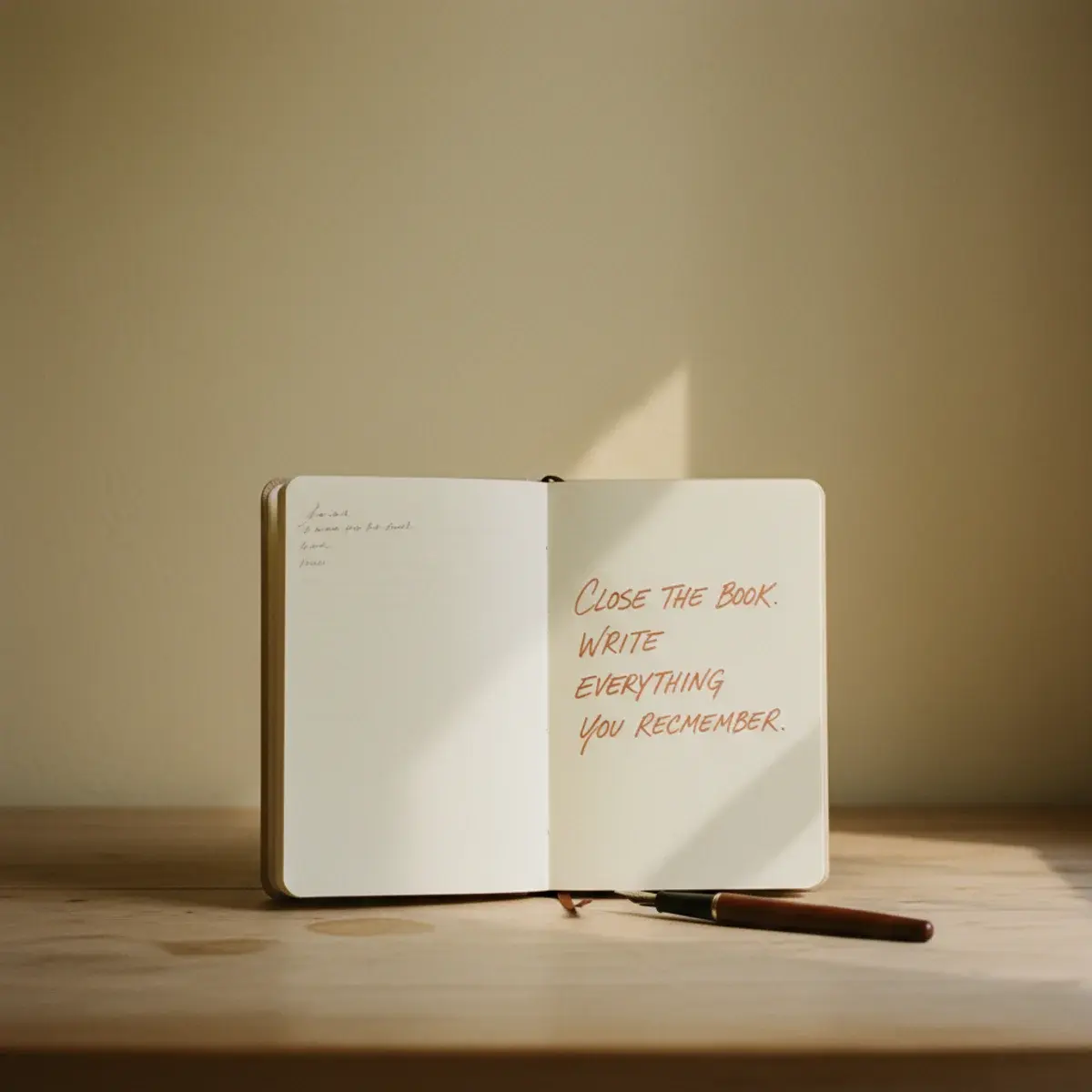
Step 2: Close the book. Write everything you remember
The active part. Close the textbook. Open a fresh page of your notebook. Spend 15-20 minutes writing down everything you can remember from what you just read.
Use bullet points. Use diagrams. Use anything that gets the information out of your head onto the page. Don't worry about the order. Don't worry about completeness. The act of trying is the entire point.
When you genuinely cannot remember any more, stop.
Step 3: Open the book and check your work
Now compare what you wrote to what's actually in the chapter. Three categories will emerge:
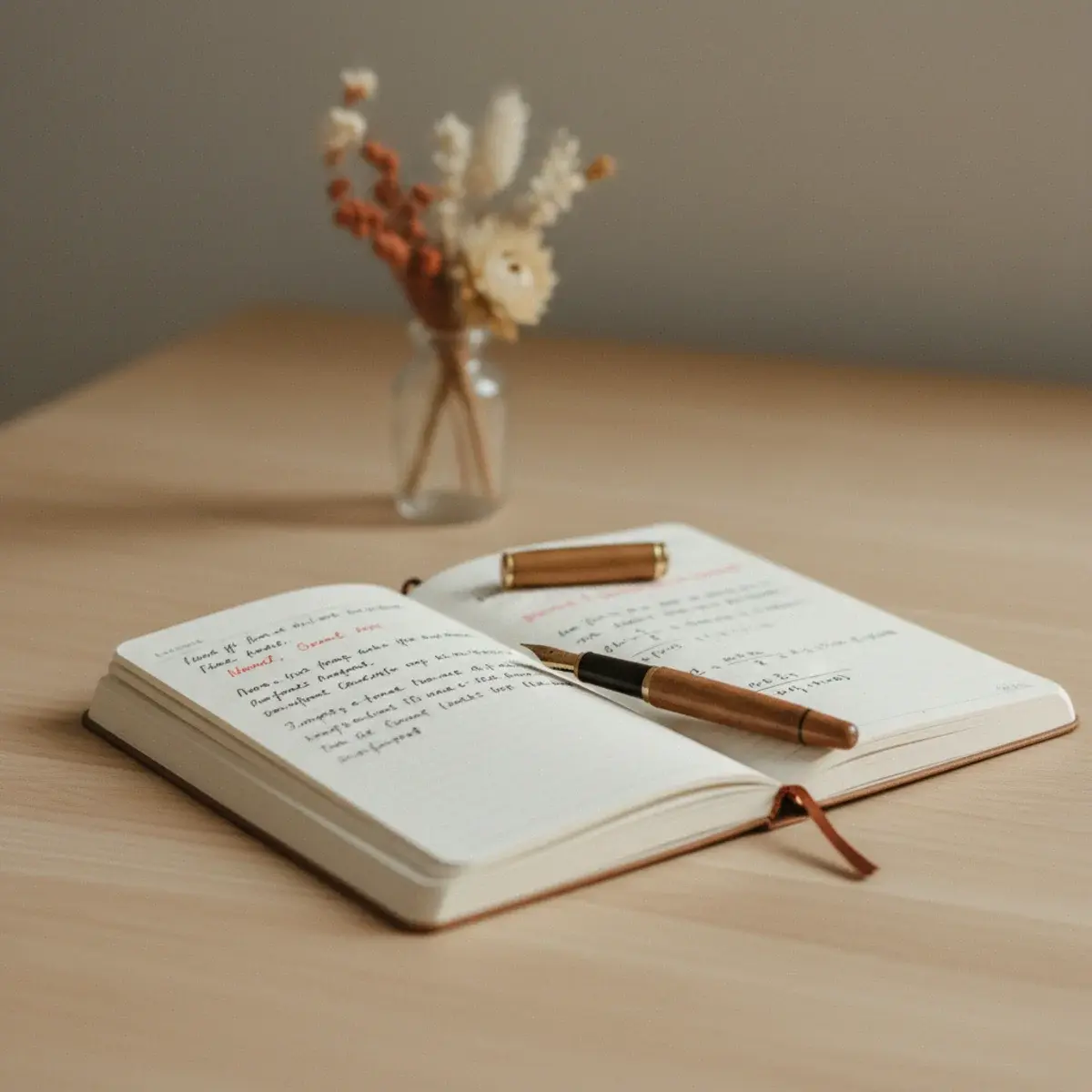
- Things you remembered correctly. Great. Underline these in your active-recall notes in green.
- Things you remembered but got wrong. These are the most valuable. Mark them clearly in red and write the correct version.
- Things you missed entirely. Add them to your active-recall page in a different colour (blue works) so you can see at a glance which information needed help.
The three-colour system is the visual map of where your knowledge is solid, shaky, and missing.
Step 4: Wait 24 hours. Repeat the recall (without re-reading)
This is the spaced-repetition step. Don't re-read the chapter the next day. Just open your notebook to a fresh page and try to write everything you remember about the chapter again, from scratch.
This time you'll remember more than yesterday (the previous day's active recall consolidated some of it), and you'll discover specific gaps that need attention. Mark them. Look up only what you can't remember.
Step 5: Repeat at 3 days, 7 days, 14 days
The full spaced-repetition schedule. By day 14, the chapter is genuinely yours — moved from short-term to long-term memory, retrievable on demand, ready for an exam.
The full cycle takes 90-120 minutes spread over two weeks. Compared to the 6+ hours of re-reading most students would do for the same chapter, the maths is dramatic.
Concrete Examples Across Subjects
How the technique looks in practice for the three most common subject types.
For science and medical subjects
The chapter is on cell respiration. Step 2 looks like: a hand-drawn diagram of the mitochondrion, labels of the parts, the chemical equation for glucose breakdown, the three stages (glycolysis, Krebs cycle, electron transport chain), what comes out at each stage.
You'll discover, on first attempt, you can usually remember the broad strokes but you get the specific molecules wrong. That's the gap. Mark it. Try again tomorrow.
For humanities subjects
The chapter is on the causes of the French Revolution. Step 2 looks like: a list of the three main causes you can name, one sentence of evidence for each, three or four key dates, two or three historians whose arguments matter.
The active-recall version of humanities work is more conceptual and less mechanical, but the principle is the same — produce the argument from memory, then check against the source.
For language learning
A chapter introduced thirty new vocabulary words and one grammar concept. Step 2 looks like: write down every vocabulary word you can remember (English and target language), construct three example sentences using the new grammar concept, identify the grammar pattern in your own words.
For languages specifically, pair with Anki for ongoing review. See How to Make Easy and Effective Revision Flashcards.
What Active Recall Looks Like in Daily Practice
The schedule that fits a real student's life.
The daily rhythm
- Lectures and reading: input (Step 1).
- Same evening (15-20 minutes): the first active recall of the day's material.
- Following morning (5-10 minutes): quick re-recall.
- Three days later (10 minutes): check what's still solid.
- Weekend review: full spaced-recall pass of the week's material.
Total time per topic across two weeks: roughly 90 minutes. Total retention at the end: dramatically higher than the equivalent hours spent re-reading.
The weekly review session
A 60-minute session on Saturday or Sunday. Pull out your active-recall notebooks. For each subject, attempt one full retrieval of the week's material without looking. Identify the persistent gaps. Plan to revisit those in the week ahead.
The weekly review is what turns the daily practice into a system that actually works over a whole term.
Why Most Students Don't Use It (And You Should)
Three honest reasons why active recall is undervalued.
It feels harder. Re-reading is pleasant. Active recall is uncomfortable. Most students choose the comfortable option without realising the trade-off.
It produces messier-looking notes. Active-recall pages look chaotic compared to the beautiful colour-coded transcription notes other students post on Instagram. Messy notes feel less like progress. They are, in fact, much more progress.
It doesn't photograph well. A book full of highlighter looks like studying on social media. A page of half-correct retrievals in three colours does not. The students who care about how their studying looks miss the students who care about how their studying works.
The Common Mistakes
Mistake 1: Glancing at the textbook during retrieval. Even briefly. The whole point is the difficulty of remembering from nothing. The moment you peek, the technique stops working.
Mistake 2: Doing it once and stopping. A single active-recall session is dramatically better than a single re-reading. But the magic of the technique is the spaced repetition — the four to five passes across two weeks. Don't skip the follow-ups.
Mistake 3: Treating it as a substitute for understanding. Active recall works best when the underlying concept is understood. If you genuinely don't get the material, no amount of retrieval will fix that — go back to the textbook, find an explanatory video, or ask the professor. Active recall reinforces understanding; it doesn't create it from nothing.
A Two-Week Trial Plan
Try it. Two weeks. One subject. See what happens.
Week 1: apply the 5-step method to one subject — the one you find hardest. Use a dedicated notebook just for this experiment. Schedule the 24-hour, 3-day, and 7-day reviews in your calendar.
Week 2: apply it to a second subject while continuing the first. Run the two parallel systems. Notice how the first subject is starting to feel genuinely solid.
End of week 2: take a brief self-test on the material from both subjects. Compare your retention honestly to how you usually feel at this stage of a term.
The trial is small, low-risk, and decisive. Almost every student who runs it converts.
Final Thoughts
Active recall is not a productivity hack. It is the closest thing the cognitive science literature has to a universal study-skills truth: you remember what you practice retrieving, not what you re-read.
Close the textbook. Open a blank page. Write what you remember. Check what you got. Repeat.
The technique is unsexy. The notebooks look messy. The hour-by-hour experience is harder than the alternative. The exam results, two weeks later, are not even comparable.
Two weeks. One subject. Try it. The maths is real.
More from this category



Leave a Reply
Want to write back? Comments aren't open yet — but you can reply to this article on Pinterest, save it to a board, or share it with a friend.