Study Tips & Skills
How to Take Organized and Aesthetic Math Notes

Jan 28
2026
How to take organised and aesthetic math notes — a calming, colour-coded notebook system that helps you understand maths and not just memorise it.
Look down at your maths notebook on hour three of a long revision session, and you'll usually find the same thing: a chaos of half-finished equations, scribbled formulas, eraser marks, and one inexplicable doodle of a flower. The notes are unreadable. The maths is no clearer than it was an hour ago. The whole exercise has been mostly performative.
Aesthetic maths notes are not just about appearance. The well-organised maths page is a cognitive tool — a layout that helps you see relationships between equations, track your reasoning across a problem, and revise efficiently weeks later. The beauty is incidental; the structure is the point.
This article is the full system. The colour code, the layout principles, the supplies, and — importantly — the things to avoid that turn beautiful pages into ones that look good on Pinterest but don't actually help you learn.
Save this. Try the system on your next problem set.
The Foundation Principles
Three principles that distinguish maths notes that work from maths notes that just look good.
Principle 1: Function before form
The beautiful page that doesn't help you learn is worse than the messy page that does. Every styling choice should pay its way in clarity, navigability, or revision-efficiency. If a colour or a flourish doesn't make the maths easier to follow, drop it.
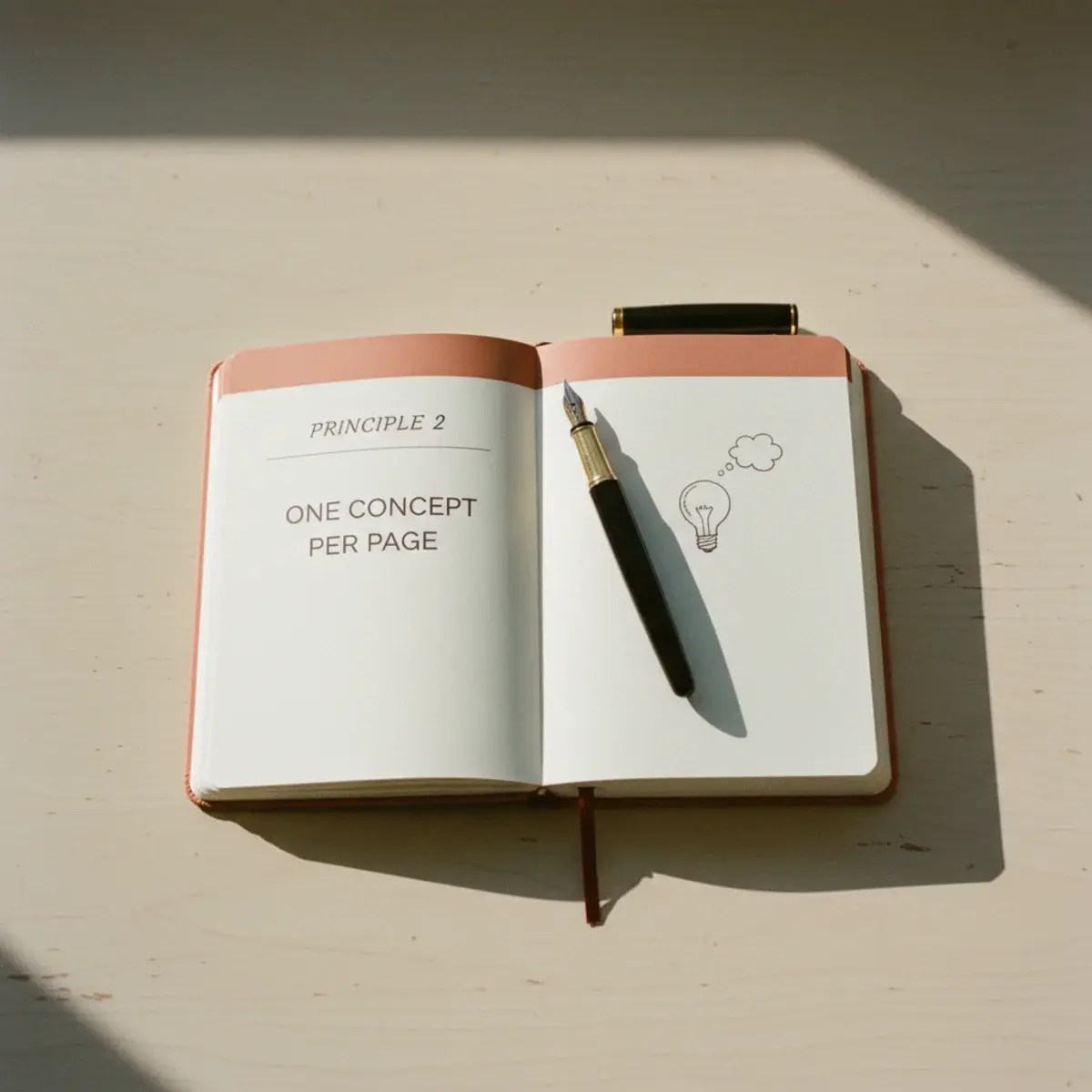
Principle 2: One concept per page
Maths is hierarchical — definitions build on definitions, theorems on theorems. The single most useful structural rule: one concept (one theorem, one technique, one proof) per page. The visual breathing room reflects the conceptual structure.
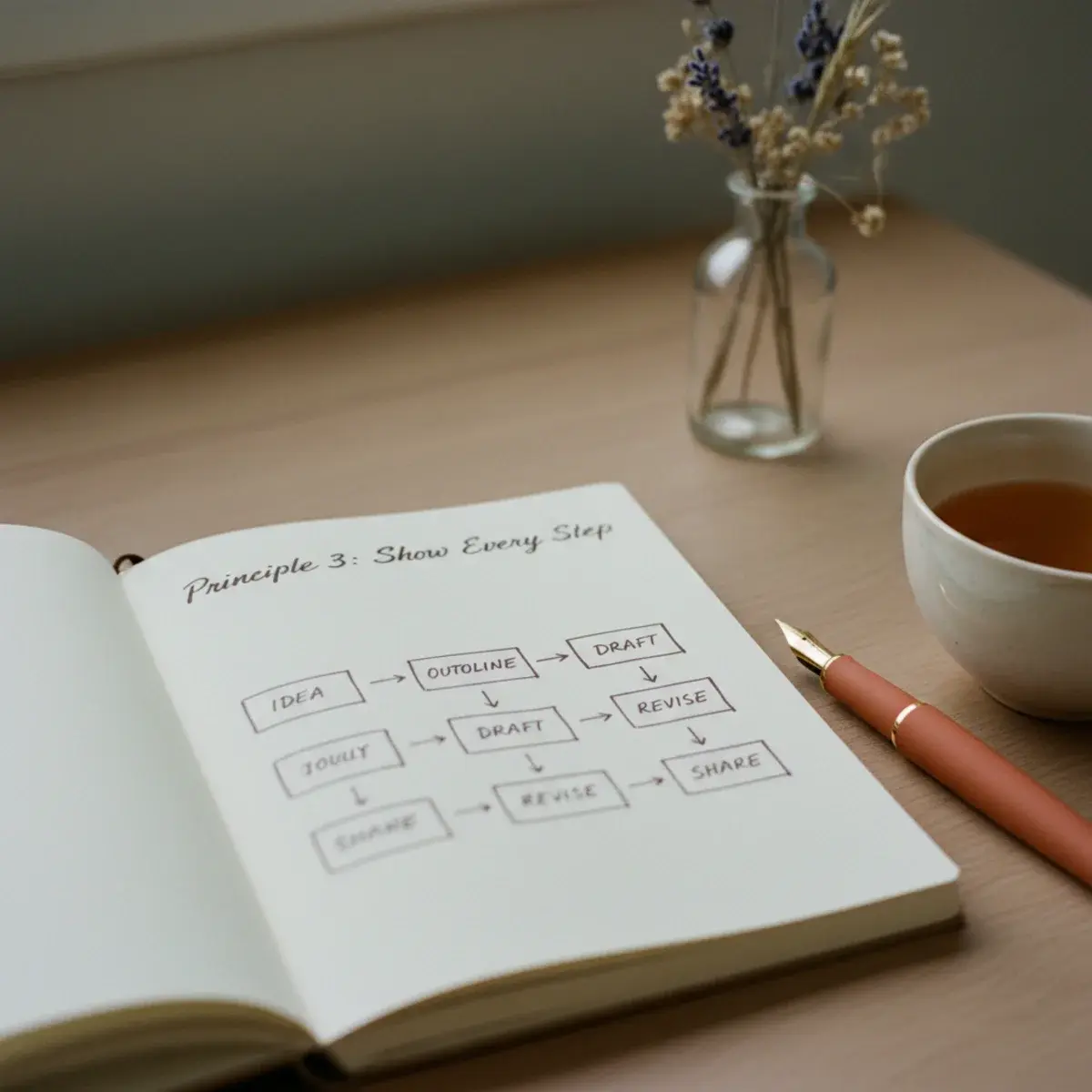
Principle 3: Show every step
Maths notes that skip steps to look cleaner are the notes that fail you in the exam. Every line of working stays on the page — not because it's pretty, but because the step you skip is the step you don't remember six weeks later.
The Colour Code
A simple three-or-four-colour system that genuinely helps comprehension.
Black — the maths itself
All equations, working, and main text in black ink. Black is the default. Don't dilute the maths itself with colour.
Blue — definitions and key terms
Whenever a new term is introduced, write it in blue. Underline it. This makes the definitional spine of the page immediately visible — which terms are the building blocks, which are derived from elsewhere.
Red — important results and warnings
Theorems, final answers, important results, and "watch out for this!" annotations all in red. Sparingly used — if everything is red, nothing is.
Green — examples and applications
Worked examples, applications of the theorem, "let's see how this works in practice" sections all in green. The green sections are the part you'll come back to when revising.
That's the entire system. Four colours, each with a single specific job. The discipline is what makes it useful.

The Layout Principles
How to actually structure the page.
The two-column layout
Divide the page vertically into two unequal columns — about 70% on the left for the main maths, 30% on the right for annotations.
The right column is where you write: explanations of why each step is valid, references to the theorems being used, small reminders for revision ("this is the chain rule!"), and your own commentary in your own words.
The two-column layout is the single biggest improvement most students can make to their maths notes. The annotation column transforms cold maths into your understanding of the maths.
The boxed answer
Every final answer goes in a clean rectangle of red ink at the bottom of the working. The box is a visual closure — the brain registers the problem as complete, and revision is much easier because the answers are immediately findable.
Step numbering for proofs
For long proofs, number each step (1, 2, 3...) down the left margin. The numbered steps make the proof structure visible at a glance and make it possible to reference specific lines ("...by step 4 above...").
Generous whitespace
The biggest mistake students make with maths notes is cramming too much onto one page. Leave generous whitespace — half-blank pages are fine. The cognitive cost of crammed pages is much higher than the cost of using a thicker notebook.
The Supplies (Genuinely Useful)
The minimum kit. Don't over-invest.
The notebook
A hardback dotted notebook. Leuchtturm1917 A4 dotted (£20) or Muji A4 grid (£8). The dotted/grid format is essential — lined paper doesn't work for maths because equations need both vertical and horizontal alignment.
The pens
Four pens in the four colours above. Muji 0.38 gel pens are the universal recommendation (£1.20 each). They write smoothly, don't bleed, and the 0.38 line weight is right for both maths and annotations.
If you prefer fountain pens, a Lamy Safari (£20) with cartridges in four colours works equally well.
A ruler
A clear 15cm ruler from any stationer (£1.50). Used for drawing tables, dividers, and clean diagrams. The single most underrated maths-notes accessory.
A pencil with a good eraser
For initial drafting of complex problems. Mechanical pencil with 0.5mm lead (£3) plus a quality eraser (£2). Erase generously. The pencil draft becomes the inked final version.
The Page Templates
Three reusable templates that cover most maths note-taking.
Template 1: A new theorem or definition
- Top of page: the name of the theorem in red, underlined.
- Below: the formal statement in black, with key terms underlined in blue.
- Right column: an intuitive explanation in your own words.
- Middle of page: the proof, in numbered steps, in black.
- Bottom third of page: two or three worked examples, in green, with the final answers boxed in red.
Template 2: A problem-set solution
- Top: the problem statement in black, copied verbatim.
- Below: "Goal:" in blue, followed by what the problem is asking.
- Working: every step shown in black, with annotations to the right in pencil or a softer colour.
- Final answer: boxed in red at the bottom, with a unit if applicable.
Template 3: A revision summary page
- Top: the topic name in red.
- Three sections: "Key definitions" (blue), "Key theorems" (black with red names), "Common applications" (green examples).
- Each section: kept to a single concept, with cross-references to the page numbers of the full notes.
The summary pages are what you actually use in the final week before an exam. The full pages are the underlying detailed work.
What to Avoid
Three habits that make maths notes look beautiful and work badly.
Excessive washi tape and decoration. A page that's 30% decoration is 70% useful. Skip the washi tape. The aesthetic comes from the structure, not the embellishments.
Six or more colours. More than four colours and the system breaks down — your brain can't reliably distinguish what each colour means. Discipline beats variety.
Recopying notes from class. The single most overrated study technique. Copying notes from lecture verbatim is a low-value activity that feels productive. The Feynman-style rewrite (in your own words, with your own structure) is dramatically more useful. See How to Use the Feynman Technique for Studying.
How to Use the Notes for Revision
The notes are only useful if you actually use them.
The day after the lecture
Spend 10-15 minutes re-organising your live-lecture notes into the structured template. Add the colour code. Add the annotations. The same-day processing is what makes the information stick.
Weekly
A 30-minute pass on Sunday: re-read the week's maths pages. Make summary pages for the topics that came up. Identify the proofs or techniques you don't yet feel solid on.
Before the exam
The summary pages — not the full notes — are what you study. The summary pages cover everything; the full notes are the reference for when a summary point needs more detail.
The Common Mistakes (Specific to Maths Notes)
Three habits that turn mathematically-useful pages into mathematically-useless ones.
Mistake 1: Copying lecture notes verbatim
The single most overrated approach to maths revision. Verbatim copying feels productive but produces almost no learning. The Feynman-style rewrite — in your own words, with your own structure — is dramatically more useful. The page should be yours, not a duplicate of the textbook.
Mistake 2: Skipping the intermediate steps
The temptation is to copy only the "key" equations and skip the algebra. This is exactly wrong. The intermediate steps are where the technique lives. Skip them and you'll find, six weeks later, that you can recognise the start and end of a derivation but can't reproduce the middle.
Show every line. Even the boring ones. The boring lines are what the exam tests.
Mistake 3: Using pencil for everything "in case you make a mistake"
The pencil-and-eraser approach produces messy, smudgy, hard-to-read pages. Use pencil for the initial draft of complex working, then go over the final version in ink. The two-pass approach takes 20% longer and produces pages worth ten times the revision value.
How to Use the Notes for Different Exam Types
The same notebook serves different purposes depending on the exam format.
For closed-book exams
The full notes get summarised down into a 4-6 page "exam cheat sheet" (even though you can't bring it in) two weeks before the exam. The act of summarising is itself the revision. The summary becomes the thing you re-read in the final week.
For open-book exams
The notebook gets indexed properly so you can find any concept in under thirty seconds. The structure matters more than memorisation. Annotate with cross-references between related concepts so you can navigate quickly during the exam itself.
For coursework-only courses
The notebook becomes your reference for problem sets across the term. Keep it organised by topic, not by chronological lecture order. The first thing you reach for when stuck on a problem.
Final Thoughts
Aesthetic maths notes are not about Instagram. They are about building a notebook you can actually use six weeks later when the material is no longer fresh in your head. The colour code, the layout, the structure — all of it earns its place by making revision easier and the maths clearer.
The page that looks beautiful but doesn't help you learn is a failed page. The page that's slightly less polished but lets you find any concept in seconds is a successful one. Aim for the second.
Try the system on your next problem set. Use four colours. Use the two-column layout. Box every answer. Show every step. By the end of a term, the notebook is genuinely beautiful — and you actually understand the maths inside it.
More from this category



Leave a Reply
Want to write back? Comments aren't open yet — but you can reply to this article on Pinterest, save it to a board, or share it with a friend.