Study Tips & Skills
How to Study Smarter and Not Harder: 13 Study Tips

Jan 27
2026
How to study smarter and not harder — 13 research-backed study tips that mean fewer hours at your desk and better grades on your transcript.
Every college student is told the same myth at some point: that academic success is a function of hours spent studying. Sit at the desk longer. Read the textbook more times. Highlight every paragraph. Suffer in proportion to the reward.
The published research on actual learning is much, much more interesting than this. It turns out that the techniques most students use — re-reading, highlighting, mass-cramming — are some of the least effective ways to learn. The techniques that actually work are well-documented, well-replicated, and used by a small minority of students who quietly outperform everyone else.
This article is the consolidation. Thirteen evidence-backed strategies for studying smarter, not harder. Each one is something you can apply this week.
Save this. Pick three. Notice the difference inside a month.
The Foundation Three
The three highest-impact study habits in the published research literature. If you do nothing else from this list, do these.
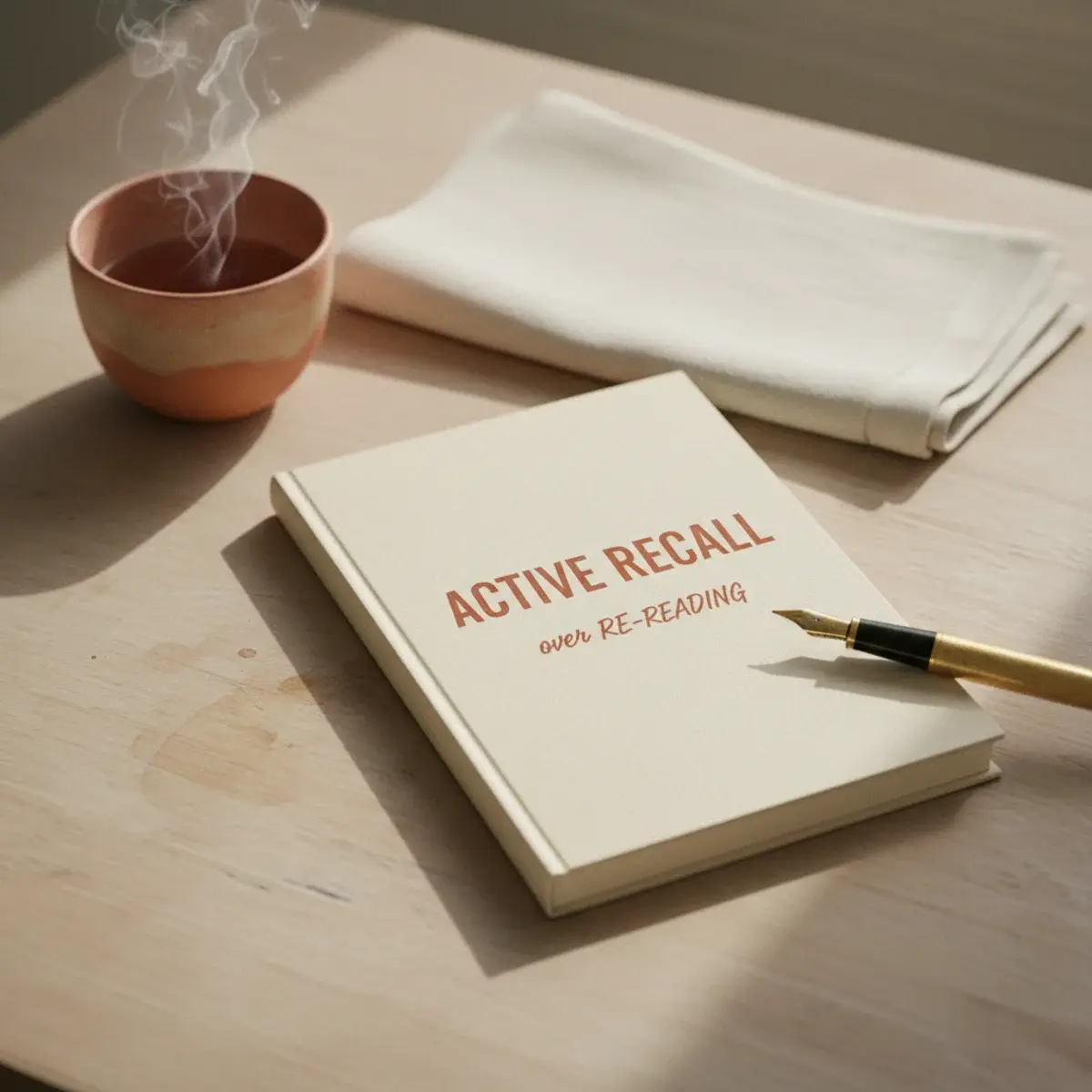
1. Active Recall Over Re-Reading
The single most evidence-backed study technique. The act of trying to retrieve information from memory builds memory far more effectively than re-reading.
The practical move: close the textbook after reading a chapter. Write down everything you remember on a blank page. Check against the original. The difference in retention versus simple re-reading is dramatic.
For the deep guide, see How to Use Active Recall for Studying.
2. Spaced Repetition
The corollary of active recall. Information needs to be retrieved multiple times across spaced intervals to move from short-term to long-term memory. A single intense study session doesn't work; five short sessions distributed across two weeks does.
The implementation: use Anki for memorisation-heavy subjects, or the manual Leitner system (three-box paper system) for everything else.
For more, see How to Make Easy and Effective Revision Flashcards.
3. Practice Testing (Not Just Reading)
The act of attempting practice questions — even when you haven't fully studied the material — is one of the highest-leverage study activities possible. The brain pays much more attention to information that has been tested than information that has been merely read.
The practical move: do practice questions before you feel ready, not after. The discomfort of failing questions reveals exactly which areas need attention.
The High-Value Tactics
The next tier — interventions that, while not quite as foundational, produce dramatic improvements when stacked on the above.
4. The Feynman Technique for Difficult Concepts
For the concepts you genuinely don't understand (as opposed to don't yet remember), the Feynman Technique is unmatched. Explain the concept in plain language to an imaginary 10-year-old. The gaps in your explanation are the gaps in your understanding.
For the full method, see How to Use the Feynman Technique for Studying.
5. Interleaving Across Subjects
Studying one subject for three hours straight is less effective than studying three subjects for one hour each in the same session — even if the total time is the same. The brain learns better when it's forced to switch between related-but-distinct topics, because it has to actively retrieve which framework applies to which problem.
The implementation: instead of "Monday is maths day, Tuesday is physics day", interleave shorter blocks of each. The temporary feeling of "this is harder" is the brain working at the higher difficulty that produces real learning.
6. Elaboration (Connecting New Material to Old)
Whenever you learn a new concept, deliberately connect it to something you already know. "This works similarly to X from last term, except…" or "This is the same principle that explains Y in the real world." The brain remembers connected information far better than isolated information.
The practical move: after each study session, write a single sentence linking what you just learned to something you learned previously. Three minutes of work; major retention benefits.
The Time-Use Tactics
The interventions that don't change what you study, but transform how you spend the studying hours.
7. The Pomodoro Technique
Twenty-five minutes of focused work, five minutes of break, repeated. The single most-evidenced time-structuring technique. Bounds the suffering, creates rhythm, builds focus stamina.
For the deep guide, see How to Use the Pomodoro Technique for Studying.
8. Studying in Your Peak Cognitive Window
Most students have a 3-4 hour daily window of peak focus. For most chronotypes, this is 8am–12pm. Schedule your hardest cognitive work — writing, complex problem-solving, new learning — in this window. Save admin and lighter review for the afternoon.
The single most undervalued strategic decision in studying: matching the type of work to the time of day. The student who writes essays at 9am and reviews flashcards at 3pm outperforms the student who does the reverse.
9. Single-Tasking Over Multitasking
The research is unambiguous: humans cannot do two cognitive tasks simultaneously. What looks like multitasking is rapid task-switching, and the context-switching cost makes it dramatically less efficient than single-tasking.
The implementation: one tab, one document, one task. The phone in another room. The chat apps closed. The studying session with twelve tabs open is the studying session that produces nothing.
The Sleep and Body Tactics
The non-study activities that determine how much of your study time is actually productive.
10. Sleep Seven to Nine Hours
The single most under-leveraged academic performance intervention. The student who sleeps 7.5 hours consistently outperforms the student who sleeps 6 hours on essentially every measurable cognitive metric — by margins that compound over weeks.
Sleep is when the brain consolidates the day's learning into long-term memory. Skip the sleep and you skip the consolidation. The all-nighter doesn't add study time; it deletes the previous day's progress.
11. Move Your Body Daily
Twenty minutes of movement a day — walking, yoga, swimming, anything — measurably improves cognitive performance. The mechanism: increased blood flow to the brain, improved mood, better sleep, reduced anxiety.
The student who studies for six hours with no movement underperforms the student who studies for five hours and walks for one. The maths is real.
12. Eat Three Real Meals
The brain runs on glucose. The student who skips breakfast and runs on coffee until lunch is the student whose afternoon focus is mediocre. Three real meals at three real times beats grazing every time.
For the specifics, see 15 Easy Ways to Save Money on Food in College — the same eating habits that save money also fuel the brain.
The Meta-Strategy
The single most important shift, more powerful than any specific technique.
13. Track What's Actually Working
Most students never measure their own study effectiveness. They just feel productive or feel unproductive, with no data to actually know.
The intervention: a small weekly tracker. Five minutes on Sunday evening. Three columns:
- What I studied this week. (Honest list.)
- What I retained. (Self-test or honest assessment.)
- What technique seemed to help most.
Over a term, the tracker reveals patterns no individual session could. You discover which techniques work for your specific brain — which is the only data that actually matters.
What "Studying Harder" Usually Means (And Why It Fails)
The classic "study harder" response to a bad grade usually means more hours, doing the same things. This is exactly wrong. The student getting a 2:2 by studying 40 hours a week using bad techniques won't get a first by studying 60 hours a week using the same bad techniques — they'll get a slightly better 2:2 and burnout.
The student who switches techniques — even with the same number of hours — sees disproportionate improvements. The maths is in the method, not the volume.

How to Actually Implement
Don't try all thirteen. The plan:
- Week 1: install active recall as your default revision technique.
- Week 2: add spaced repetition for memorisation-heavy material.
- Week 3: add practice testing twice a week.
- Week 4: restructure your study schedule to match your peak cognitive window.
By the end of a month, the four highest-impact changes are in place. The rest can be added gradually over the next term.
What Doesn't Work (And Why)
Three "study harder" approaches that get recommended and that the research does not support.
Highlighting and underlining
The single most-overrated study technique in the world. Highlighting feels like progress but produces almost no learning improvement compared to plain reading. The brain treats highlighted text as "I'll review this later" — which mostly means you don't.
If you must highlight, do it sparingly — three or four key phrases per page, not entire paragraphs.
Re-reading
Reading the same chapter four times produces dramatically worse retention than reading it once and actively retrieving the content. Re-reading is the most popular study technique among students and one of the least effective. The fluency you feel during the third re-read is recognition, not understanding.
Mass cramming
Studying for ten hours in one day produces dramatically worse long-term retention than studying for two hours a day across five days. The brain consolidates memory during the gaps — and cramming has no gaps. The all-nighter feels productive and produces almost nothing that lasts past the exam.
The Compound Effect
The single most important truth about smart studying: the techniques in this article are compounding. A student who uses active recall consistently from week one is dramatically ahead by week ten — not because of any single session, but because the cumulative effect of better technique grows over time.
The students who change technique in week six because of poor exam results almost always recover — but they recover from a deeper hole than the students who started right. Start the better techniques early. The maths is in the consistency.
Final Thoughts
The phrase "study smarter, not harder" gets dismissed as a productivity cliché. The research it's based on is genuinely substantial — decades of cognitive psychology, replicated across cultures and subjects, with effect sizes large enough that the practical difference is undeniable.
The students who pull ahead by year two are not the ones working the most hours. They are the ones using the techniques in this article — quietly, consistently, without making a fuss about it — while their peers spend twice the time on inferior methods.
Pick three. Try them for a month. Watch the gap between effort and outcome shrink.
More from this category



Leave a Reply
Want to write back? Comments aren't open yet — but you can reply to this article on Pinterest, save it to a board, or share it with a friend.