Study Motivation
15 Best Tips to Study During Christmas Holidays

Feb 2
2026
15 best tips to study during the Christmas holidays — how to keep your momentum without sacrificing the joy of the season.
Christmas break should be three glorious weeks of pyjamas, family, mince pies, and a slow gentle return to a life that doesn't involve a textbook. For many students it is. For the rest of us — the ones with January exams, the ones with a thesis deadline in mid-term, the ones who can't quite afford to lose three weeks — the holidays are a strange in-between season. You need to study. You also need to be a daughter, a sister, a partner, a human being. The two need to coexist.
This article is the realistic playbook. Fifteen specific tactics for studying during the holidays without sacrificing the holiday itself — and, importantly, without falling so far behind that January is impossible.
Save this. The students who plan in early December have a calm January. The ones who don't, don't.
The Foundation Mindset
Before the tactics: a small re-framing of the whole problem.
Holiday studying is not term-time studying. The conditions are wildly different — a different house, often with no proper desk, surrounded by family members who want your attention, with the genuine social and emotional pull of Christmas drawing on you constantly. Trying to replicate your term-time study schedule in your parents' kitchen on Boxing Day is a recipe for misery and failure.
The right approach is a holiday-specific approach. Fewer hours per day. Different times of day. Different goals. The result, done well, is real study progress alongside a real holiday. Not one or the other.
The Time-Based Tactics
The mechanics of when to study during the holidays.
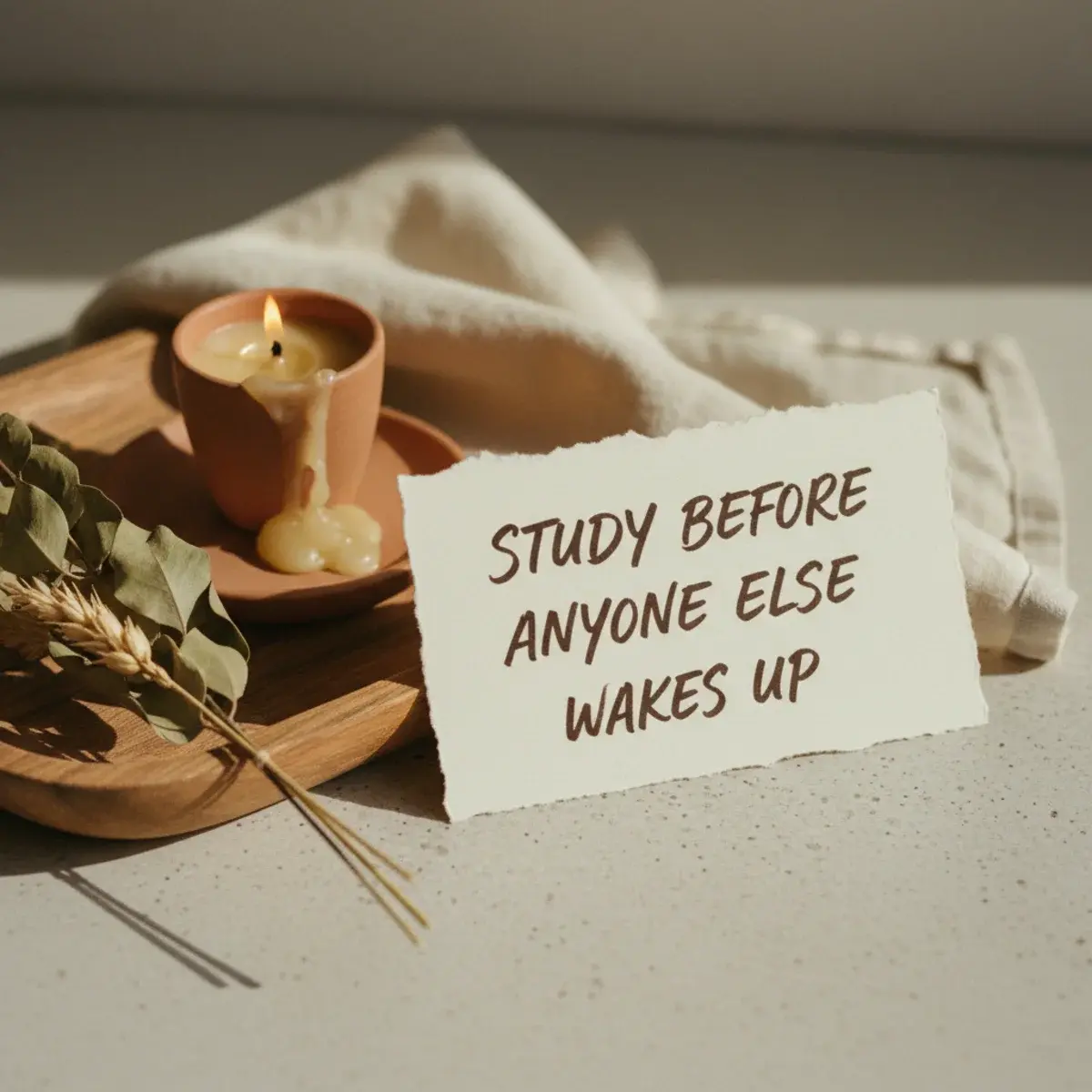
1. Study Before Anyone Else Wakes Up
The single most effective holiday-studying tactic. The hours of 7am-10am at your parents' house are the only hours when nobody will ask you to do anything, talk to anyone, or join in with anything.
Set an alarm. Make a coffee quietly. Go to a quiet room. Study for two hours. By 10am — when the rest of the house is just stirring — you've already done a full term-time-equivalent morning of work. The rest of the day is genuinely free.
2. Use the Quiet Hour After Dinner (8pm–9pm)
If mornings genuinely don't work (you're not a morning person, you have insomniac parents who get up at 5am), the second-best window is the hour after dinner when the family is watching TV. A small focused hour of review at the kitchen table while everyone else is in the living room.
3. Set a Hard Daily Hour Cap
Two hours a day is the right target. Maximum three. Anything more and the holiday stops being a holiday, you become resentful of the studying, and the studying suffers.
Two hours a day for fifteen days of holiday is thirty hours of work. That is genuine progress. It is also less than a sixth of your day. The maths is reasonable.
4. Take Christmas Day and New Year's Day Completely Off
Non-negotiable. Even with a January exam. Even with a deadline. Two days of zero studying, completely guilt-free, with the rest of your family and the people who love you. The recovery these days provide is what makes the rest of the holiday's studying sustainable.
The Space-Based Tactics
The where and how of holiday studying.
5. Find Your Holiday Study Space on Day One
Don't try to make it work at the kitchen table. Don't study on your childhood bed (the studying-bed association is hard to shake afterwards). Find a dedicated holiday study space on the day you arrive.
Best options in most family homes: a corner of the dining room, a spare bedroom desk, the unused-this-week home office. Move a chair into a quiet corner. Add a desk lamp. This is your spot for the next three weeks.
6. Pack a Travel Study Kit
You won't have your full term-time setup. Pack the minimum:
- The single notebook you need
- Two pens, one highlighter
- Your laptop and charger
- One specific book or printout
- A small candle (the smell-as-focus-trigger still works in a different house)
That's it. Don't try to bring half your desk. The packed kit is portable; the home setup isn't.
7. Find a Local Library or Café for "Out" Sessions
The single best mental-health move for holiday studying: book one or two sessions a week at a local library or independent café. The change of scenery from your parents' house is restorative, and the public-place accountability ensures real focus.
Bonus: it gives you a defensible reason to leave the house when family dynamics get intense. "I need to do two hours of revision; I'll be at the library, back for dinner" is a clean, blameless exit.
8. Make a "Do Not Disturb" Sign That You Actually Mean
A small piece of card on your door. "Studying for the next 90 minutes — please knock only for emergencies." Family members are generally respectful when given a clear signal. The vague "I'm sort of working" leaves the door open to interruption every twenty minutes.
The Goal-Based Tactics
The strategic decisions about what to actually do with the study hours.
9. Set Three Specific Goals for the Whole Holiday
Not "study for January exams". Three specific deliverables. "Read chapters 4, 5, and 6 of the textbook. Finish problem set 9. Write the first draft of the introduction to the essay."
Three goals across three weeks is realistic. Five is too many. One is too few. The specificity is what makes the holiday studying feel purposeful instead of vaguely guilty.
10. Do the High-Value Tasks, Skip the Low-Value Ones
Not all study tasks are equally important. The holiday is the time for active study — practice questions, past papers, essay drafting, active recall from flashcards. Skip the passive low-value tasks — re-reading the textbook, watching lectures you've already watched, "organising your notes".
The two hours a day rule means you can only afford the highest-return work. The reorganising can wait until January.
11. Use Active Recall, Not Re-Reading
If you have two hours and you spend it re-reading the textbook, you've wasted most of the time. If you spend the same two hours testing yourself on flashcards and answering practice questions, the retention is dramatically better.
The Pareto principle of revision: 20% of your techniques produce 80% of the learning. Active recall, spaced repetition, and practice testing are the three. Lean on them.

The Family-Management Tactics
The hardest part of holiday studying isn't the studying — it's the navigating of family expectations.
12. Communicate Your Schedule Before You Arrive
The single most important conversation: text your mum, your dad, your siblings before you arrive. "I'm planning to study about two hours a day during the holiday — usually mornings. Just want you to know so we can plan around it. Looking forward to seeing everyone."
The pre-warning prevents the awkward in-the-moment conversation about studying that always sounds like you'd rather work than spend time with family. The pre-warning frames it as a logistic, not a rejection.
13. Be Fully Present When You're Not Studying
The two hours a day of studying only works if the other twelve hours are wholehearted family time. Phone away. Laptop closed. Engaged in the actual moment of being with people you love.
The trade you're making: shorter study time, fuller presence in the rest of the day. The trade is the point. Don't half-study during family dinner and call it productivity.
14. Have a Polite Script for Holiday Interruptions
When a family member knocks during a study session, the script that works:
"I'd love to chat properly. Can I find you in 40 minutes when I'm done with this section?"
It honours the relationship. It protects the work. It almost always lands well.
What doesn't work: silently resenting the interruption, getting snappy, or stopping the session and then resenting the family. Have the script ready.
The Recovery Tactics
The pieces most students forget — the things that make the holiday studying actually sustainable instead of grinding.
15. Plan One Genuinely Restorative Activity Every Day
Not "watching TV". An actual restorative thing. A long walk after lunch. An hour of reading a novel by the fire. A morning at a Christmas market with your mum. A board game with your siblings.
The restorative activity is what keeps you human through the studying. The students who burn out over Christmas break are the ones who didn't build any actual recovery into the days.
For seasonal restorative options, see 50+ Fall Themed Activities College Students Will Love — most of the autumn list applies through the winter season too.

A Realistic Day-by-Day Plan
What a productive Christmas-break day actually looks like:
- 7:00am — wake gently
- 7:15am — coffee, quiet kitchen
- 7:30–9:30am — two-hour study session (the most important part of the day)
- 9:30am — proper breakfast with whoever's around
- 10:00am onwards — fully holiday. Family. Walks. Visits. Cooking.
- 8:00pm — quiet evening; reading, board games, the slow Christmas evening
- 10:30pm — sleep
One block of focused work. The rest of the day truly free. Twenty days of this is forty hours of real study progress — and a holiday you actually had.
Three Mistakes to Avoid
Mistake 1: Trying to study all day. Doesn't work. You'll resent the studying, resent the family, resent the holiday, and produce mediocre work. The constrained two-hour window is what makes it sustainable.
Mistake 2: Studying in pyjamas in bed. The single most reliable way to ruin a study session. Get dressed. Sit at a real desk. The signal matters.
Mistake 3: Studying on Christmas Day "just for an hour". Don't. The slope is slippery, the family notices, and the hour produces almost no work. Two full days off is the right protocol.
Final Thoughts
A successful Christmas break, for a student who has to study, is one where you come back to university in January feeling rested and feeling on top of the material. Most students achieve one or neither. The framework above gets you both.
The studying is real. The holiday is real. The two coexist if you plan the structure in early December and protect the boundaries through the three weeks.
Two hours a day. The mornings, ideally. Specific goals. Real breaks. Full presence the rest of the time. The whole protocol fits on a postcard. The execution is what makes the term ahead of you possible.
More from this category



Leave a Reply
Want to write back? Comments aren't open yet — but you can reply to this article on Pinterest, save it to a board, or share it with a friend.