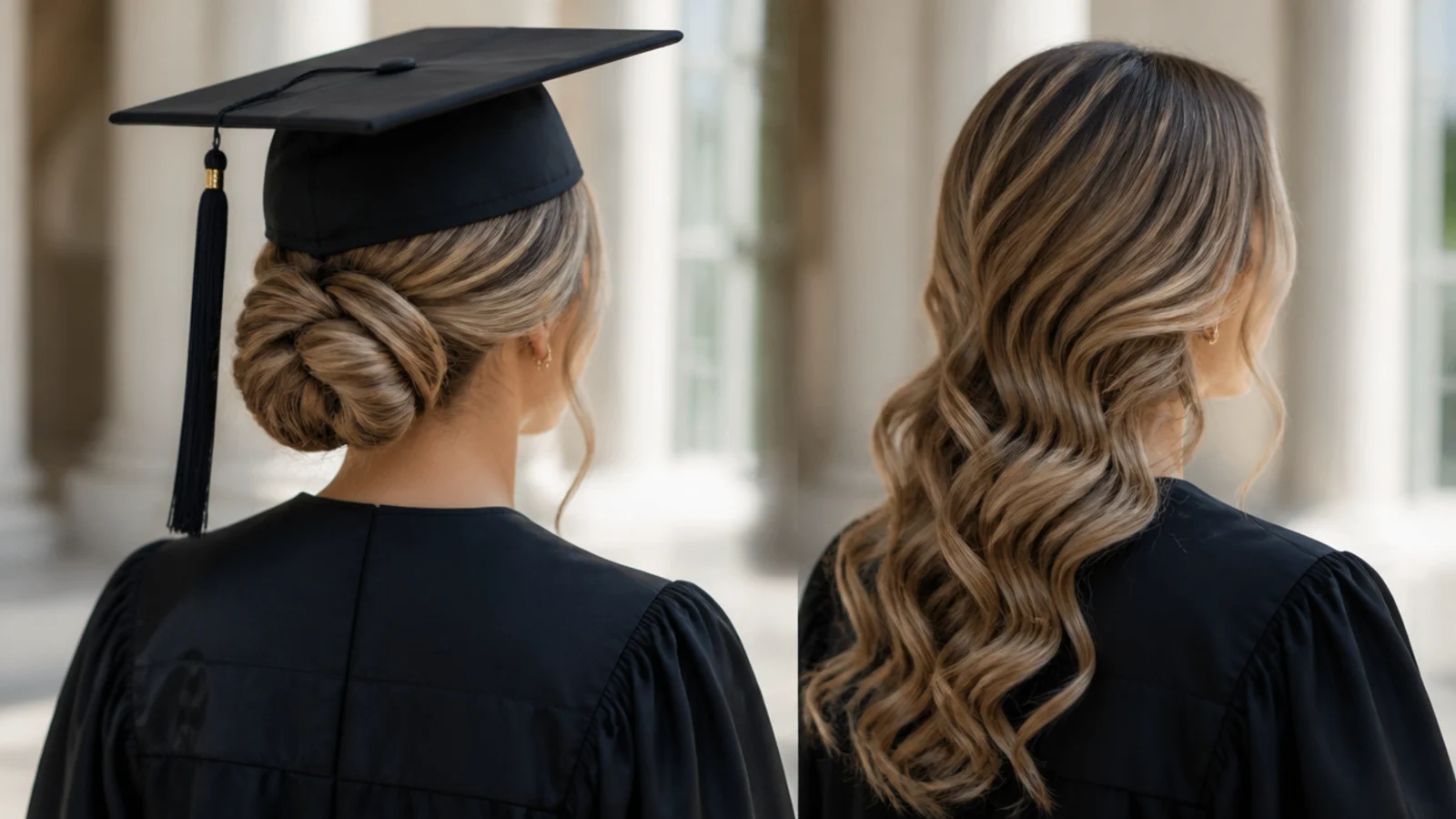
Quick Comparison
| Updo for Graduation | Hair Down for Graduation | |
|---|---|---|
| Cap fit and stability over four hours | High; a low bun gives the band a dry, flat surface to sit on and grip | Medium; smooth hair is slippery and lets the cap creep backward |
| Risk of a visible cap dent | Very low; there is nothing at the crown left to crush | High on straight hair, low on curls, which spring back in minutes |
| Performance in humidity and outdoor heat | Better; pinned and braided hair physically cannot expand or frizz | Worse; loose lengths swell at spring and summer outdoor ceremonies |
| Photos with the cap on | Strong; the silhouette stays crisp and the neck and jaw stay visible | Mixed; dark hair down can blend into a black gown and lose shape |
| Photos after the cap comes off | Excellent; the shape is unchanged and needs no fixing | Needs a 5-minute reset with water and fingers before the photo line |
| Styling time the morning of | 12 to 30 minutes, mostly pinning, no cooling time needed | 10 to 25 minutes, most of it curling, plus 10 minutes to cool |
| Comfort in a hot polyester gown | Better; the neck stays completely clear for the whole ceremony | Warmer; the length sits on your neck under a lined gown |
| Best hair lengths | Shoulder-length through waist-length; needs enough to coil and pin | Pixie through long, but strongest at bob and shoulder length |
| Skill needed to do it yourself | Moderate; pinning blind from behind takes one practice run | Low; curling and brushing out needs no reaching behind your head |
1. Low Chignon at the Nape: The Updo Pick for a Four-Hour Outdoor Ceremony
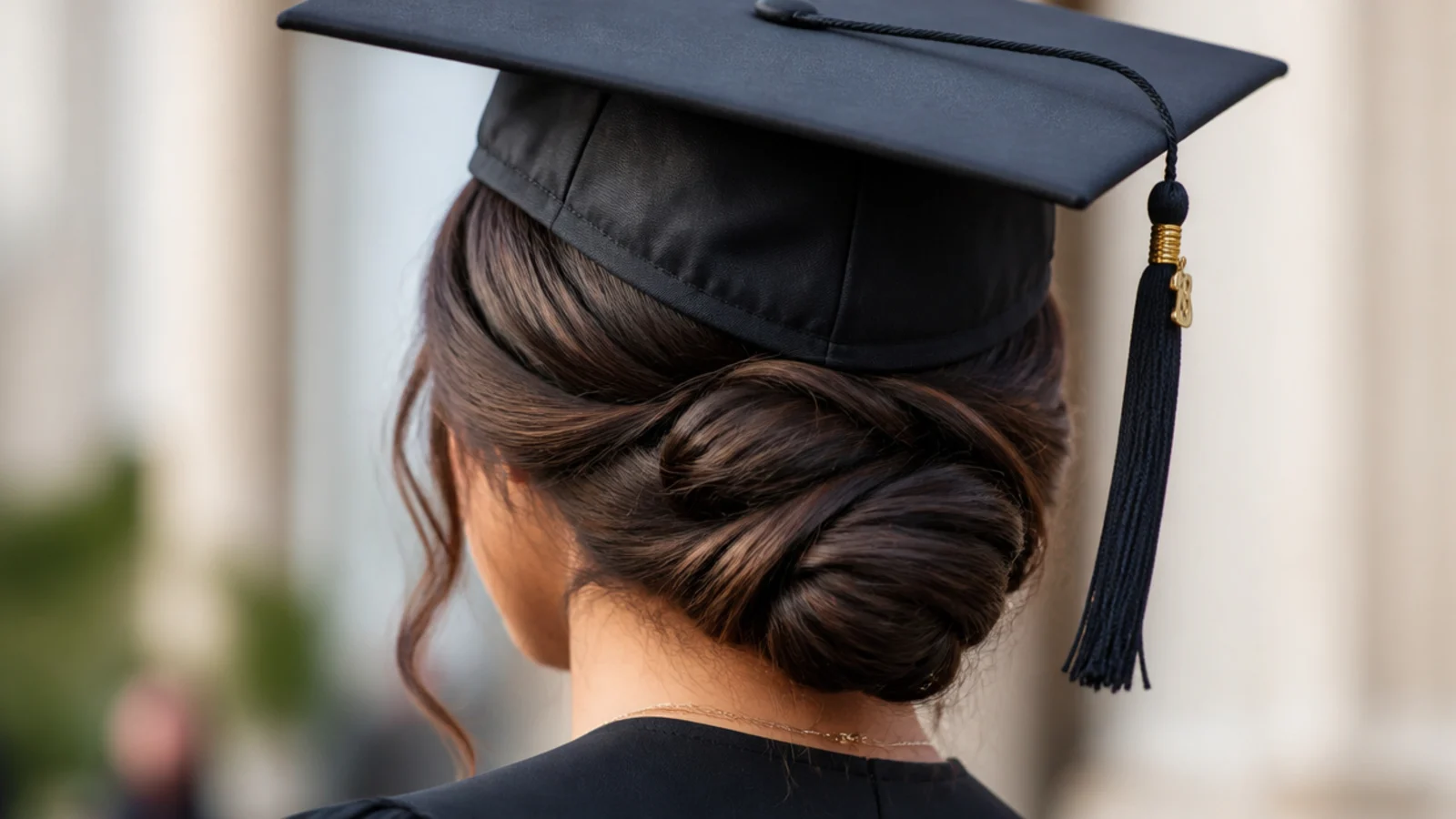
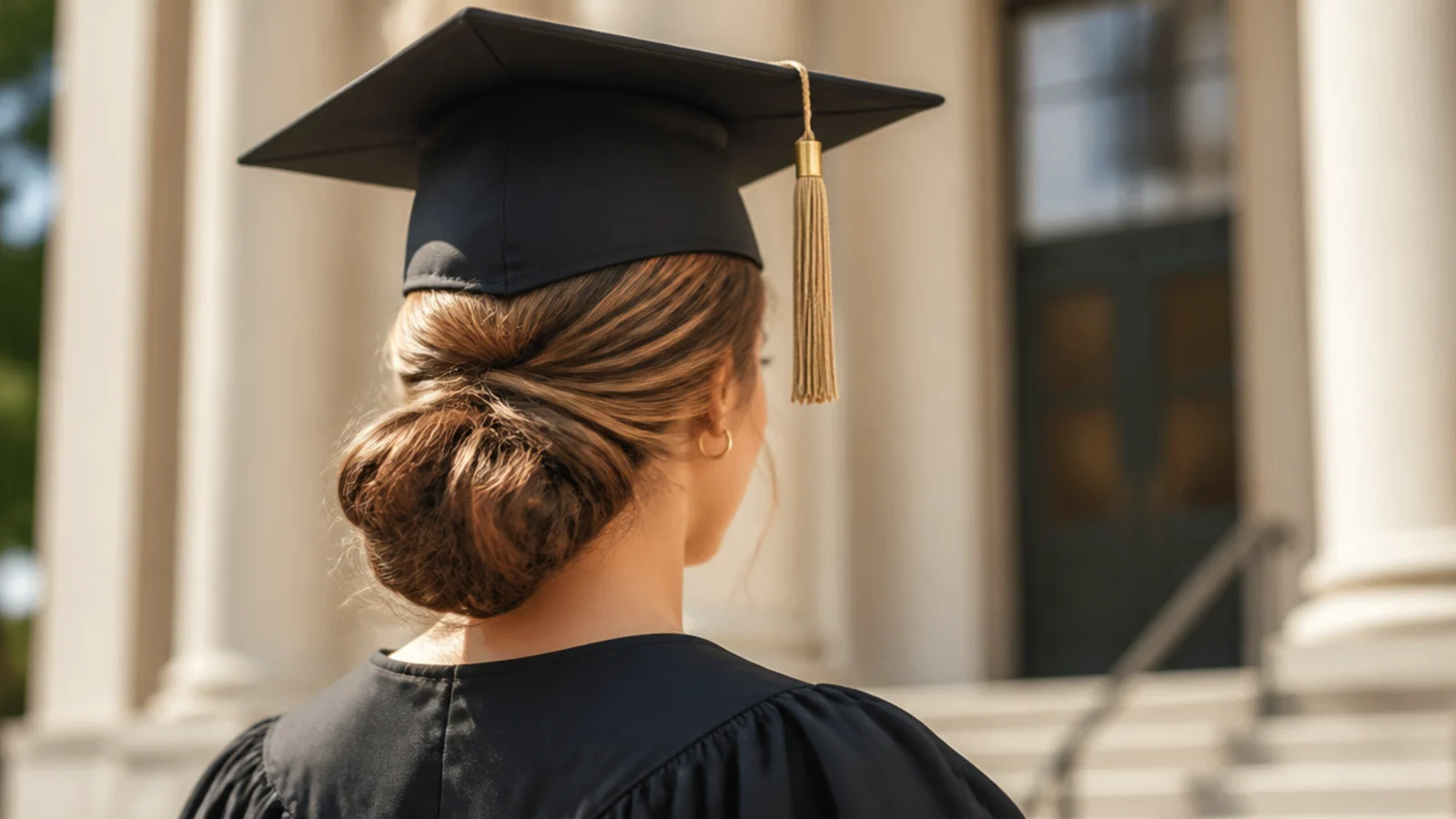
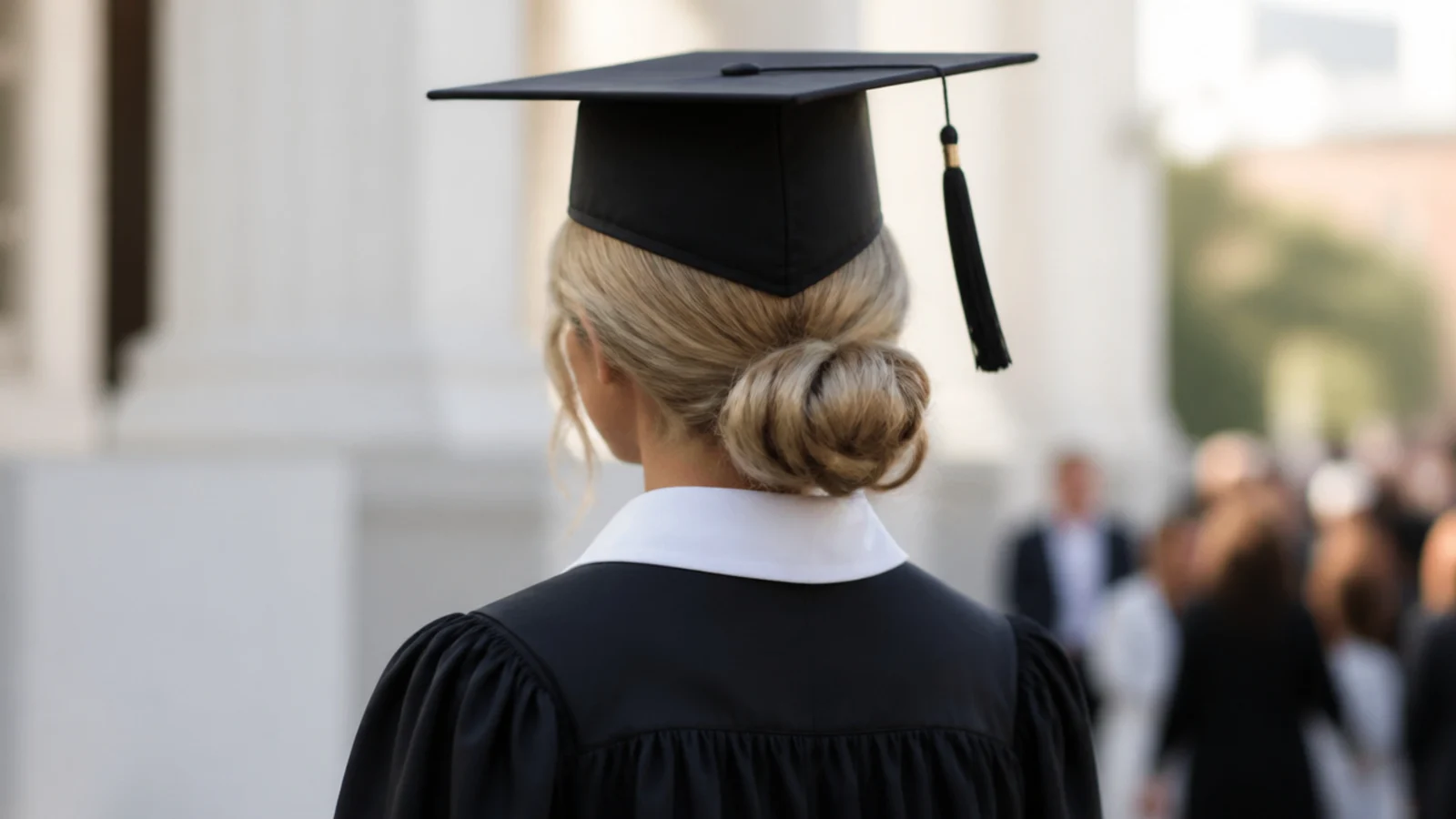
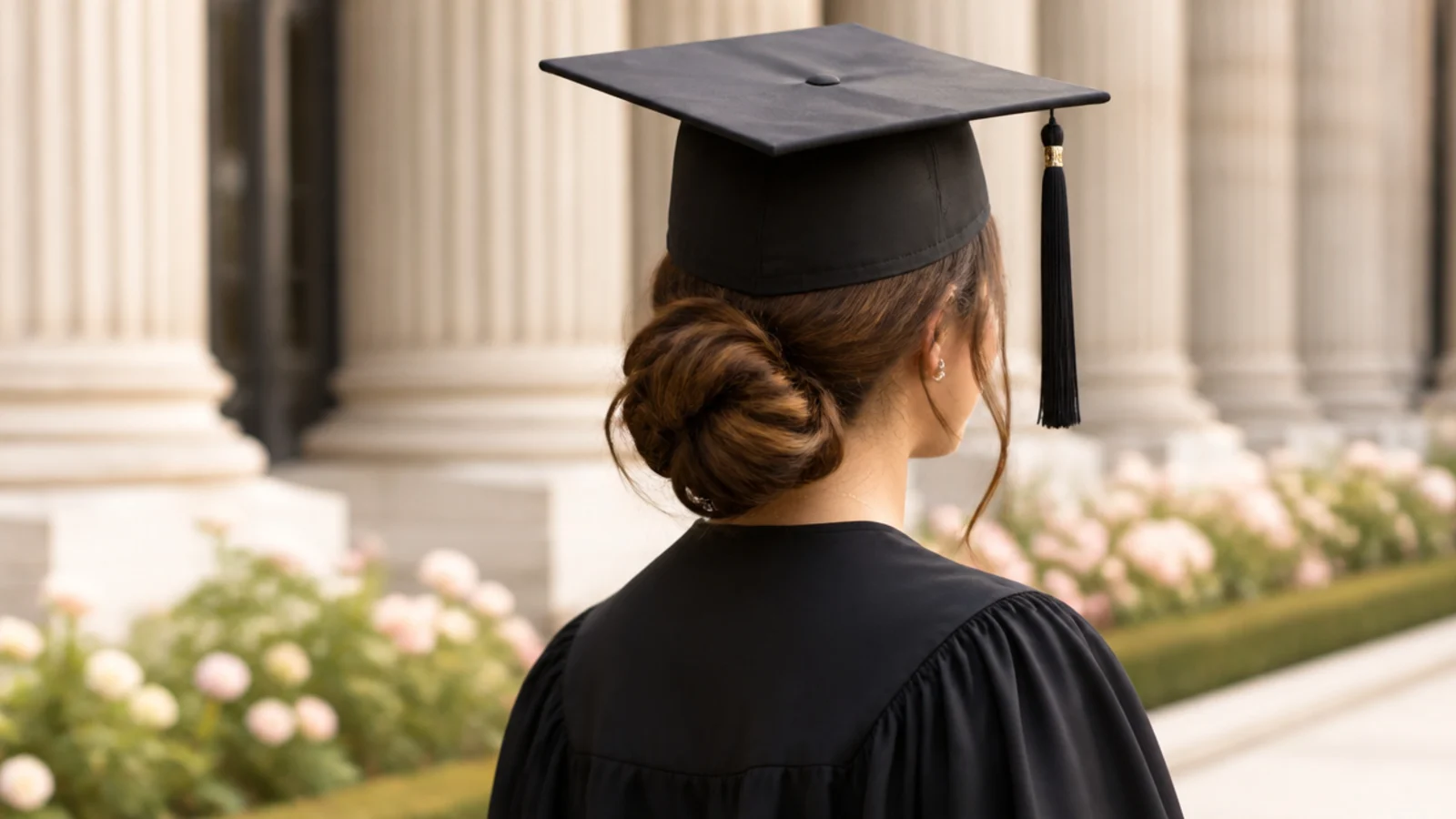
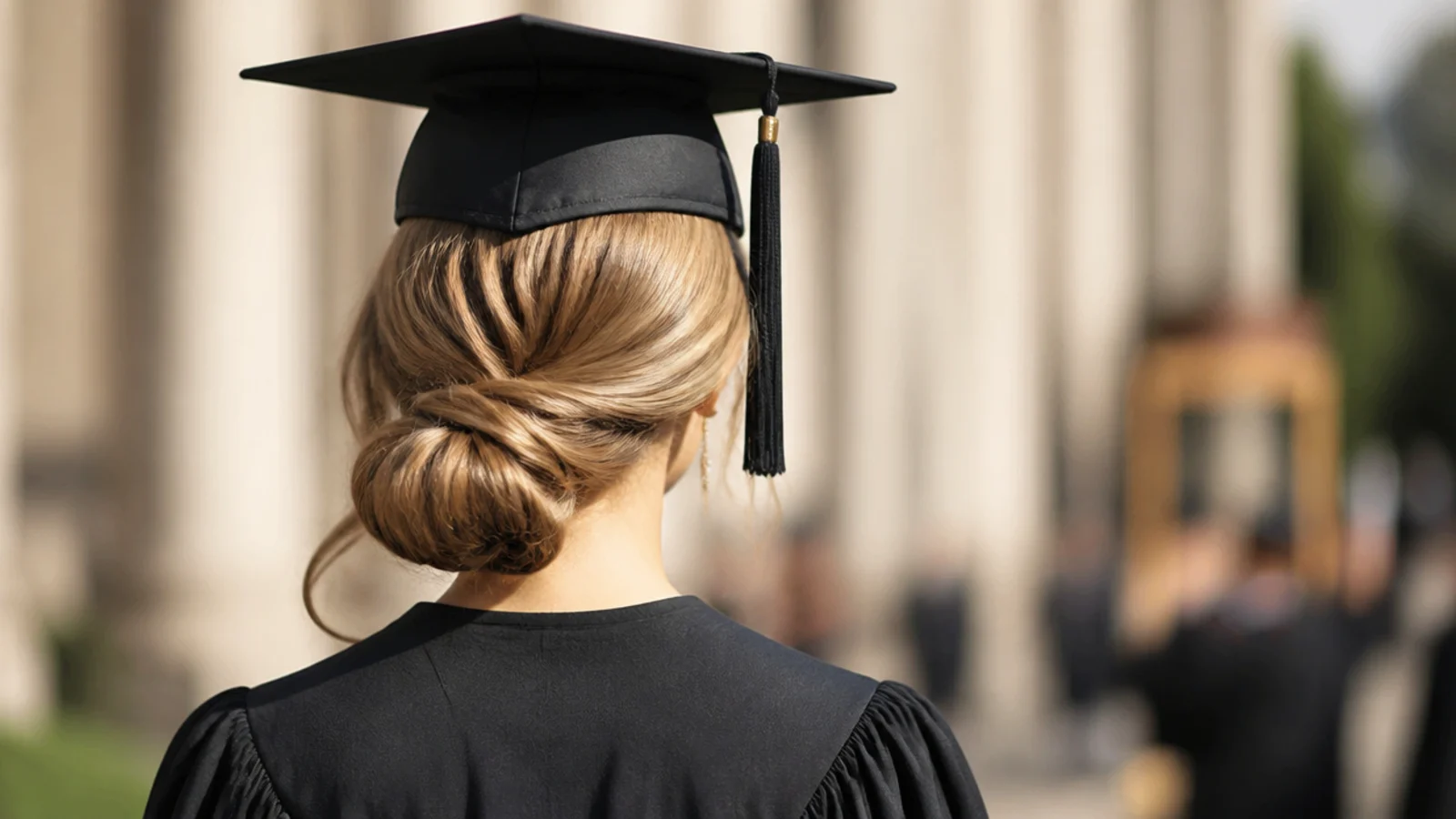
This is the style the whole updo side of the argument rests on. Gather at the nape, twist the length into a rope, coil it flat against the skull and secure at four points with U-pins rather than bobby pins. The bun sits at or below the occipital bone, roughly two inches under the cap band, so the mortarboard never touches it. It survives heat, wind and a long outdoor spring ceremony without a single touch-up, and it looks identical the moment the cap comes off. About 15 minutes on shoulder-length or longer hair.
Who it suits: Shoulder-length to waist-length hair, outdoor ceremonies, formal gowns and high necklines.
Tip: Angle every pin toward the scalp and slightly upward so the bun weight cannot drag the cap backward.
2. Sleek Low Ponytail: The Updo Pick for Thick or Heavy Hair
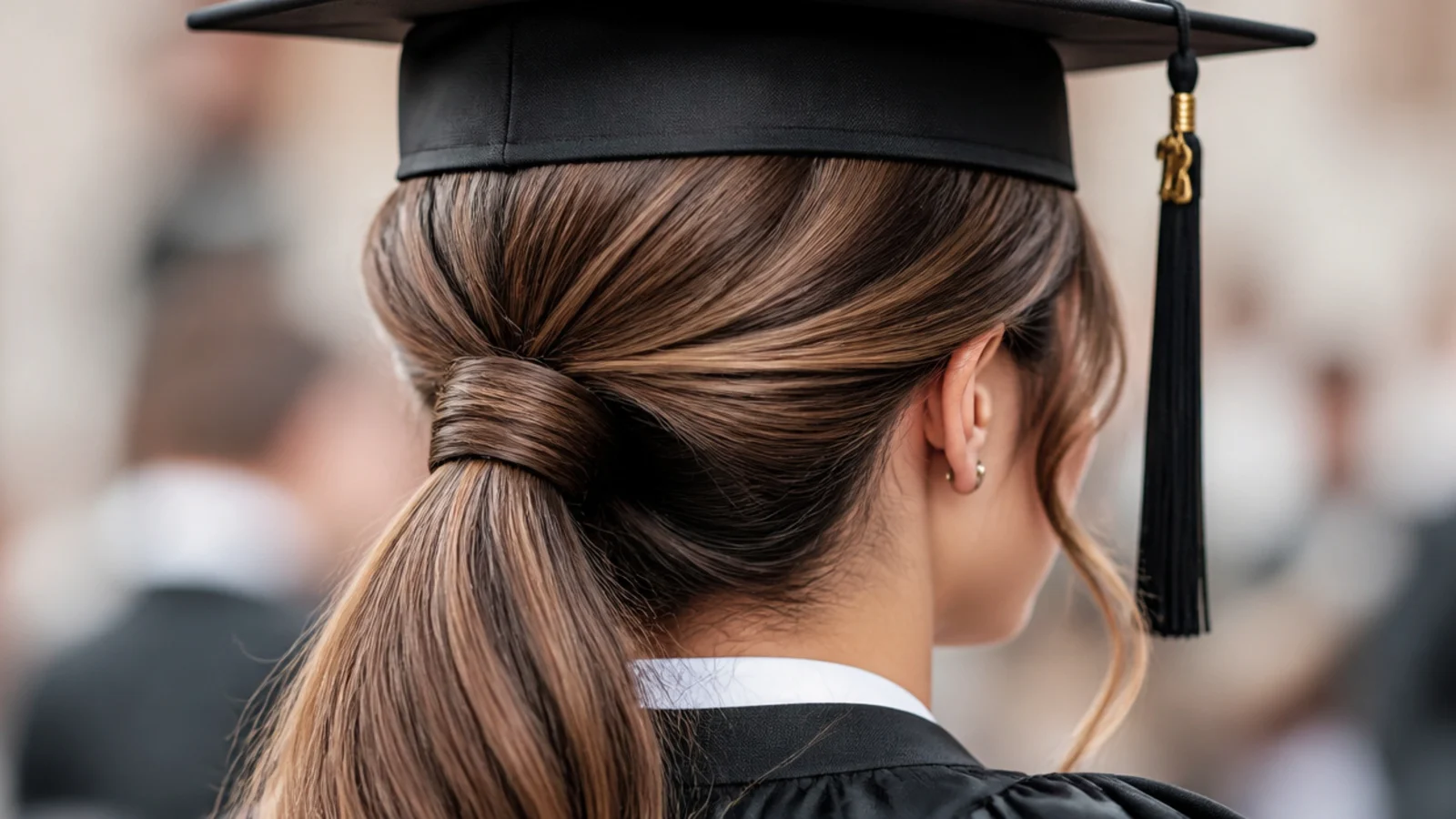
Technically an updo-adjacent style, and the smartest option if your hair is thick enough that a real bun turns into a five-ounce weight at the back of your head. Smooth back with an alcohol-free gel on damp hair, tie at the bony ridge at the back of the skull, then wrap a half-inch section over the elastic. Placement is the whole game: one inch higher and the elastic sits under the band and tilts the cap forward. Fifteen minutes, no braiding skill, and it reads polished in every handshake photo. More placements in ponytail styles.
Who it suits: Thick, coarse or very long hair; anyone who wants zero fuss and a clean silhouette.
Tip: Use gel, not freeze spray, since stiff spray flakes visibly white against a black gown.
3. Classic French Twist: The Updo Pick for a High-Neckline Dress
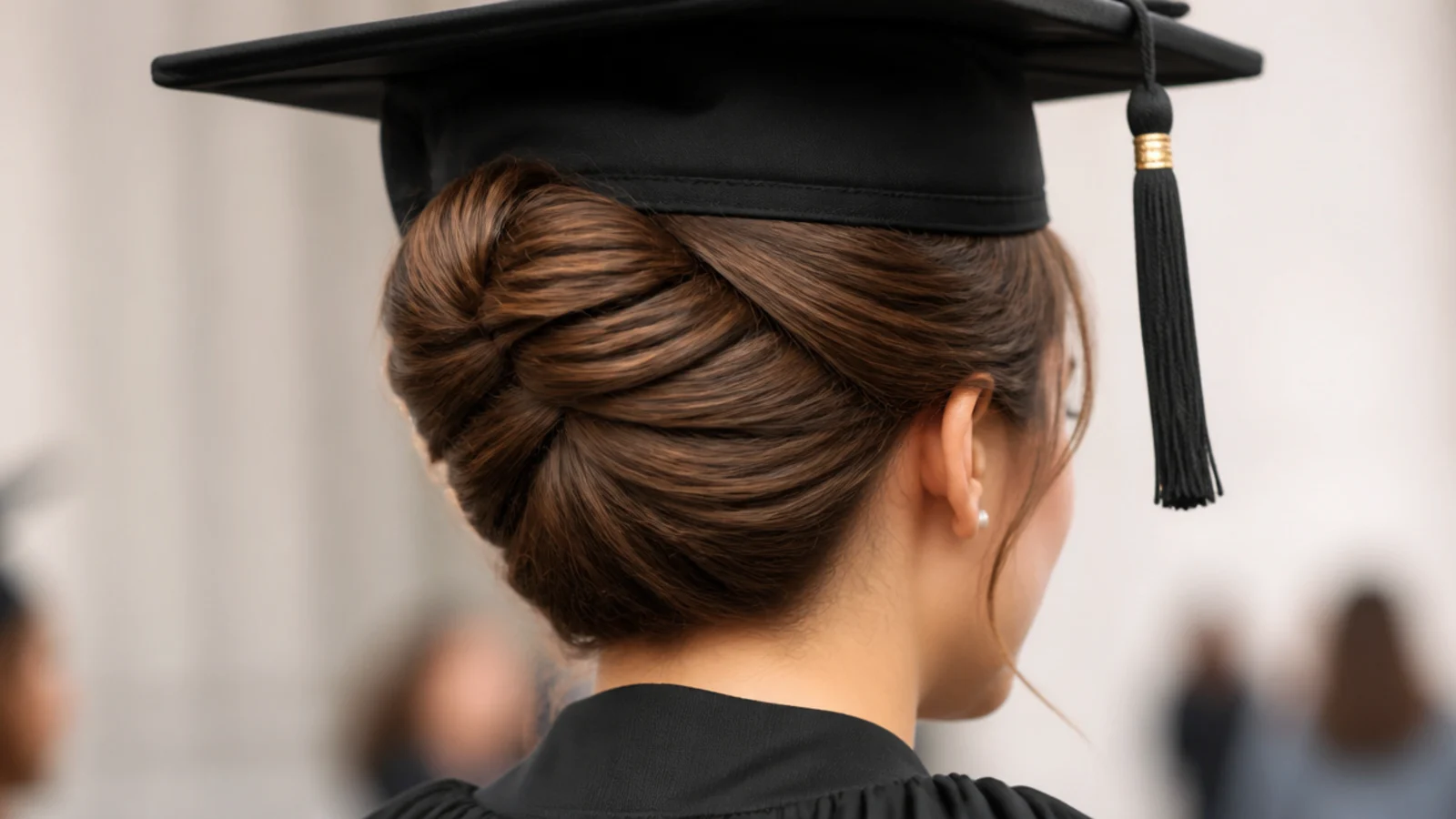
Every listicle names the French twist and none of them explain it. Brush all the hair to one side, hold it flat against the head, then fold the opposite side over it and roll the whole mass vertically upward, tucking the ends inside the fold. Pin down the seam with eight bobby pins pushed horizontally into the roll, not through it. The roll must stop below the cap band, so keep the fold low and wide rather than tall. Twenty-five to thirty minutes the first time, fifteen once you have practiced it twice. See also long hair updos that last.
Who it suits: Straight to wavy hair of one length, collared or high-neck dresses, formal hooding ceremonies.
Tip: Spray each bobby pin and let it tack for five seconds before sliding it in so it grips clean hair.
4. Braided Low Bun: The Updo Pick for Humidity and Frizz
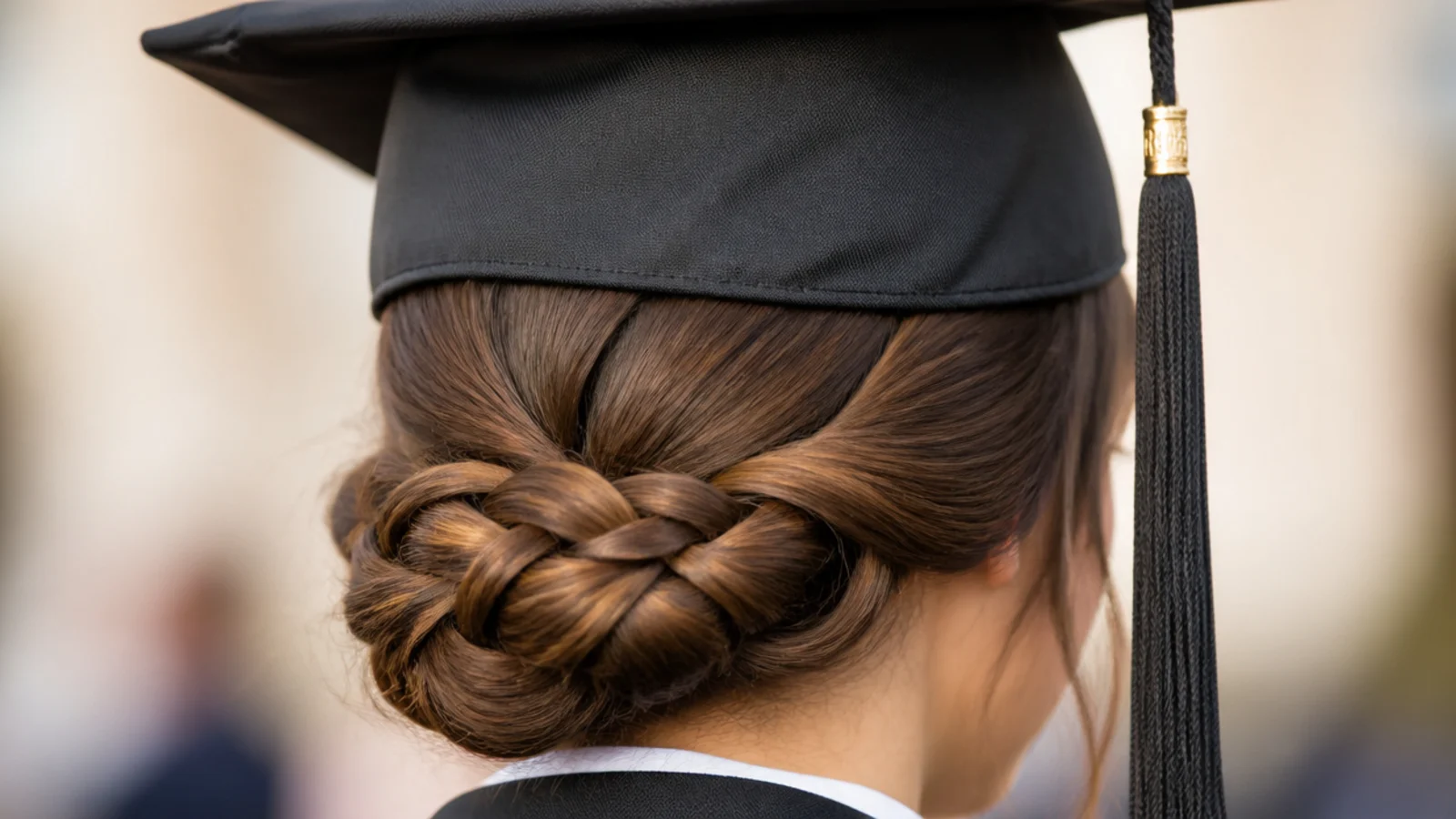
Braid the length into a standard three-strand plait, coil the braid at the nape and pin the coil at six points. Braided hair is the only structure on this page that humidity cannot expand, because every strand is locked against its neighbors. Outdoor May and June ceremonies are exactly where loose styles swell and updos win, and this is the version that wins hardest. It is also the one style you can genuinely do the night before, since day-two braid texture looks better than fresh. About 20 minutes.
Who it suits: Anyone graduating outdoors in humidity, medium to long hair, all textures.
Tip: Pancake the braid gently before coiling so the bun looks fuller without adding any height.
5. Twisted Rope Bun for Fine Hair: The Updo Pick Under Ten Minutes
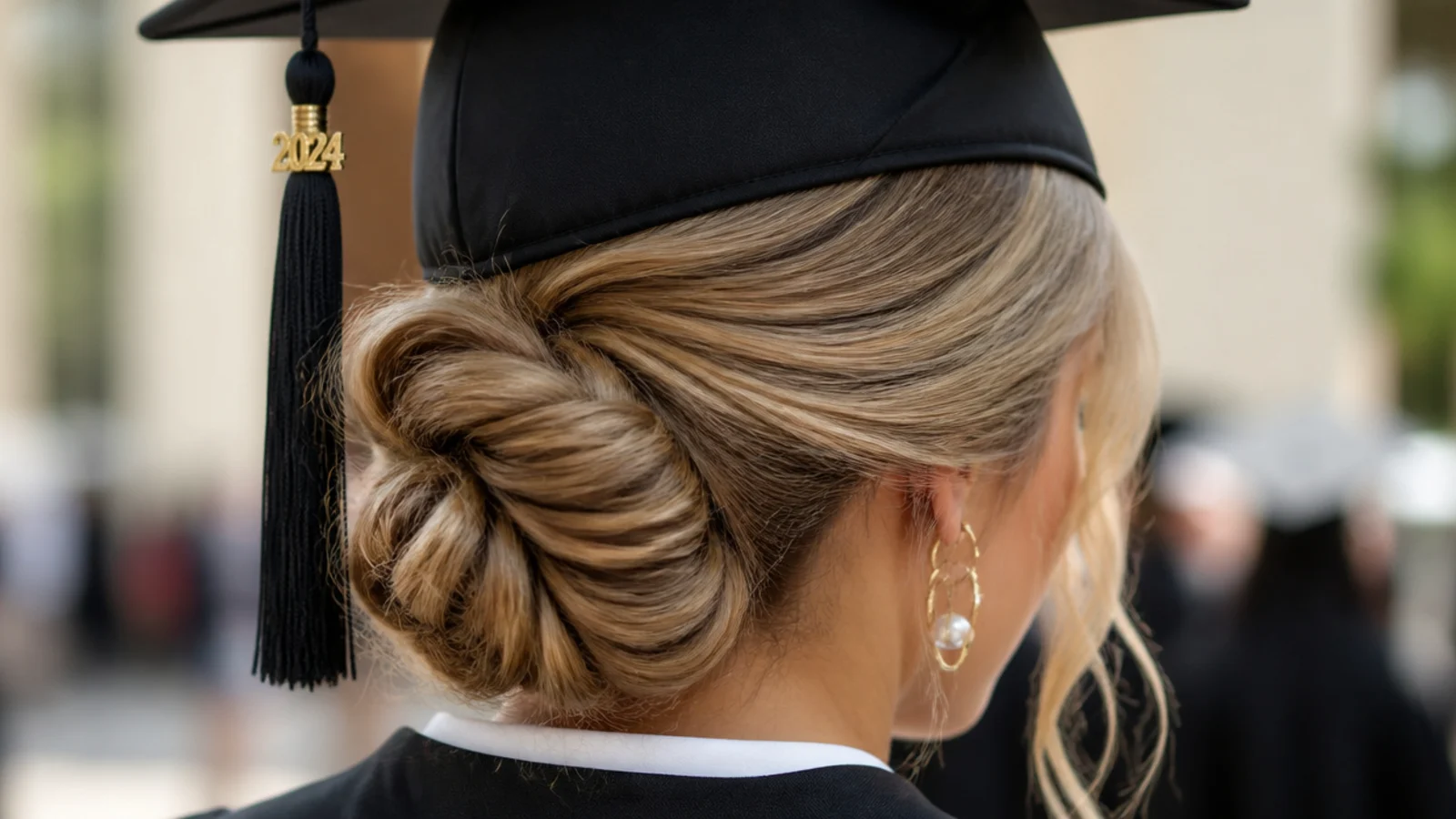
Fine hair is the usual reason people give up on an updo, and the fix is texture rather than skill. Mist dry texture spray through the mid-lengths, split the hair into two sections, twist each one away from your face, wrap them around each other and coil into a low bun. Pin with six bobby pins crossed into three Xs, because a single pin has nothing to grip in fine hair while a crossed pair holds roughly twice as well. Eight to ten minutes, no heat, no comb. The same twist logic drives low space buns.
Who it suits: Fine, thin or slippery hair that slides out of a standard bun.
Tip: Style on second-day hair; freshly washed fine hair is too slick for pins to hold four hours.
6. Ballet Bun Dropped Two Inches: The Updo Pick for Sleek Straight Hair
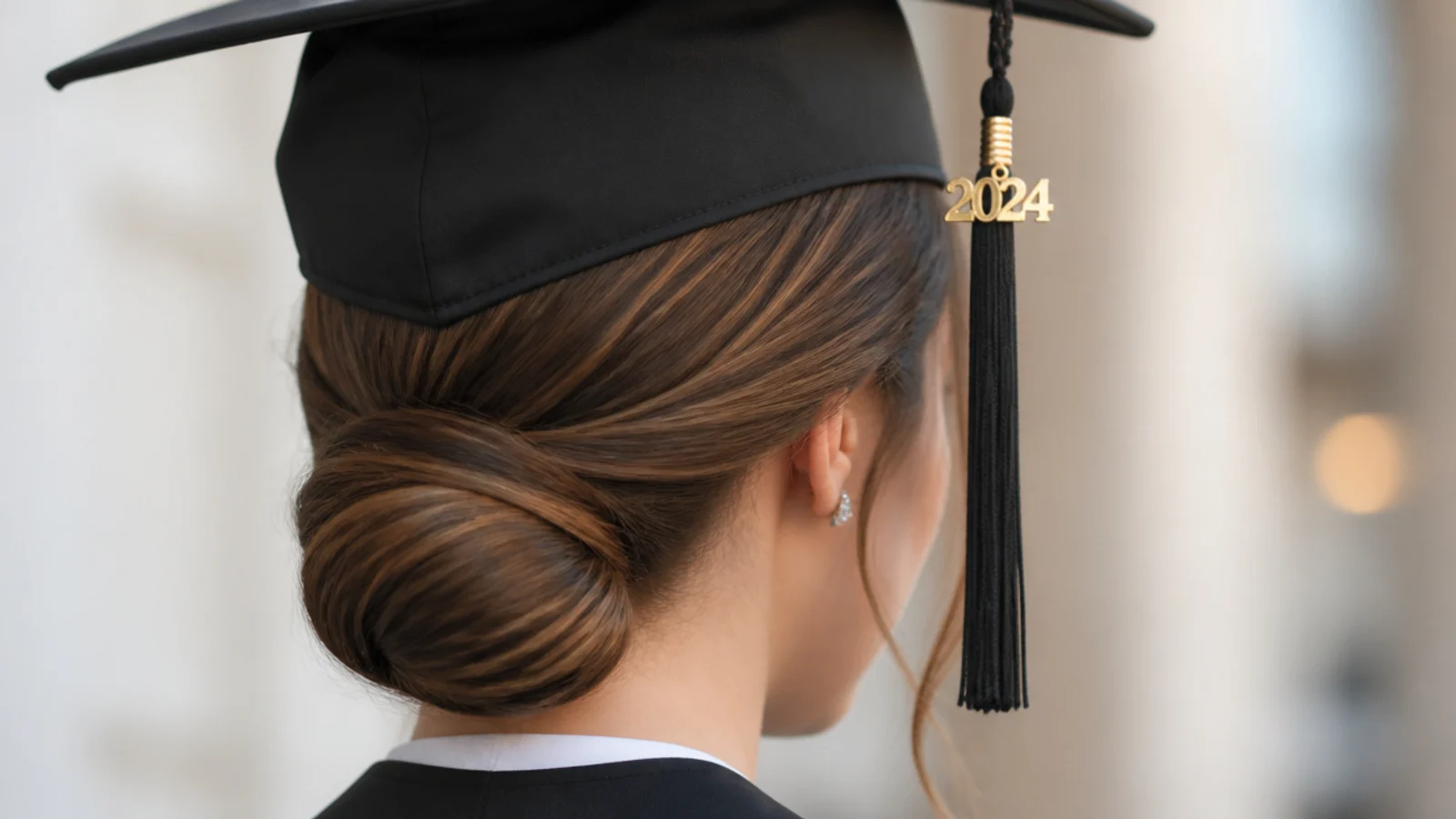
The high ballet bun is the single most common graduation hair mistake, because it sits exactly where the band needs to sit and tips the cap backward within ten minutes. Drop the same bun two inches, to the crease where your skull curves in above the nape, and it becomes one of the most cap-stable styles there is. Smooth with a boar bristle brush and a pea of shine serum, wrap the ponytail into a doughnut and pin the perimeter. Twelve minutes, and it photographs crisply against a dark gown.
Who it suits: Straight or blown-out hair, minimalist looks, statement earrings.
Tip: Leave two face-framing pieces out so the front does not read severe once the cap covers the crown.
7. Half-Up Half-Down With a Flat Pinned Crown: The In-Between Pick
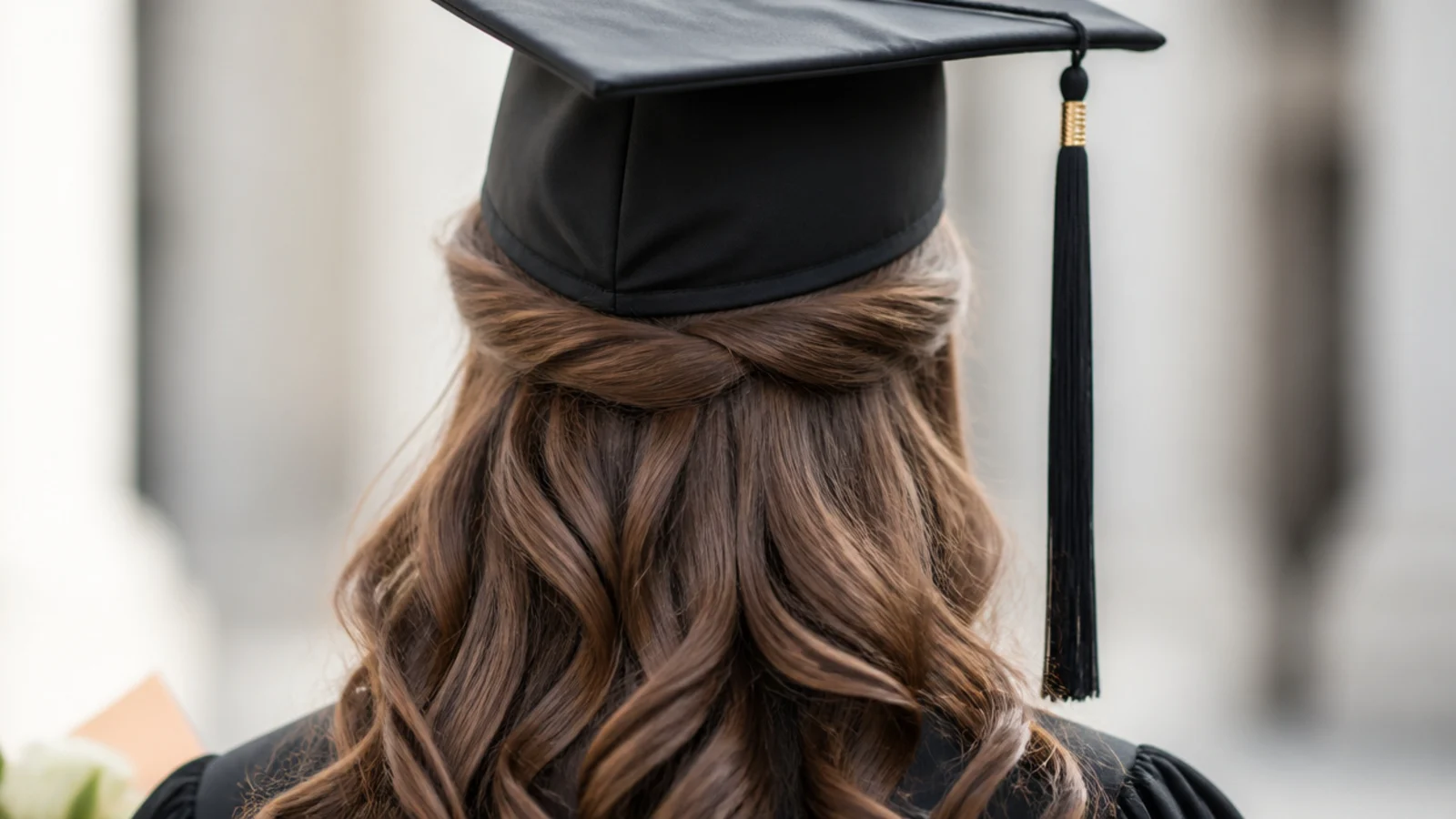
The honest answer to updo vs down for most graduates. Take the section from temple to temple, twist it back and pin it flat against the head rather than gathering it into a puff. Flat is the whole trick: a bouffant half-up fights the band, a flat one disappears under it. You keep your length visible in photos while the front stays off your face for four hours. Two crossed bobby pins at the join plus one each side. Ten minutes plus curling time, and it is the easiest style to repair mid-day.
Who it suits: Almost everyone with shoulder-length or longer hair; the default if you cannot decide.
Tip: Set the cap over the pinned join, not in front of it, so the band hides the hardware.
8. Half-Up Bubble Ponytail Below the Cap Band: The Playful Middle Pick
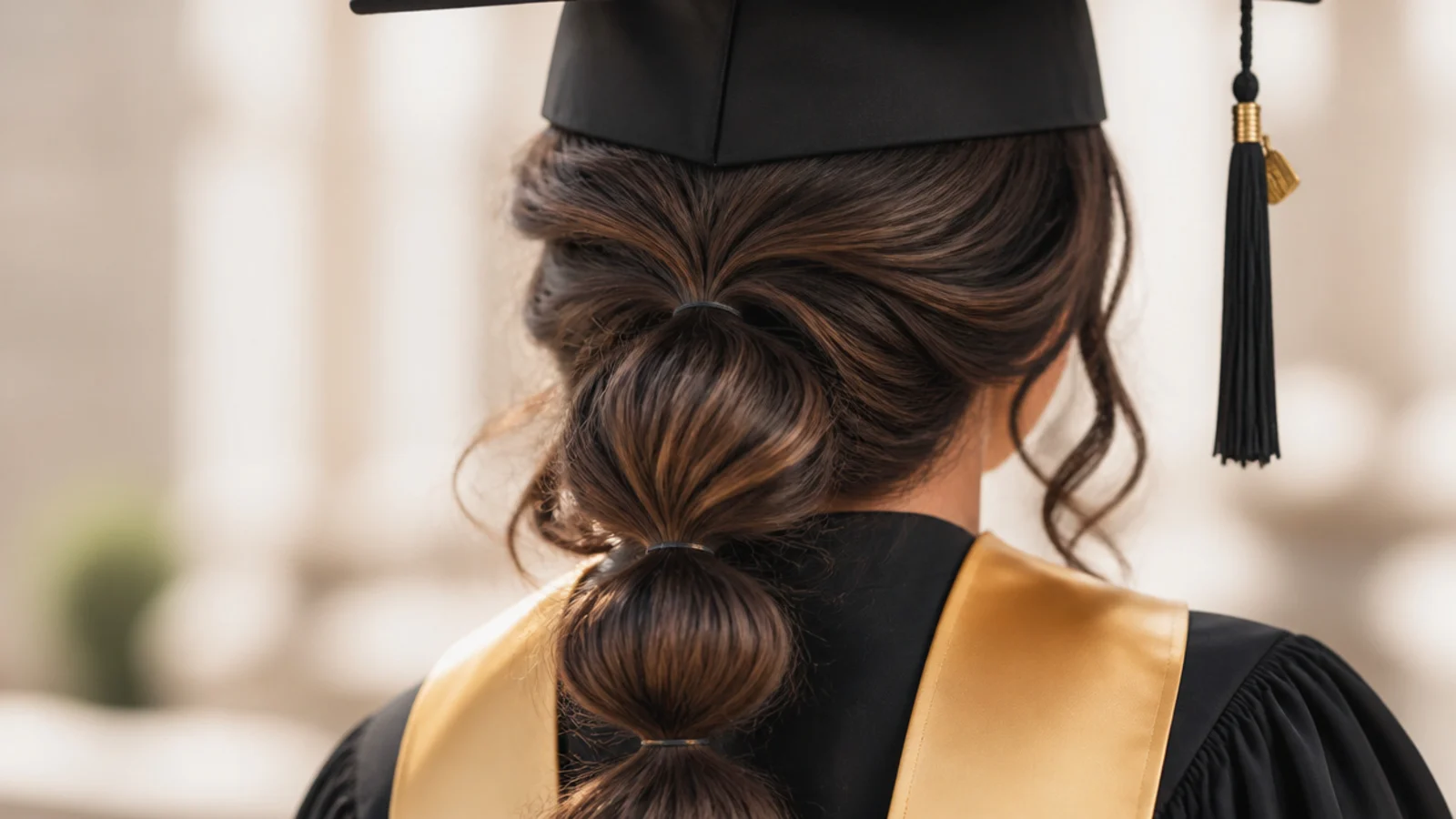
Gather the top half at the back of the head, secure it low, then add clear elastics every two inches down the tail and tug each segment outward into a bubble. The bubbles start below the band, so they add visible interest exactly where the cap is not covering anything. It reads younger and more celebratory than a chignon, which suits high school ceremonies, and the segmented structure holds far better than a plain half-up tail across a long afternoon. About 12 minutes.
Who it suits: High school graduates, medium to long hair, anyone who wants photos that do not look bridal.
Tip: Use five clear elastics, not three; more segments means less droop by the third hour.
9. Side-Swept Hollywood Waves Over One Shoulder: The Down Pick for Photos
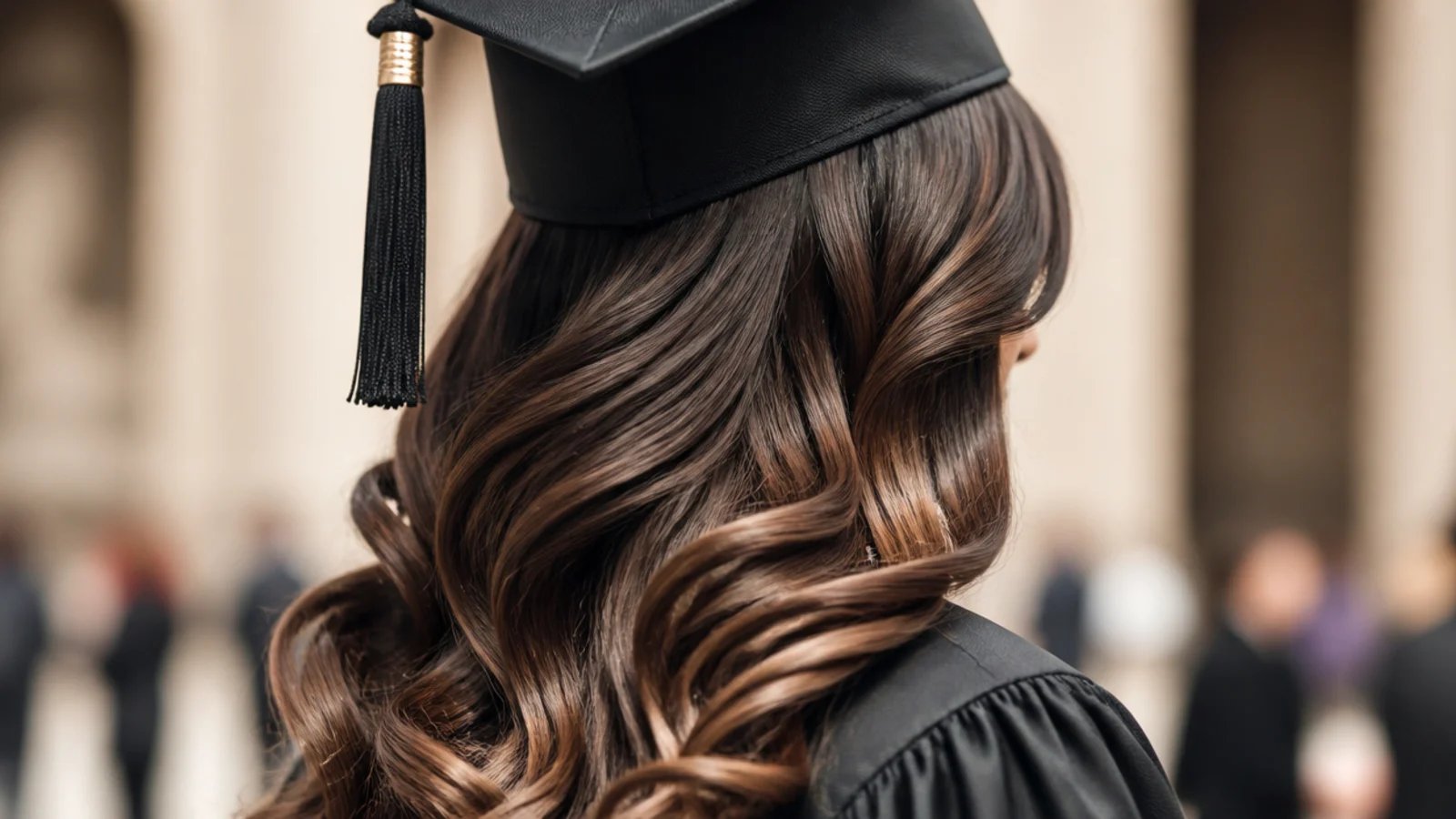
The strongest case for wearing it down. Deep side part, all the length brought forward over one shoulder, waves set with a 1.25-inch iron and brushed out soft with a paddle brush. The cap sits on a smooth crown while the entire style lives at chest level, which is why it survives untouched. It also solves the black-gown problem: the waves occupy one half of the frame and the cap the other, so nothing blends together. Roughly 25 minutes including curling. See more in old Hollywood waves.
Who it suits: Long and medium-long hair, off-shoulder and wide necklines, indoor ceremonies.
Tip: Let every curl cool for a full ten minutes before the cap goes on, or the shape drops flat.
10. Loose Beach Waves on Shoulder-Length Hair: The Down Pick for Easy
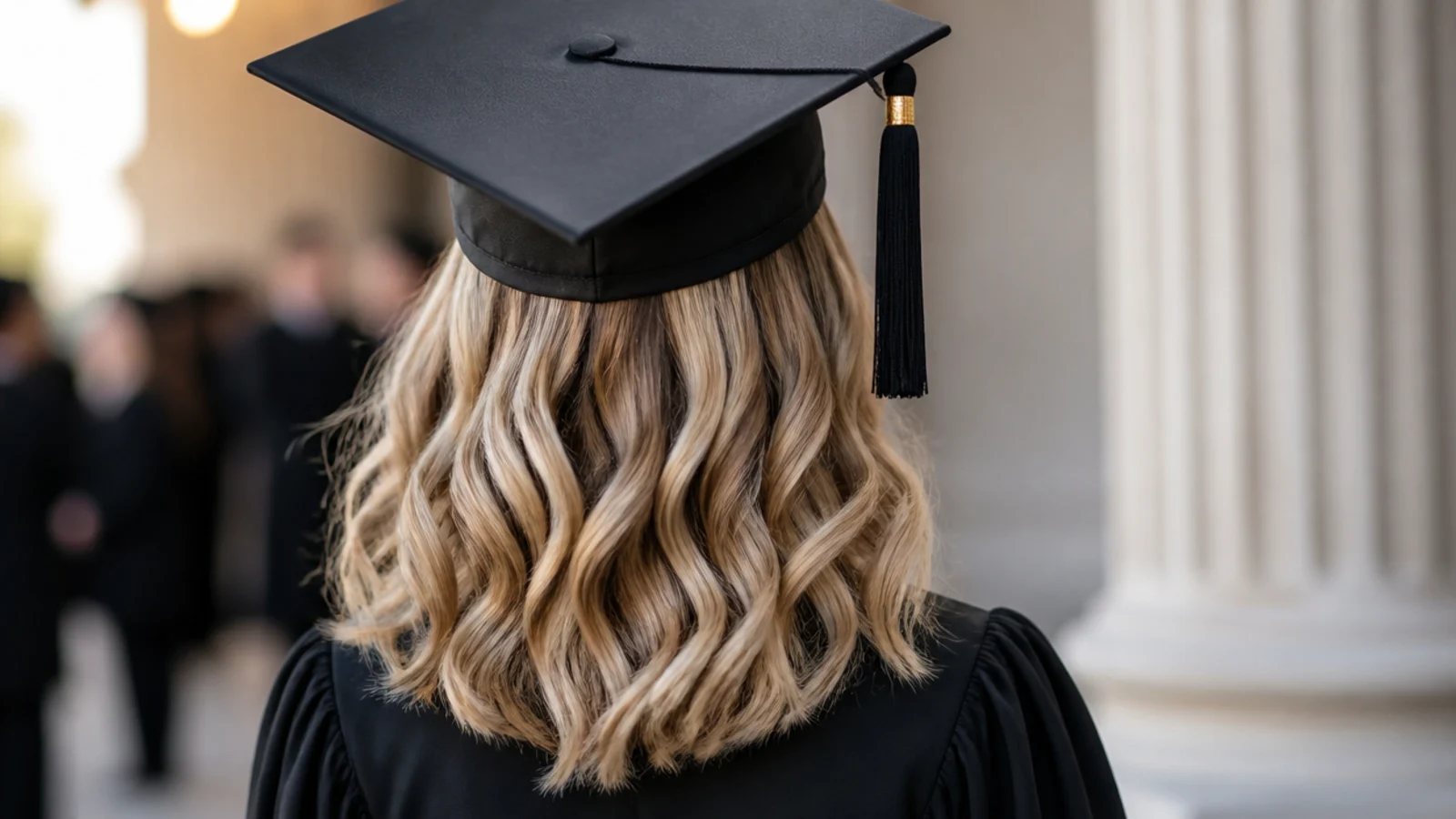
Shoulder length is where down styles perform best, because the hair is long enough to read as a style and short enough that its weight never drags the cap. Wave the mid-lengths and ends only with a 1-inch iron, alternating directions, and leave the top three inches straight so the crown stays flat under the band. Scrunch a texture spray through the ends and stop touching it. Fifteen minutes, or zero heat if you set it overnight. See overnight heatless curls.
Who it suits: Shoulder-length hair, casual outdoor ceremonies, anyone short on time.
Tip: Skip product entirely at the crown so the dent lifts with plain water instead of setting greasy.
11. Blunt Bob Worn Straight and Down: The Down Pick for Short Hair
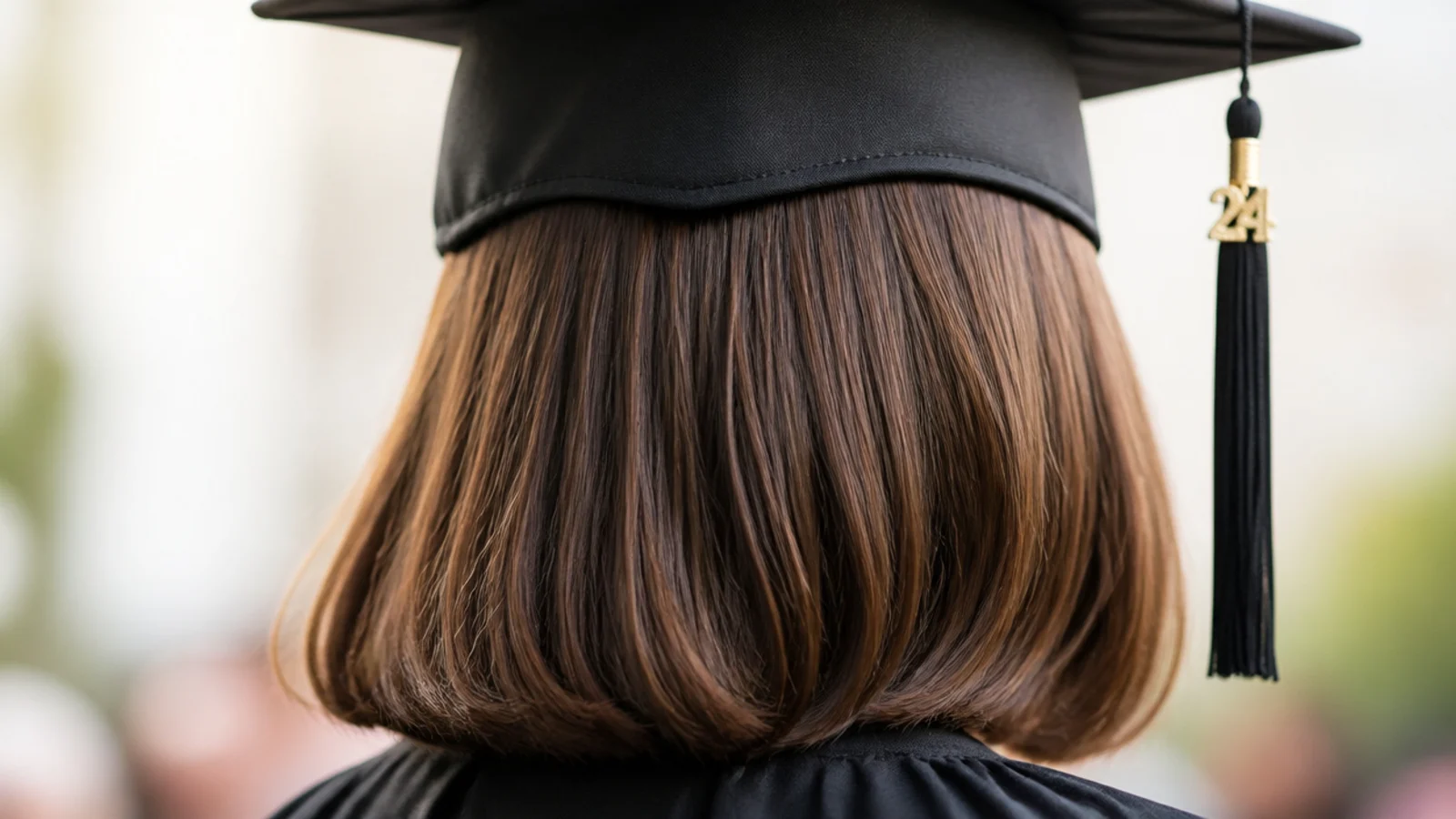
On a chin-length bob there is barely an updo option, so the comparison collapses and down wins by default. Flat iron in one pass, then bend only the last inch of each end outward with the iron so the shape flares at the jaw instead of collapsing into the neck. The cap hides the crown entirely, which means every bit of visual interest has to happen at the jawline. Ten minutes. More at graduation hairstyles for short hair.
Who it suits: Chin to collarbone bobs, pixies growing out, anyone with too little length to pin.
Tip: Anchor the cap with two crossed pins behind each temple, since a bob gives the band nothing to grip.
12. Deep Side Part With a Money Piece: The Down Pick for Highlighted Hair
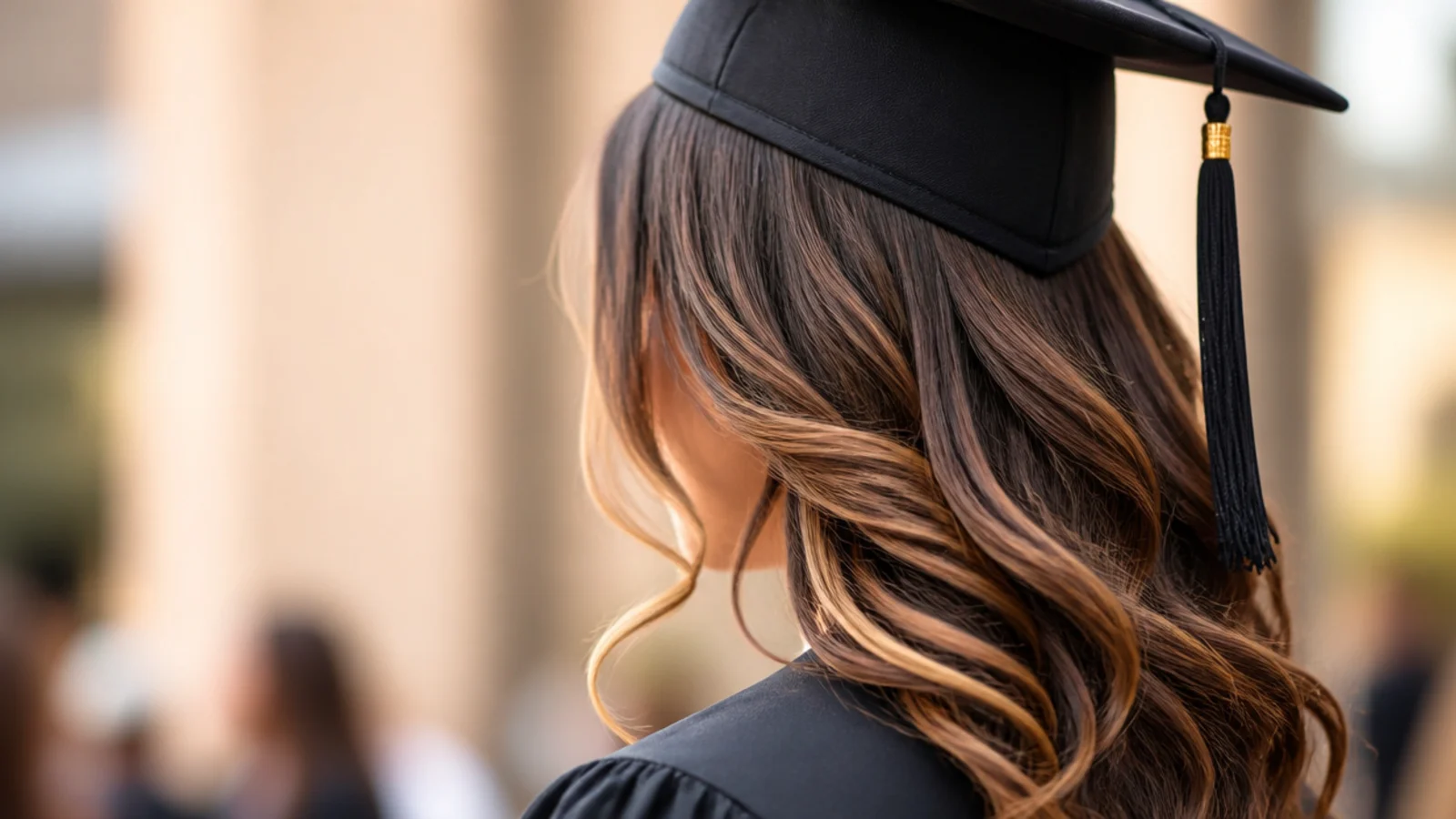
If you paid for face-framing highlights, an updo hides most of them under a board. A deep side part with the lightened front pieces swept across and left down puts the brightest hair exactly where the camera looks, at the cheekbone, below the band line. Straighten or lightly wave the rest so the contrast stays clean. This is the one genuine reason to choose down over up regardless of weather. Twelve minutes. See money piece ideas for brunettes.
Who it suits: Anyone with balayage, a money piece or a color that lives at the front.
Tip: Set the part before the cap goes on, then never comb it again; the band flattens a fresh part.
13. Defined 3B Curls Worn Down: The Down Pick for Curly Hair
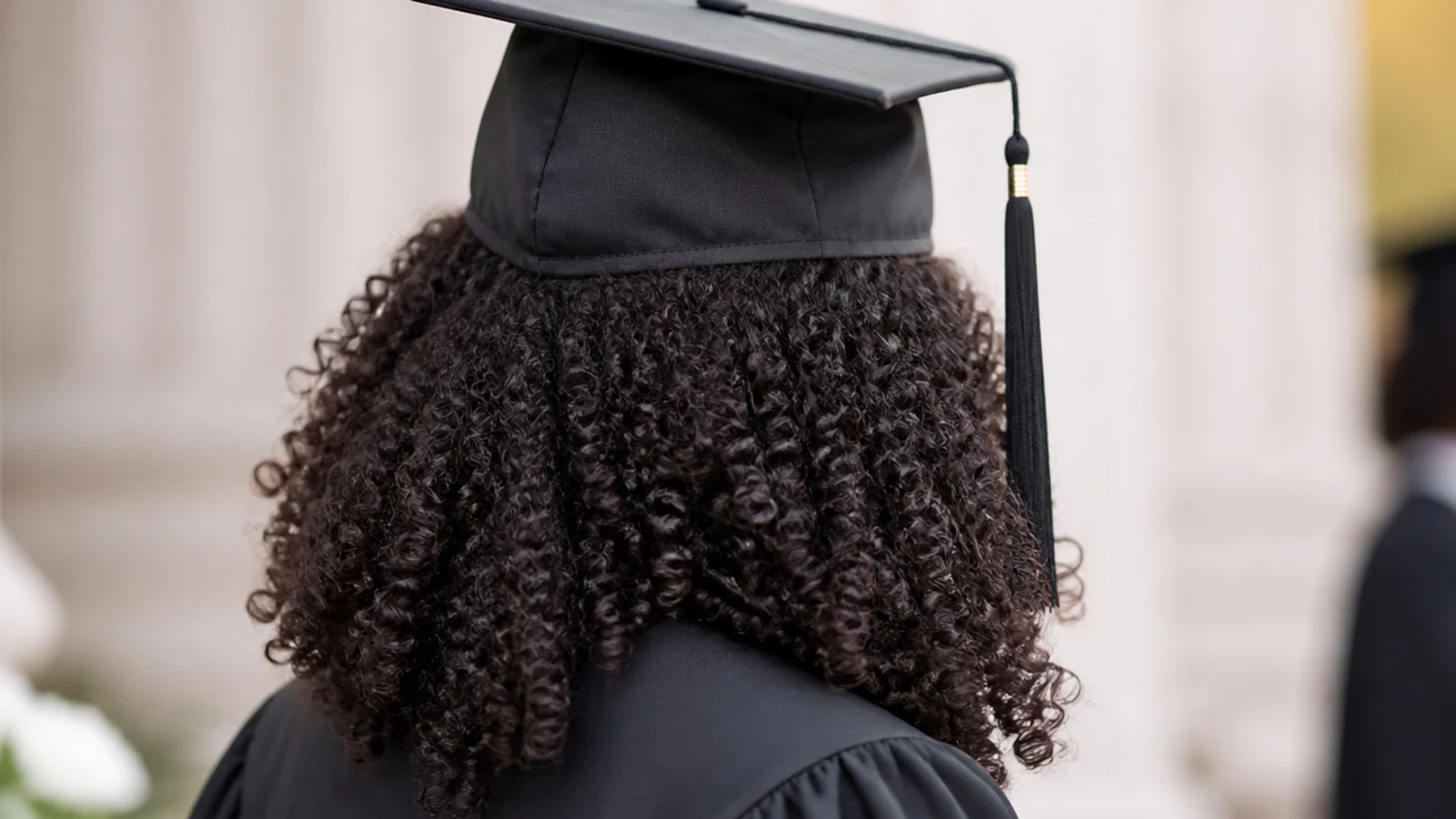
Curls handle a cap better than straight hair does, because the crown compresses and springs back rather than creasing. Diffuse on low speed with the roots clipped, use a light gel cast and scrunch it out only once the hair is fully dry. Push all the volume to the sides and below the ears, not upward, so the band has a flat landing zone. Carry a pick in your clutch and lift from underneath before photos. About 30 minutes wet to dry. More at graduation hairstyles for curly hair.
Who it suits: Type 2C through 3C curls, natural texture, outdoor ceremonies where a bun would feel hot.
Tip: Refresh with water in a spray bottle, never with more product, or the ends turn stringy by hour three.
14. Knotless Braids Worn Down: The Down Pick for Protective Styles
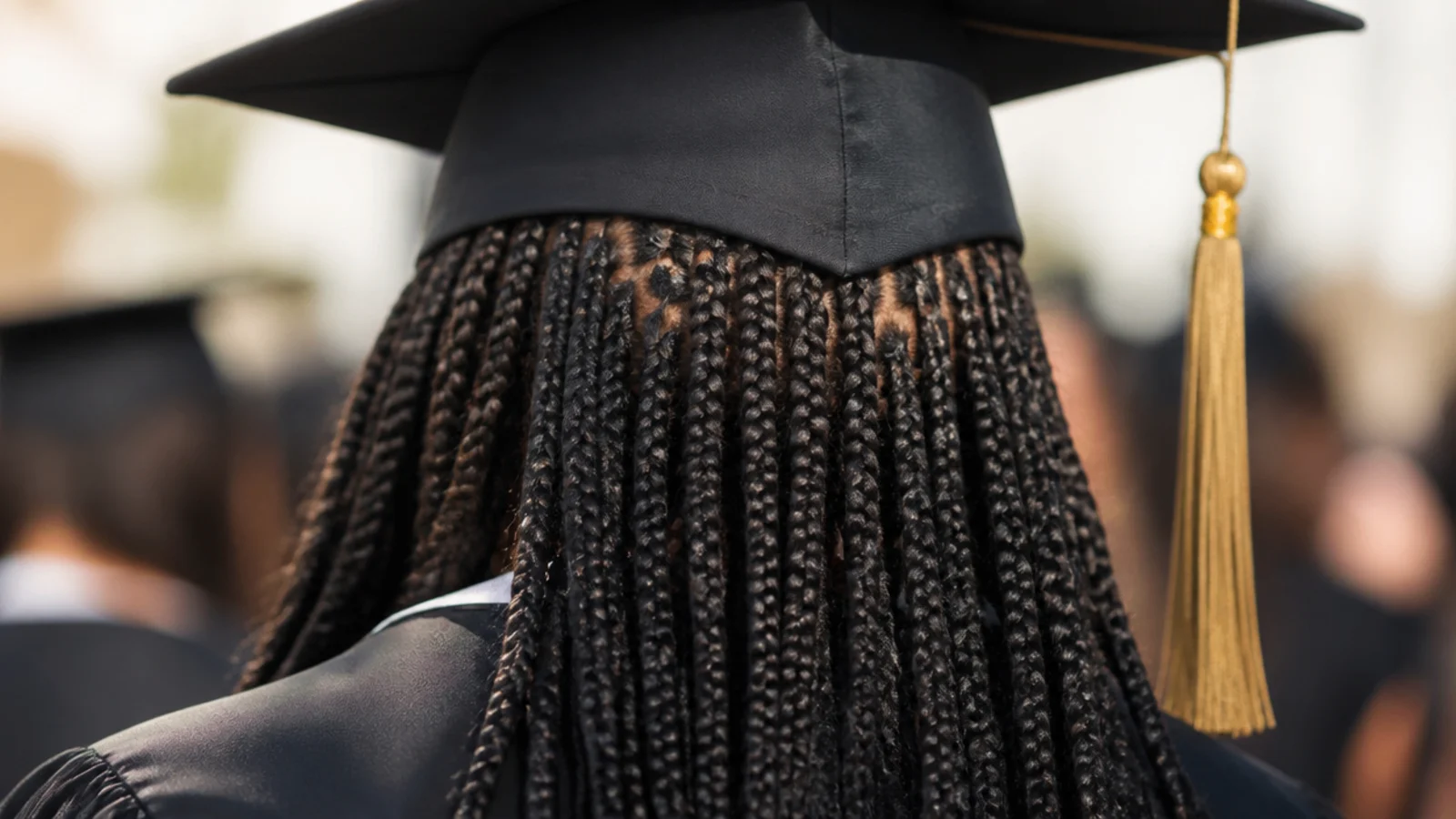
Knotless braids lie flat at the scalp with no bulky knot at the root, which is exactly what a cap band needs. Worn down they carry no dent risk at all and look the same at hour four as at hour one. Timing matters more than styling: install them five to seven days before, not the day before, because a fresh tight install plus four hours of band pressure is genuinely painful. Half of the length can be swept behind one shoulder for photos. See butterfly locs ideas for a softer alternative.
Who it suits: Type 4 textures, anyone in a protective style, long ceremonies in heat.
Tip: Ask for a slightly looser perimeter at the hairline so the band does not press on new tension.
15. Half-Up Crown Braid With Length Left Down: The Hybrid Pick for Long Hair
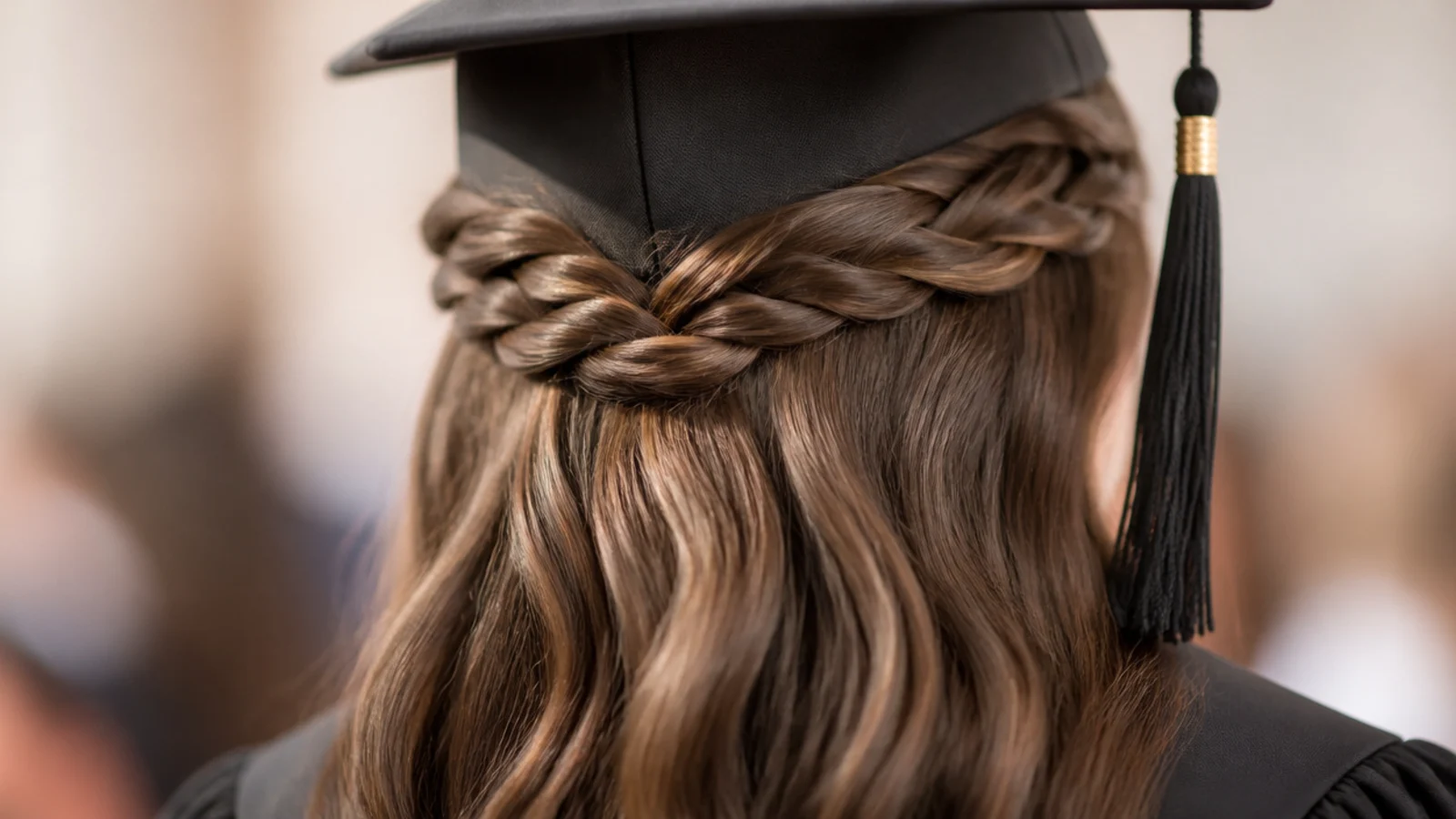
A Dutch braid worked from one ear around the back and pinned above the opposite ear, with all the length left loose beneath it. The critical adjustment is height: a standard crown braid sits precisely where the mortarboard front edge lands, so drop yours a full inch and the conflict disappears. You get the structure and hold of an updo at the top and the movement of a down style below. Twenty minutes with practice. See graduation hairstyles for long hair.
Who it suits: Long and very long hair, anyone who wants both looks in one style.
Tip: Pancake the braid outward at the sides only, so the volume lands where the cap does not reach.
Updo vs Down Under the Graduation Cap: Where the Band Lands
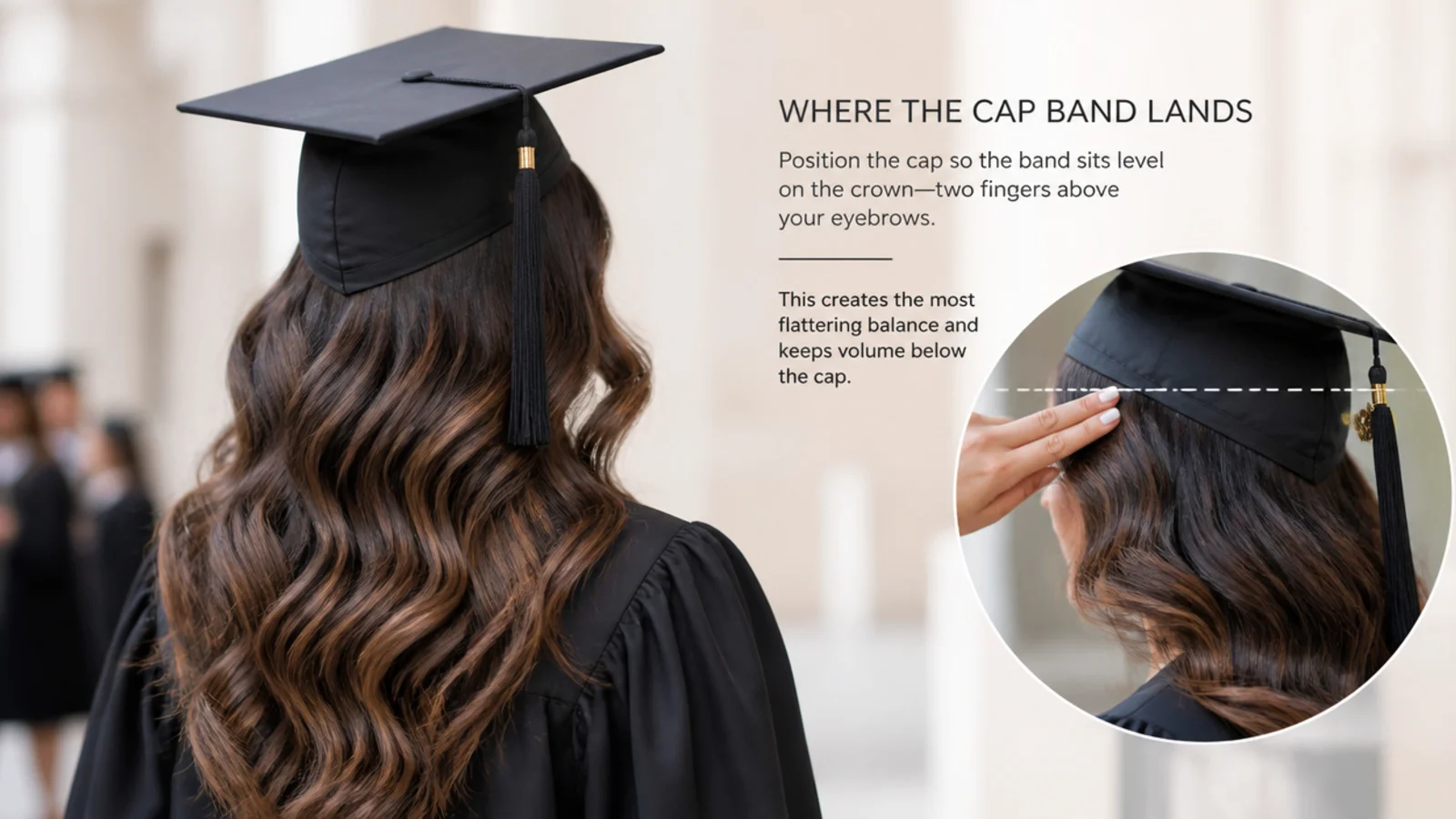
Before you weigh updo against down on style, settle the physical question. A mortarboard is a flat board on a fitted band, and the band is built to sit level with the floor, which puts the front edge about two fingers above your eyebrows and wraps the head at that same height all the way around. Put your actual cap on right now and mark that line with your fingers in the mirror. Everything above it is dead space for four hours. Everything below it is where your hairstyle has to live. Read that way, the updo vs down debate stops being about formality. A low chignon and a set of side-swept waves both pass, because both sit under the line. A high topknot and a bouffant half-up both fail, because both occupy the volume the band needs, so the cap rides up at the front and slides backward. The two crossed bobby pins that anchor a cap hook under that band on each side, which means you also need a little hair at the temples that is not gelled slick. More on placement in graduation hairstyles with cap.
Updo vs Down for Graduation Photos
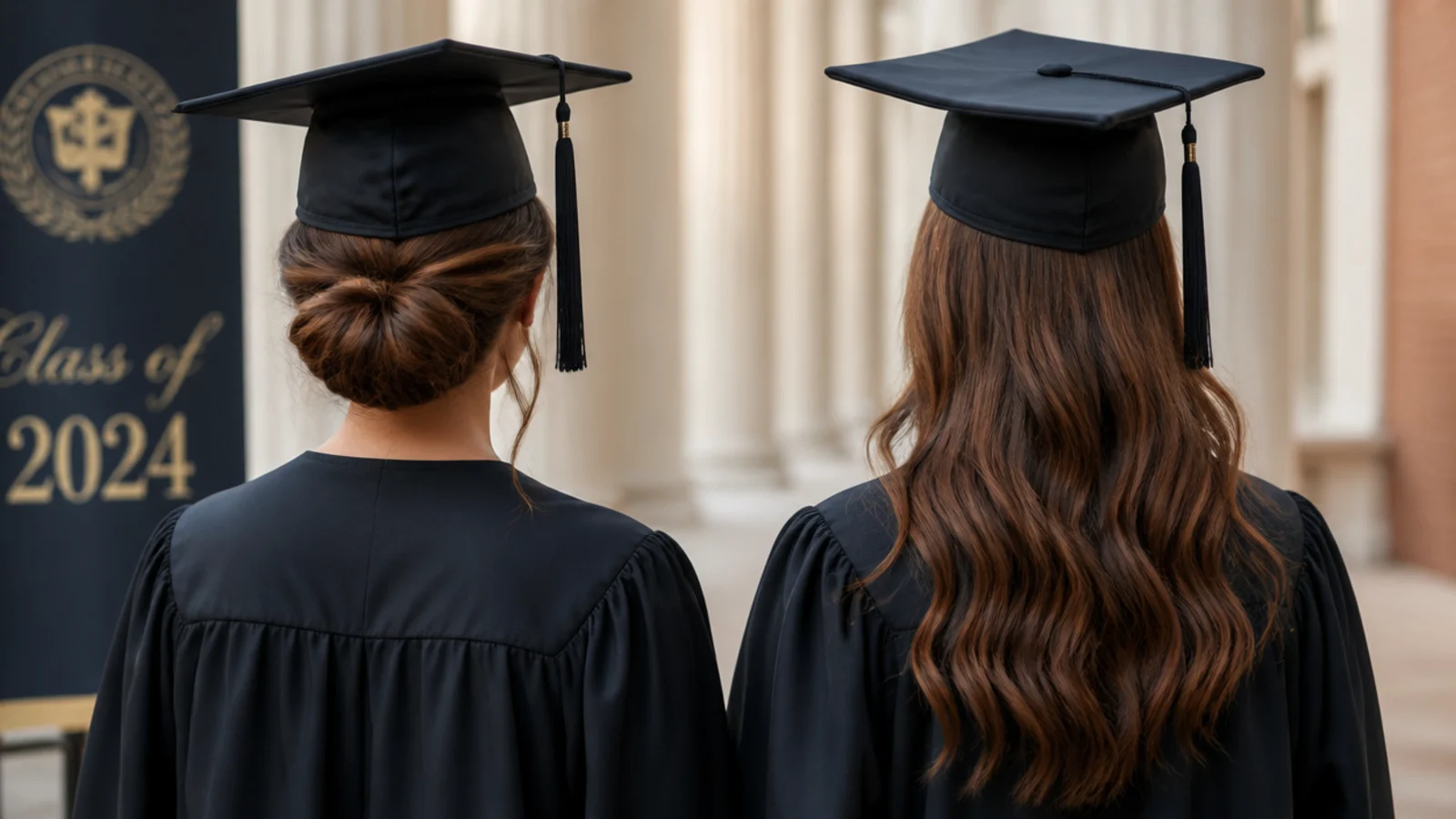
Graduation photos are unusually hostile to hair. You are wearing a matte black or dark gown, standing under a gym ceiling or bright outdoor sun, and half your head is covered by a board. Structured shapes survive that; loose ones sometimes do not. A low bun or French twist keeps a clean outline against the gown, so the photo reads as a person with a defined jaw and neck. Dark hair worn straight down against a dark gown can lose its edges entirely and photograph as one shadow, which is the single most common complaint after the fact. The fix is not to abandon down styles, it is to give them texture and direction. Waves catch light where straight hair does not, and sweeping everything over one shoulder puts the hair and the cap in different halves of the frame instead of stacking them. Volume at the sides and the back also photographs better than volume on top, since the crown is hidden anyway. If your color lives at the front, down wins outright: an updo buries a money piece under a board.
Which Holds Better for a Four-Hour Ceremony
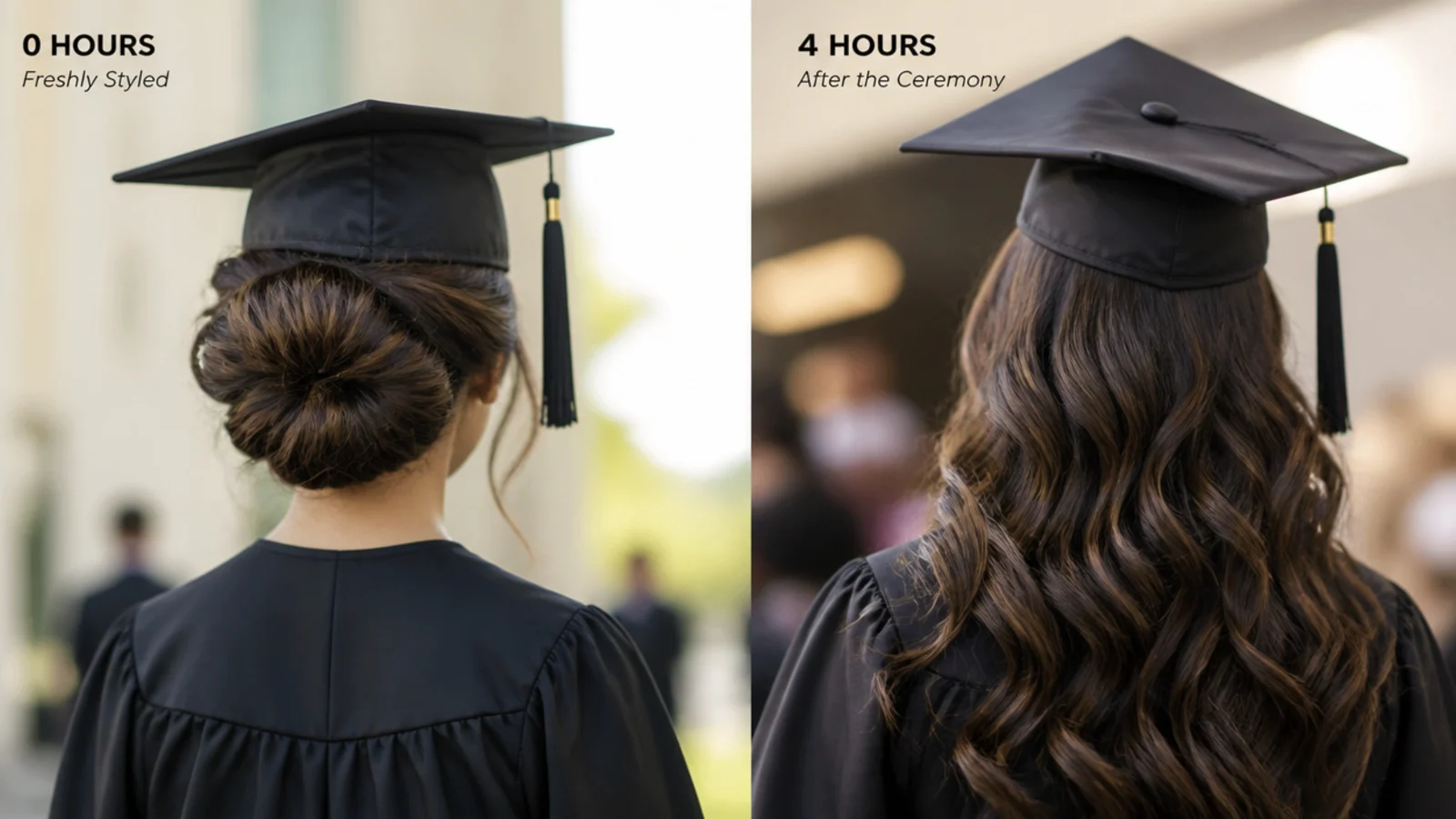
Ceremonies run long. Between lining up, the processional, speeches, name reading and the recessional, four hours from styling to first photo is normal, and that is the real test. Updos win this outright. Once hair is pinned and coiled it has nowhere to go, so hour four looks like hour one. Braided updos win hardest, because a plaited strand physically cannot swell in humidity. Down styles are working against gravity and moisture the whole time: curls set with an iron drop, waves relax, and a spring outdoor ceremony expands loose hair the moment the doors open. Two things move the odds. Let curls cool completely for ten minutes before the cap goes on, since a warm curl crushed under a band sets flat, and use a flexible-hold hairspray rather than an extra-strong freeze formula. Stiff spray locks hair into whatever shape the cap presses it into, so the crease becomes permanent for the day. Flexible hold lets hair recover. For a genuinely heatless set, see overnight heatless curls for long hair.
Updo vs Down Graduation Hair by Hair Length
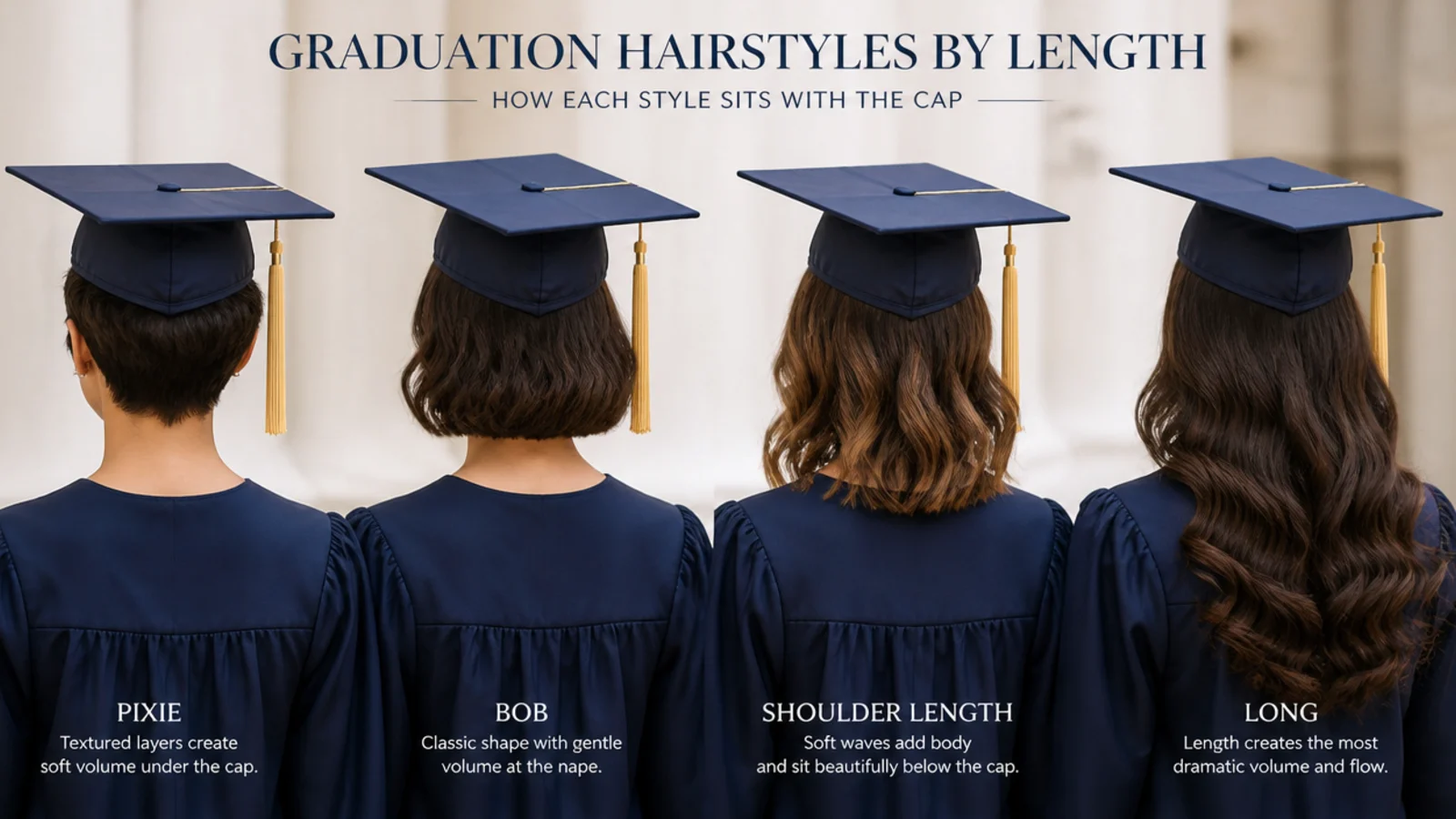
Length settles the argument faster than anything else. On a pixie or a crop there is no updo to have, so the question becomes anchoring rather than styling: two crossed bobby pins behind each temple give the band something to hook under, and a matte paste keeps the front piece standing. On a chin-length bob the cap covers the crown completely, so down wins and all the interest has to happen at the jawline, with the ends bent outward rather than the roots lifted. Shoulder length is the only zone where both sides genuinely compete, which is why half-up styles are so popular there. Long and very thick hair flips the answer back to up, and for a reason nobody warns you about: mass. A heavy bun or braid hanging at the back slowly drags the mortarboard backward across a long ceremony until it is sitting on the back of your skull in every photo. The fix is to bring the weight forward over one shoulder if you are wearing it down, or pin the bun upward toward the scalp rather than letting it hang. See graduation hairstyles for long hair and short hair for length-specific picks.
Cap-On to Cap-Off: What Each Looks Like After the Reveal
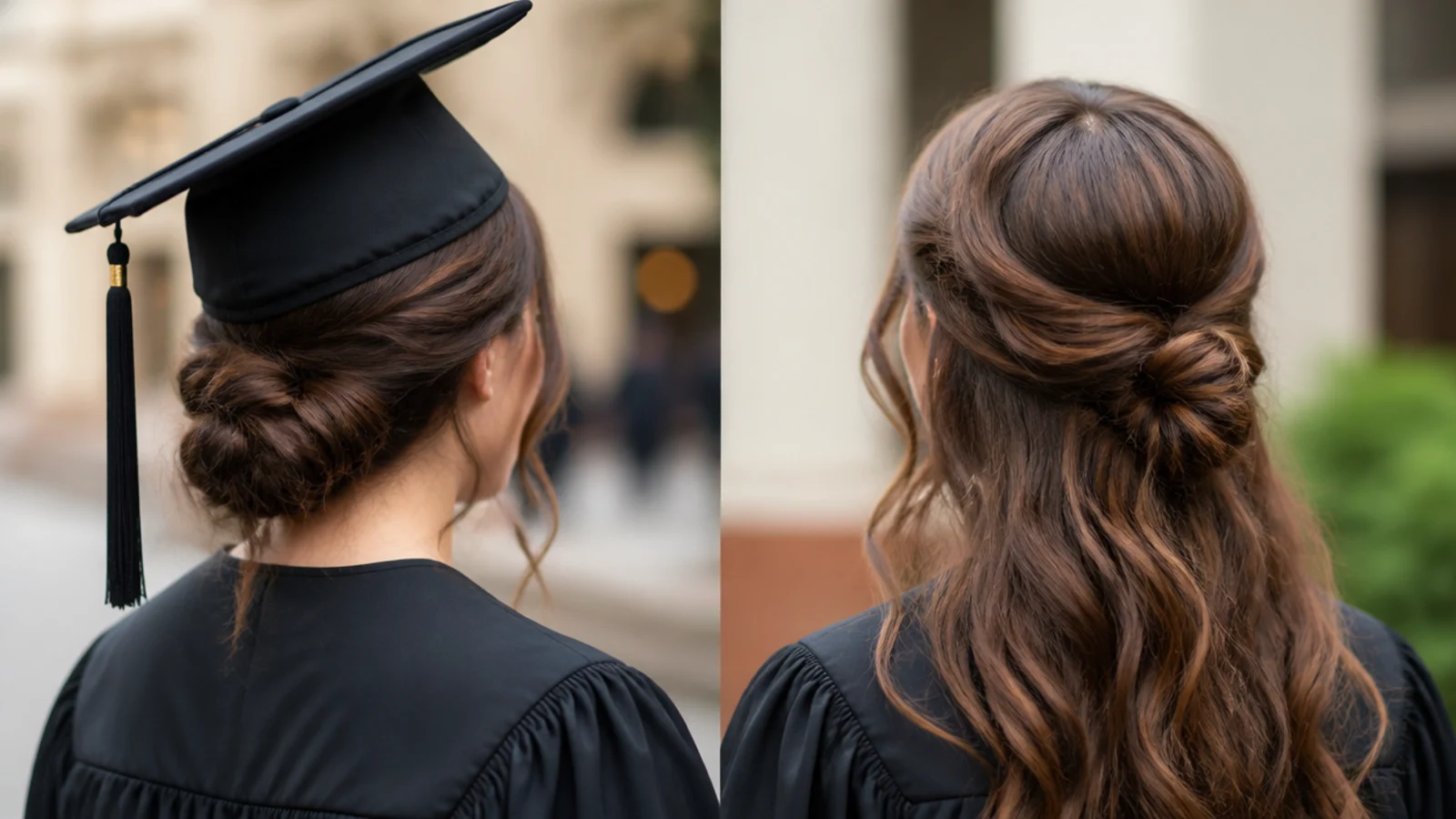
Most graduates take the cap off within minutes of walking out, and almost every photo their family keeps is taken after that. Nobody writes about it, and it is arguably the strongest argument in the whole updo vs down comparison. An updo is unchanged. The cap never touched it, so what you pinned at 8am is what you have at 2pm, and you can walk straight into the photo line. Hair down has a reveal problem: a visible ring-shaped crease across the crown where the band sat, and flat roots underneath it. The recovery is quick if you plan for it. Mist plain water directly onto the crease, flip your head forward, finger-comb from the roots and let it air dry upright for two or three minutes. Do not brush, because brushing spreads the flatness across the entire crown instead of lifting it. Curly hair skips most of this, since coils rebound on their own; lift from underneath with a pick rather than from the top. Keep product off the crown entirely so water can do its job.
Timing the Morning Of: How Long Each One Actually Takes
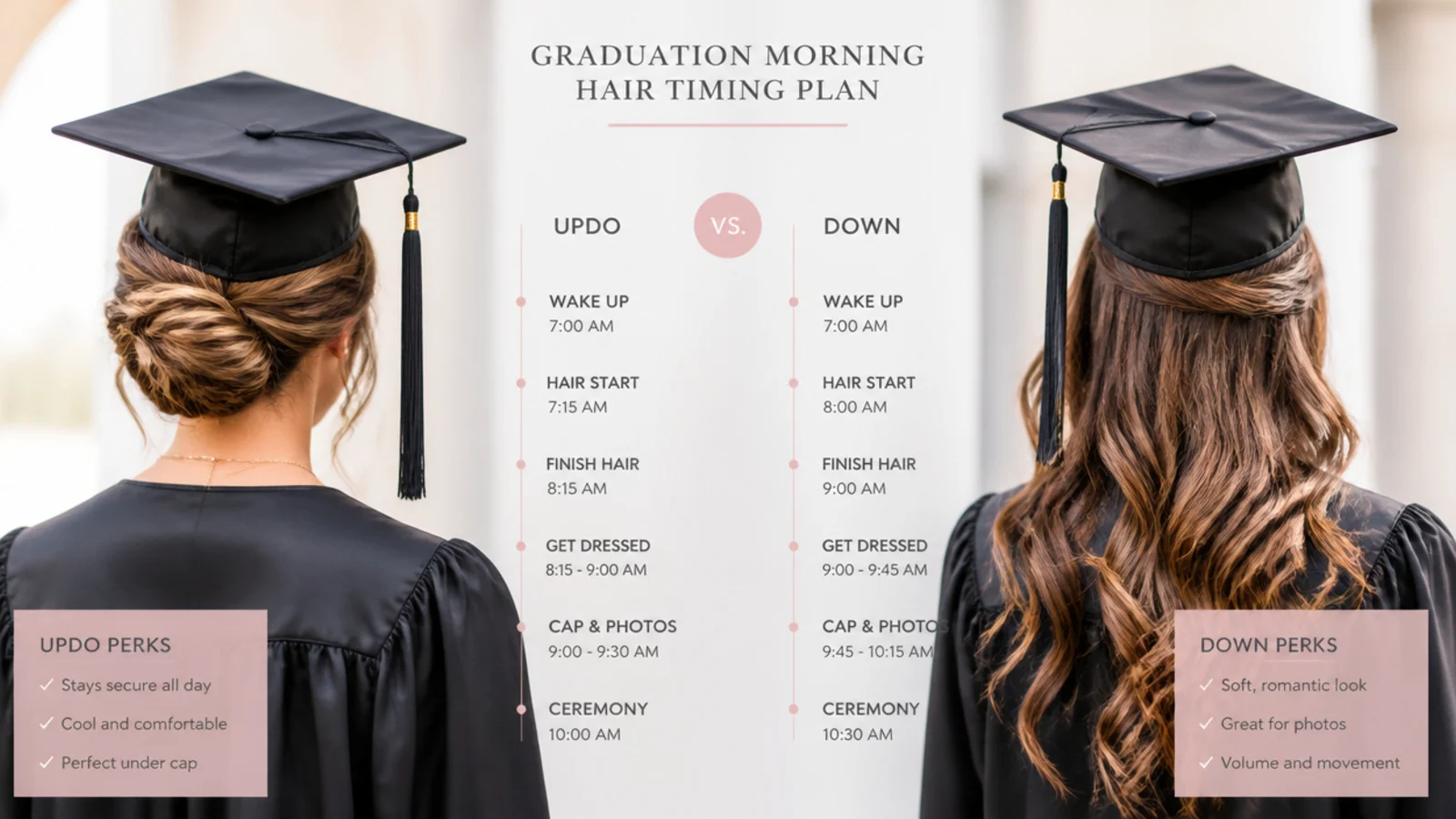
Style one to two hours before the ceremony, not the night before, unless the style is braided. Braids are the single exception; they hold overnight and day-two braid texture usually looks better than a fresh one. Everything else has a window. Updos need 12 to 30 minutes of hands-on time depending on complexity, with no cooling period, which makes them the safer choice if your morning is tight or you are sharing a bathroom. Down styles need 10 to 25 minutes of curling plus a full 10 minutes of cooling before the cap goes on, and skipping that cooling window is the most common reason down styles collapse by the processional. Wash the day before rather than the morning of, since freshly washed hair is slippery and pins slide out of it. Do one full practice run with the actual cap three days out, walking and turning your head as you would receiving a diploma. If you are running late on the day itself, easy graduation hairstyles has the under-ten-minute options.
Frequently Asked Questions
Should I go for an updo or wear my hair down on graduation day?
Choose an updo if your ceremony is outdoors, humid, longer than two hours, or if your hair is thick and heavy. Choose down if you are indoors, have a bob or defined curls, or have face-framing color an updo would hide. If you cannot decide, a half-up style pinned flat gives you the hold of an updo at the crown and the length of a down style in photos.
Is an updo better under a graduation cap?
Usually yes, but only if it is low. A bun at or below the occipital bone gives the cap band a flat, stable surface and eliminates dent risk entirely. A high bun or topknot is worse than wearing your hair down, because it sits exactly where the band needs to sit and pushes the cap backward until it slides off. Height, not the updo itself, is what decides this.
Does hair down look bad in graduation photos?
Not inherently, but straight dark hair against a dark gown can lose its outline and read as one flat shadow. Adding wave texture and sweeping the length over one shoulder solves it, because the hair then catches light and occupies a different part of the frame from the cap. Long loose waves with real texture photograph as well as any updo.
How do you wear your hair down with a graduation cap?
Keep the top three inches flat and untextured so the band has a smooth place to sit, then put all your wave and volume at the sides and below the ears. Anchor the cap with two bobby pins crossed into an X behind each temple. Let curls cool for a full ten minutes before the cap goes on, and skip product at the crown so you can lift the dent with water later.
Will a graduation cap ruin my curls if I wear them down?
It flattens the crown, it does not ruin the style. Type 2 and type 3 curls compress under the band and rebound within a few minutes of the cap coming off. Type 4 coils compress more and need a pick worked from underneath rather than from the top. Clip the roots while diffusing, keep product off the crown, and do not touch the top of your head during the ceremony.
What is the best updo for graduation if I have never done one?
A twisted low rope bun. Split the hair in two, twist each half away from your face, wrap them around each other and pin the coil at the nape with six bobby pins crossed into three Xs. It needs no braiding skill, no reaching awkwardly behind your head, and it takes eight to ten minutes. A French twist looks more polished but takes closer to thirty minutes the first time.
Can I do my graduation hair the night before?
Only if it is braided. Braids hold overnight and often improve. Buns, curls and any set style should be done one to two hours before the ceremony so you have time to fix problems. Sleeping on a bun leaves a flattened, uneven shape, and sleeping on curls set with heat drops them. If you want a heatless overnight option, use a fabric rod set rather than pinning a finished style.
Which lasts longer in humidity, an updo or hair down?
An updo, and braided updos most of all. Humidity works by letting hair swell and rearrange, which pinned and plaited strands physically cannot do. Loose hair at an outdoor spring ceremony will expand and frizz within the first hour no matter what product you used. If you want hair down at a humid outdoor ceremony, a smoothed low ponytail or knotless braids worn down are the two versions that survive.
How many bobby pins do I need for graduation hair?
Budget six to ten pins for an updo plus two crossed pins per side for the cap itself, so ten to fourteen total. For hair worn down you only need the four cap pins. Use pins that match your hair color, since part of each cap pin stays visible under the band, and pack six spares in your bag for the walk between the ceremony and the photo line.
Which graduation hairstyles look are you saving?
If you want the short version of this updo vs down graduation hair comparison: put the cap on, find the band line, and be honest about your ceremony. Outdoor, humid, long, hot gown, thick hair? Take the updo. Indoor, ninety minutes, a bob or defined curls you love, photos immediately after? Wear it down. Genuinely torn? Half-up pinned flat is not a compromise, it is the style that solves the most problems at once, which is exactly why it dominates real graduation photos. Whichever way you go, do a practice run with the actual cap three days out, use flexible-hold spray rather than a freeze formula, and pack six bobby pins for the walk to the photo line. Browse the rest of the graduation hairstyles hub, read the full 25 graduation hairstyles roundup, or start with easy graduation hairstyles if you are doing this yourself at 6am.