
Quick Comparison
| Jellyfish Haircut | Wolf Cut | |
|---|---|---|
| Layer relationship | Hard disconnection; the bell never touches the length | Fully blended; choppy layers cascade with no break |
| Where the short layer sits | A rounded bell at cheekbone to chin, all the way around | Face-framing and crown layers starting near the cheekbone |
| Best hair textures | Straight and wavy; loose curls with adjustment | Wavy, curly and thick; the choppiness hides shrinkage |
| Best face shapes | Oval and heart; softens a strong jaw from the sides | Round and square; vertical layers break up width |
| Trim cadence | Blunt bell every 6 to 8 weeks or the line goes fuzzy | Every 10 to 12 weeks; softens rather than fails |
| Daily styling | Round brush or flat-iron flick on the bell, 10 to 15 min | Texture spray and scrunch, 5 minutes or air dry |
| Grow-out behavior | A 2 to 3 month awkward phase, then a shag or curtain bangs | Just gets softer and more blended for months |
| Wearing it up | The bell falls out of a ponytail as a heavy half-fringe | Layers escape as face-framing pieces and look intentional |
| Reversibility | Cut a jellyfish into a wolf in one appointment | Wolf to jellyfish means waiting for the layers to grow |
1. The Blunt Jellyfish Bell vs the Shaggy Wolf Crown

The purest side by side. The jellyfish bell is cut with scissors held flat for a solid, unbroken perimeter at about chin level, and the stylist stops there, leaving a visible ledge over the length. The wolf crown is point cut at a steep angle so every layer feathers into the one below it. Same starting length, opposite finish: one reads architectural, the other reads windblown. If you want people to notice the haircut, the blunt bell wins every time.
Who it suits: Straight to 2A hair that holds a clean line without frizzing.
Tip: Ask for the bell cut with the head upright, not tipped forward, or the back sits shorter than you asked.
2. Chin-Length Jellyfish Bell vs Wolf Cut Curtain Bangs

Both give you short hair around the face, and that is where the similarity ends. The chin-length bell wraps the whole head, so short hair sits over your ears and at the nape too. Wolf cut curtain bangs split at the center and sweep back toward the cheekbone, leaving the sides long. The bell is the bigger commitment by a wide margin. Curtain bangs at 3 to 4 inches are the low-risk way to test whether you like short hair near your face before committing to a full disconnection.
Who it suits: First-timers who want the vibe without the back-view surprise.
Tip: Try the curtain bangs first, live with them 6 weeks, then decide on the bell.
3. Jellyfish vs Wolf Cut on Fine Straight Hair
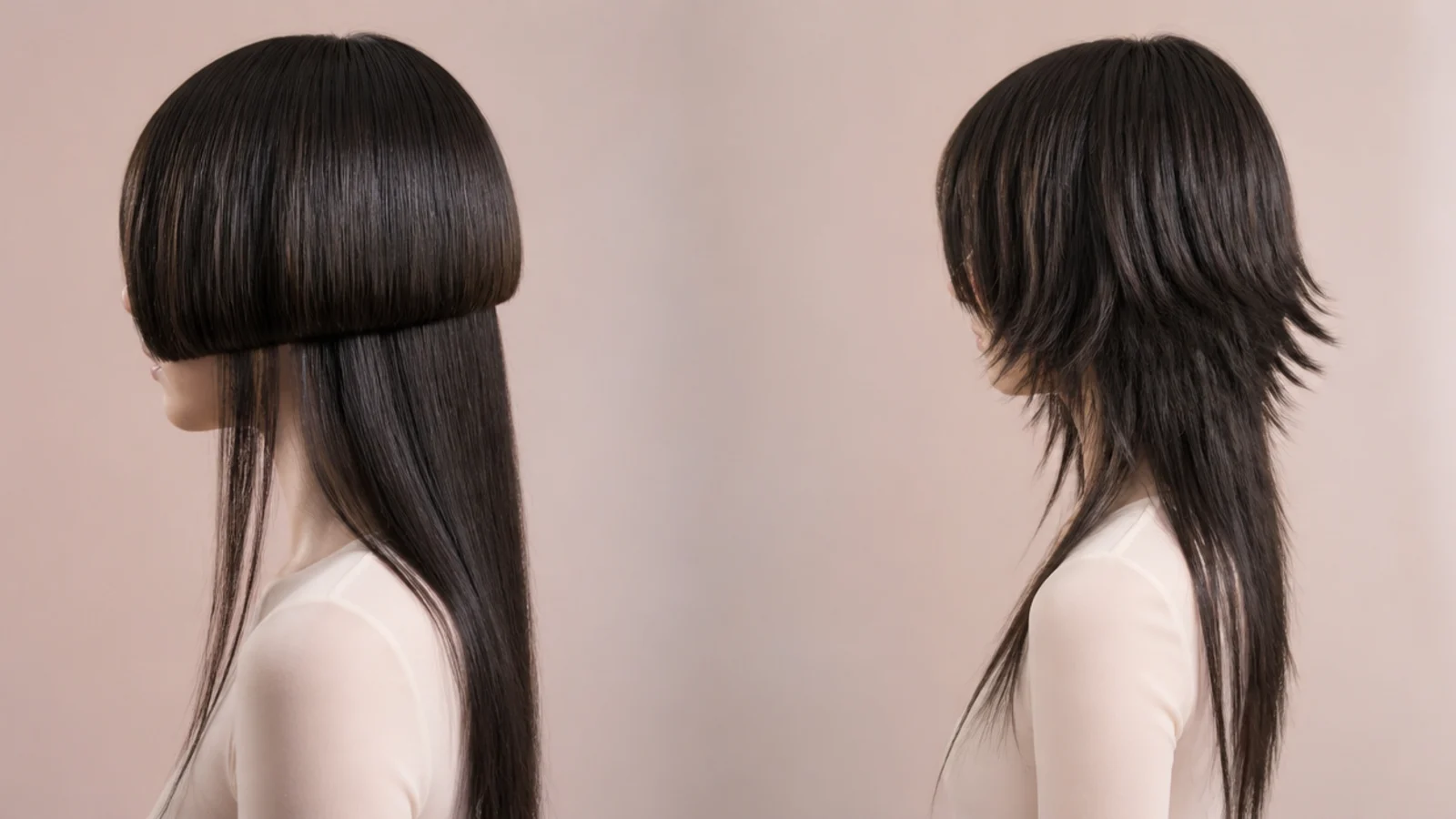
Fine hair has a limited amount of weight and a wolf cut spends all of it. Heavy internal layering on fine strands leaves see-through ends and a crown that collapses by lunchtime. The jellyfish does the opposite: a blunt bell concentrates all your density into one solid shape, so fine hair suddenly looks thick from the front and from behind. Keep the lengths underneath blunt too, no layers, and the contrast between two dense sections is what carries the look.
Who it suits: Fine, low-density straight hair that goes limp with layers.
Tip: Say no thinning shears, no razor, blunt perimeter on both sections.
4. Jellyfish vs Wolf Cut on Thick Coarse Hair
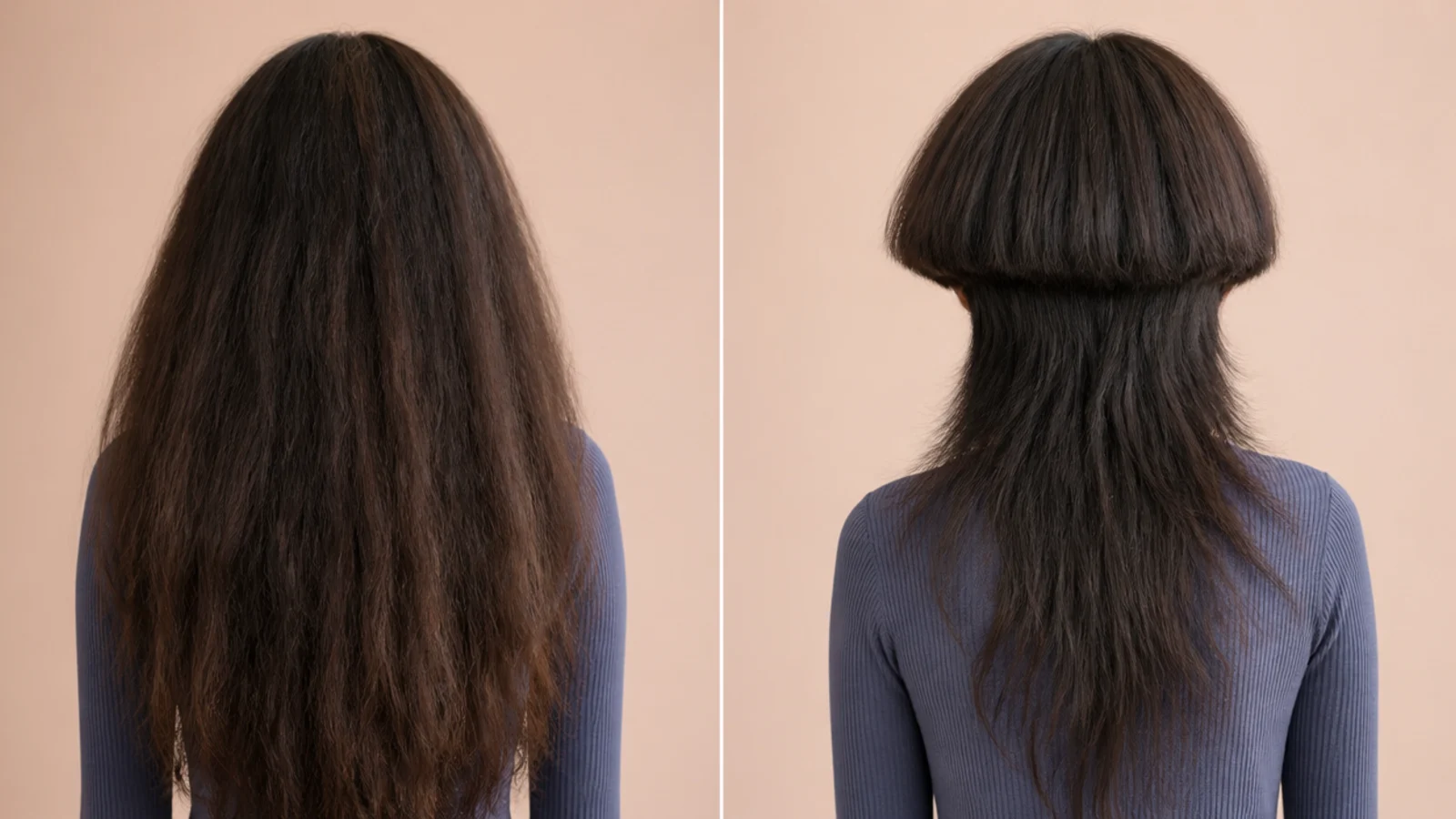
Thick coarse hair is the wolf cut's home ground. All that internal layering removes bulk, stops the triangle silhouette and lets the shape sit close to the head. A jellyfish on the same hair often flares: a solid bell of dense hair wants to stick out horizontally at the sides rather than curve under, so you get a mushroom. If you love the jellyfish anyway, the fix is invisible internal thinning on the underside of the bell only, keeping the outline blunt while removing weight where nobody sees it.
Who it suits: Dense, coarse hair with a wide natural silhouette.
Tip: Ask for weight removed from the underside of the bell, outline left blunt.
5. Jellyfish vs Wolf Cut on 2B Waves
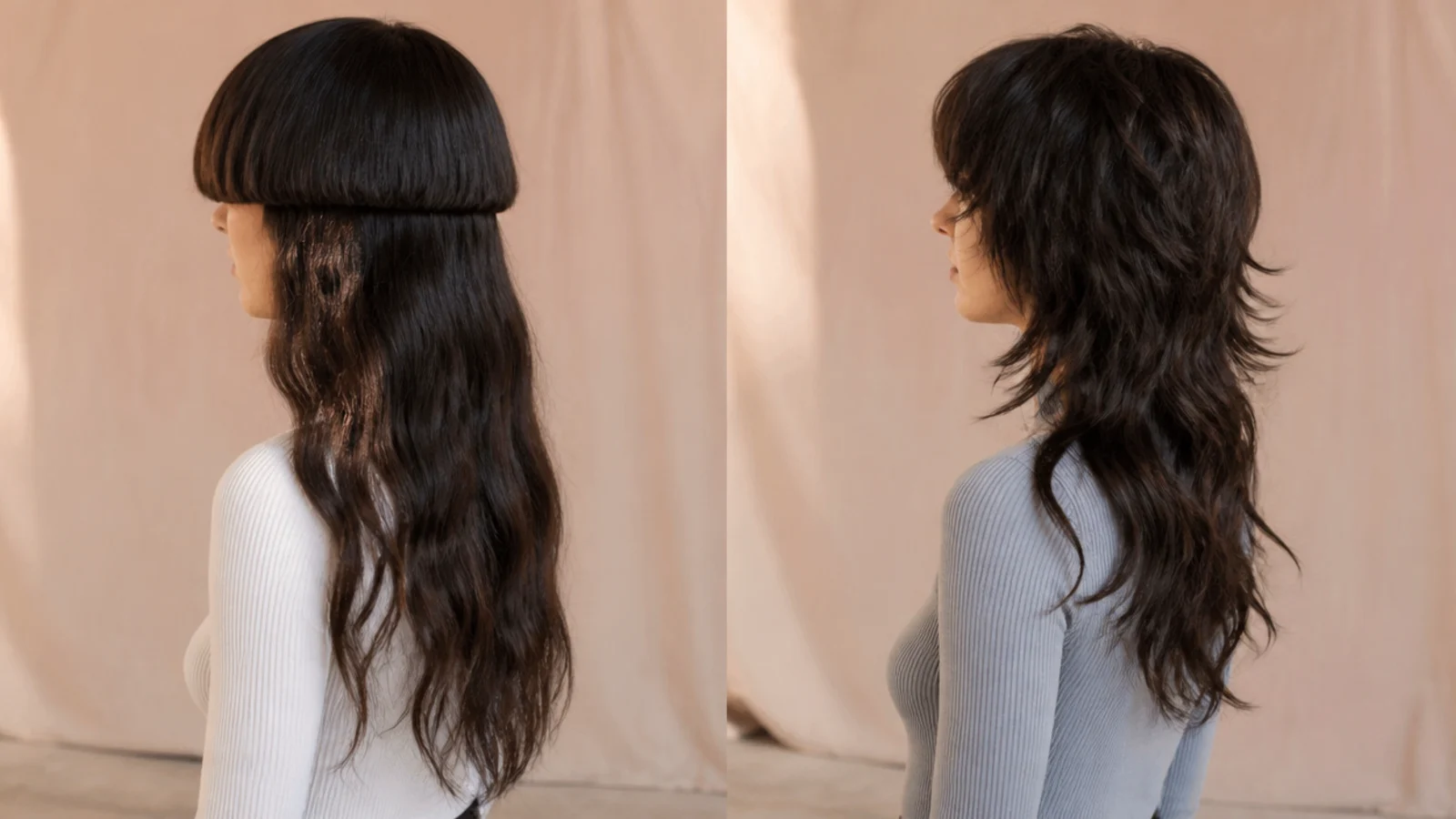
2B waves are the one texture where both cuts genuinely work, which makes this the hardest choice on the list. Waves keep enough of a defined S pattern to show the jellyfish disconnection while adding softness to the bell edge, so the line reads without looking severe. The same waves give a wolf cut effortless piecey separation with no styling at all. Decide on effort: the wavy jellyfish still needs the bell smoothed, the wavy wolf needs a scrunch and nothing else.
Who it suits: 2B to 2C waves choosing between polish and ease.
Tip: Cut waves dry so the bell lands where you want it once the pattern springs up.
6. Jellyfish vs Wolf Cut on 3B Curls
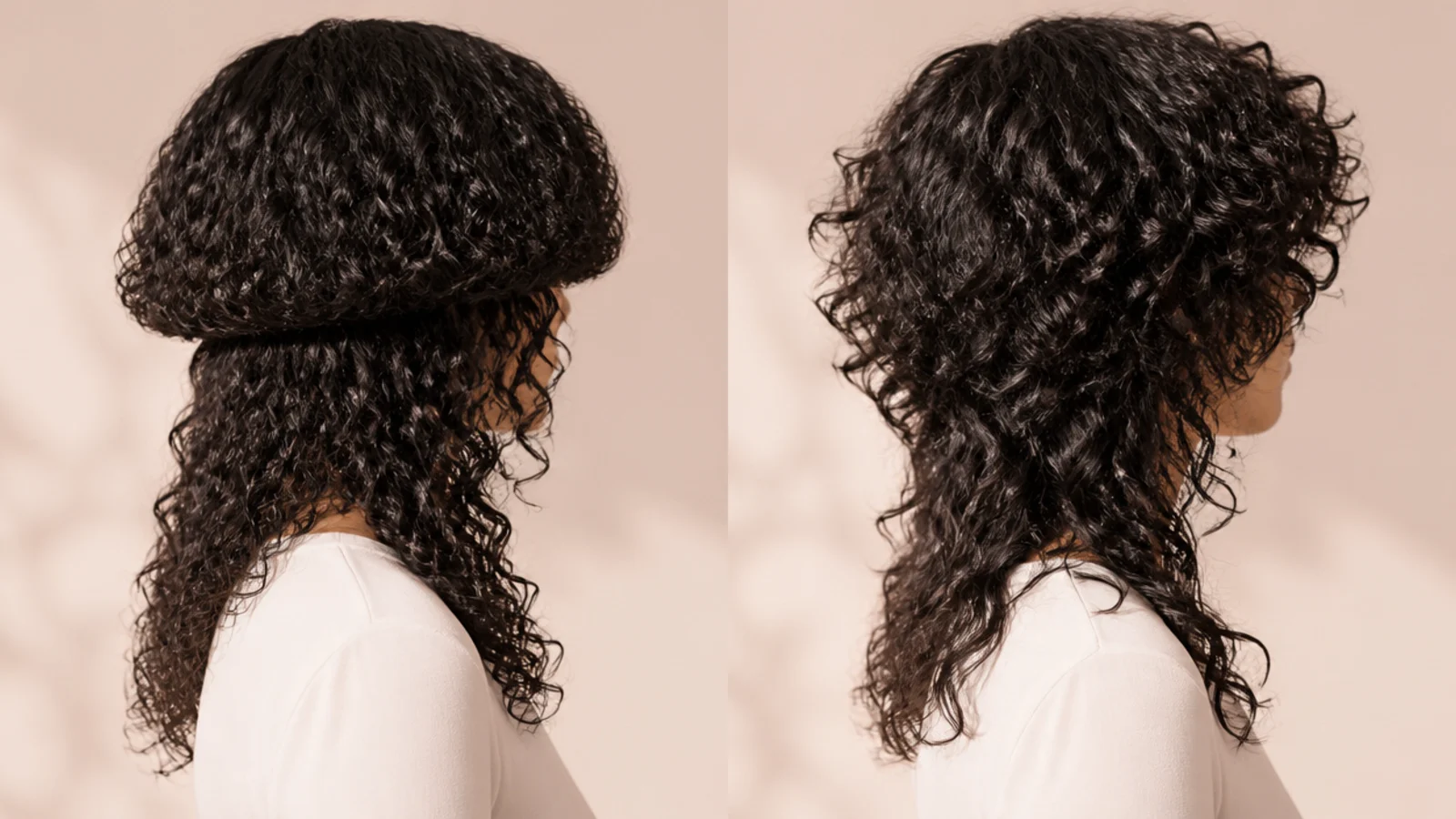
On 3B curls the jellyfish disconnection largely disappears, because curl volume fills the gap between the bell and the lengths until the eye reads one continuous shape. You also fight shrinkage of 2 to 4 inches, so a bell cut at the chin dries at the cheekbone. The wolf cut was practically built for this pattern: layers give curls somewhere to expand, and the choppiness is invisible anyway. If you want a curly jellyfish, ask for an exaggerated length gap so the disconnection survives shrinkage.
Who it suits: 3A to 3C curls, where the wolf is the lower-risk choice.
Tip: Cut curls dry, curl by curl, and add 2 inches to the bell for shrinkage.
7. Jellyfish vs Wolf Cut on a Round Face
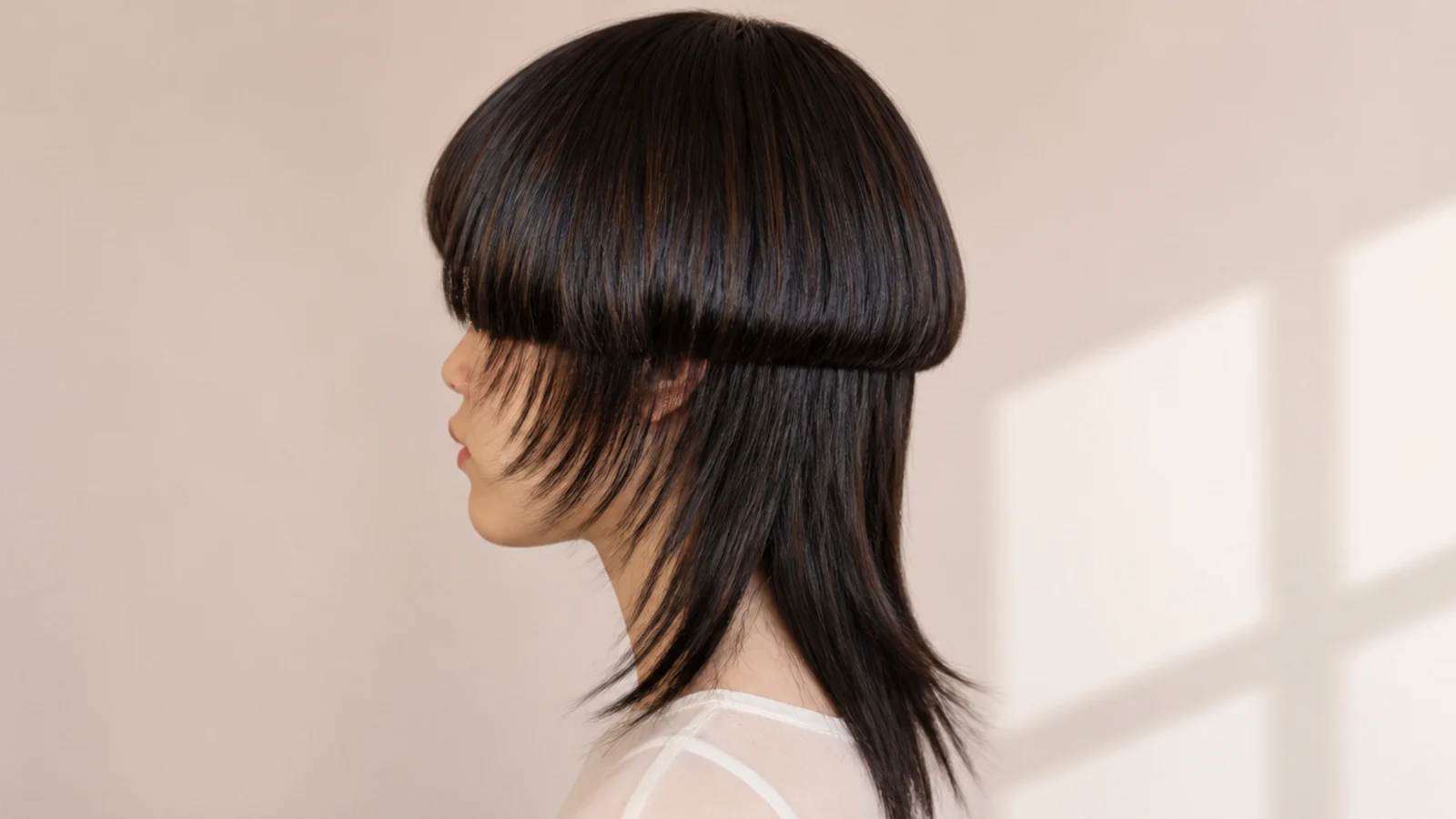
A round face reacts badly to horizontal weight at the widest point of the cheek, which is exactly where a cheekbone-length bell lands. Drop the bell to the jaw or just below and it works, because the curve now finishes past the width instead of on it. A wolf cut is easier here by default: its long vertical face-framing pieces cut the face into a narrower column and the crown volume adds height. If you want the jellyfish on a round face, ask for a slightly oval bell that sits lower at the front.
Who it suits: Round and full-cheeked faces wanting length, not width.
Tip: Say bell at the jaw, longer at the front than the back, so it elongates.
8. Jellyfish vs Wolf Cut on a Long Oval Face

This is the jellyfish's best face shape and the wolf's worst. A cheekbone-length bell puts a horizontal band across a long face, breaking the vertical line and making the whole silhouette look shorter and wider in the right way. A wolf cut with heavy crown volume does precisely the wrong thing, stacking height onto a face that is already long. If you have an oval or oblong face and you have been deciding between these two, the jellyfish is your cut and you can go short with the bell.
Who it suits: Oval, oblong and long heart-shaped faces.
Tip: Ask for the bell to land at the cheekbone, with a soft inward flick at the ends.
9. Jellyfish vs Wolf Cut for Waist-Length Hair You Want to Keep
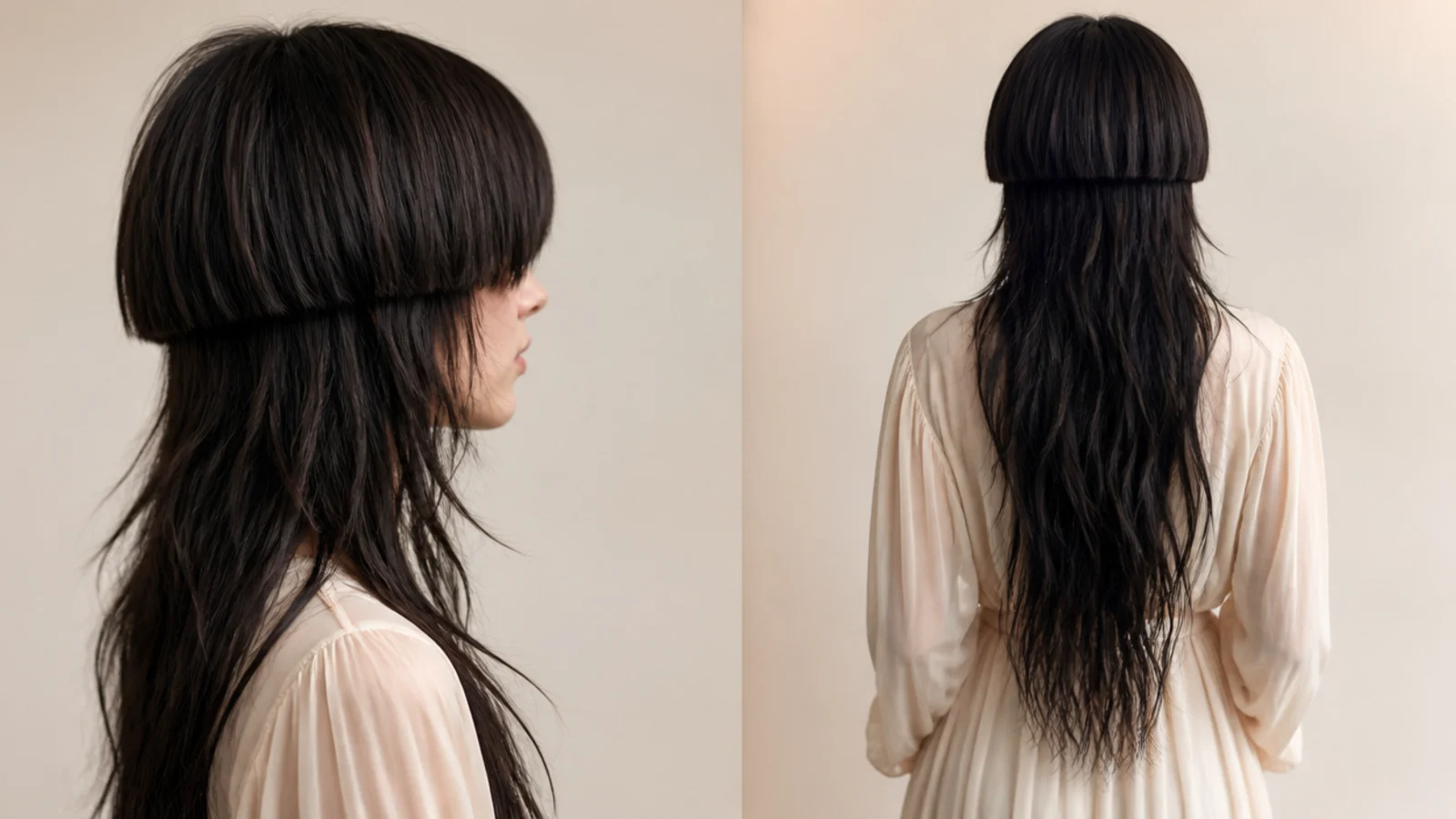
If your priority is keeping every inch, the jellyfish is the safer of the two. It only cuts the top section, so your waist-length ends stay exactly where they are and the perimeter is untouched. A wolf cut layers the entire head, which means the lengths get shortened, thinned and piecey, and your bottom hem stops being solid. Long hair also flatters the jellyfish more than any other length, because the drop between bell and hem is dramatic enough to read from across a room.
Who it suits: Waist and mid-back length hair you refuse to shorten.
Tip: Say the perimeter is not to be touched, only the upper section is cut.
10. Jellyfish vs Wolf Cut at Shoulder Length
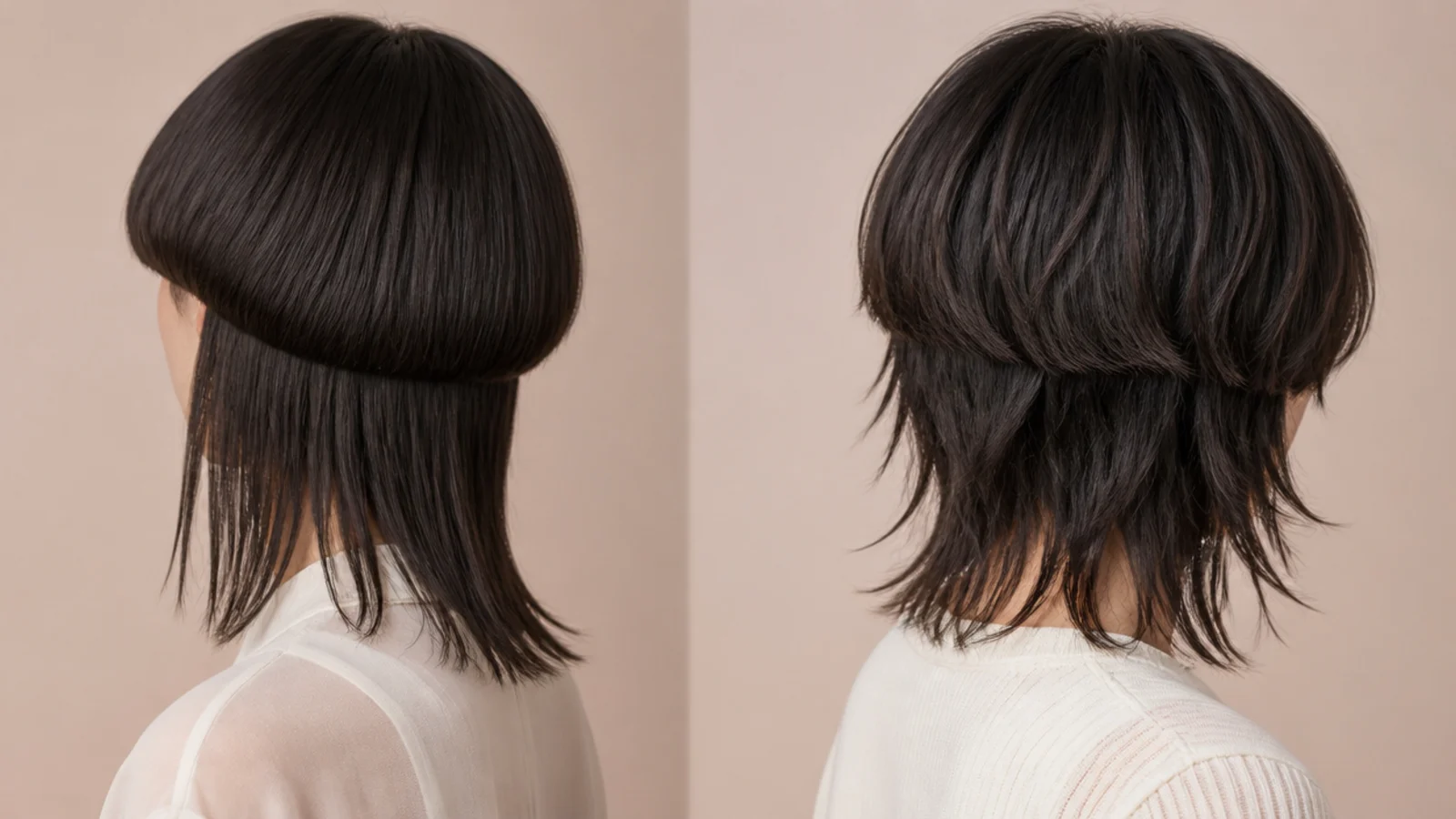
Shoulder length is where the two cuts get closest to each other and the jellyfish gets riskiest. With only about 5 inches between a cheekbone bell and a shoulder hem, the disconnection can look accidental rather than designed. The wolf cut is the natural shoulder-length choice, since that is the length the trend was built at. If you want the jellyfish here, keep the bell higher at the cheekbone to buy contrast, or grow to collarbone first and get a cleaner gap.
Who it suits: Shoulder-grazing hair leaning toward the wolf by default.
Tip: Need at least 5 to 6 inches between bell and hem for the disconnection to read.
11. Two-Tone Jellyfish Color vs Wolf Cut Money Piece
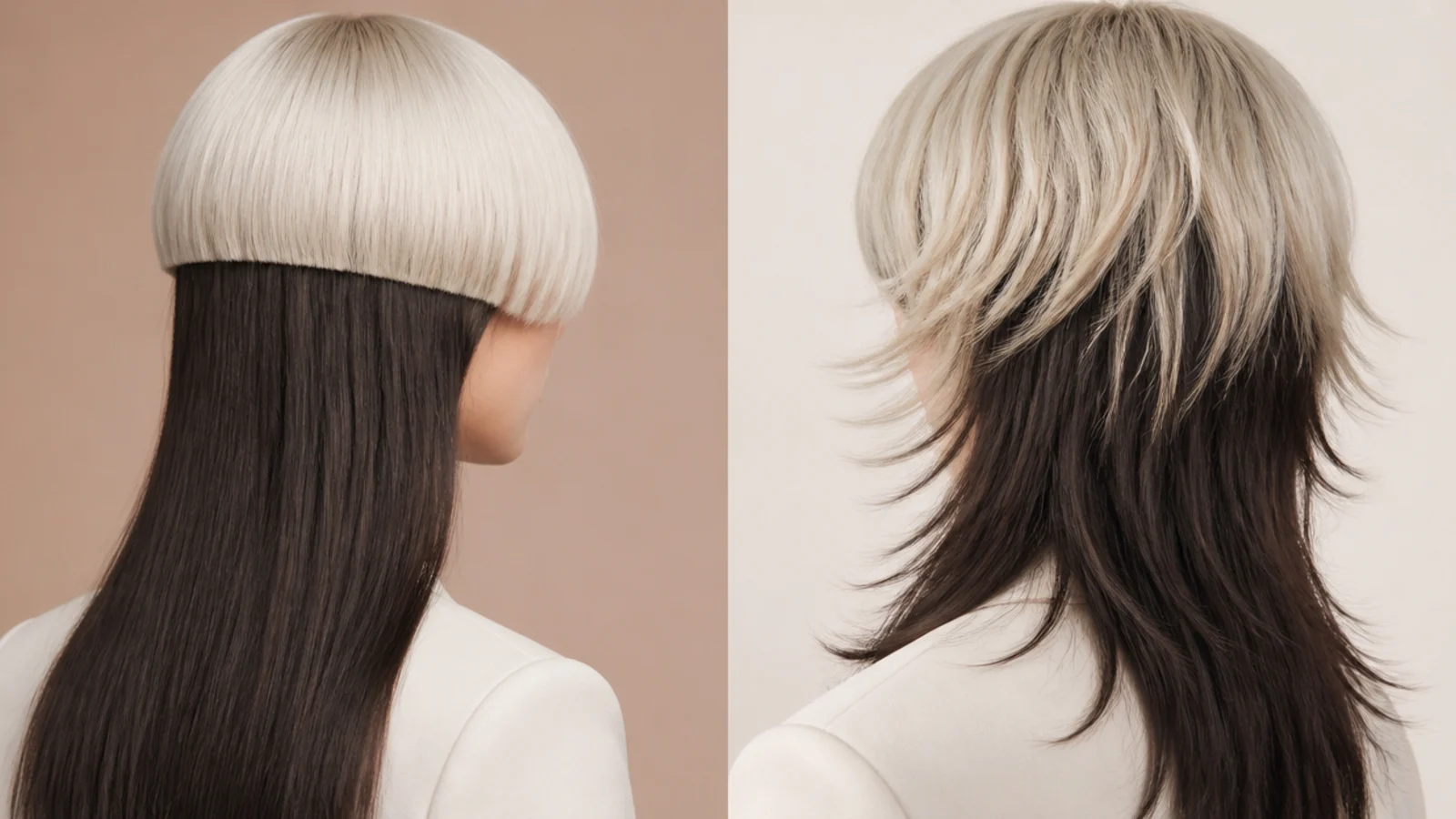
Color placement follows the cut's structure. A jellyfish gives you a clean two-tone canvas: a platinum or vivid bell over a dark natural base, with the disconnection doing the color blocking for you and no blending needed. A wolf cut has no line to color against, so blocked color looks muddy on it. Its natural home is a money piece or soft face-framing balayage that moves with the layers. Expect 200 to 400 dollars for a full bleached bell, and note the bell fades faster because it takes more heat.
Who it suits: Anyone choosing color first and cut second.
Tip: Ask for the bell colored only to the disconnection line, never past it.
12. Jellyfish vs Wolf Cut for a 10-Minute Morning Routine
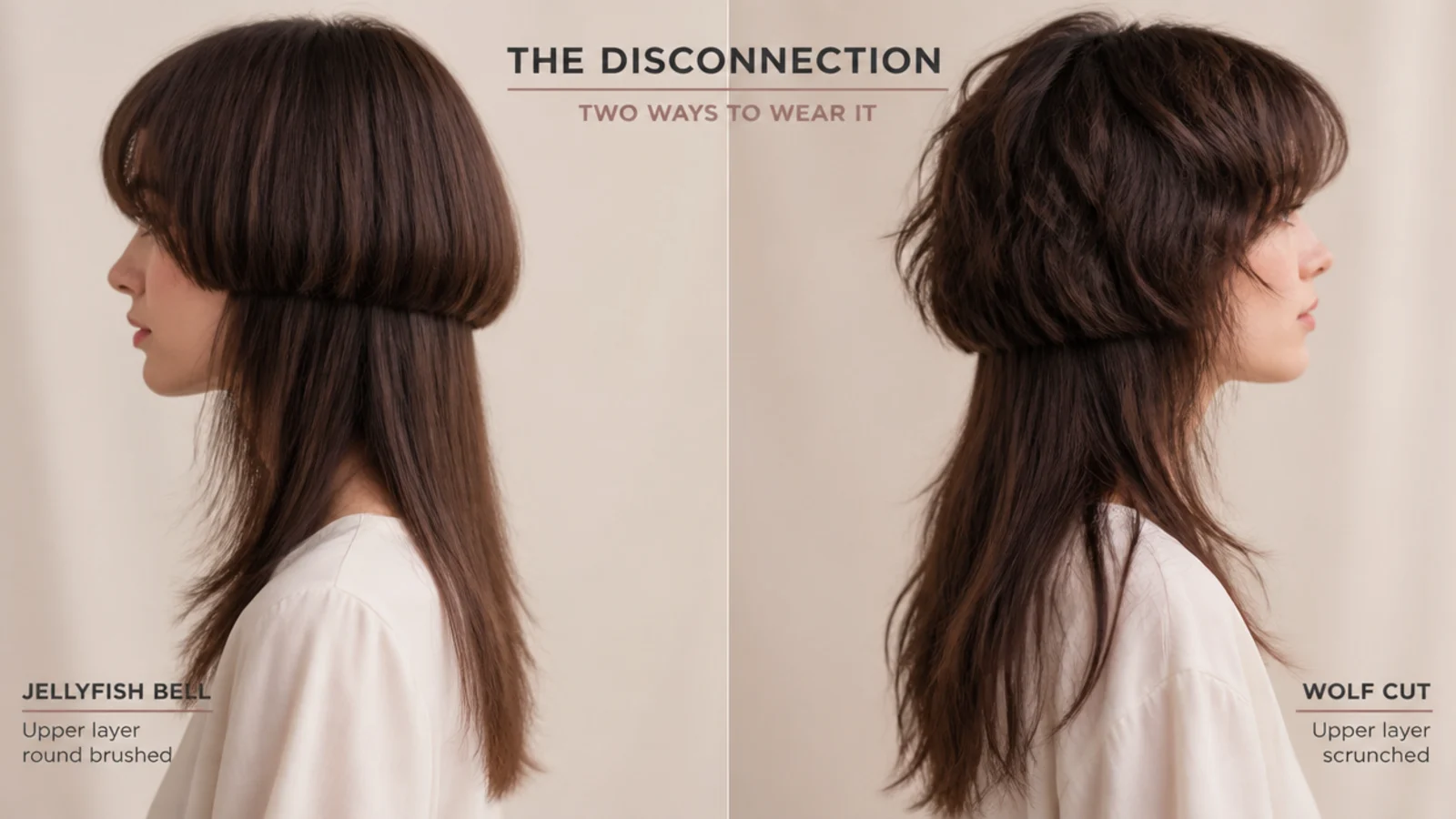
Honest time accounting. A jellyfish needs the bell dried with a round brush or flicked with a flat iron most days, which is 10 to 15 minutes, and it looks noticeably unfinished when you skip it because the shape depends on the curve. A wolf cut takes 5 minutes of texture spray and scrunching, and on a skipped day it just looks a bit more undone, which is on brand. If your real morning window is under 10 minutes, the wolf is not a compromise, it is the correct answer.
Who it suits: Anyone with a short, non-negotiable morning routine.
Tip: Test it first: blow dry only your top layer for a week and see if you keep it up.
13. Jellyfish vs Wolf Cut in a Ponytail or Bun
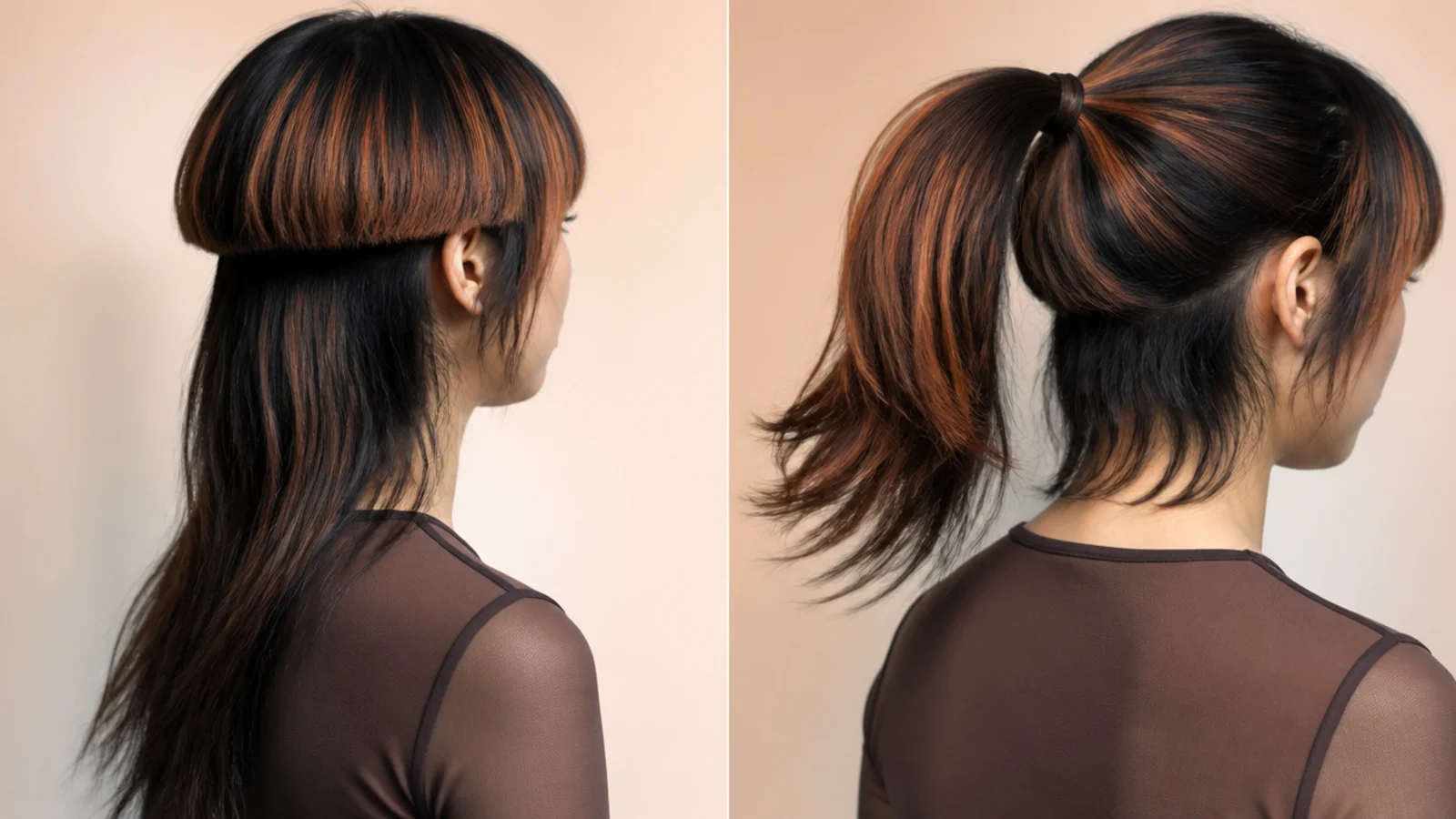
Nobody warns you about this and it decides a lot of appointments. Pull a jellyfish into a ponytail and the entire bell falls out, giving you a thick, blunt curtain of chin-length hair around your face that reads like a heavy fringe. Some people love it; many are surprised. A wolf cut in a ponytail loses only its face-framing pieces, which fall as soft tendrils and look deliberate. If you wear your hair up more days than down, that difference matters more than any front-view photo.
Who it suits: Gym-goers, nurses and anyone whose hair lives in a ponytail.
Tip: Try the ponytail in the salon mirror before the stylist cuts the second side.
14. Jellyfish vs Wolf Cut at Month Three of Grow-Out
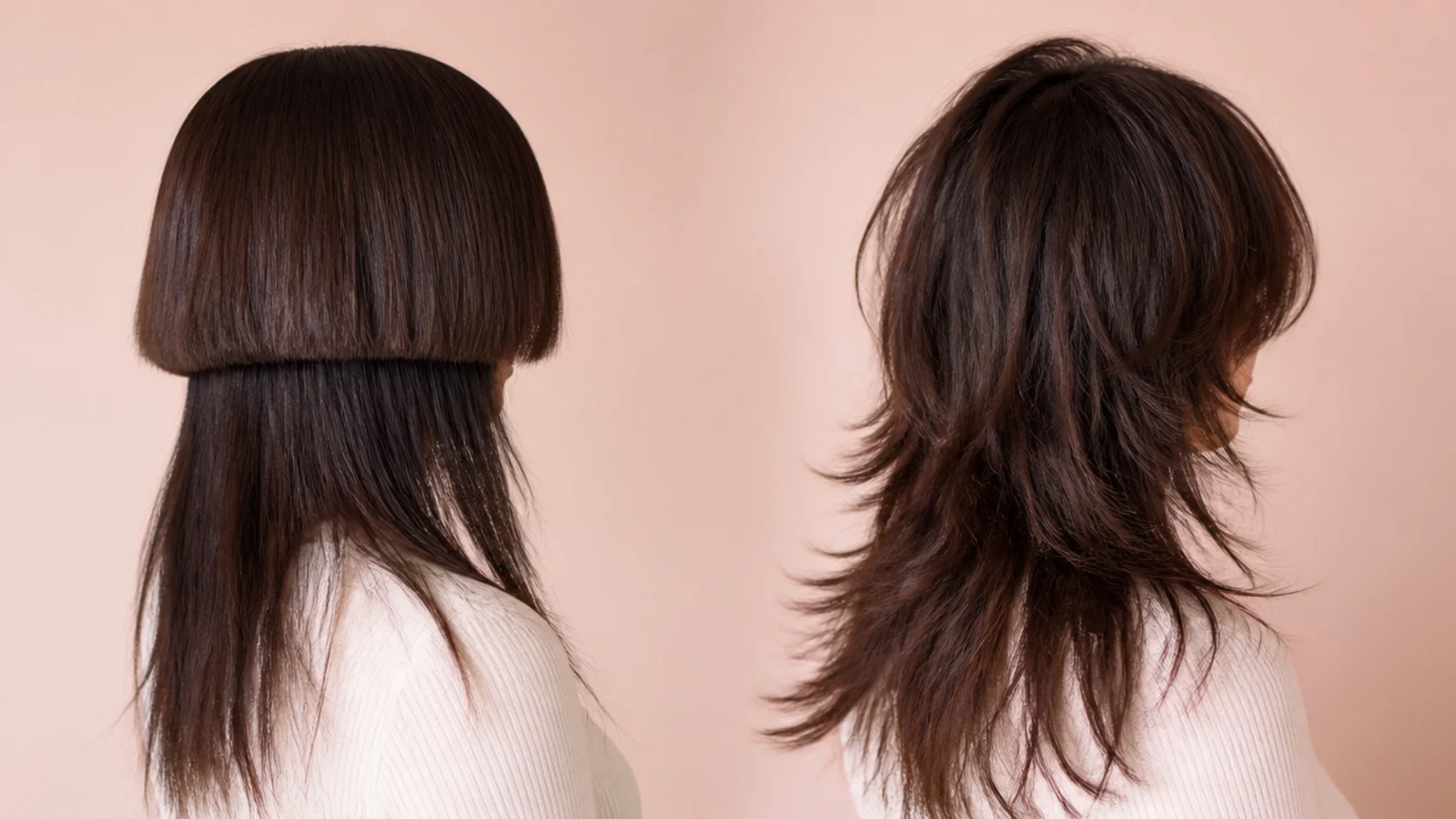
Three months in, a wolf cut has quietly become a long layered cut. Nothing awkward happens, because there was never a line to lose. A jellyfish at three months is in the hardest stretch: the bell has grown about 1.5 inches, which is too long to flick under and too short to sit with the lengths, so it flares out at the ends. That phase lasts roughly two to three months before it becomes a shag or curtain bangs. Knowing this in advance is the single best way to avoid regret.
Who it suits: Anyone weighing the worst month, not the first week.
Tip: Book a bell trim at week 7 to keep the shape sharp and delay the awkward phase.
15. Turning a Wolf Cut Into a Jellyfish Cut and Back
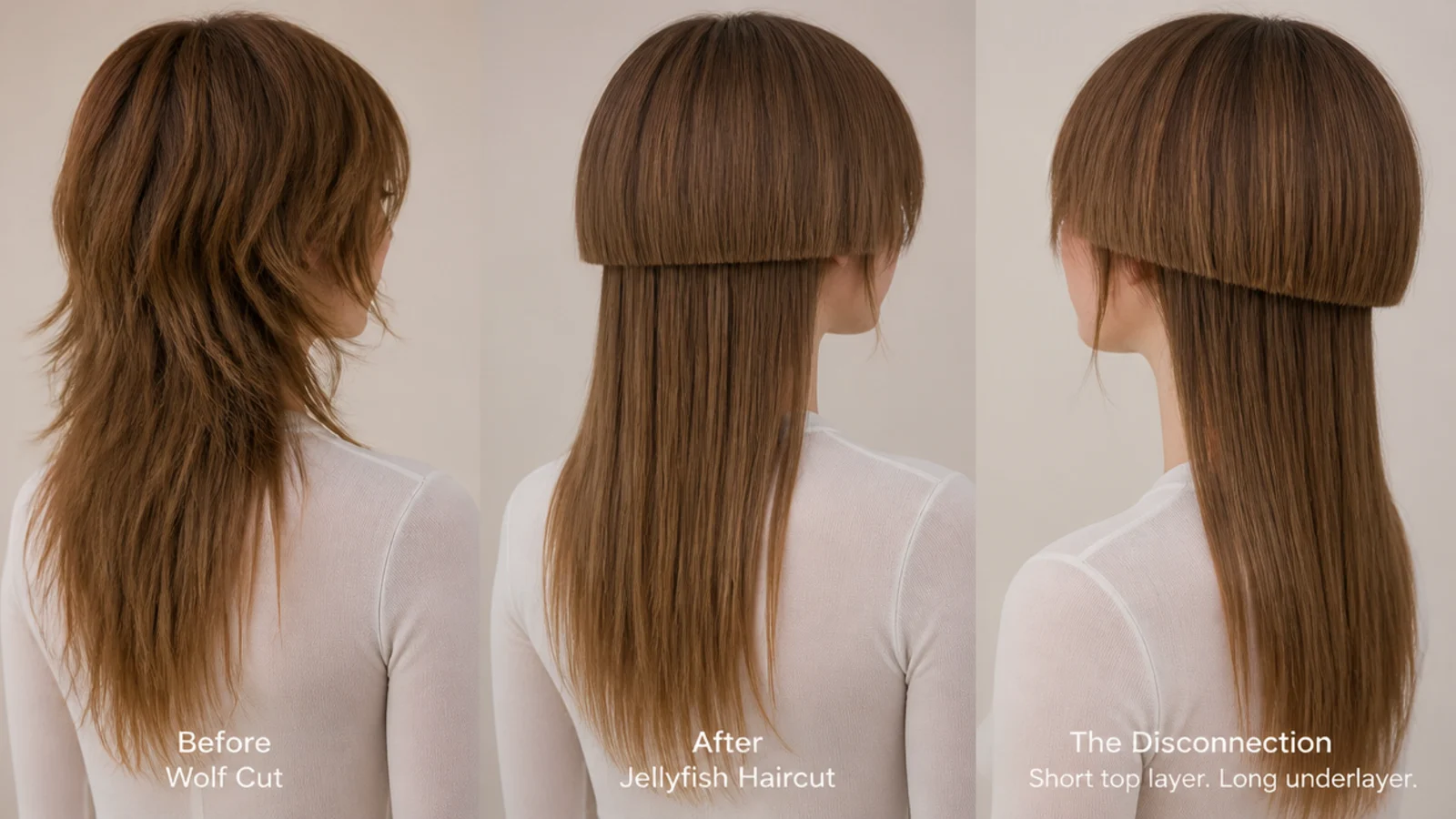
The conversion runs easily one way. A jellyfish becomes a wolf in a single appointment: the stylist just blends the disconnection line into the lengths with point cutting and adds crown layers. Going the other direction is harder, because a wolf's layers are all different lengths and a bell needs one even circumference. You usually wait 3 to 6 months for the shortest layers to catch up before a clean bell is possible. Practical conclusion: if you are unsure, get the wolf second, not first.
Who it suits: Anyone hedging their bet between the two cuts.
Tip: Tell the stylist you may convert later so the layers are cut to grow into a bell.
What a Jellyfish Haircut Is: The Disconnected Two-Layer Structure

A jellyfish haircut is two haircuts stacked. The upper section is cut into a short, rounded, bowl-shaped layer that runs the full circumference of the head, usually landing between the cheekbone and the chin. Everything underneath is left long and essentially untouched. What makes it a jellyfish rather than a heavy shag is that the stylist never blends those two sections into each other. The cutting line stays hard, so the bell visibly floats on top of the length and the gap between them reads as a shape rather than a mistake. That disconnection is the whole design, and it is why the cut photographs so strongly from behind, where the round bell sits like a dome over falling lengths. It also explains the texture rule: straight and wavy hair show the line most clearly, while tight curls blur it into softness. The full breakdown of bell placement lives in the jellyfish haircut guide.
What a Wolf Cut Is: Shag Meets Mullet, Blended Throughout
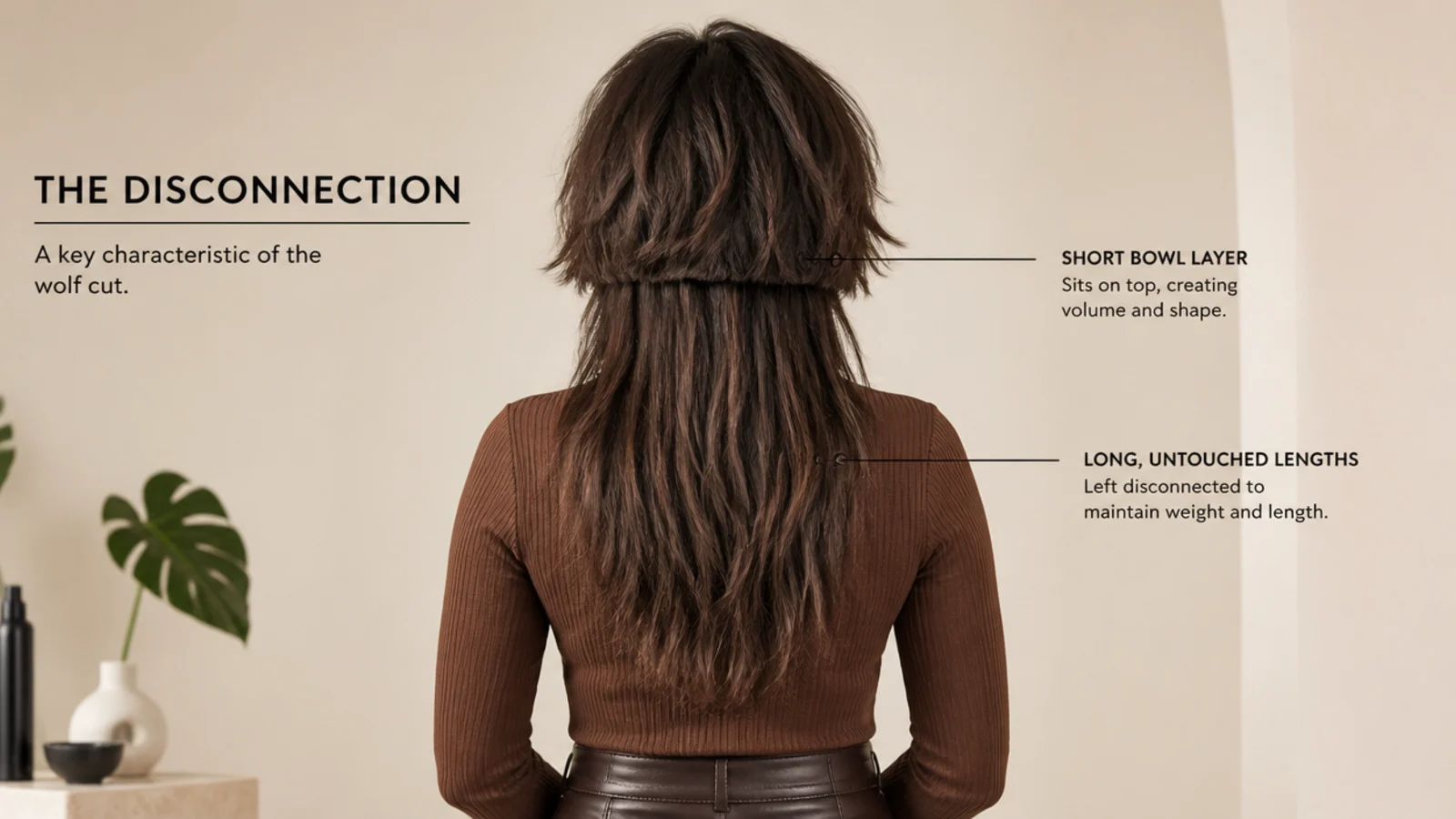
A wolf cut is a shag and a mullet crossed. The stylist builds heavy layering through the crown, shortens the face-framing to somewhere around the cheekbone, and then point cuts or razors every layer beneath it so each one melts into the next. Volume gathers at the top, weight is stripped out of the interior, and the ends stay piecey and separated. There is no line anywhere in the cut, which is exactly the opposite intention to a jellyfish. That absence of a line is what makes the wolf so forgiving: it works at shoulder length or waist length, on 2A waves or 3C curls, and on hair that is too thick to sit flat. It also means it never quite looks precise. If you want the tousled version at collarbone length, the shaggy mid length haircut is essentially a softened wolf.
Jellyfish vs Wolf Cut vs Mullet vs Hime Cut Compared
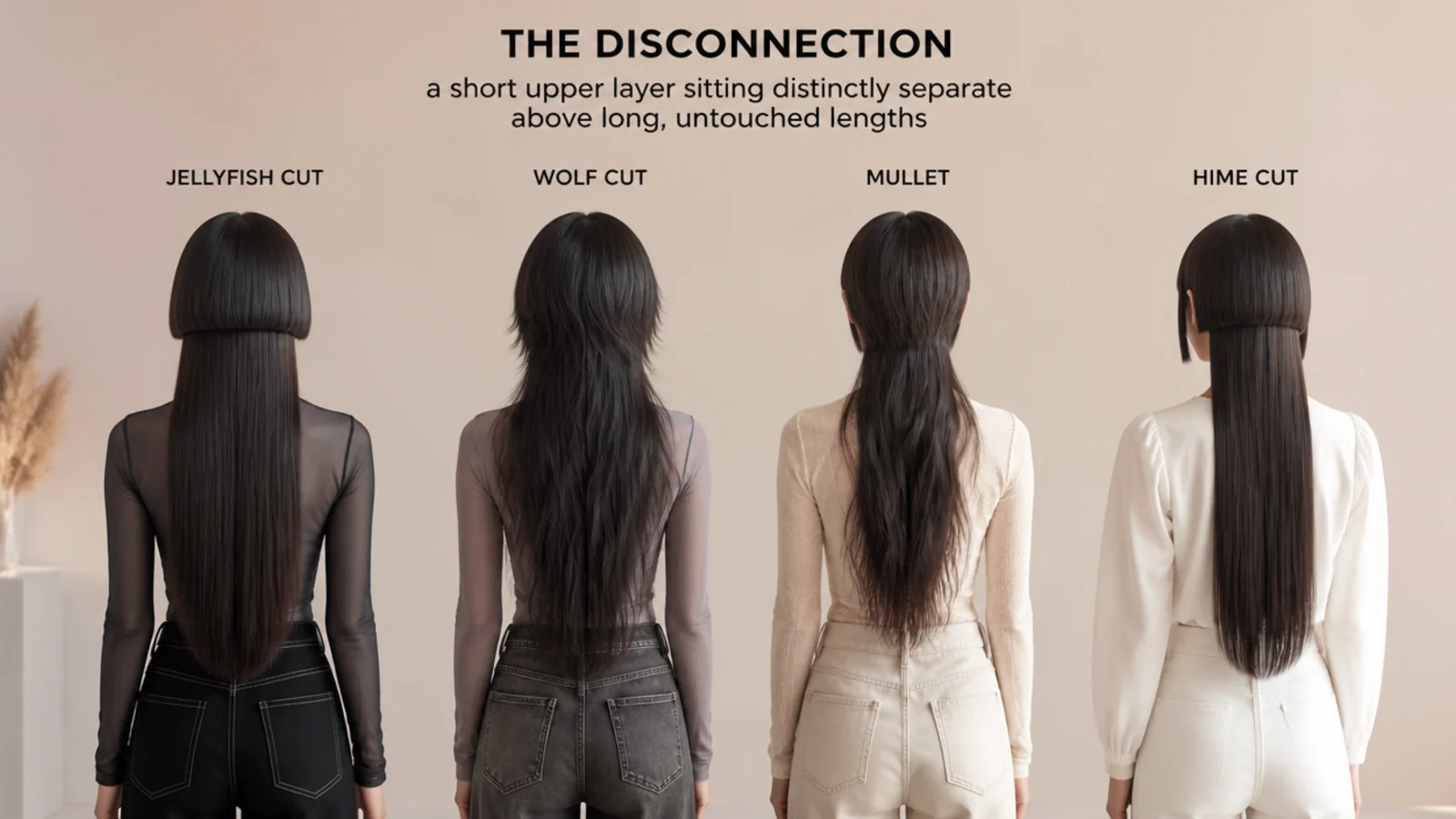
Four cuts get confused with each other, and one question separates all of them: where does the short hair sit, and is it blended? A jellyfish puts a short rounded layer all the way around and blends nothing. A wolf puts short layers at the crown and face and blends everything. A mullet keeps the front and sides short and leaves only the back long, so the contrast runs front to back rather than top to bottom. A hime cut leaves two blunt cheekbone-length side panels beside a long straight base, so the contrast is vertical and only at the face. That means a jellyfish is not a mullet, even though people call it one, because a mullet has no long hair over the ears while a jellyfish has long hair everywhere. And a hime is the closest relative to the jellyfish, since both refuse to blend. The difference is that hime only cuts the front panels, while jellyfish cuts a full bowl. See the face-framing version in jellyfish haircut bangs.
Who Each Cut Suits: Face Shape and Hair Texture
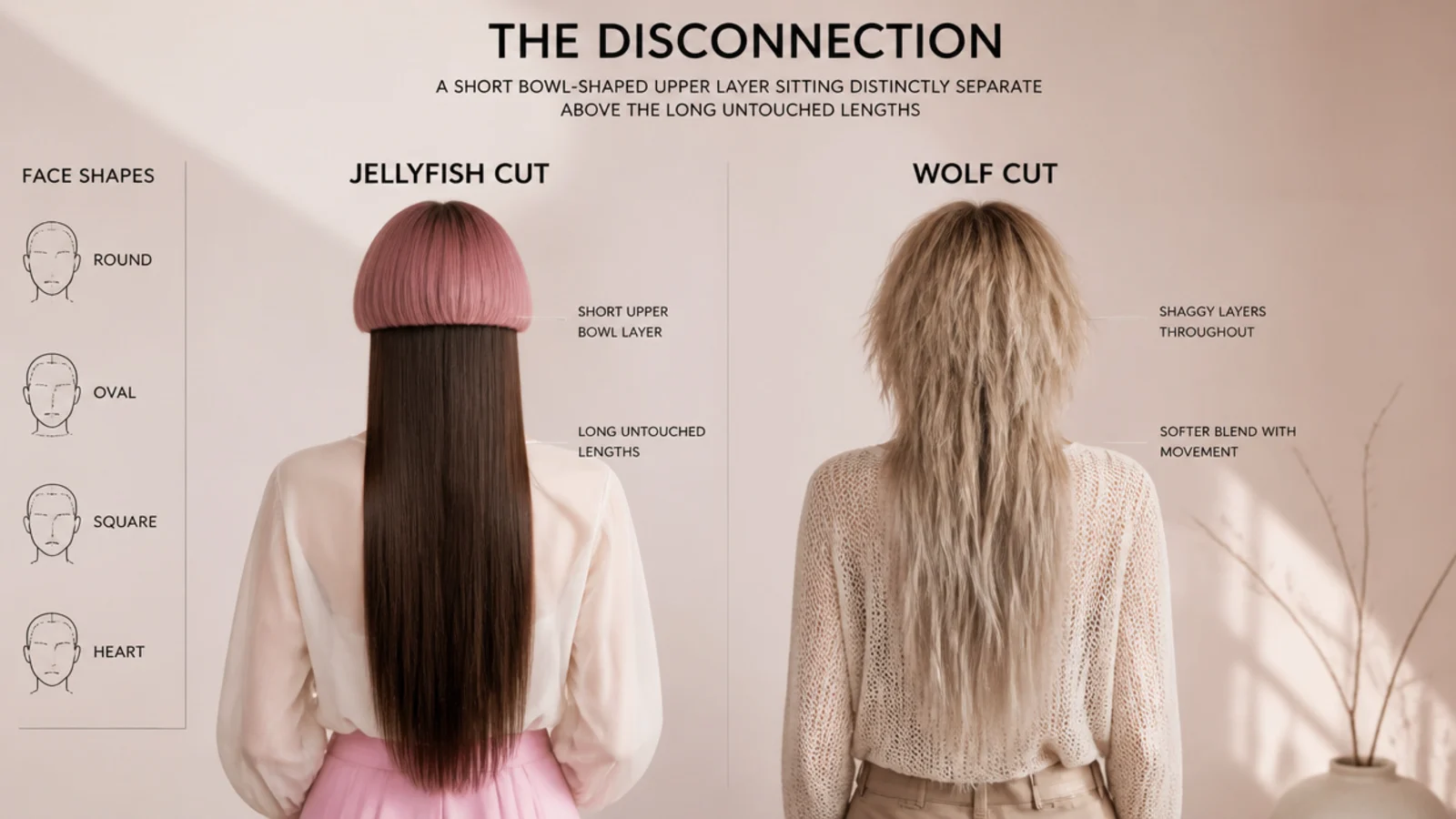
On face shape, the jellyfish adds a horizontal band of weight at whatever level the bell lands, so it flatters oval and heart faces and can widen a round one unless you drop the bell to the jaw. The wolf cut does the reverse: its vertical, broken layers slim a round or square face and add height at the crown, which is why it is the safer pick if width is your concern. On texture the split is sharper. Fine straight hair gets its best density from a blunt jellyfish bell, because a wolf cut removes the very weight fine hair needs. Thick coarse hair usually fights a jellyfish, since a solid bell of dense hair sticks out at the sides instead of curving under, while a wolf cut exists to remove that bulk. Curls from 3A on tend to blur the jellyfish line entirely, so a wolf reads better. Curl-specific options are in curly jellyfish haircut, and wave behavior in wavy jellyfish haircut.
Styling a Jellyfish Cut vs Styling a Wolf Cut
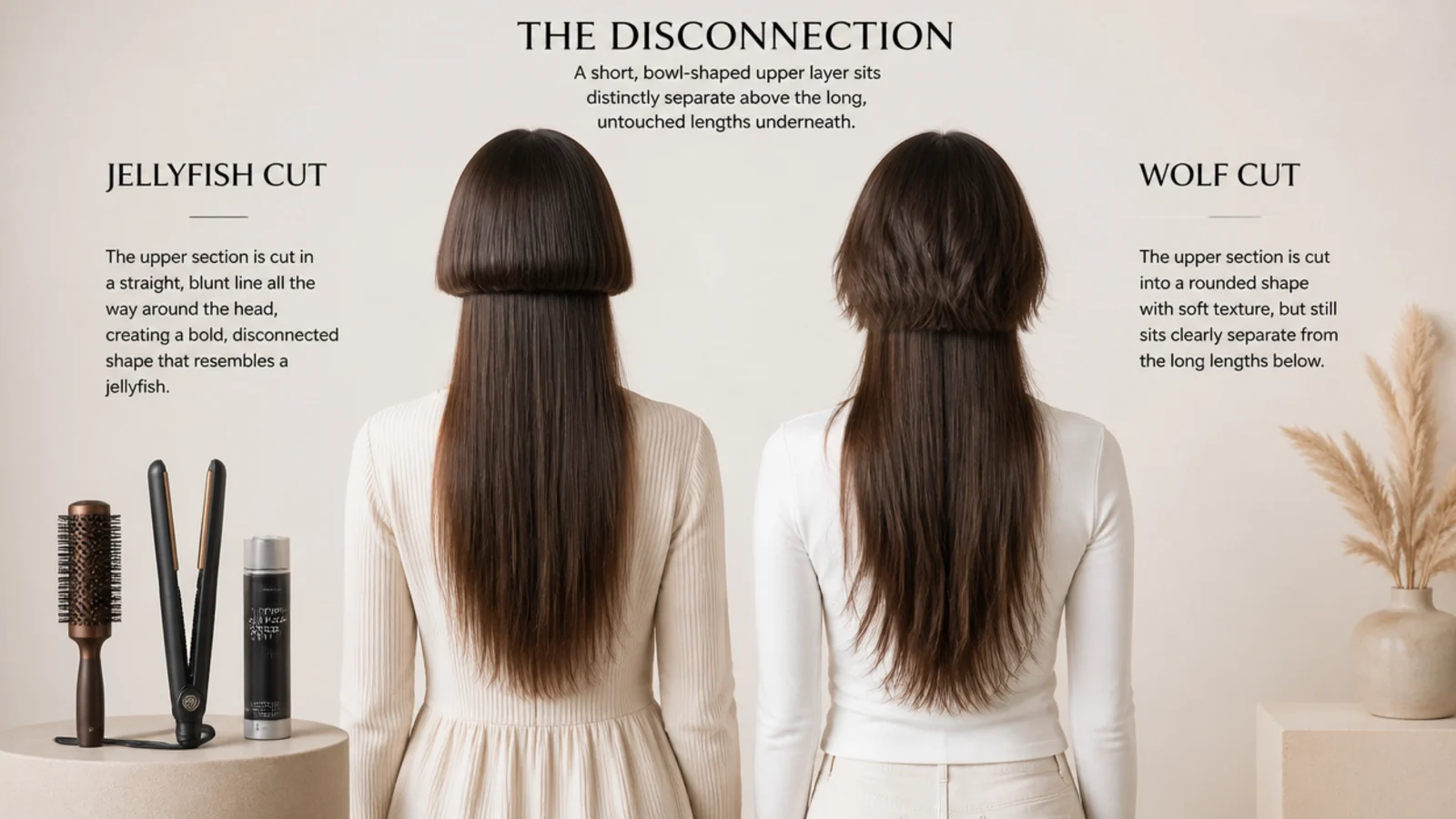
These two cuts need opposite products and opposite motions. The jellyfish bell almost always needs heat: a 1.5 inch round brush on a blow dry, rolling the ends under, or a flat iron held horizontally and rotated at the last inch to flick the perimeter inward. Without that, the short layer sits flat and the shape stops reading. The lengths underneath need almost nothing, just a smoothing cream so they stay sleek enough to contrast the bell. Budget 10 to 15 minutes. A wolf cut wants the reverse: a salt or texture spray on damp hair, scrunched, then either air dried or rough dried head down with a diffuser, finished with a dry wax or paste through the ends. Five minutes, and messier is better. The practical takeaway is that a jellyfish is a styled haircut and a wolf is a wash-and-go one. More technique sits in long jellyfish haircut and textured mid length haircut.
Growing Out a Jellyfish vs a Wolf Cut, and How to Ask for Each
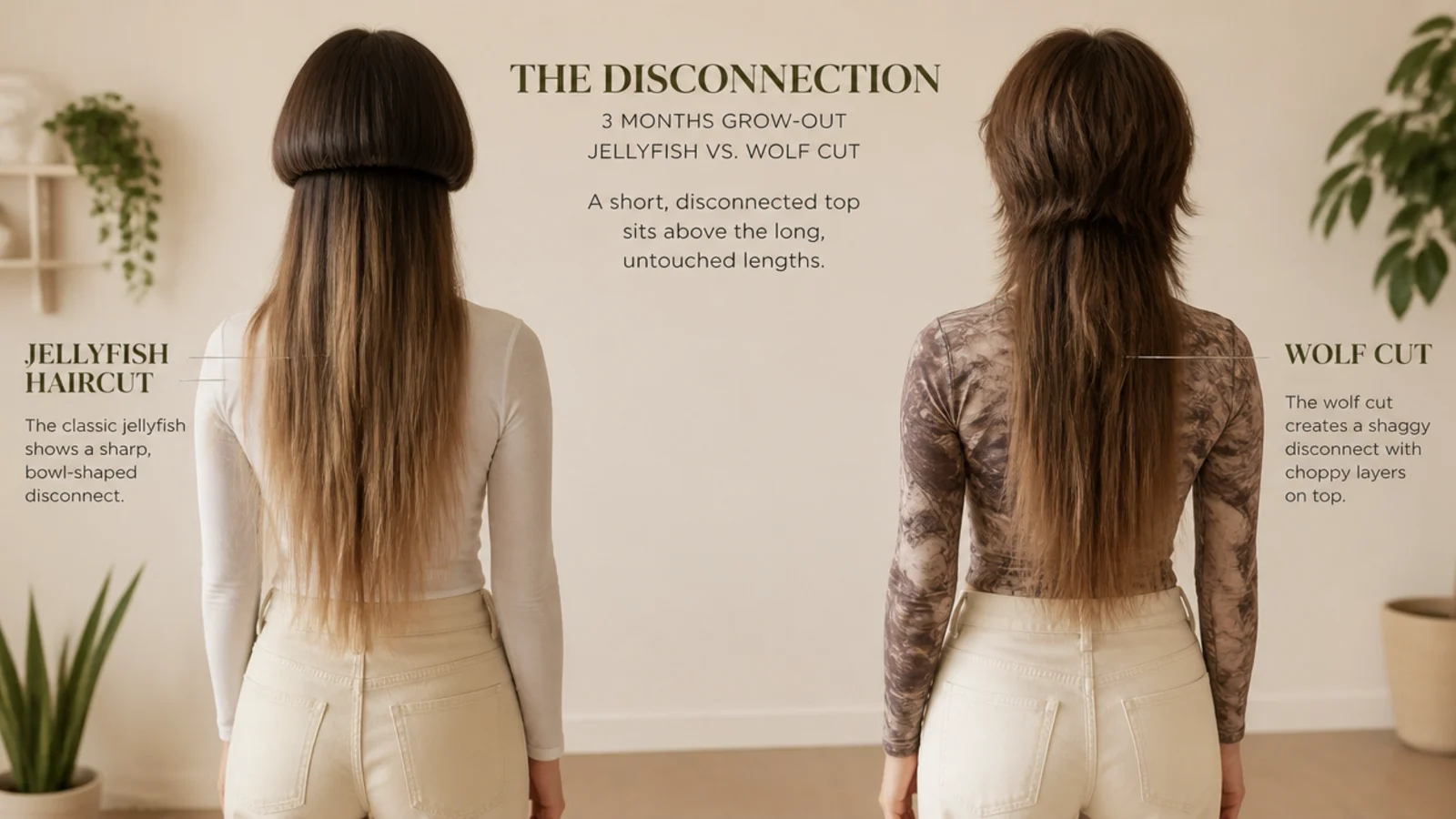
Grow-out is where these cuts separate the most, and it is the part nobody warns you about. A wolf cut simply softens. Its layers lengthen at the same rate, the choppiness dulls, and after four or five months you own a long layered cut nobody would question. A jellyfish goes through a real awkward phase of roughly two to three months, when the bell reaches an in-between length that is too long to curve under and too short to join the lengths. Push through and it becomes a shag or a set of curtain bangs, which is a genuinely nice place to land. On wording, ask for a jellyfish with the phrase disconnected bowl-shaped upper layer, length left long underneath, and say do not blend out loud. For a wolf, say shaggy blended layers, face-framing at the cheekbone, point cut through the ends. The curtain-bang landing is covered in short curtain bangs.
Frequently Asked Questions
What is the difference between a wolf cut and a jellyfish cut?
The disconnection. A jellyfish cut leaves a hard, unblended line between a short bowl-shaped top layer and the long hair underneath, so the two sections stay visibly separate. A wolf cut blends choppy layers from the crown down so nothing has an edge. Same rough idea of short over long, opposite finish: one is structured, one is shaggy.
Is the jellyfish haircut a mullet?
No. A mullet is short at the front and sides with length only at the back, so the contrast runs front to back. A jellyfish keeps long hair all the way around and stacks a short rounded layer on top of it, so the contrast runs top to bottom. A wolf cut borrows mullet proportions, which is why the two get confused.
Can you turn a wolf cut into a jellyfish cut?
Not immediately. A wolf cut's layers all sit at different lengths, and a jellyfish bell needs one even circumference to read as a bowl. Most stylists want the shortest layers to grow 3 to 6 months first. Going the other way is easy: a jellyfish converts to a wolf in one appointment by blending the disconnection line into the lengths.
Which cut is better for thick hair?
The wolf cut, in most cases. Its internal layering removes bulk and stops thick hair from widening into a triangle. A blunt jellyfish bell on dense coarse hair tends to flare out at the sides instead of curving under. If you want the jellyfish anyway, ask for invisible thinning on the underside of the bell with the outline left blunt.
Do wolf cuts and jellyfish cuts need the same products?
No, they need opposite ones. A wolf cut wants sea salt or texture spray, a scrunch and a dry wax to keep the ends piecey. A jellyfish wants a smoothing cream, a heat protectant and a round brush or flat iron so the bell curves under. Texture spray on a jellyfish actually blurs the disconnection you paid for.
Is a jellyfish haircut high maintenance?
More than a wolf cut, yes. A blunt bell needs trimming every 6 to 8 weeks or the line goes fuzzy, and it needs 10 to 15 minutes of heat styling most mornings to hold its curve. A wolf cut rides 10 to 12 weeks between trims and air dries. Neither is high maintenance in cost terms; the jellyfish is high maintenance in daily minutes.
What is the difference between a jellyfish haircut and a hime cut?
A hime cut leaves two blunt cheekbone-length panels beside the face and nothing else short, so the contrast is vertical and only at the front. A jellyfish cuts a full rounded bell all the way around the head. Both refuse to blend, which is why they look related, and the jellyfish is often described as a hime cut taken the whole way around.
Which grows out better, a jellyfish or a wolf cut?
The wolf, clearly. Its layers just get longer and softer, and after four or five months it reads as a normal long layered cut. A jellyfish hits an awkward phase of roughly two to three months when the bell is too long to flick under and too short to join the lengths, before it settles into a shag or curtain bangs.
Which cut is better for a round face?
A wolf cut is the easier choice, because its long vertical face-framing layers narrow the face and the crown volume adds height. A jellyfish can widen a round face when the bell lands at the cheekbone, which is the fullest point. It still works if you drop the bell to the jaw or below and ask for it slightly longer at the front.
How much does a jellyfish haircut cost compared with a wolf cut?
Both are priced as a standard cut in most salons, roughly 60 to 120 dollars in a US city, with specialist and creative-cut stylists charging more. The real cost difference is cadence: a blunt jellyfish needs 6 to 8 week bell trims, so figure 6 to 8 appointments a year against 4 to 5 for a wolf cut.
Which jellyfish haircut look are you saving?
Across all 15 of these jellyfish vs wolf haircut comparisons, the choice keeps coming back to one question: do you want the layers to show or to disappear? If you want the shape to read across a room, photograph from behind and look unmistakably deliberate, ask for the jellyfish and commit to the six to eight week bell trim. If you want volume and movement with a routine you can skip on a Tuesday, take the wolf cut. Straight and wavy hair gets the cleanest jellyfish; curls and very thick hair are almost always happier in a wolf. Bring a front and a back photo either way, then browse the rest of the jellyfish haircut hub or start with the jellyfish haircut guide.