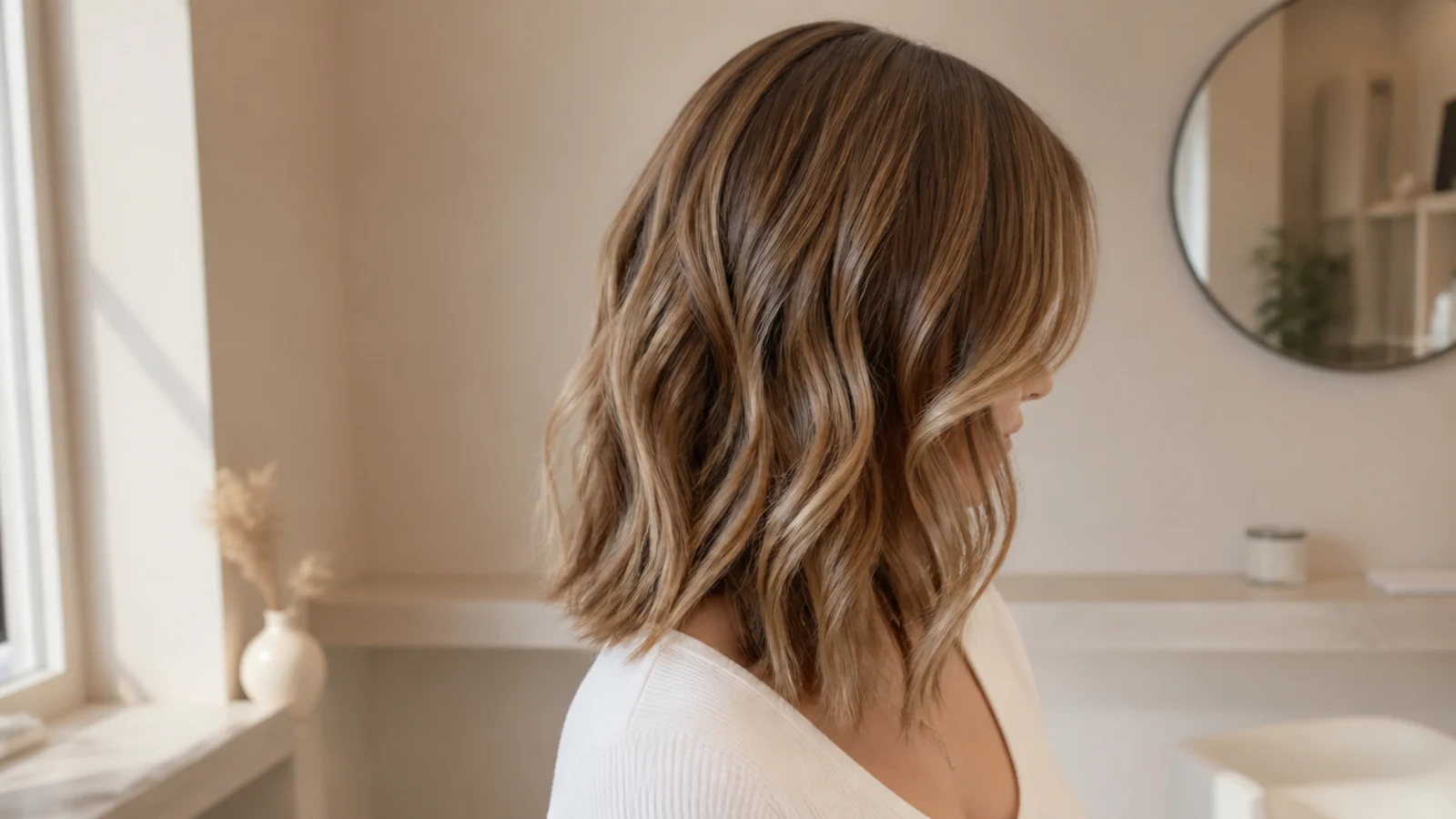
Quick Comparison
| Shaggy Mid Length Haircut | Wolf Cut | |
|---|---|---|
| Crown layers | Blended; the layers step down with no visible break | Disconnected; a visible step of 1 inch or more |
| Shortest layer | Cheekbone to chin, blended into the length | Ear level or higher, sitting on top of the length |
| Silhouette from the back | One continuous shape, wider at the crown | Two clear tiers, reads half mullet |
| Best hair density | Medium to thick; fine hair needs a softened version | Thick or coarse only |
| Best hair texture | 2A to 3B waves and curls, plus thick straight | 2B to 3A hair with visible natural movement |
| Daily styling time | 5 to 12 minutes with mousse or texture spray | 10 to 20 minutes; the crown needs lifting daily |
| Trim cadence | Every 8 to 10 weeks | Every 6 to 8 weeks |
| Grow-out time to one length | About 5 to 6 months | About 9 to 12 months |
| Regret risk | Moderate; blends out with two trims | High; the step has to grow all the way down |
1. Collarbone Shag With Curtain Bangs

The default modern shag and the safest first version. The perimeter sits right on the collarbone, the shortest crown layer lands at the chin, and a curtain fringe splits at the center and sweeps back to the cheekbone. Because the fringe is long enough to tuck, it doubles as face-framing on the days you cannot be bothered to style it. Ask for the fringe to be cut dry so the natural lift at the hairline is visible before the last quarter inch comes off. Full detail on the fringe half lives in mid length haircut curtain bangs.
Who it suits: Anyone trying a shag for the first time, on almost any face shape.
Tip: Blow the fringe forward and down with a flat nozzle for 20 seconds before it fully dries so it splits cleanly.
2. Soft Modern Shag for Fine Straight Hair

The honest version for fine hair. A full choppy shag divides a limited number of strands across too many lengths and the ends go see-through by week three. The fix is two long layers only, the shortest starting about 4 inches below the chin, plus a perimeter left blunt so the bottom line stays dense. All the shag character then comes from the fringe and the face-framing rather than from the interior. Skip thinning shears entirely. If your hair is fine and also short, how to style short fine hair covers the same principle.
Who it suits: Fine, low-density straight hair that still wants shag movement.
Tip: Say the words keep the perimeter blunt, no thinning shears, out loud before the cape goes on.
3. Seventies Rocker Shag With a Full Fringe

The original shag, not the softened one. A dense fringe cut straight across at the eyebrow, a heavily stacked crown that sits high and round, and ends chopped into deliberate points at the shoulder. The silhouette is wide at the top and narrow at the bottom, which is the opposite of most modern cuts and exactly why it reads vintage. It needs thick or coarse hair to hold that top volume, and it needs commitment, since a full fringe takes about 5 months to reach cheekbone length if you change your mind.
Who it suits: Thick or coarse hair, oval and long face shapes, high style tolerance.
Tip: Ask for the fringe to be cut a half inch longer than the target and trimmed again once dry.
4. Shaggy Textured Lob With Blunt Ends
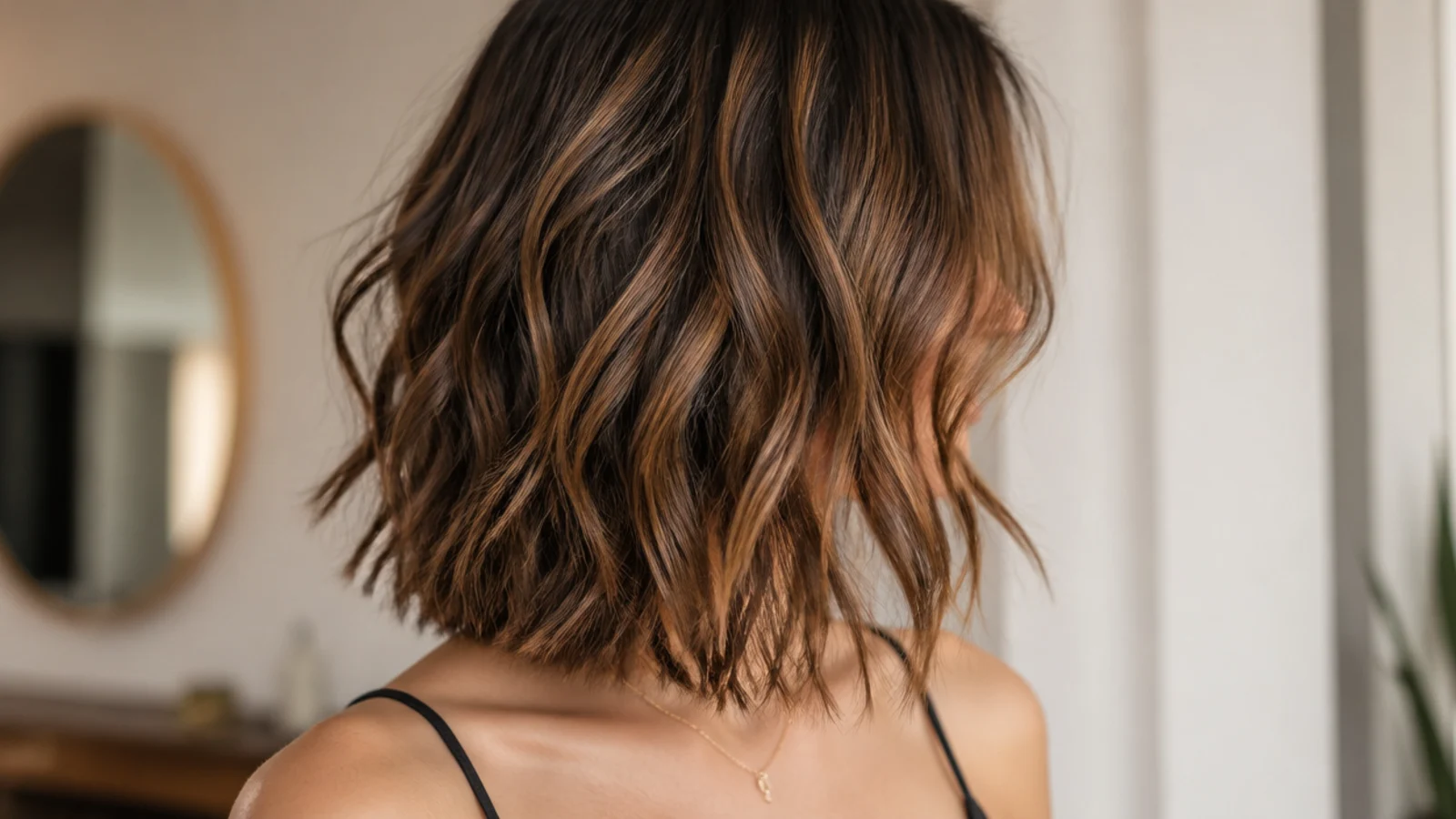
The office-safe shag. The perimeter stops just above the collarbone and stays blunt, so the bottom line looks intentional and grown-up, while the shag lives entirely in the interior as soft stacked layers through the crown and around the face. From the front it reads polished, from the side it reads textured. It is also the easiest shag to grow into a plain lob if you decide the look is not for you, because there is no disconnection to blend out. Compare the non-shag baseline in bob haircuts.
Who it suits: Corporate settings, straight to 2A hair, first-time layer takers.
Tip: Ask for the layers to start behind the front section so nothing short shows from the front.
5. Wavy Shag for 2B Hair
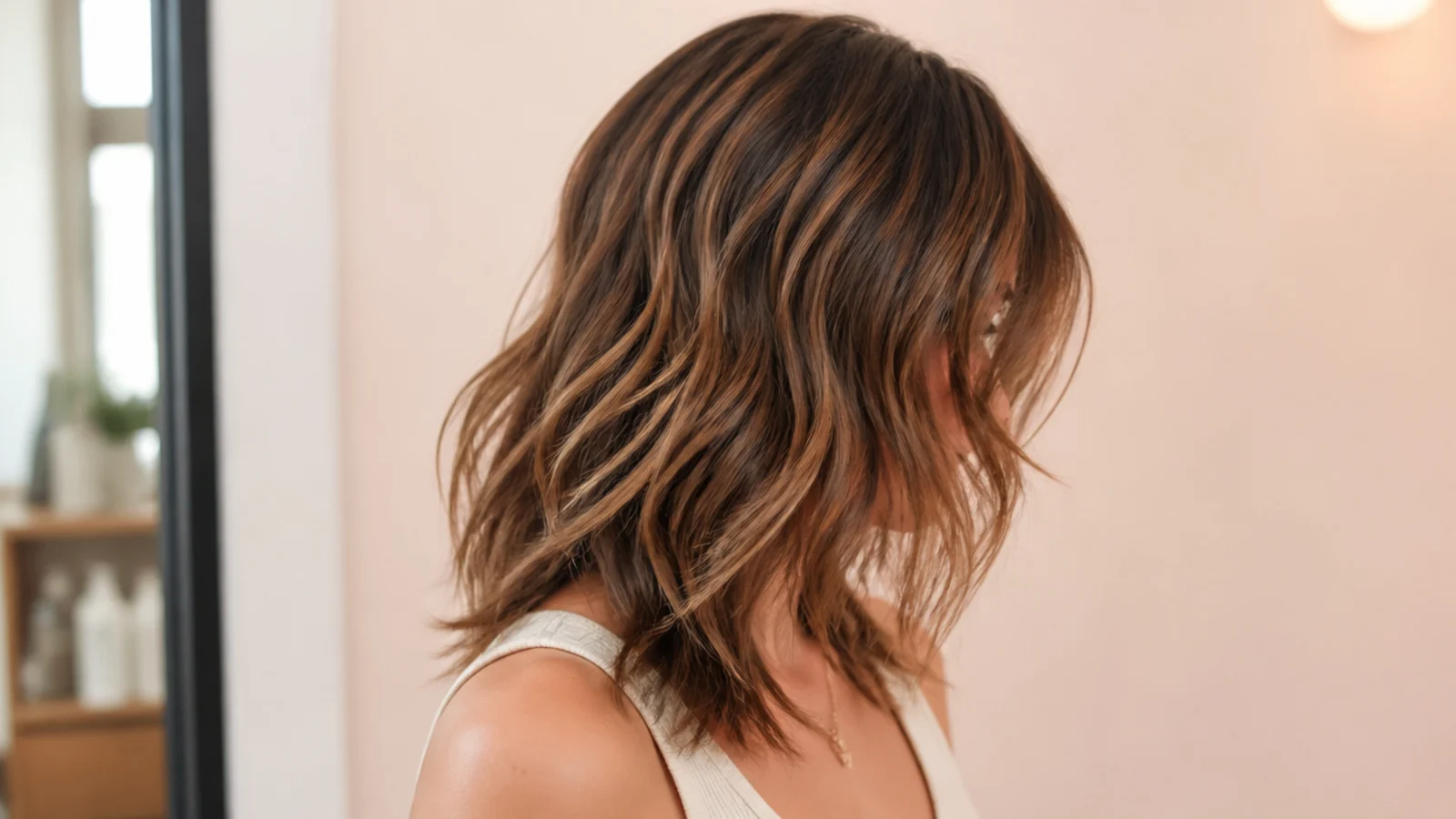
2B waves form a defined S from mid-shaft down, and a shag is arguably the best cut they can have, because the layers remove the weight that was flattening the wave at the root. Keep the perimeter at collarbone when dry, knowing it will sit an inch or two higher than it hangs wet. Layers should be cut with the wave pattern visible rather than combed straight, so each piece lands where it will actually live. Air-dry with mousse and you are done. More wave-specific detail sits in wavy mid length haircut.
Who it suits: 2B waves that go flat at the root and puffy at the ends.
Tip: Ask for the cut to be finished dry so the stylist can see where each wave springs to.
6. Curly Shag Cut Dry for 3A Curls
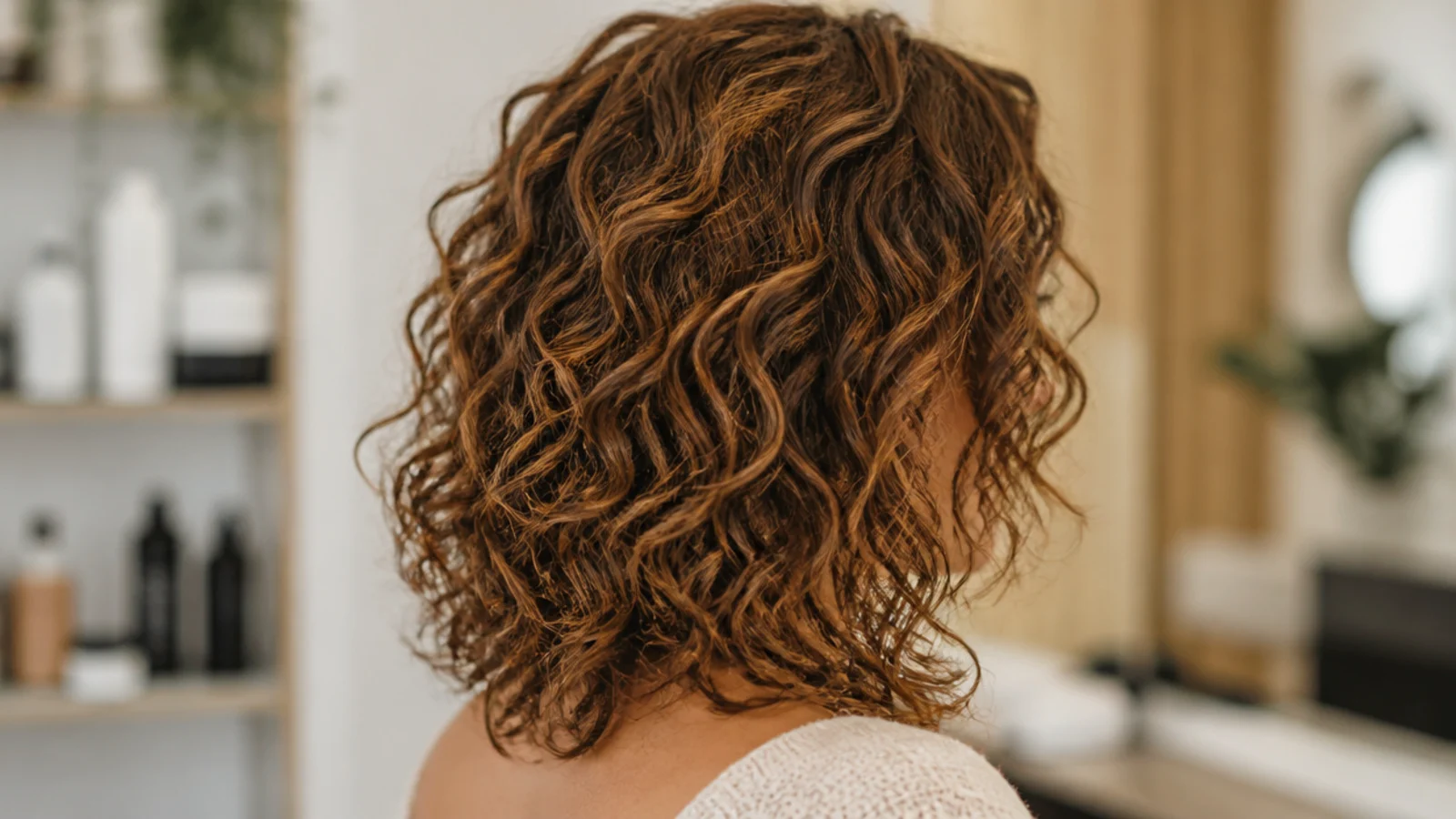
On 3A curls a shag has to be cut dry and curl by curl, because wet curly hair hangs 3 to 5 inches longer than it sits once it springs, and a wet cut to the collarbone routinely lands at the chin. Cutting dry also lets the stylist remove bulk from the sides, where curly hair collects width and forms the triangle, without shortening the outline you actually see. The crown layers should be rounded rather than stacked square, so the top stays a dome and not a mushroom cap.
Who it suits: 3A to 3B curls that go triangular in a one-length cut.
Tip: Arrive with hair styled the way you normally wear it, fully dry, no updo the night before.
7. Shaggy Mid Length Haircut for Thick Hair

Thick hair is the shag's natural home, because a shag is fundamentally a weight-removal cut. The problem it solves is the shelf of bulk that collects at shoulder level and flares the silhouette outward. The fix is internal weight removal taken from underneath the top layer so the surface stays smooth, plus layers stacked from the chin down through the crown. Done right, a thick shag loses a genuine amount of drying time. Done wrong, with thinning shears on the surface, it frizzes into a halo of broken ends that takes a year to grow back.
Who it suits: Thick, dense hair that gets wide at the shoulder.
Tip: Say remove weight from underneath, keep the top surface smooth, so the shears stay off your outer layer.
8. Bardot Shag With Round Crown Volume
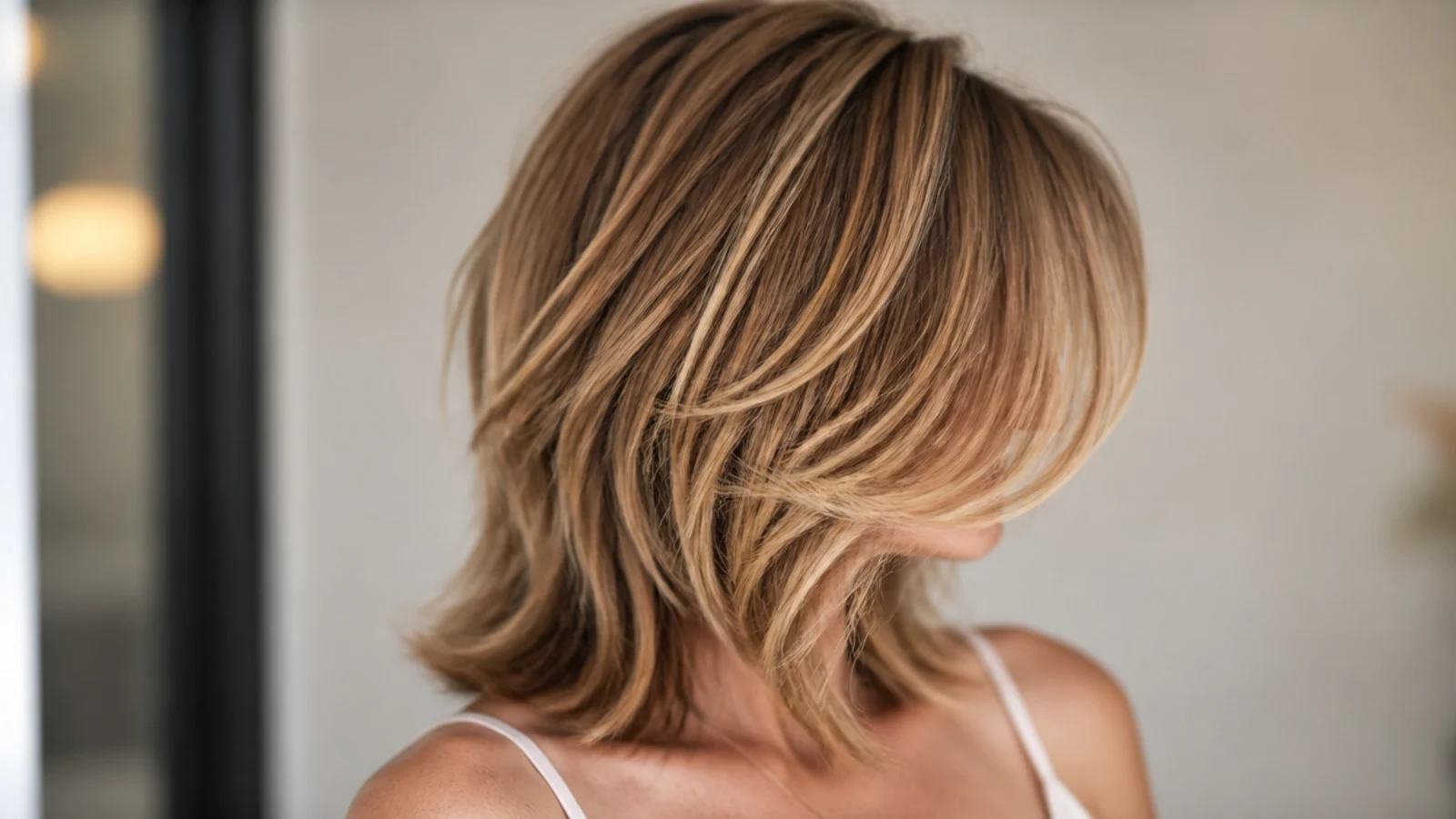
The romantic end of the shag family. The crown is deliberately built round and high, the fringe is soft and swept rather than blunt, and the ends are left fuller than a rocker shag so the shape reads soft rather than spiky. It is the shag that photographs best and takes the most work, because the crown volume is created at the blow dry rather than at the cut, using a 2 inch round brush and about 8 minutes on the top sections only. Velcro rollers left in for 10 minutes while you do your makeup do the same job.
Who it suits: Medium to thick hair, heart and oval face shapes, evening styling.
Tip: Set two Velcro rollers at the crown while the hair is still warm, then let it cool before you unroll.
9. Shaggy Mid Length Haircut With Bottleneck Bangs
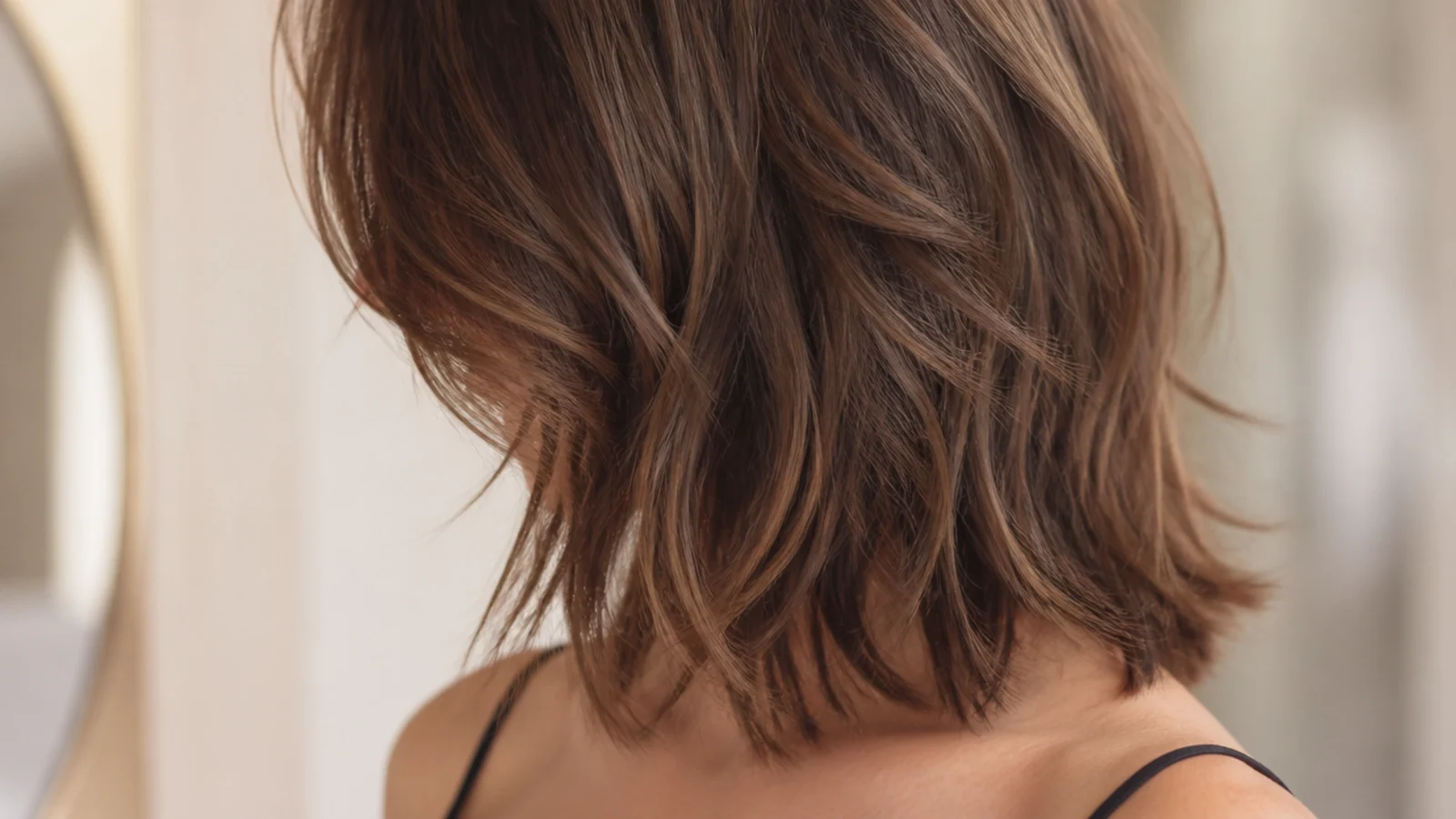
A bottleneck fringe is shorter and rounded in the center, roughly at the eyebrow, then flares out sharply to cheekbone length at the sides. It is the gentlest full fringe there is, because the narrow center gives the impression of bangs while the long sides keep an escape route. On a shag it is a very effective pairing, since the flare merges straight into the face-framing layers with no visible step. Expect a fringe trim every 3 to 4 weeks to keep the center from creeping into your lash line.
Who it suits: Anyone curious about bangs but nervous about commitment.
Tip: Ask for the sides of the fringe to connect into the face-framing, not sit separately on top of it.
10. Wolf Cut Shag for Round Faces
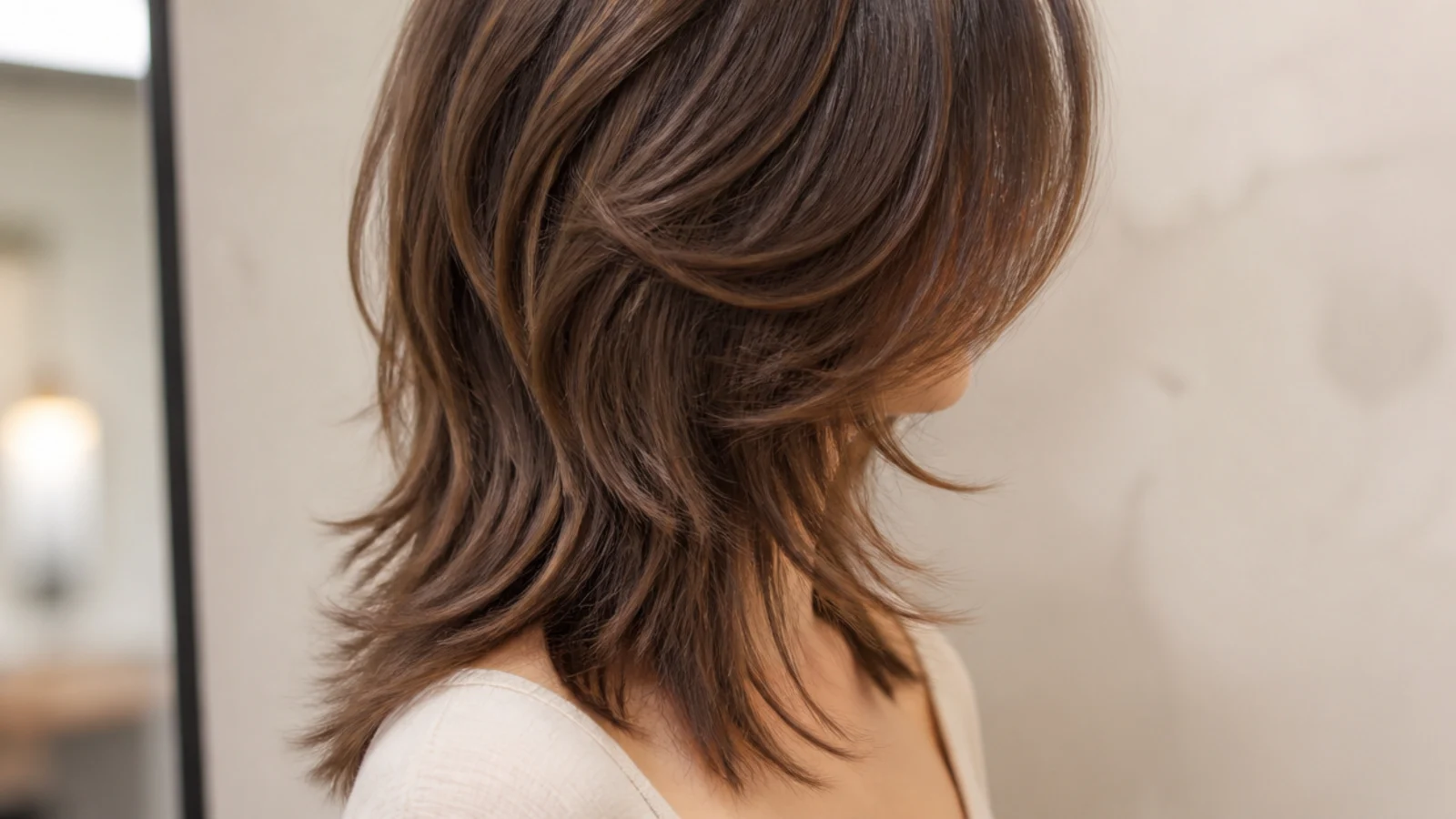
The wolf cut is the shag's more aggressive cousin: the crown layers are disconnected rather than blended, so there is a visible step between the short top and the long bottom. On a round face that vertical break is genuinely useful, because it pulls the eye up and down instead of across the widest point. Keep the face-framing starting below the chin, never at the cheekbone, and keep the perimeter at or below the shoulder. Just know the trade-off: a disconnected crown takes 9 to 12 months to grow back into one length.
Who it suits: Round and square faces with medium to thick density.
Tip: Ask for a soft disconnection, about an inch of step, rather than a full two-tier break.
11. Boho Shag With Face-Framing From the Jaw
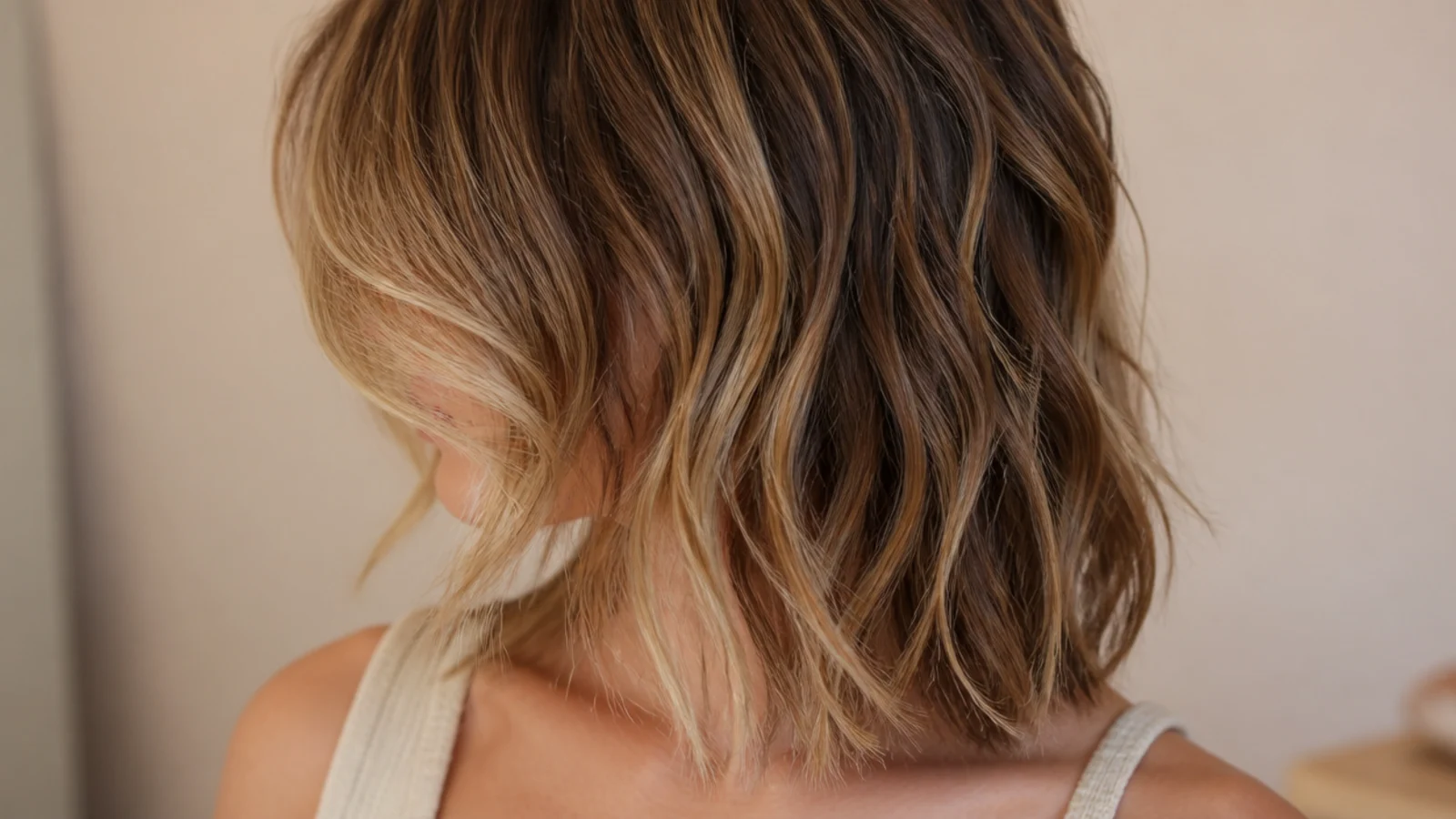
The lowest-drama shag on this list. There is no fringe at all; instead the shortest front piece starts at the jaw and sweeps back, which opens the face without costing you any length or any styling time. Interior layers stay long and blended, and the ends get point cut for separation. This is the version that grows out most gracefully, because a jaw-start piece reaches the collarbone in roughly 5 months and blends in on its own. The lived-in styling matches beach hairstyles almost exactly.
Who it suits: Anyone who wants shag texture with a plain-cut maintenance schedule.
Tip: Say face-framing starting at the jaw, not at the cheekbone, so it never behaves like a fringe.
12. Shaggy Mid Length Bob Just Above the Collarbone
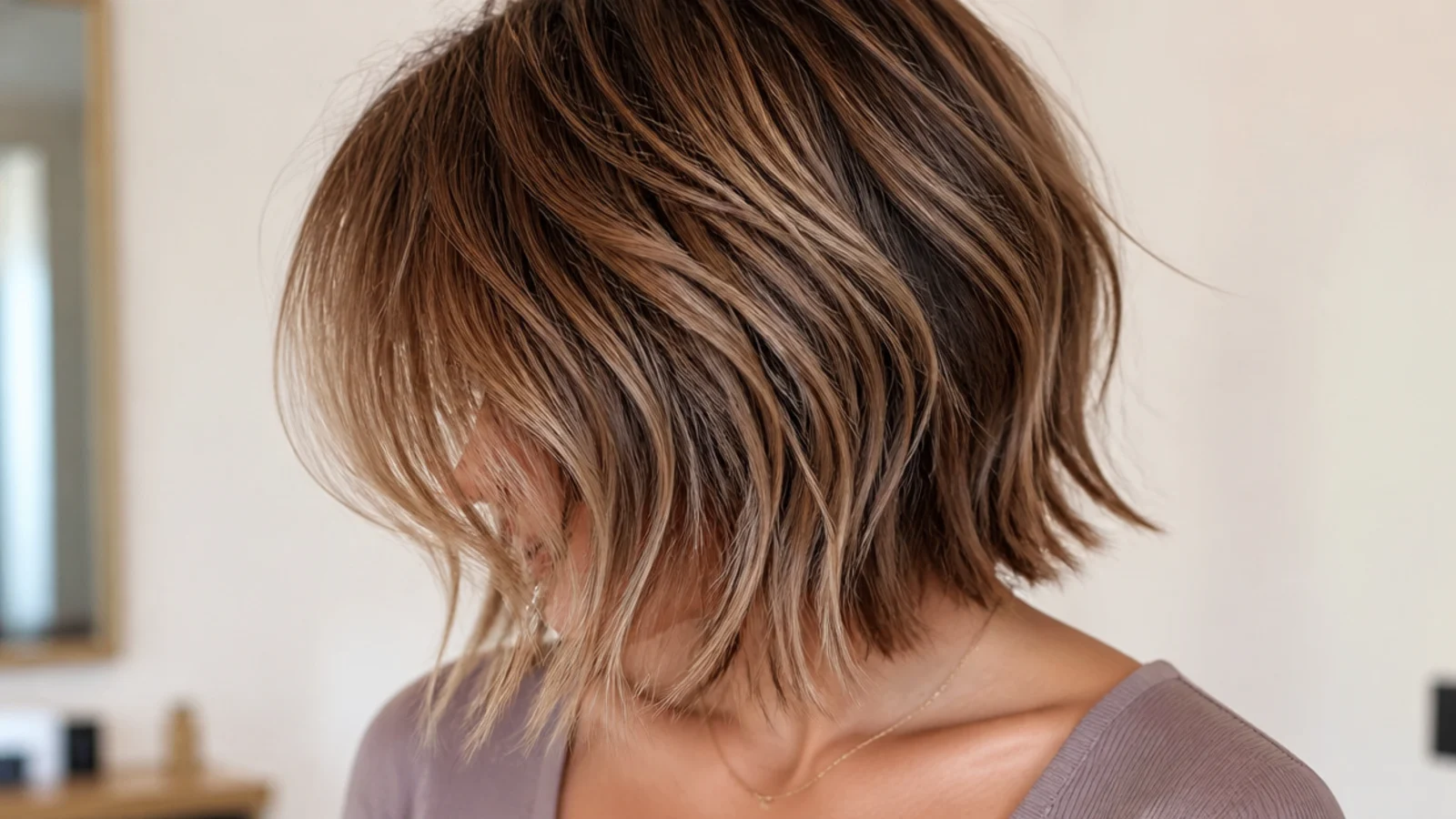
The shortest cut that still counts as mid length. The perimeter ends about an inch above the collarbone, the crown layers start at the cheekbone, and the ends are chopped hard so the bottom line breaks up. Because there is less length pulling the hair down, this version holds crown volume better than any other shag here, which makes it the strongest choice for hair that goes flat by lunchtime. It is also the fastest to dry, roughly 10 minutes with a diffuser on medium heat.
Who it suits: Flat-rooted hair, long face shapes, anyone impatient with drying time.
Tip: Check the perimeter length in the mirror at eye level before the blow dry, while it is still fixable.
13. Razored Shag for Coarse Straight Hair

A straight razor tapers each section to a fine point instead of cutting it flat, which is exactly what heavy coarse straight hair needs to look like it moves. The ends feather rather than sit in a blunt block, and the crown layers lose bulk without losing shape. The rule is hair type: razoring is superb on coarse and thick, acceptable on medium, and genuinely bad on fine or chemically lightened hair, where it splits the cuticle and the ends fray within weeks. Ask whether your stylist razors regularly before agreeing.
Who it suits: Coarse, dense, virgin or minimally colored straight hair.
Tip: If your ends are bleached, ask for point cutting with shears instead and skip the razor entirely.
14. Shaggy Mid Length Haircut for Square Faces
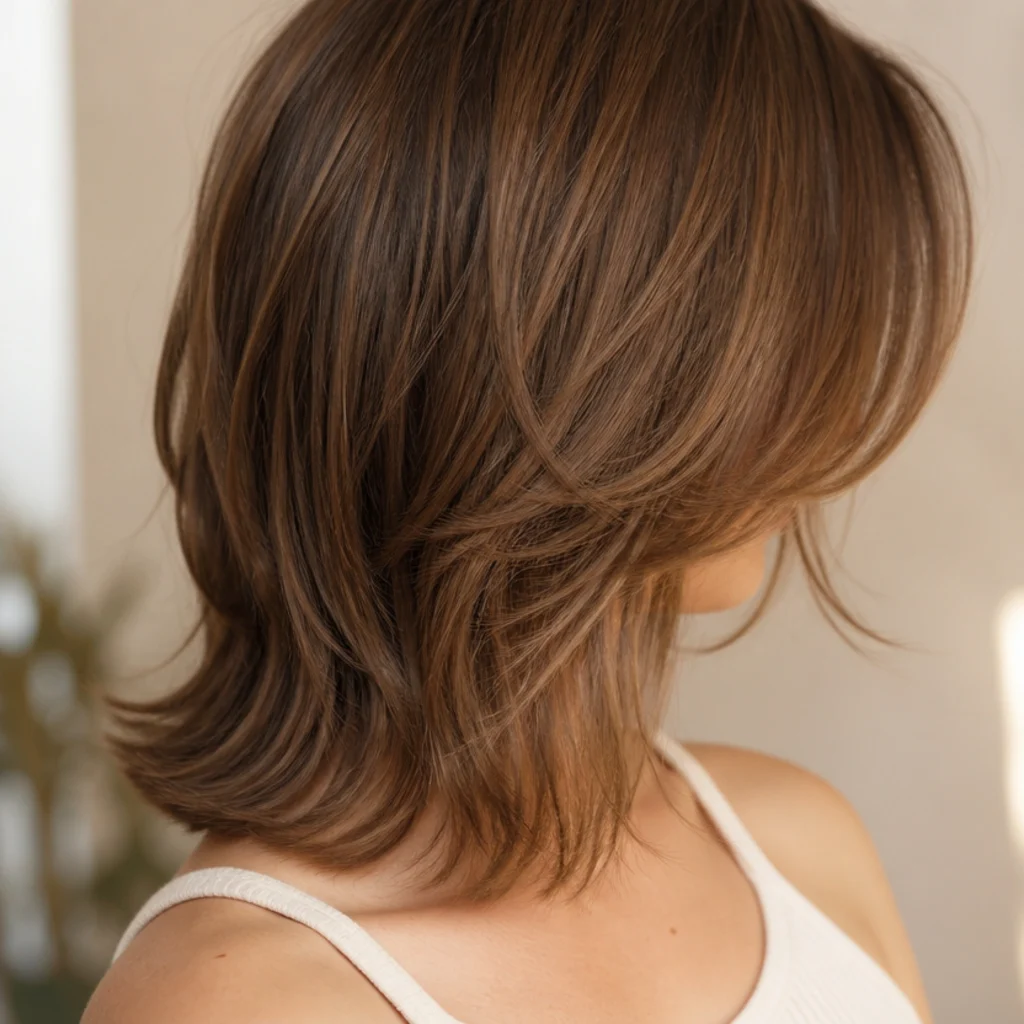
A square jaw wants curves crossing it, not lines echoing it. So the face-framing starts at the jaw and curves inward toward the chin rather than falling straight, and the fringe stays soft and side-swept instead of blunt across the brow. The perimeter is best at collarbone or slightly below, where it sits away from the jaw line entirely. Avoid a blunt chin-length front piece, which draws a horizontal line at the widest point of the face and makes the angle read stronger than it is.
Who it suits: Square and rectangular faces with a defined jawline.
Tip: Ask for the front pieces to be curved in with a round brush at the finish so the shape is visible.
15. Grown-Out Shag With Invisible Layers
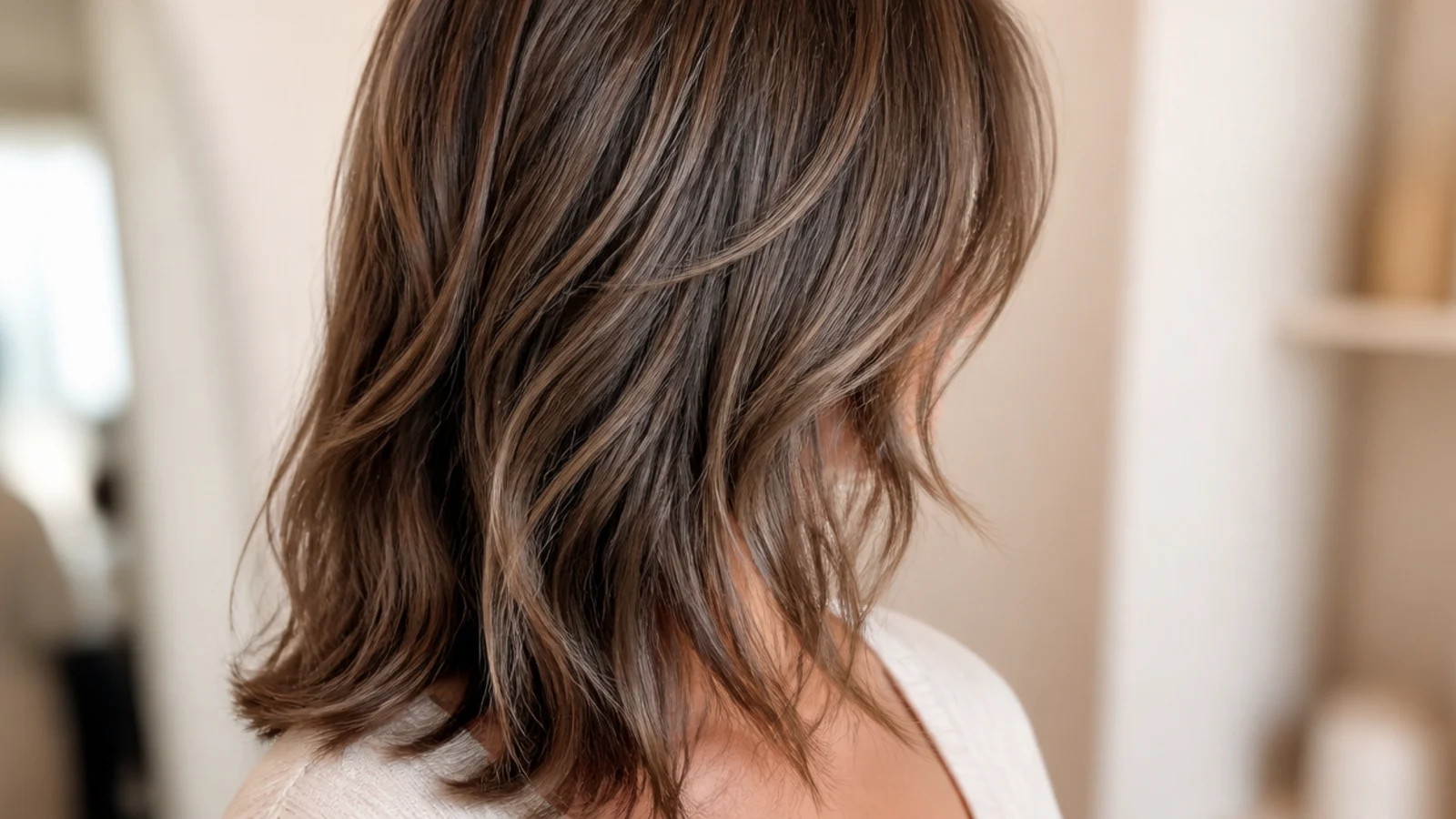
The low-maintenance shag, built to look good at week ten rather than week one. Layers are long and internal with no visible step, the crown stack is minimal, and the texture comes from point cut ends rather than from stacked lengths. It stretches the trim window from 8 weeks out to 12, which is roughly one salon visit a year saved. It also solves the shag's real failure mode, since there is no high crown layer to widen into a mushroom as it grows. Layer mechanics are covered in mid length haircut layers.
Who it suits: Anyone who wants the look without an 8 week salon habit.
Tip: Ask for invisible layers with point cut ends, and name the shortest interior layer at the chin.
16. Shaggy Mid Length Haircut With a Middle Part
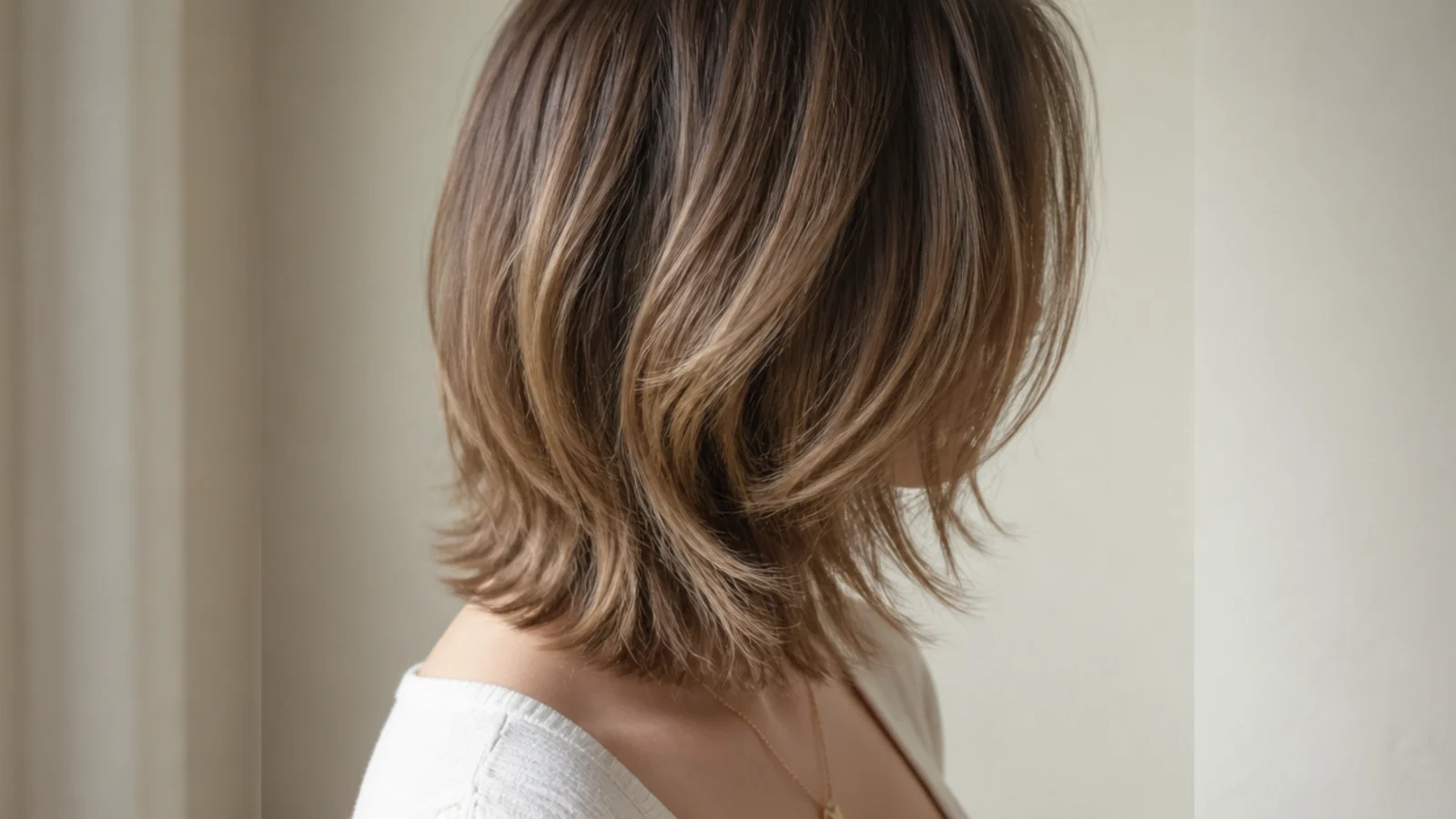
A center part turns the shag symmetrical, which suits oval and heart faces and looks deliberately editorial. The cut has to be balanced for it: layers matched on both sides, and face-framing that starts at exactly the same point left and right, usually the jaw. The catch is root volume, since a center part flattens the crown more than any other parting. The fix is drying the first inch of root in the opposite direction for 30 seconds, then dropping it back into the center, which lifts it without a single product.
Who it suits: Oval and heart faces, hair with a naturally central growth pattern.
Tip: Dry the roots against the part first, then let them fall, for lift that lasts to the evening.
17. Piecey Shag for 2C Hair Prone to the Triangle
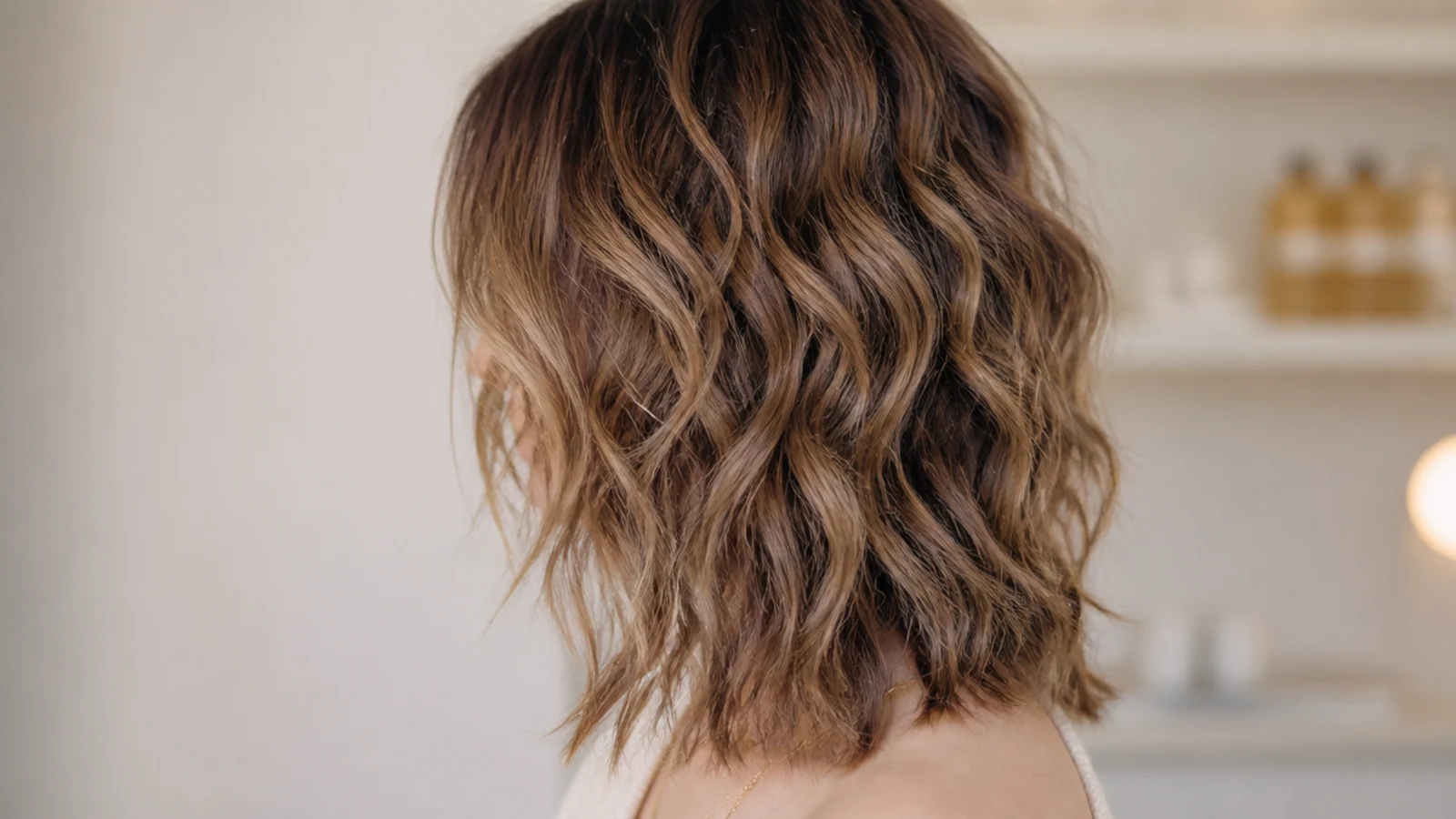
2C hair sits at the wave and curl border and its signature problem is the pyramid: flat at the crown, wide at the ends. A shag fixes it in two moves. First, weight comes out at the sides between the ear and the jaw, which is where the width actually collects. Second, the crown gets short stacked layers to build height where there was none. Ends are separated into pieces rather than left in a solid line. Do not let anyone thin the ends themselves; that is what created the frizz halo last time.
Who it suits: 2C hair that reads triangular in a blunt or one-length cut.
Tip: Point to your ears and say the width is here, take weight out at the sides, not off the ends.
18. Shaggy Mid Length Haircut for Gray or Silver Hair
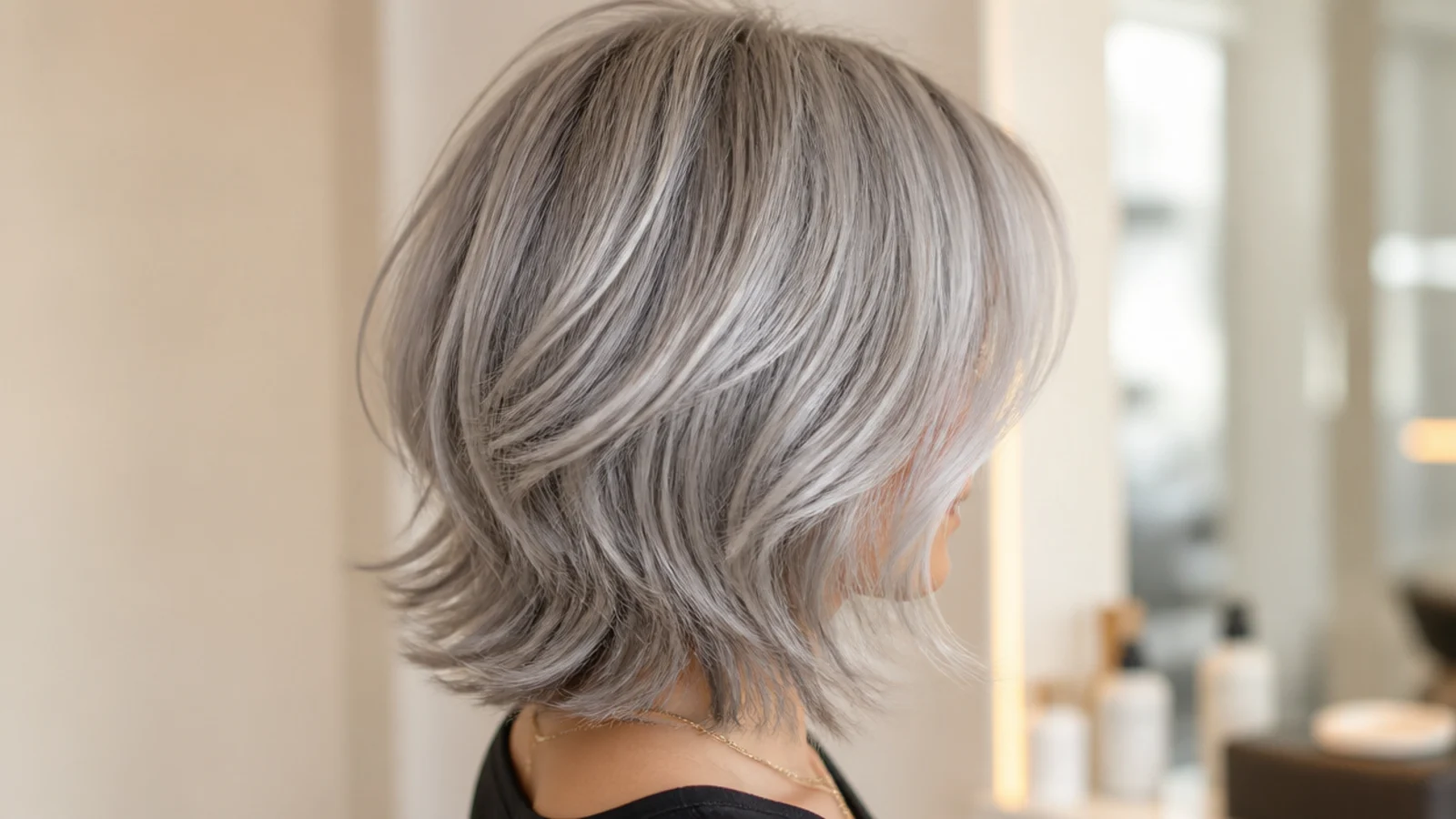
Gray hair is usually coarser and more wiry than the hair it replaced, and it often has less density at the temples, so the shag needs adjusting rather than rejecting. Keep the crown layers soft and rounded so the wiriness is not sticking up in spikes, start the face-framing at the jaw to soften the front, and keep the perimeter at collarbone where the density is still strongest. A shag is genuinely one of the better cuts for silver hair, because the texture makes the natural coarseness look intentional.
Who it suits: Silver and salt-and-pepper hair, especially coarse regrowth.
Tip: Use a violet-toned conditioner weekly so the texture reads bright silver rather than dull yellow.
19. Choppy Shag With a Money Piece

Cut and color doing one job. The shag supplies the choppy texture, and a money piece, meaning the two front sections lightened two to three levels brighter than the base, supplies the light at the face. This matters more on a shag than on other cuts, because heavy texture can read flat and shapeless in a single dark shade; the brightness at the front makes the layers legible. Note that a money piece is color only, no cutting, which is the single most common mix-up. See money piece hair colors for shade choices.
Who it suits: Dark bases that lose definition, anyone wanting brightness without full highlights.
Tip: Ask for the money piece to start at the same point as your face-framing so cut and color line up.
20. Air-Dry Shag for Low Effort Mornings

Built for people who will never own a round brush. The cut leans into whatever your hair already does: layers are cut dry so nothing is fighting the natural bend, the ends are separated so they cannot dry into a solid triangle, and there is no fringe that needs blow drying to sit right. The routine is a golf-ball-sized amount of mousse on soaking wet hair, scrunched, then hands off completely until dry. Overnight versions of the same idea are in heatless curls overnight ideas.
Who it suits: Wavy and curly hair, and anyone with a 10 minute morning.
Tip: Do not touch it while it dries; every touch before it is fully dry is one more frizz halo.
What Counts as a Shaggy Mid Length Haircut
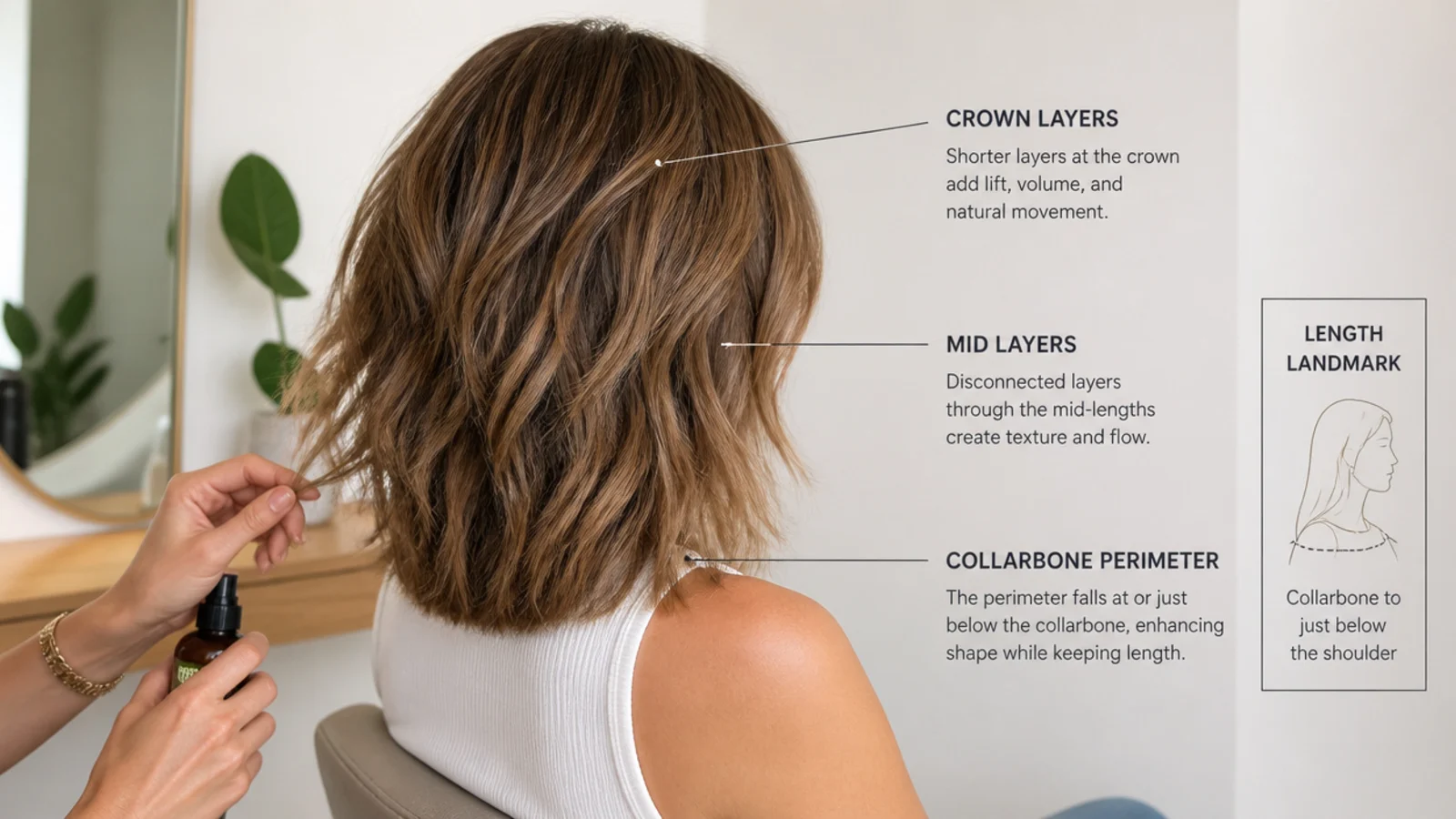
Mid length runs from the collarbone at the short end to about 2 inches below the shoulder at the long end. Name the landmark, not the word medium, because collarbone means the same thing to every stylist and medium does not. A shag then adds three specific things to that perimeter. First, short stacked layers through the crown, usually starting somewhere between the cheekbone and the chin, which is what creates the round top and the airy lift. Second, progressively longer layers down the back so the weight steps down instead of sitting in a block. Third, ends that are point cut or razored so they separate into pieces rather than closing into a line. Take any of those three away and you have a layered mid length cut, not a shag. That distinction is worth holding onto, because the word shaggy is applied loosely across the internet to anything with visible movement, and walking into a salon with the wrong photo is how people end up with three inches gone.
Shag vs Wolf Cut vs Butterfly Cut vs Hush Cut
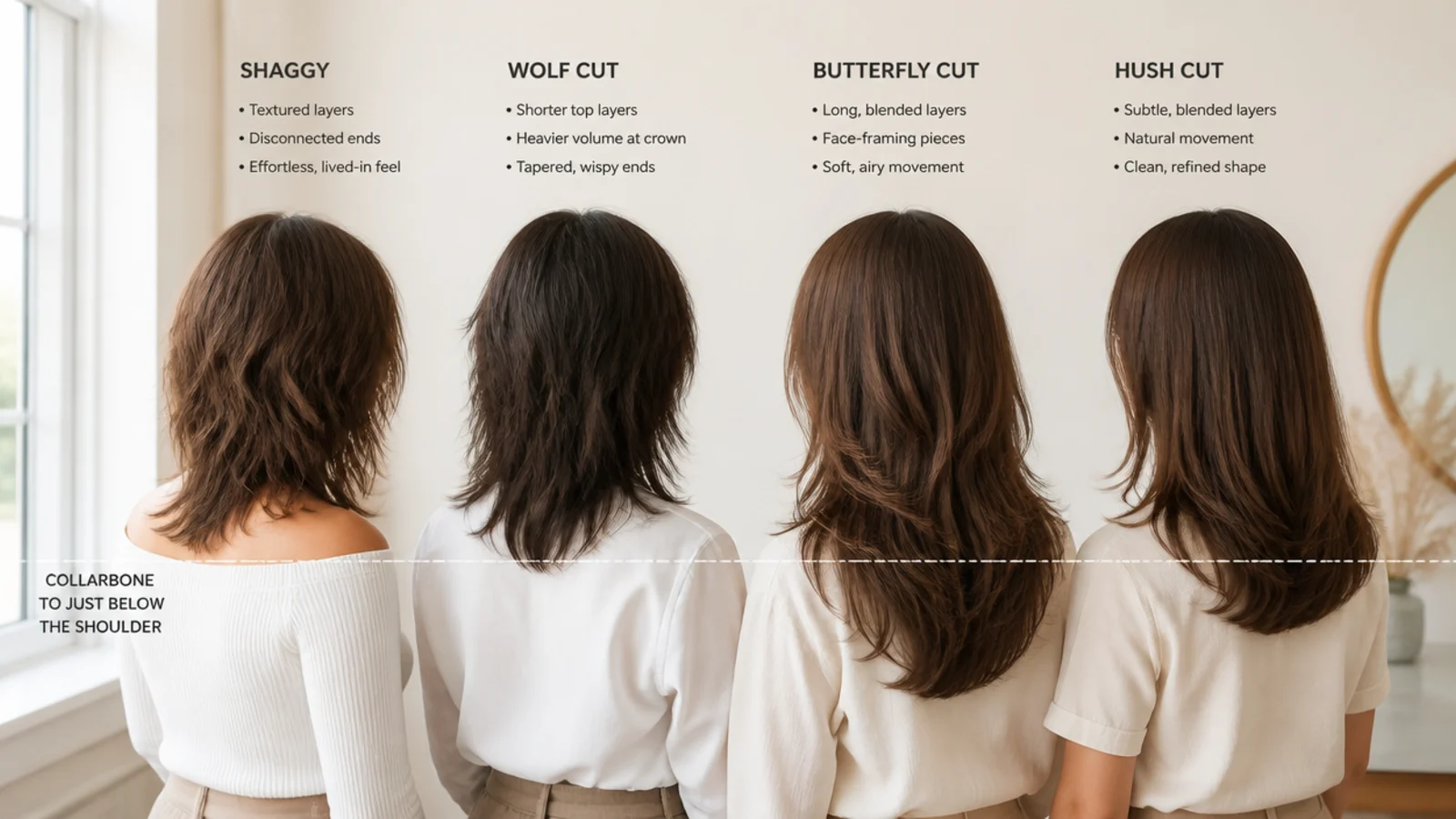
These four names get used interchangeably and they are not the same cut. A shag has blended layers through the crown and a lot of texture at the ends; the layers step down without a visible break. A wolf cut takes the same shape and disconnects it, leaving a deliberate step of an inch or more between the short top and the long bottom, which is why it looks half mullet from the back. A butterfly cut is not really a shag at all: it is long face-framing layers cut to sit at chin and collarbone level over an untouched long perimeter, engineered to look like a mid length cut when curled and to fall straight back to long hair when you tie it up. A hush cut is the softest of the four, with wispy curtain bangs and long feathered layers and almost no crown stack. In upkeep order, from lowest to highest: hush, butterfly, shag, wolf. In regret order, from most forgiving to least: butterfly, hush, shag, wolf.
Shaggy Mid Length Haircut by Face Shape
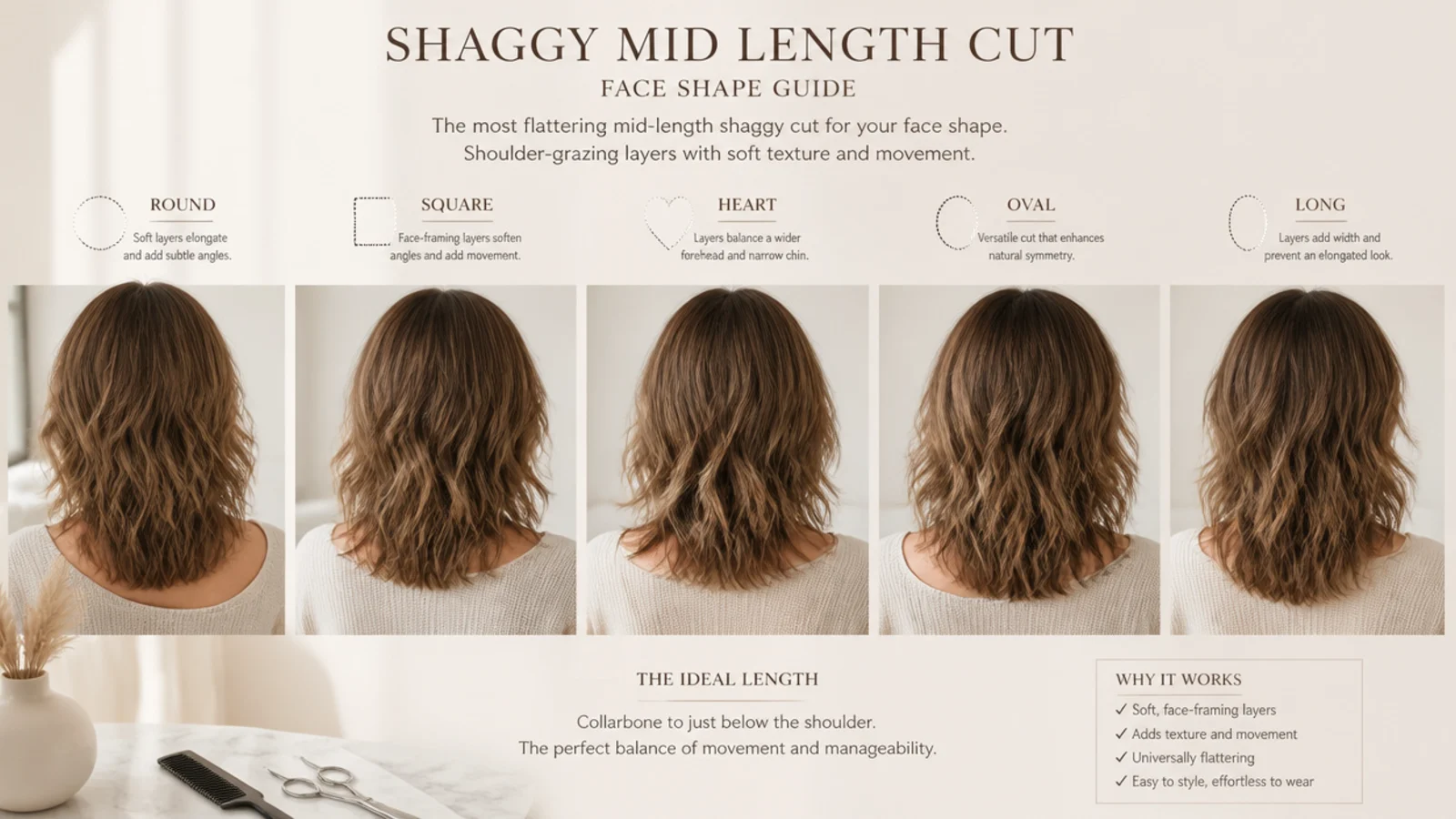
Face shape does not change the perimeter, it changes where the shortest front piece starts and how much crown height you want. On a round face, start the face-framing below the chin so the line runs past the widest point rather than across it, and keep some crown height, since vertical volume counters horizontal width. On a square face, start at the jaw and curve the pieces inward so they cross the angle instead of echoing it, and keep the fringe side-swept rather than blunt. On a long or oblong face, do the opposite: keep crown height low, because a high round crown adds length you do not need, and add a full or bottleneck fringe for a horizontal break. On a heart face, where the forehead is wide and the chin narrow, curtain bangs plus a fuller end at collarbone level balances the taper. Oval faces genuinely take all of it, so choose on hair type instead. If you are unsure which family you are in, hairstyle for your hair type works as a second filter, and the face-shape section in mid length haircut goes deeper.
Shag Layers, Face-Framing, and Exactly How to Ask Your Stylist
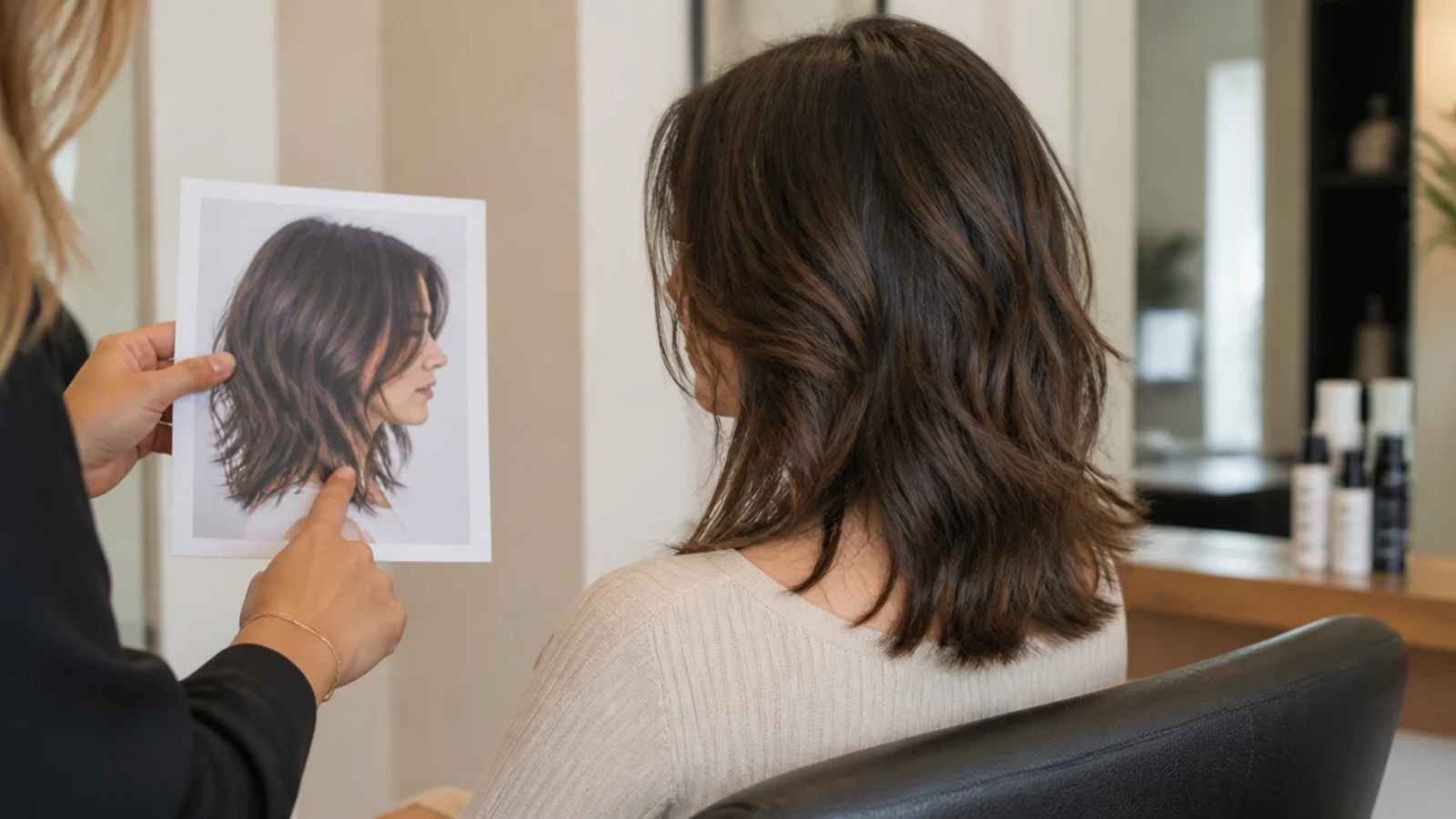
A shag contains four decisions: the perimeter, the crown, the front, and the finish on the ends. Say all four and you will get the photo. The wording that works is this: collarbone length, shortest crown layer at the chin, face-framing starting at the jaw, ends point cut for separation. Perimeter first, because that is the number you cannot get back. Then the crown, where the number that matters is the shortest layer, since that single measurement controls how high and how wide the top sits. Then the front, where cheekbone-start behaves like a fringe and needs styling, jaw-start opens the face and grows out gracefully, and collarbone-start is so subtle you may not see it. Then the finish, where point cutting is safe on every hair type and razoring belongs only on coarse, uncolored hair. Three things people confuse constantly are worth separating out loud: face-framing layers are cut, curtain bangs are a fringe with a center part, and a money piece is color with no cutting at all. Ask to see the perimeter at eye level before the blow dry, while it is still fixable.
Shaggy Mid Length Haircuts for Fine, Thick and Curly Hair
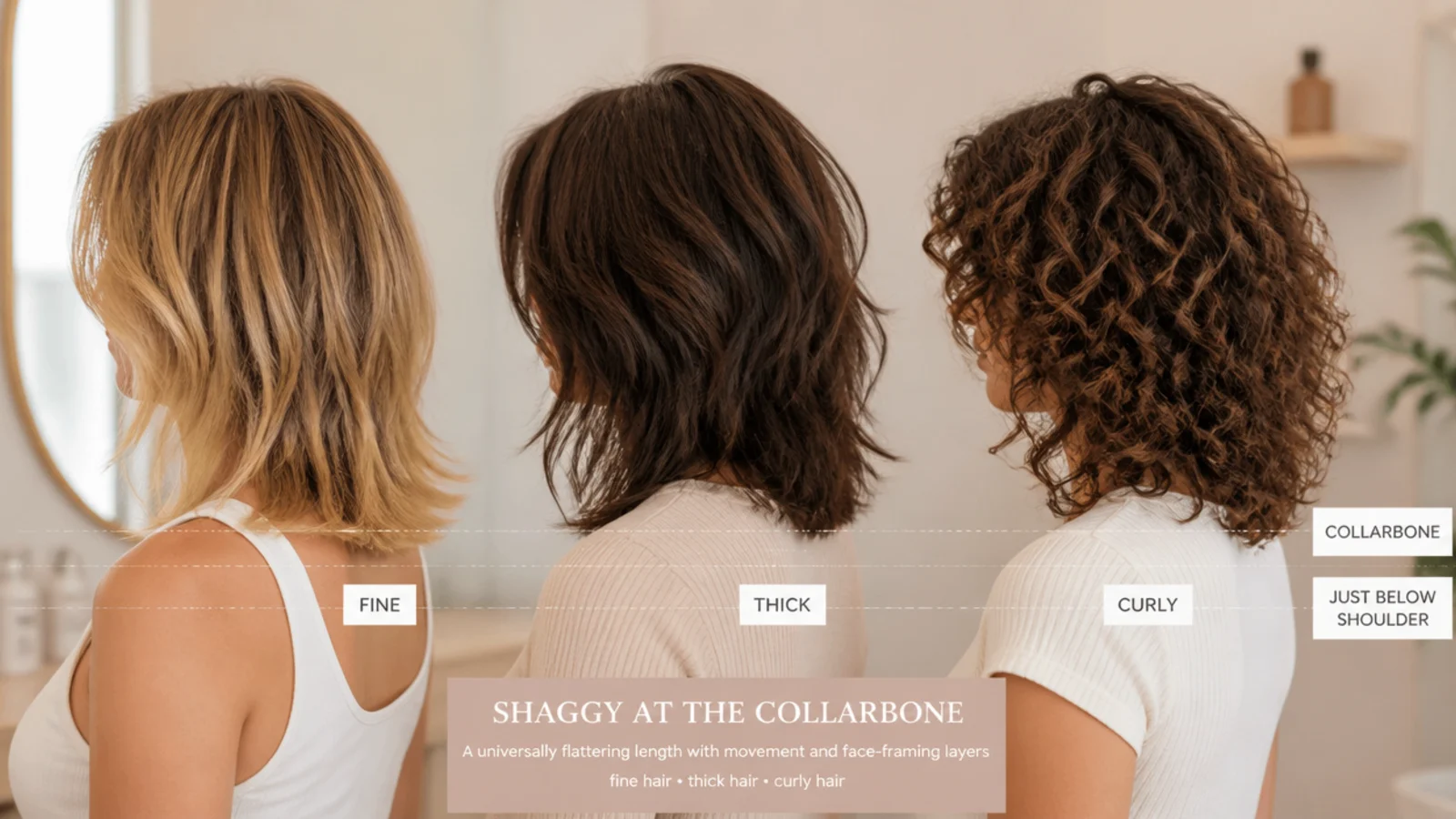
The shag is not equally good on all hair, and pretending otherwise is why so many people hate theirs. Fine hair wants fewer, longer layers, because every extra layer divides a limited number of strands across more lengths and the ends go sparse. Two long layers, a blunt perimeter, no thinning shears, and all the shag character coming from the fringe. Thick hair has the opposite problem, weight collecting at the shoulder and flaring the silhouette into a triangle, and the fix is internal weight removal taken from under the top layer so the surface stays smooth. Curly hair should be cut dry, curl by curl, because wet hair hangs 3 to 5 inches longer than it will sit once it springs, and a wet cut to the collarbone routinely lands at the chin. Coily hair adds a further step, since shrinkage of 50 to 75 percent means the agreed length has to be labeled stretched or shrunken out loud. Fine straight hair is the one combination that genuinely struggles with a full shag, since there is no natural texture to fill the gaps the layers create, and the cut only works with a daily texture product.
Styling a Shag Day to Day, and Growing One In or Out
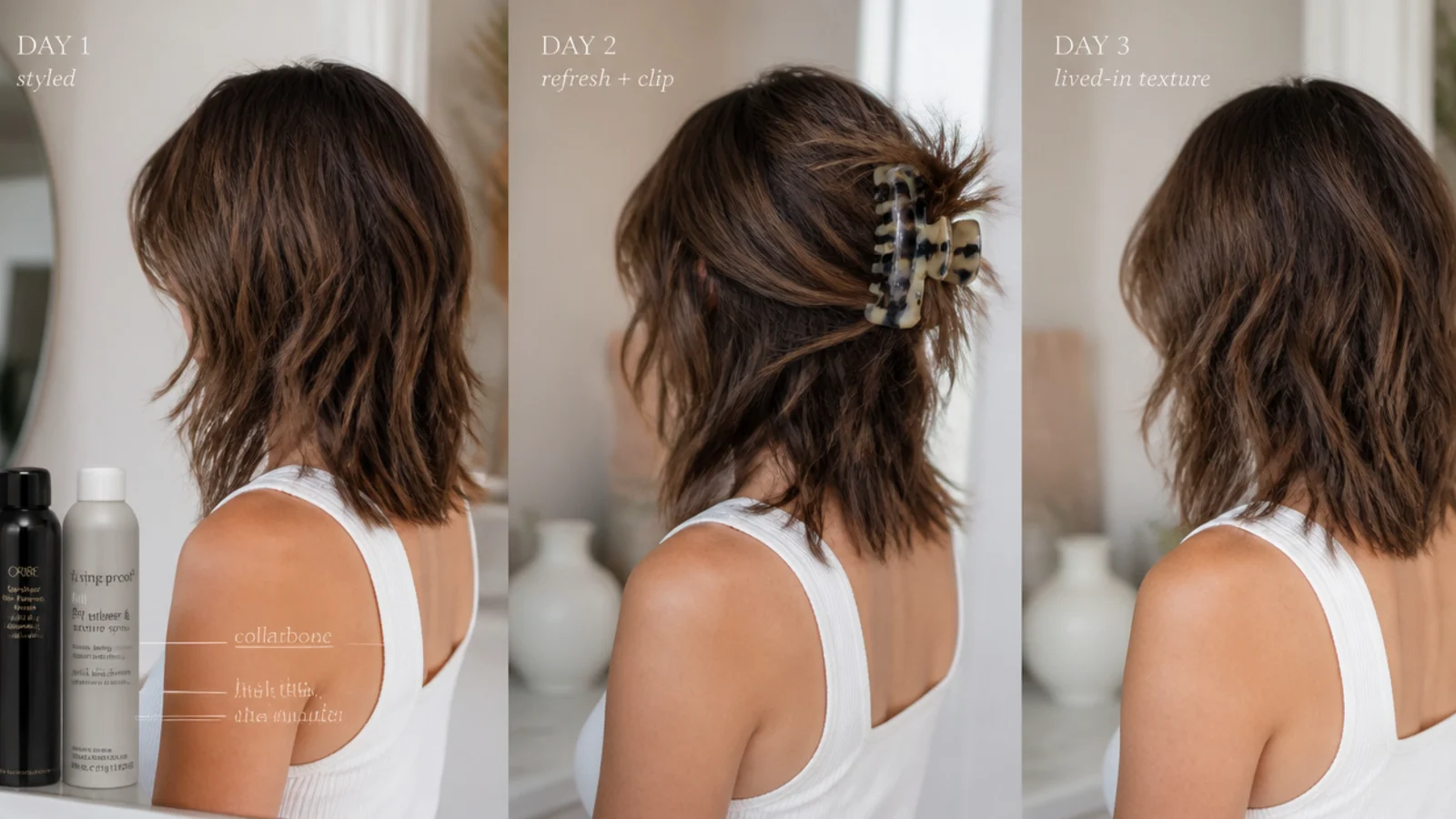
A shag is the most product-dependent cut on this board, and nobody says so. Budget one mousse for wash day, applied to soaking wet hair and scrunched, and one dry texture spray for days two and three, misted at the mid-lengths and shaken out. Total styling time runs 5 to 12 minutes, versus 0 to 5 for a blunt lob. Skip the products and a shag on straight hair reads unfinished rather than undone. The grow-out story matters just as much. Hair grows about half an inch a month, so the crown layers you cut at the chin reach the collarbone in roughly 6 months, and the failure point arrives around week eight, when those layers have widened enough to give the top a mushroom outline. That is the real reason the trim cadence is 8 to 10 weeks rather than the 8 to 12 a plain mid length cut can stretch to. Growing a shag out entirely takes 9 to 12 months if it was disconnected, or about 5 to 6 if the layers were blended. Keep dusting the perimeter a quarter inch every 10 weeks while you grow, and styling ideas that carry you through sit in 5 minute everyday hairstyle and ponytail styles.
Frequently Asked Questions
What is a shaggy mid length haircut?
It is a collarbone to just-below-shoulder cut with short stacked layers through the crown, progressively longer layers down the back, and ends that are point cut or razored so they separate. The crown stack is what makes it a shag rather than a layered cut. Take that away and you have a layered mid length haircut with texture.
What is the difference between a shag and a wolf cut?
A shag blends its crown layers into the length so there is no visible break. A wolf cut deliberately disconnects them, leaving a step of an inch or more between the short top and the long bottom, which is why it reads half mullet from behind. The wolf cut is bolder, needs more daily styling, and takes 9 to 12 months to grow out.
Does a shag haircut suit fine hair?
Only a softened version. A full choppy shag divides a limited number of strands across too many lengths and the ends go see-through within weeks. Ask for two long layers, the shortest starting about 4 inches below the chin, a blunt perimeter, and no thinning shears. Let the fringe and face-framing carry the shag character instead of the interior.
How do I ask for a shaggy mid length haircut?
Say all four decisions out loud: collarbone length, shortest crown layer at the chin, face-framing starting at the jaw, ends point cut for separation. Perimeter first, because it is the number you cannot take back. Bring two photos, one from the front and one from the back, since the back is where a shag is actually built.
How often should I trim a shag haircut?
Every 8 to 10 weeks, which is slightly tighter than the 8 to 12 a plain mid length cut can stretch to. The crown layers widen as they grow and around week eight they start giving the top a mushroom outline. If you want longer between visits, ask for a grown-out shag with long invisible layers, which holds shape to about 12 weeks.
Should curly hair be cut wet or dry for a shag?
Dry, curl by curl. Wet curly hair hangs 3 to 5 inches longer than it sits once it dries and springs, so a wet cut to the collarbone routinely lands at the chin. A dry cut also lets the stylist take bulk out at the sides where the triangle forms, without shortening the outline you actually see in the mirror.
Will a shaggy haircut suit a round face?
Yes, if the shortest front piece starts below the chin rather than at the cheekbone, and you keep some height at the crown. Vertical volume counters horizontal width, which is why the shag is often a better round-face cut than a blunt lob. Avoid a blunt fringe cut straight across the brow, which adds a horizontal line at the widest point.
How much product does a shag haircut need?
Two products, realistically. A mousse on soaking wet hair for wash day, and a dry texture spray misted through the mid-lengths on days two and three. Total styling time lands between 5 and 12 minutes. On straight hair, skipping the texture product is the difference between a shag that reads undone and one that reads unfinished.
How long does it take to grow out a shag haircut?
About 5 to 6 months if the layers were blended, and 9 to 12 months if they were disconnected as a wolf cut, since hair grows roughly half an inch a month. Keep trimming every 10 weeks while you grow it out, asking for a quarter inch dusted off the perimeter only, never a reshape, so the layers catch up to the length.
Is a shag the same as a choppy or textured haircut?
No. Choppy and textured describe how the ends are finished, using point cutting, a razor or thinning shears, and any cut can have them. A shag is a whole structure: crown stack, stepped layers, textured ends. Every shag is textured, but plenty of textured mid length cuts are not shags because they have no crown layers at all.
Which mid length haircut look are you saving?
If you take one thing from all 20 of these shaggy mid length haircut ideas, make it this: name the perimeter and the crown separately when you book. Collarbone length, shortest crown layer at the chin, face-framing starting at the jaw, ends point cut for separation. That single sentence prevents most shag regret, because the two ways a shag goes wrong are a perimeter cut shorter than you wanted and a crown stack cut higher than your density can carry. Budget a trim every 8 to 10 weeks and one texture product you actually like, and the cut earns its keep. Save the photos that match your hair type, then browse the rest of the mid length haircut hub or compare with mid length haircut layers before you commit.