Quick Comparison
| Cutting Short Curtain Bangs Yourself | Getting Short Curtain Bangs Cut at a Salon | |
|---|---|---|
| Time needed | 25 to 40 minutes for a first attempt | 20 to 30 minutes in the chair, plus travel |
| Cost | 20 to 40 dollars once, for shears you keep | Often free added to a cut, 15 to 30 dollars alone |
| Tools | 5 to 5.5 inch shears, tail comb, clips, round brush | Nothing; bring a reference photo and the script |
| Skill needed | Intermediate; the sectioning is the hard part | None, but you must describe the length precisely |
| Best textures | Straight and 2a to 2b wavy hair | 3a and curlier, coily, thinning or cowlicked hair |
| Risk if it goes wrong | 2 to 8 weeks of regrowth at half an inch a month | Low; a stylist can correct within the same visit |
| Maintenance between cuts | Trim yourself every 3 to 5 weeks in 10 minutes | Free fringe trims at most salons every 3 to 5 weeks |
| Blending into layers | Hard to judge on your own head, often stepped | Blended into your existing layers as part of the cut |
| Best for | Maintenance trims and small length adjustments | The first cut, and any change of fringe length |
1. Prep: Wash, Dry and Settle the Hair
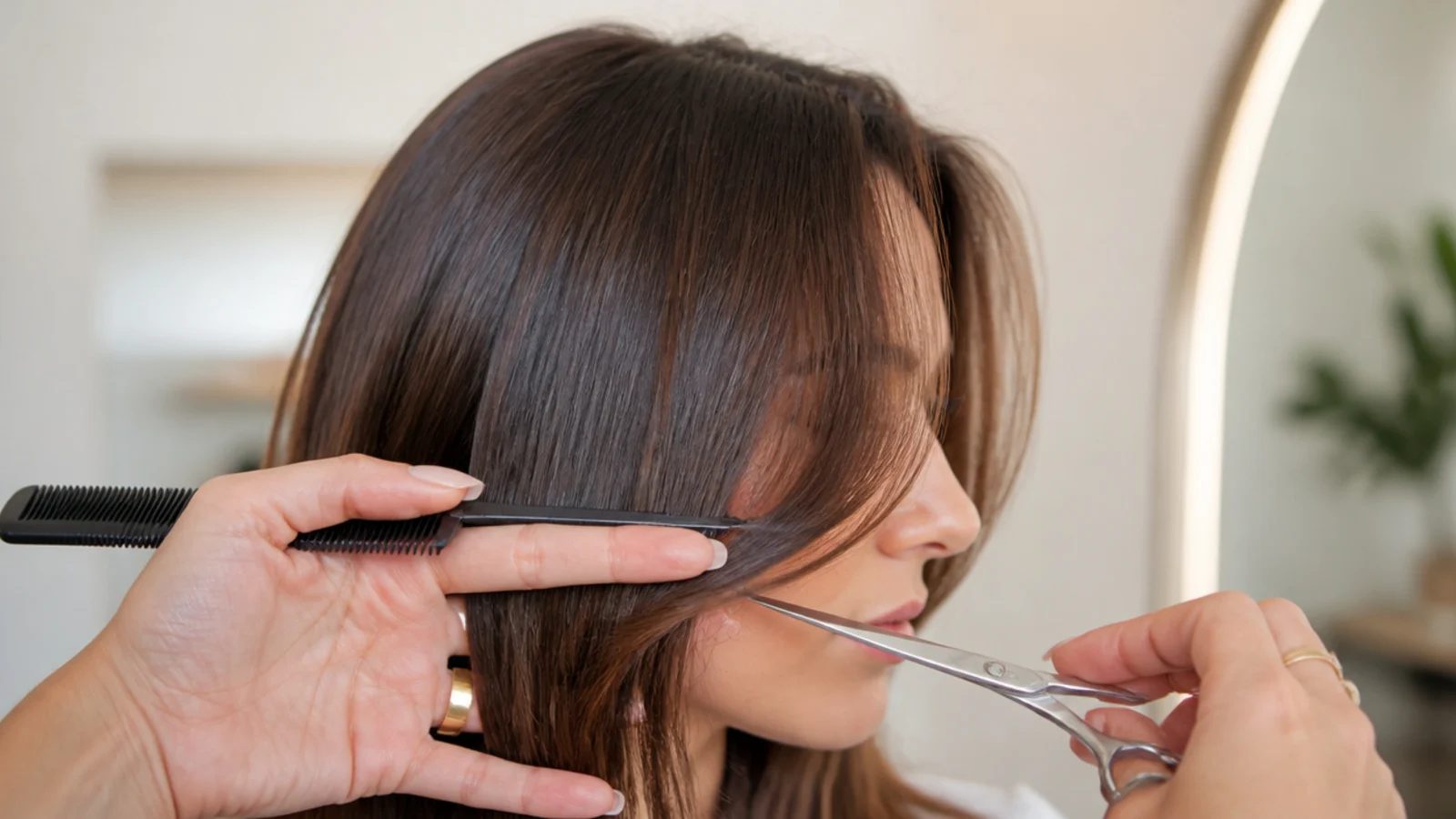
Wash and fully dry your hair, style it the way you normally wear it, and leave it for ten minutes. Lay out 5 to 5.5 inch hair shears, a fine-tooth tail comb, two clips and a 1.5 inch round brush. Work at a mirror positioned at eye level with good front light, not overhead light, which throws shadows across the fringe and hides asymmetry. Skip conditioner on the front section this one time so the hair grips between your fingers.
Common mistake: Cutting wet, which hides 0.5 to 3 inches of spring-back depending on your texture.
Pro tip: Do this in daylight. Bathroom downlights make a level fringe look sloped and vice versa.
2. Section: Part Center and Isolate a Narrow Triangle
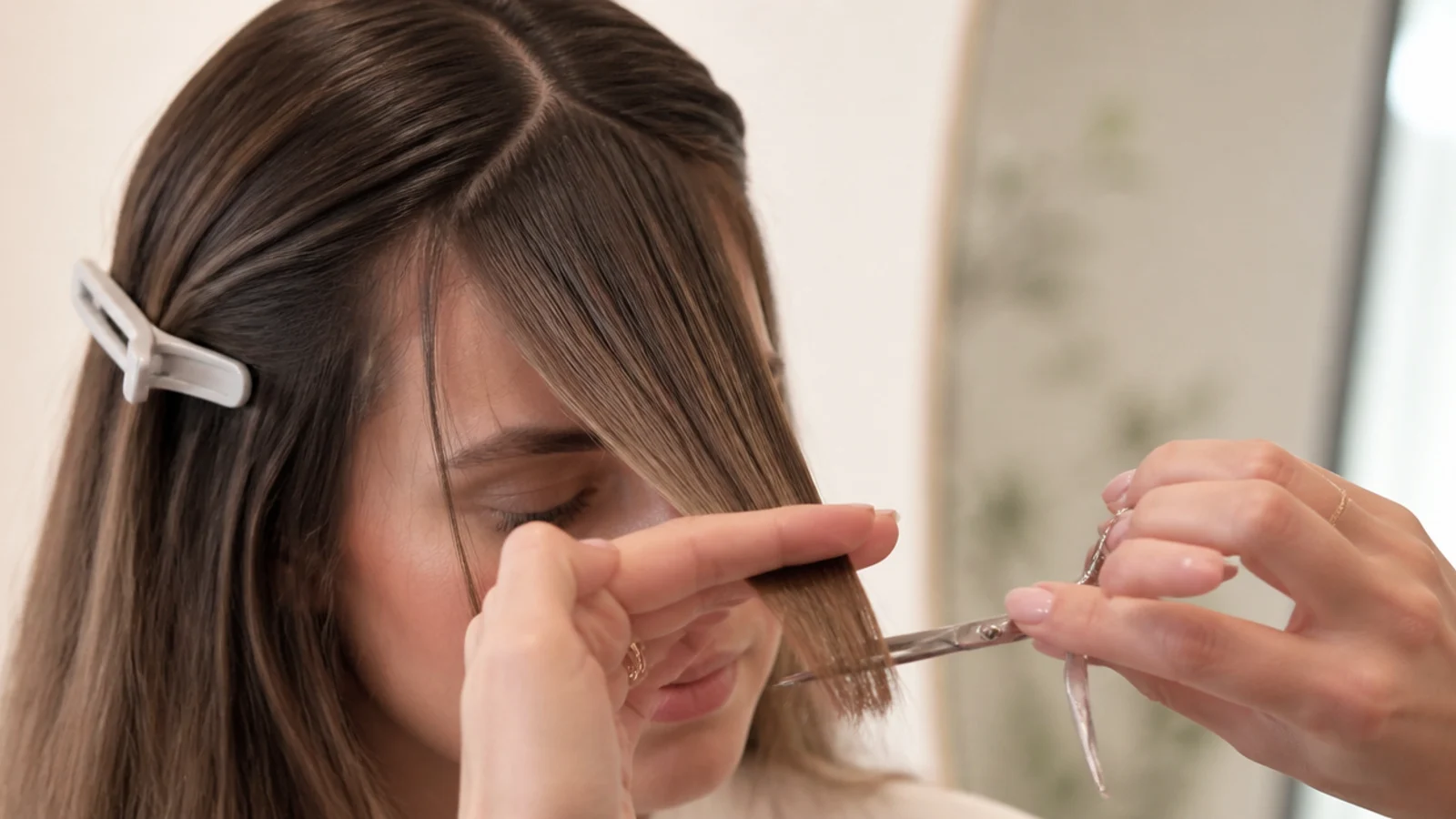
Comb a true center part back about three inches, then draw two diagonals down to the outer corners of each eyebrow so the section forms a triangle with its apex 1.5 to 2 inches back from your hairline. Clip everything outside it away in two firm sections. Narrow the apex to about an inch for fine hair and widen it to roughly 2.5 inches for thick hair, then pinch the section to sanity-check the density before you cut.
Common mistake: Taking the apex back toward the crown, which turns a curtain into a heavy full fringe.
Pro tip: A triangle apex on the part, not a rectangle, is what makes the two halves fall open.
3. Guide: Set the Shortest Point With One Thin Strand
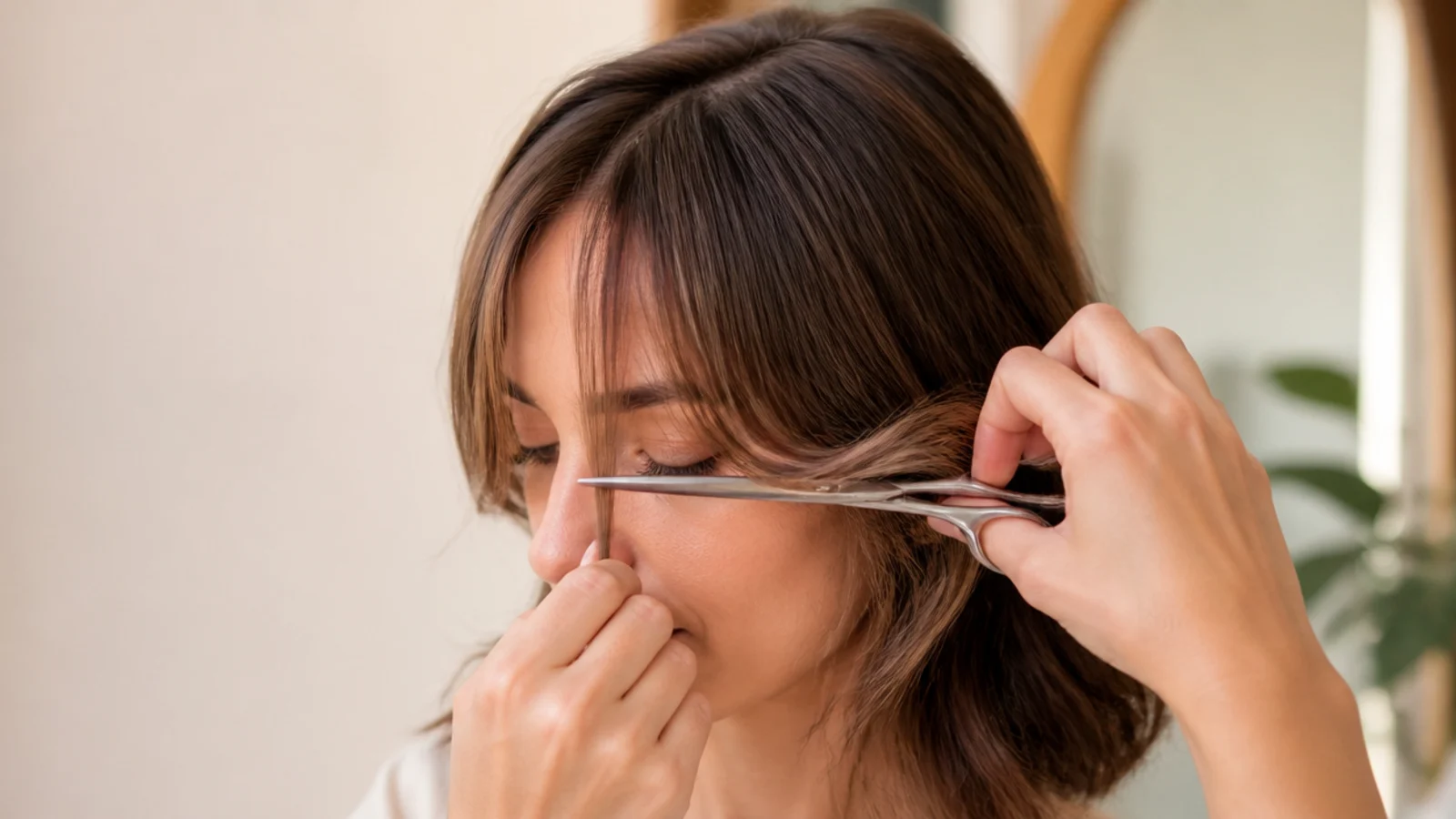
Pull a quarter inch strand from the dead center of the triangle and clip the rest aside. Comb it straight down with zero elevation and your chin level, then decide the landmark: on the brow at about 4 inches, half an inch above it for a baby fringe, or at the cheekbone at about 5 inches. Add your shrinkage allowance, a quarter inch for straight hair up to 2 or 3 inches for 3c and coilier.
Common mistake: Elevating the section before cutting, which domes the fringe into a bowl shape.
Pro tip: Hold the strand between two fingers near the ends, never up at the roots, so nothing slides.
4. Cut: First Pass, Deliberately an Inch Too Long
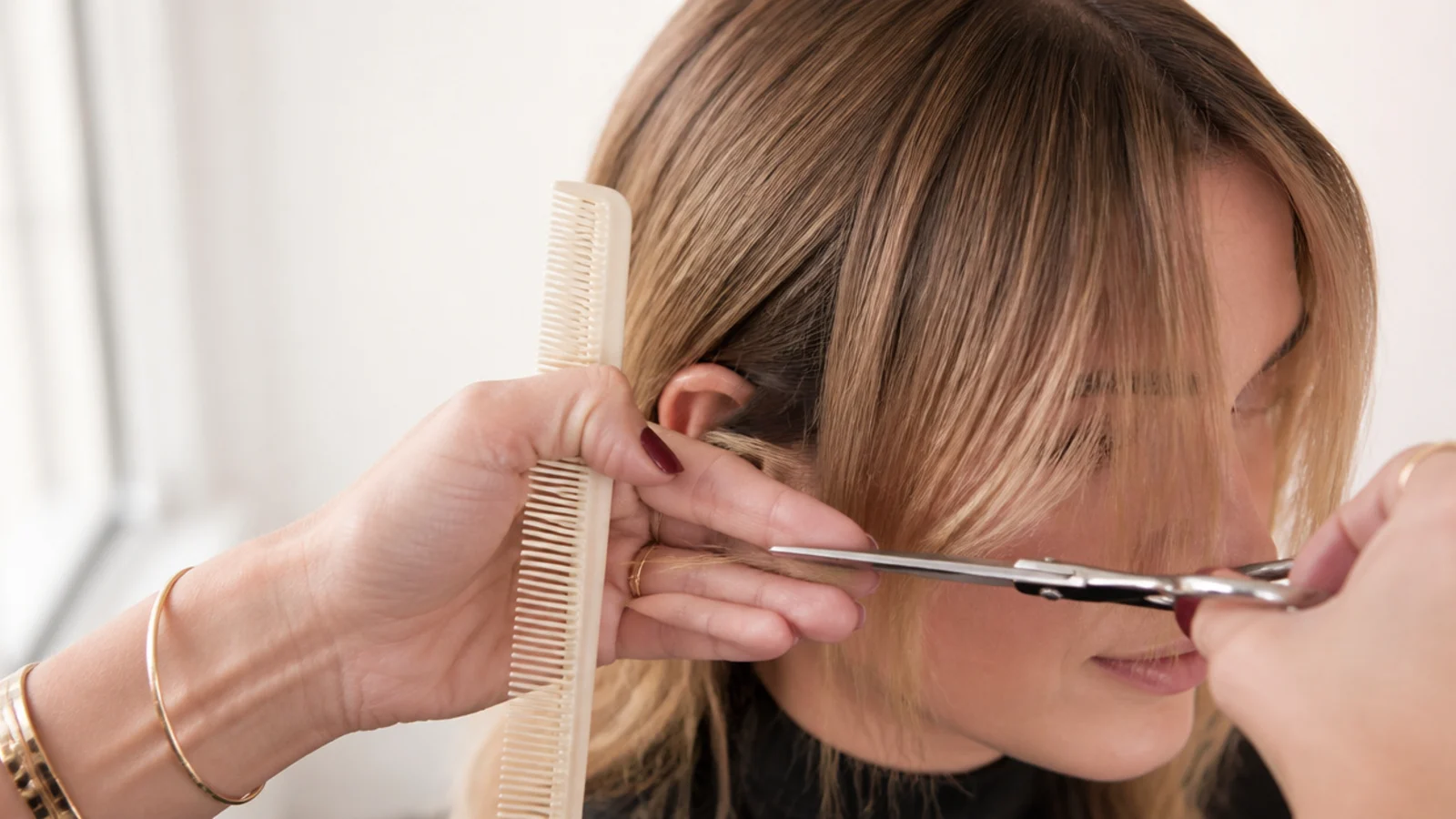
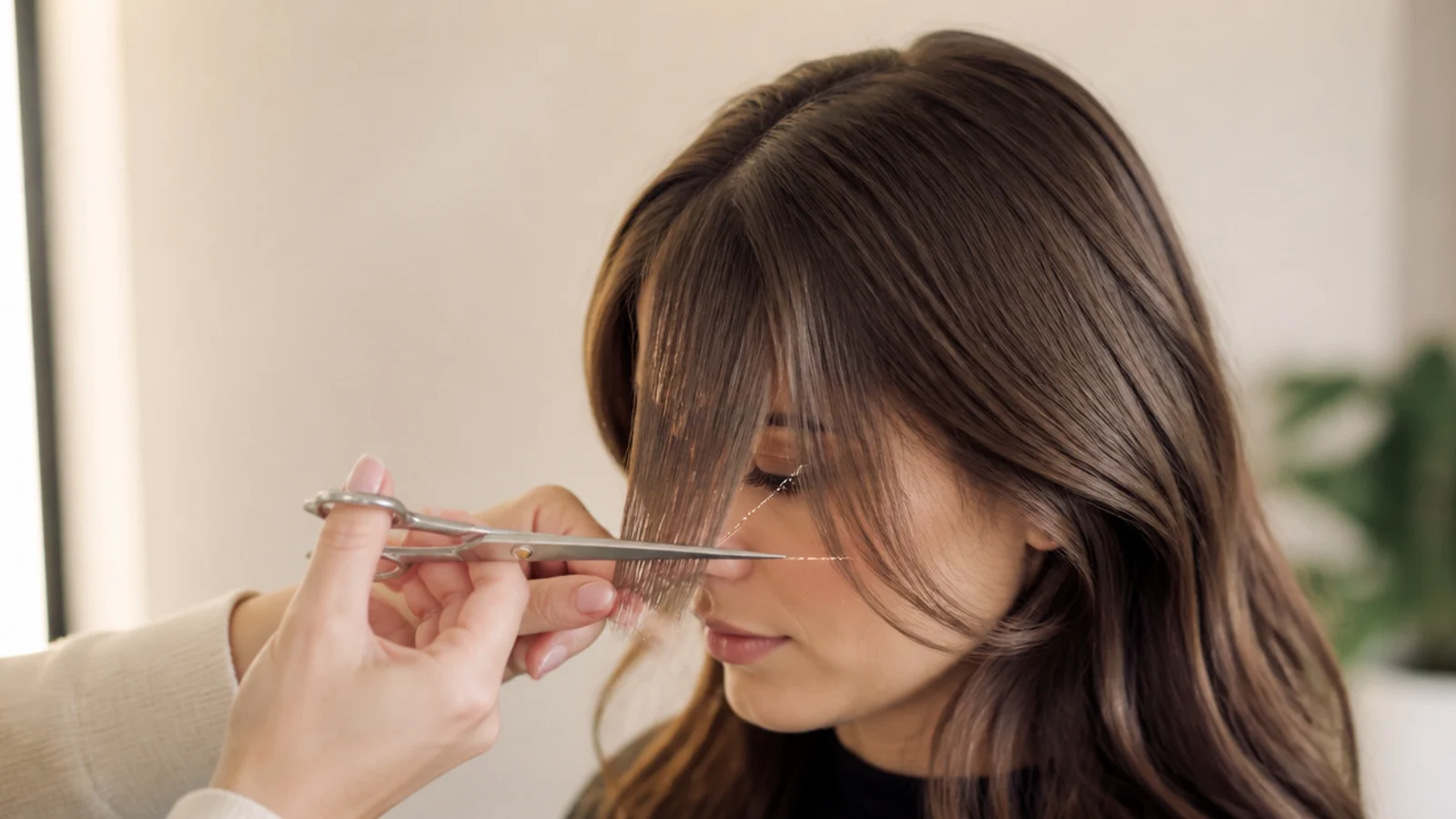
Cut the guide strand a full inch below your target, point-cutting upward into the ends with the shears at roughly 45 degrees and notches about a quarter inch deep. Take three or four notches, release the strand and look at where it lands on your face. This first pass exists only to establish a shape you can judge; the real length gets set later once you can see the fringe in context.
Common mistake: Cutting straight across, which leaves a blunt line no styling will soften.
Pro tip: Deeper notches read softer. A shallow notch is just a fuzzy version of a blunt cut.
5. Shape: Cut Both Diagonals Out to the Temples
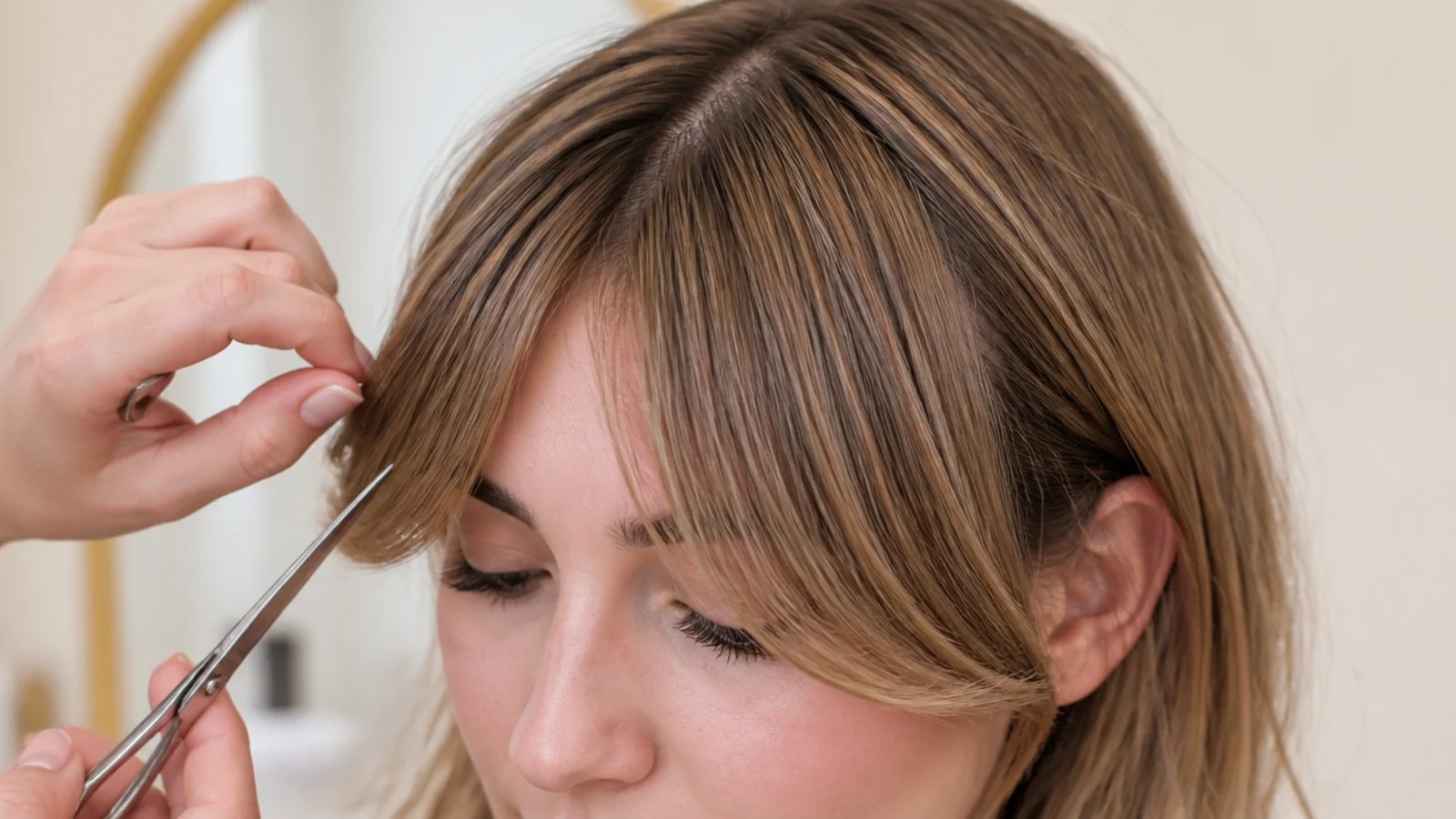
Unclip one half, comb it forward and point-cut a diagonal running from the bottom of your guide out and down to the temple, dropping 1.5 to 2 inches from center to outer edge. Work in two or three thin subsections rather than one handful. Repeat on the other side, then bring both innermost strands together at the part and match them to within an eighth of an inch, correcting only the longer side.
Common mistake: Fixing asymmetry by shortening both sides in turn until the fringe is inches too short.
Pro tip: Check in a phone camera. A mirror hides slopes your brain silently corrects.
6. Refine: Second Pass, Blend and Handle the Cowlick
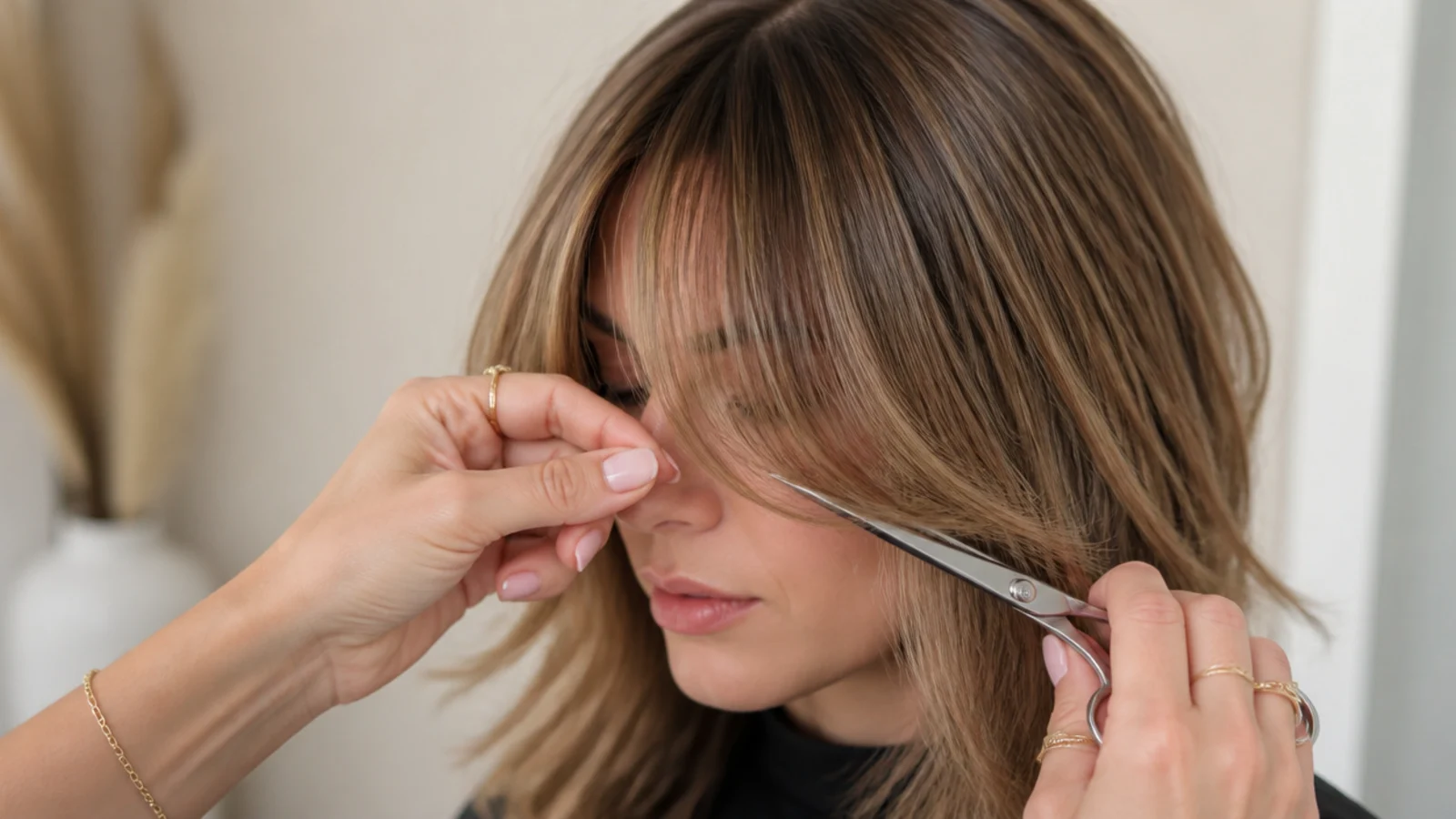
Close the inch you left, a quarter inch at a time, checking your face between every pass and stopping at your landmark. Blend the outer half inch of each side into the hair behind it with two or three notches. Leave any cowlick section a half inch longer than its neighbors, and if the fringe feels heavy, slide-cut three or four interior strands rather than reaching for thinning shears.
Common mistake: Using thinning shears, which leave short stubs that frizz out of a 4 inch fringe within weeks.
Pro tip: If it looks right a half inch longer than planned, stop there. It always looks shorter on the face.
7. Finish: Blow-Dry Out, Texture Spray, Book the Trim
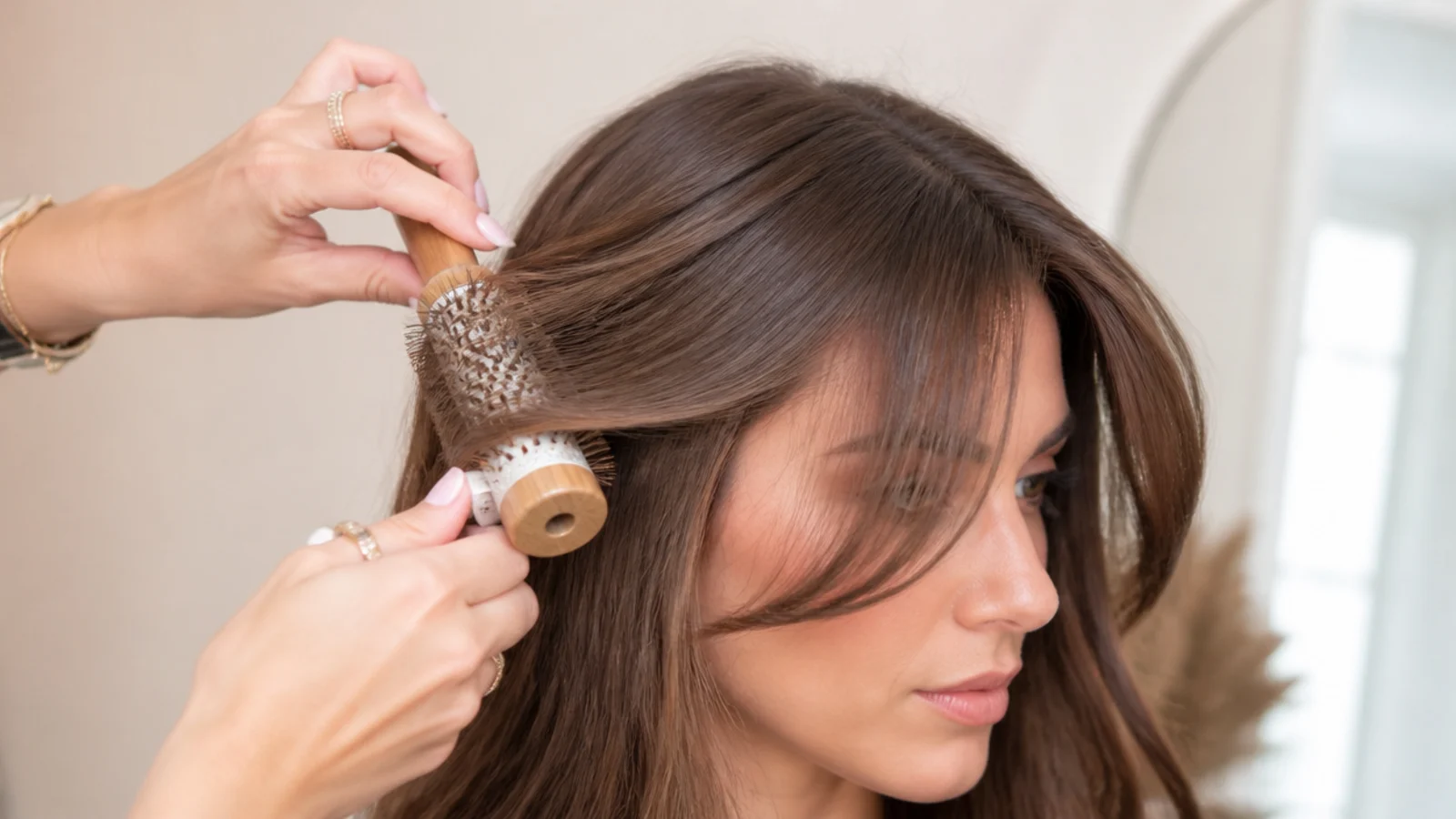
Mist the fringe damp and dry it before the rest of your hair, sweeping each half outward and slightly back from the center part with a 1.5 inch round brush, and finish each side with a two second cool shot. Fine hair lifts at the root first with the dryer aimed up and back. Mist once with dry texture spray, rake into three or four pieces, then put the next trim in your calendar for 3 to 5 weeks out.
Common mistake: Letting the fringe air-dry first; it sets where it dries and will not be restyled later.
Pro tip: Ask your salon for a free fringe trim between cuts. Most offer it and few advertise it.
How Short Is Too Short for Short Curtain Bangs
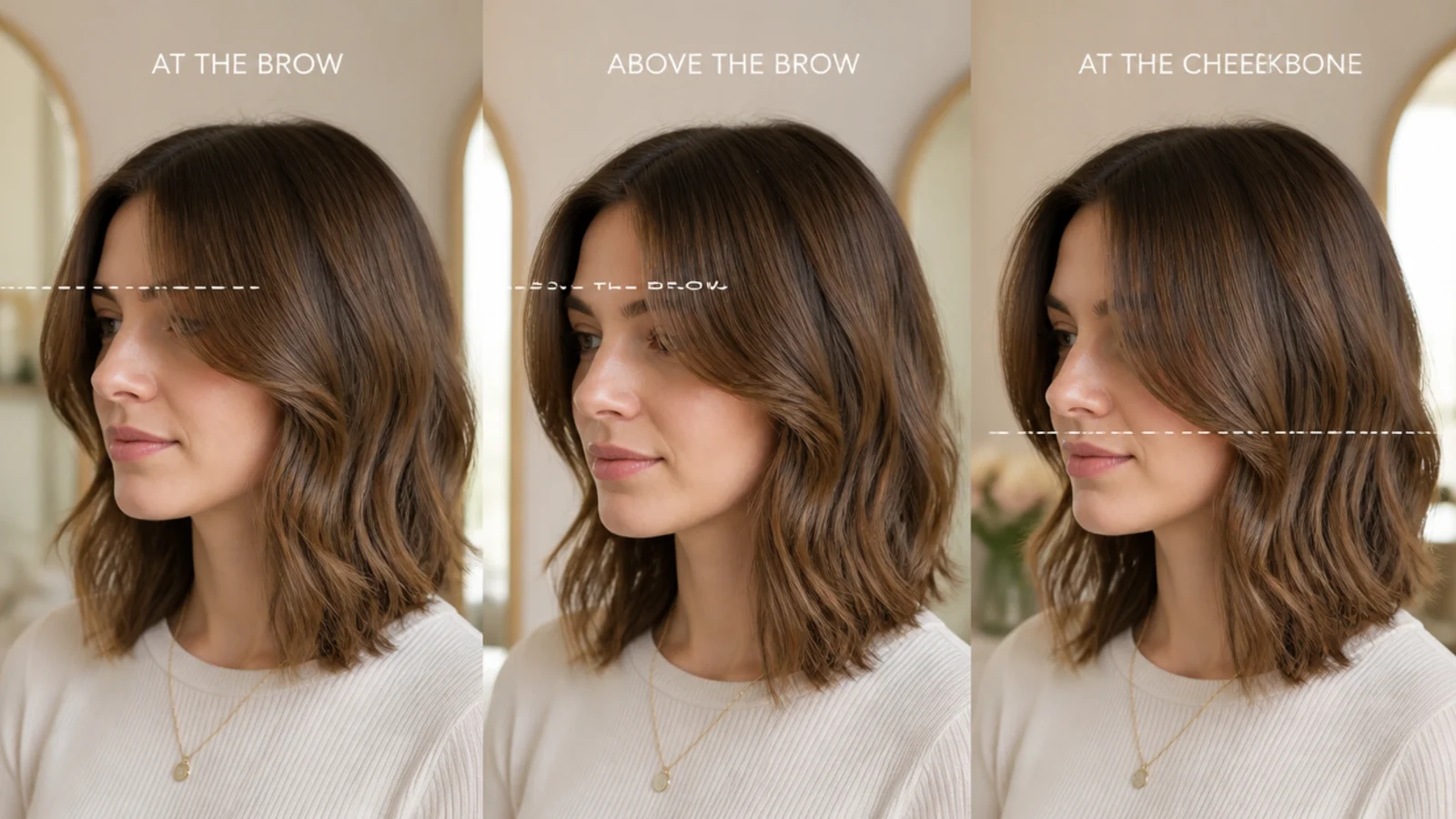
There is a real floor, and it is the upper lash line. Above the brow by half an inch, roughly 3 inches from the hairline, you are in baby fringe territory: still a curtain bang, but a deliberate editorial one that shows the entire brow and lives or dies on how tidy your eyebrows are. It also needs a trim every three weeks, because at that length half an inch of growth is a different haircut. Below that, once the shortest point clears the top of the brow, the two halves stop reading as a curtain and start reading as a short blunt fringe, since there is not enough length left to angle out to the temple. The safest short is brow-skimming at about 4 inches, and the most forgiving is cheekbone at about 5 inches, which is where most of the looks in the short curtain bangs gallery sit. Forehead height changes every one of these numbers by up to two inches, so measure against your own face rather than a number you read. And if you are cutting into hair that is already short, remember there is no length elsewhere to disguise a mistake, which is the argument for the cheekbone version.
Cutting Short Curtain Bangs by Hair Texture

Straight hair is not the easy default everyone assumes. It shows every cut line, splits at cowlicks and goes flat against the forehead by midday, so it needs the deepest point-cutting, root lift at the fringe and dry shampoo at the roots on day two. Full treatment in straight short curtain bangs. Wavy hair, the texture behind most gappy fringes, springs up about half an inch once the bend reforms and tends to split down the middle into the gappy bang everyone complains about, which is fixed by keeping the section narrow and drying the fringe first, covered in wavy short curtain bangs. Curly hair must be cut dry, curl by curl, never combed flat, with 1 to 3 inches of shrinkage allowance depending on whether you are 3a or 4a, and light density so it does not read as a bowl. Coily hair is the one texture where a first attempt at home is genuinely risky. Whatever your pattern, the sequence in find a hairstyle for your hair type is worth checking before you commit.
What Goes Wrong and How to Fix It
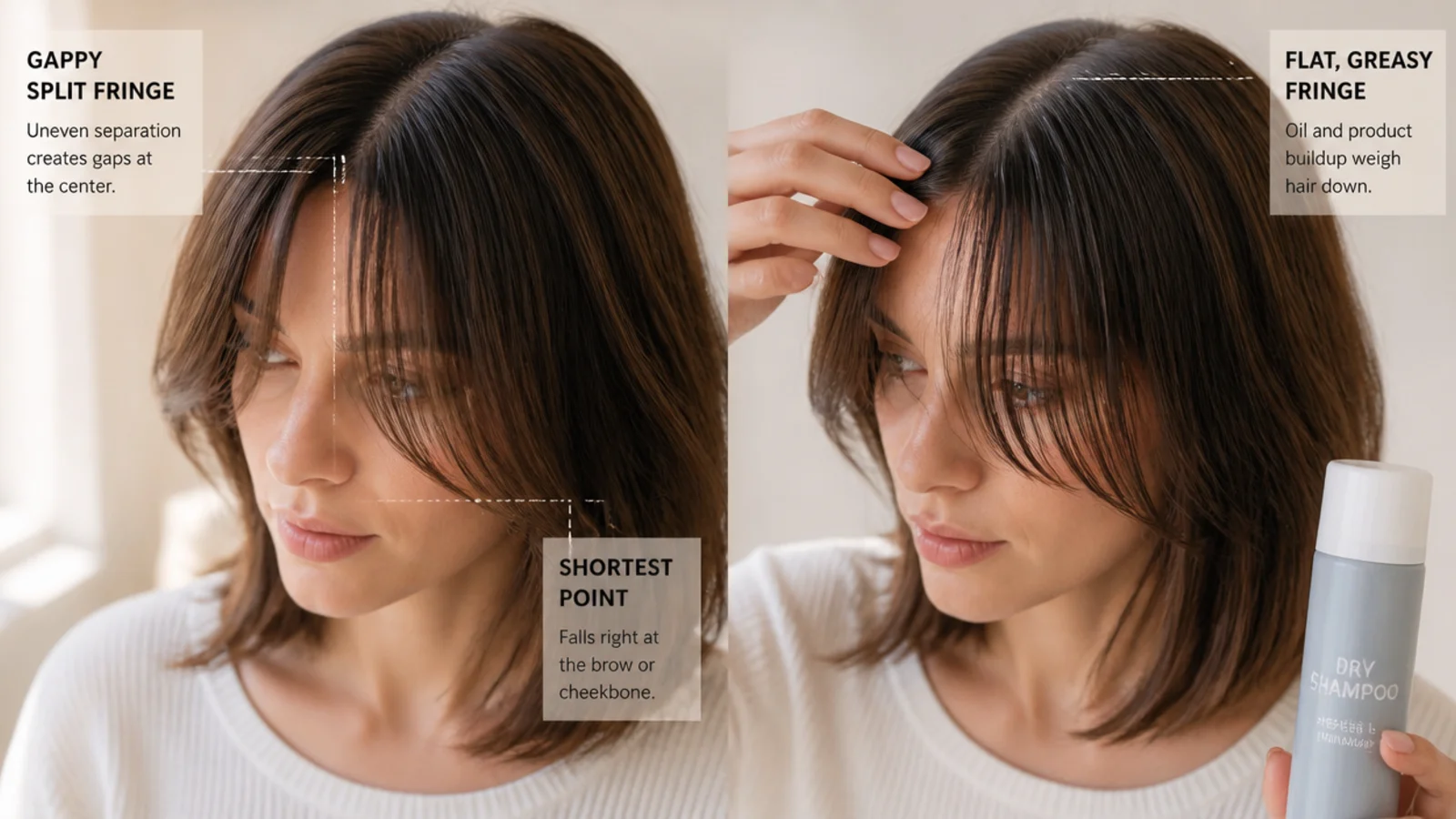
Four failures cover almost everything. The gappy bang, where the fringe splits into two clumps with a window of forehead between them, comes from a section that was too wide or too thin at the apex; fix it by drying with the round brush toward the center and, at the next trim, taking a narrower triangle. Crooked ends usually mean you tilted your chin or held one side under tension, and the repair is one or two notches off the long side only. Flat by noon is a root problem, not a length problem: lift at the fringe roots with the dryer aimed up and back, hit it with a cool shot, and skip all cream and oil. A fringe cut too short has no repair beyond pinning it back and waiting, and at half an inch a month a one inch overcut costs two months. Bobbed hair hides an awkward fringe better than most lengths, which is one reason bob haircuts and short curtain bangs get requested together so often. Stubs of frizz standing up an inch above the fringe mean thinning shears, and those only grow out.
Trim Cadence, Cost and What to Ask For at the Salon
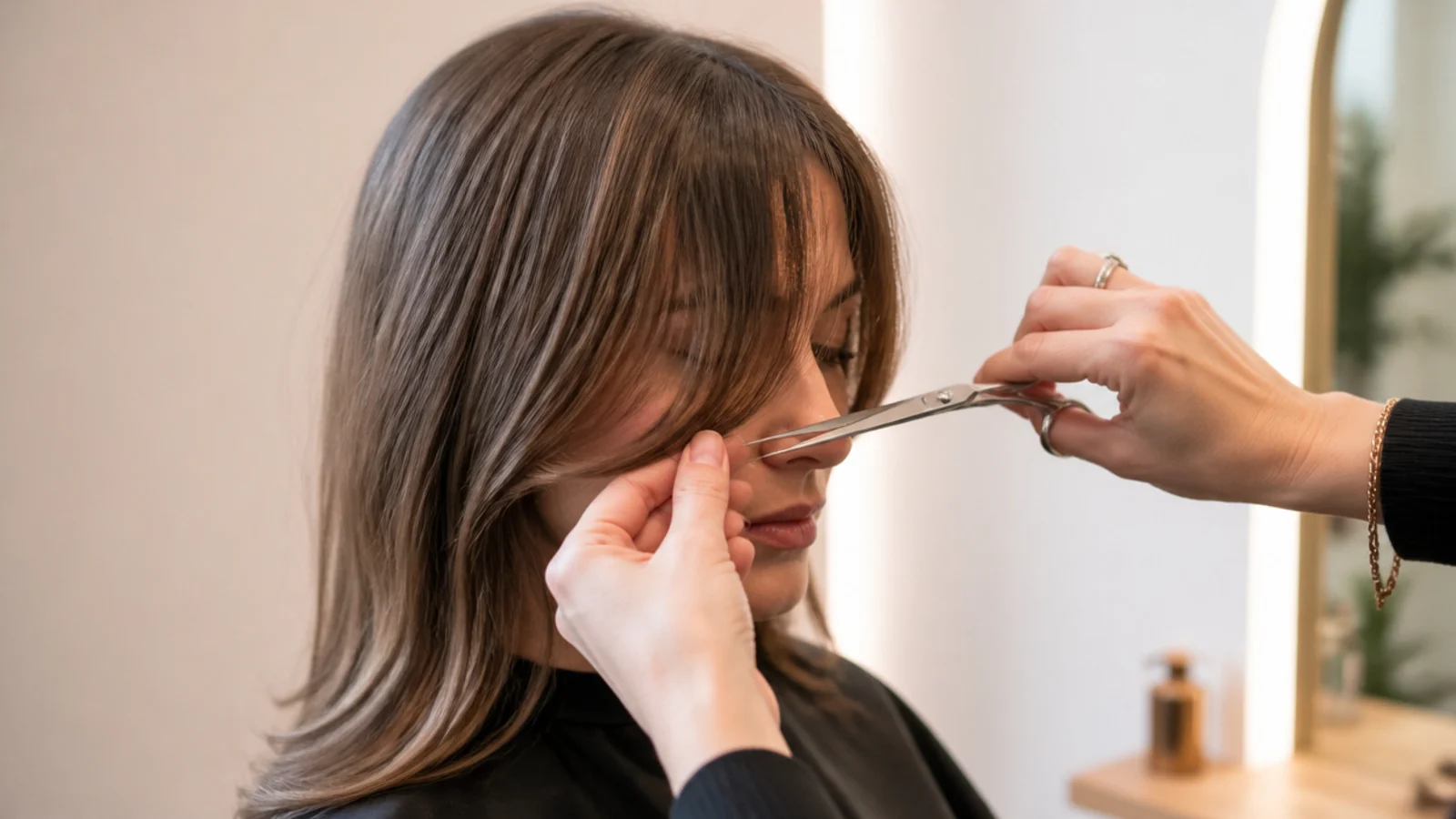
Short curtain bangs need a trim every 3 to 5 weeks, against 6 to 8 weeks for long curtain bangs, purely because hair grows about half an inch a month and half an inch is a large fraction of a 4 inch fringe. The good news on cost: most salons trim a client's fringe free between full haircuts, so the real annual spend is usually nothing beyond your normal cuts, and a standalone fringe trim where it is charged typically runs 15 to 30 dollars. When you book, be specific. Ask for short curtain bangs with the shortest point at your brow or cheekbone, name the landmark on your own face, ask for point-cutting rather than a blunt line, ask for a narrow triangle section from your part to your temples, and say no to thinning shears. If you have a cowlick, say so before the cut rather than after. That script is worth more than any photo, because photos show a result and the script describes the technique that produces it. Rebook the fringe trim before you leave the chair.
Growing Short Curtain Bangs Out Later

Curtain bangs are the easiest fringe to grow out, which is most of their appeal, but short ones still take about six months to blend fully into face-framing layers. The timeline is predictable: weeks 0 to 4 the fringe stays on shape, weeks 4 to 10 is the awkward stretch where it hits the lash line and gets in your eyes, weeks 10 to 20 it lengthens into a cheekbone curtain that most people actually prefer, and past week 20 it reads as a face-framing layer. Stop trimming the center point entirely during this phase, but keep the outer diagonal tidy so the shape does not go shapeless. Tuck the fringe behind your ears while it is damp so it dries blended into the next layer down, use no-crease clips to build an intentional wave, and switch to a side part when the length gets annoying. If you are growing them out to move to a longer cut, the transition options in mid length haircut with curtain bangs show where it ends up.
Frequently Asked Questions
How do you cut short curtain bangs at home step by step?
Start on clean, dry hair in its natural texture. Part it dead center, section a narrow triangle from the part out to each temple with the apex 1.5 to 2 inches back, and pull a quarter inch guide strand from the middle. Cut that guide an inch longer than your target, point-cutting upward at 45 degrees, then cut each side on a downward diagonal to the temple and refine in a second pass.
Should you cut curtain bangs wet or dry?
Dry, always, and in your natural texture. Wet hair hangs longer than it sits: about half an inch on straight hair, an inch on wavy, and up to three inches on tight curls. Cutting wet is the single biggest cause of a fringe that ends up at the hairline. Dry cutting also reveals cowlicks and shows you exactly where the hair will fall.
How short is too short for curtain bangs?
The upper lash line is the practical floor. Half an inch above the brow, around 3 inches from the hairline, is a baby curtain bang and still works, though it needs a trim every three weeks. Any shorter and there is not enough length to angle out toward the temples, so it stops reading as a curtain and becomes a short blunt fringe instead.
How often should you trim curtain bangs?
Short curtain bangs need trimming every 3 to 5 weeks, and long ones every 6 to 8. Hair grows roughly half an inch per month, which is a large fraction of a 4 inch fringe but barely noticeable on a 7 inch one. Most salons trim a fringe free between full haircuts, so ask when you book rather than assuming it costs extra.
Can you cut curtain bangs on curly hair?
Yes, but cut them dry and curl by curl, never combed flat or damp. Add a shrinkage allowance of 1 to 2 inches for 3a and 3b patterns and 2 to 3 inches for 3c and 4a, because a curl lifts dramatically once it is released. Keep the density light so the fringe does not round into a bowl shape at the front, and see curly short curtain bangs for pattern-by-pattern lengths.
What face shape do short curtain bangs suit?
Heart, oval and oblong faces carry a brow-level short curtain bang easily, because the fringe fills width at the top and shortens a long forehead. Round and square faces, covered in short curtain bangs for a round face, do better keeping the shortest point at or below the cheekbone, and wispy rather than blunt, so the open vertical line from eye to hairline is not cut off across the widest part of the face.
Why do my curtain bangs split down the middle?
That is the gappy bang, and it comes from a section that was too wide at the temples or too thin at the apex, so there is not enough hair to fill the center. Blow-dry each half toward the center first before sweeping it outward, and at the next trim take a narrower triangle. A cowlick at the front hairline causes the same effect and needs that section left longer.
What is the difference between curtain bangs and wispy bangs?
Curtain bangs describe a shape: shortest in the center, angling longer toward the temples, parted in the middle so the halves sweep away from the face. Wispy describes density, meaning a light, see-through fringe with tapered ends. A fringe can be both. Blunt curtain bangs are full density with a hard perimeter, and soft curtain bangs sit between the two.
Can you cut short curtain bangs on already-short hair?
Yes, but the blend is tighter because there is less length behind the fringe to travel into. Keep the diagonal drop closer to 1.5 inches than 2, and blend the outer edge higher up so the fringe meets your existing layers instead of stepping off them. On a chin-length bob the fringe should reach the cheekbone rather than the brow so the proportions stay balanced, as shown in short curtain bangs with a bob.
Do I need special scissors to cut curtain bangs?
You need 5 to 5.5 inch hair shears, which cost 20 to 40 dollars and last years. Kitchen and craft scissors have blades ground to crush rather than slice, so they bend each strand before cutting it, which splits the ends and makes the fringe frizz within a week. Short blades also give better control on a section only a couple of inches wide.
Cutting your own fringe is permanent until it grows back, and hair grows only about half an inch a month. Use proper hair shears, never kitchen or craft scissors, and cut conservatively. If you have a strong cowlick, very tight curls, thinning hair or a fringe you have already cut too short, see a licensed stylist instead.
Which short curtain bangs look are you saving?
The whole guide reduces to one habit: cut long, check, cut again. Every irreversible mistake in a home fringe comes from removing too much in a single pass, and a fringe you left half an inch long is fixable in four minutes while a fringe you cut half an inch short is fixable in four weeks. Work dry, work in your natural texture, keep the section narrow, and point-cut upward so no hard line ever forms. When it is done, blow-dry it away from the center part with a 1.5 inch round brush and break it up with texture spray. Book the first maintenance trim for three to five weeks out, since most salons do fringe trims free between cuts, and browse short curtain bangs for your next length.