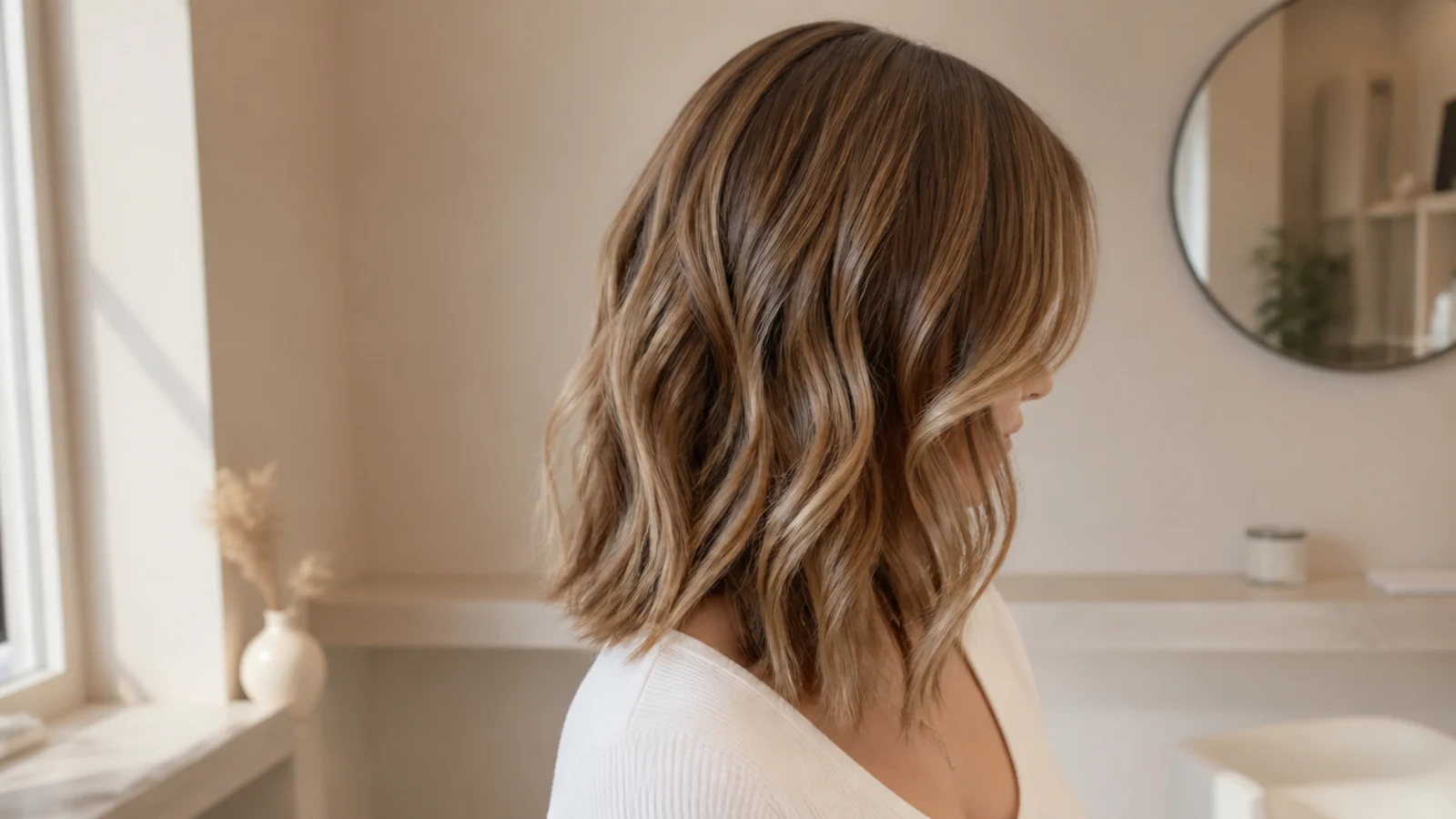
Quick Comparison
| Curtain Bangs | Full Blunt Bangs | |
|---|---|---|
| Shortest point | Cheekbone to jaw, sweeping outward | Brow level, straight across |
| Daily styling time | About 2 minutes, often air-dried | About 5 minutes with a round brush |
| Trim frequency | Every 6 to 8 weeks with the full cut | Every 2 to 3 weeks on its own |
| Grow-out time to blend | About 3 to 4 months into face-framing | About 8 to 12 months to cheekbone |
| Can you pull it back | Yes, tucks or pins behind the ear | No, it sits forward until it grows |
| Works over a cowlick | Yes if cut long and deep | Rarely; the swirl splits the line |
| Works with glasses | Yes, clears the top rim | Often lands on the frame and kinks |
| Best face shapes | Round, square, heart, oval | Oval and long with a high forehead |
| Best hair types | Fine, wavy, curly, thick, all of them | Straight and thick; poor on fine or curly |
1. Curtain Bangs on a Collarbone Lob
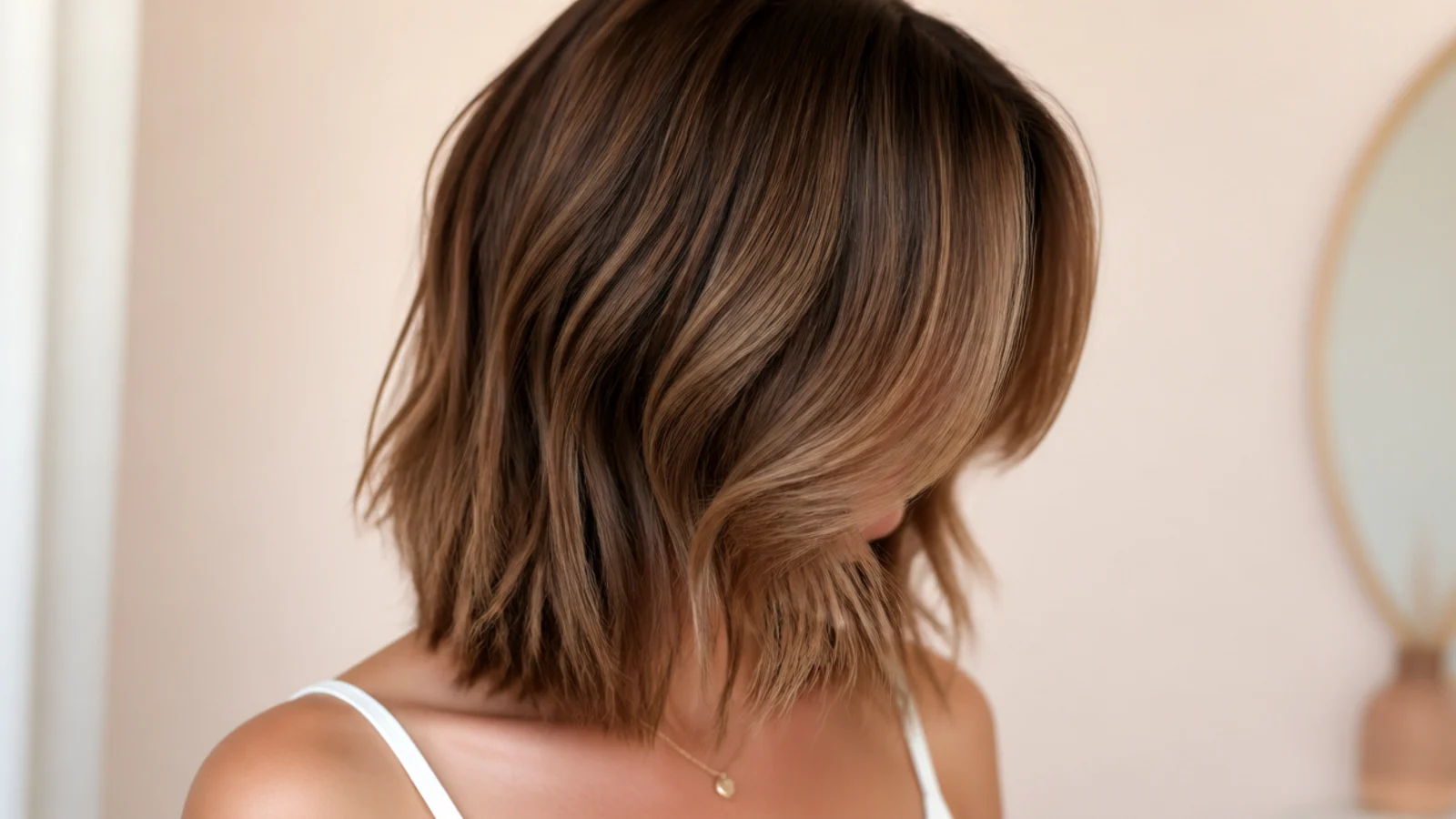
The reference version of this whole list. The length sits right on the collarbone, roughly 14 to 16 inches from the crown on average height, cut with one blunt perimeter so the ends stay dense. The fringe is parted down the center and cut on a diagonal, shortest at about the cheekbone and sweeping out to jaw length at the outer edges. Nothing is disconnected, so the bang melts into the front layers rather than sitting on top of them. It is the most photographed cut in this category because it works on almost every texture without any styling beyond a rough blow-dry.
Who it suits: Almost everyone; the safest first fringe on mid length hair.
Tip: Ask for the shortest point no higher than the cheekbone so you keep the option to tuck it back.
2. Bottleneck Bangs on Shoulder-Length Hair
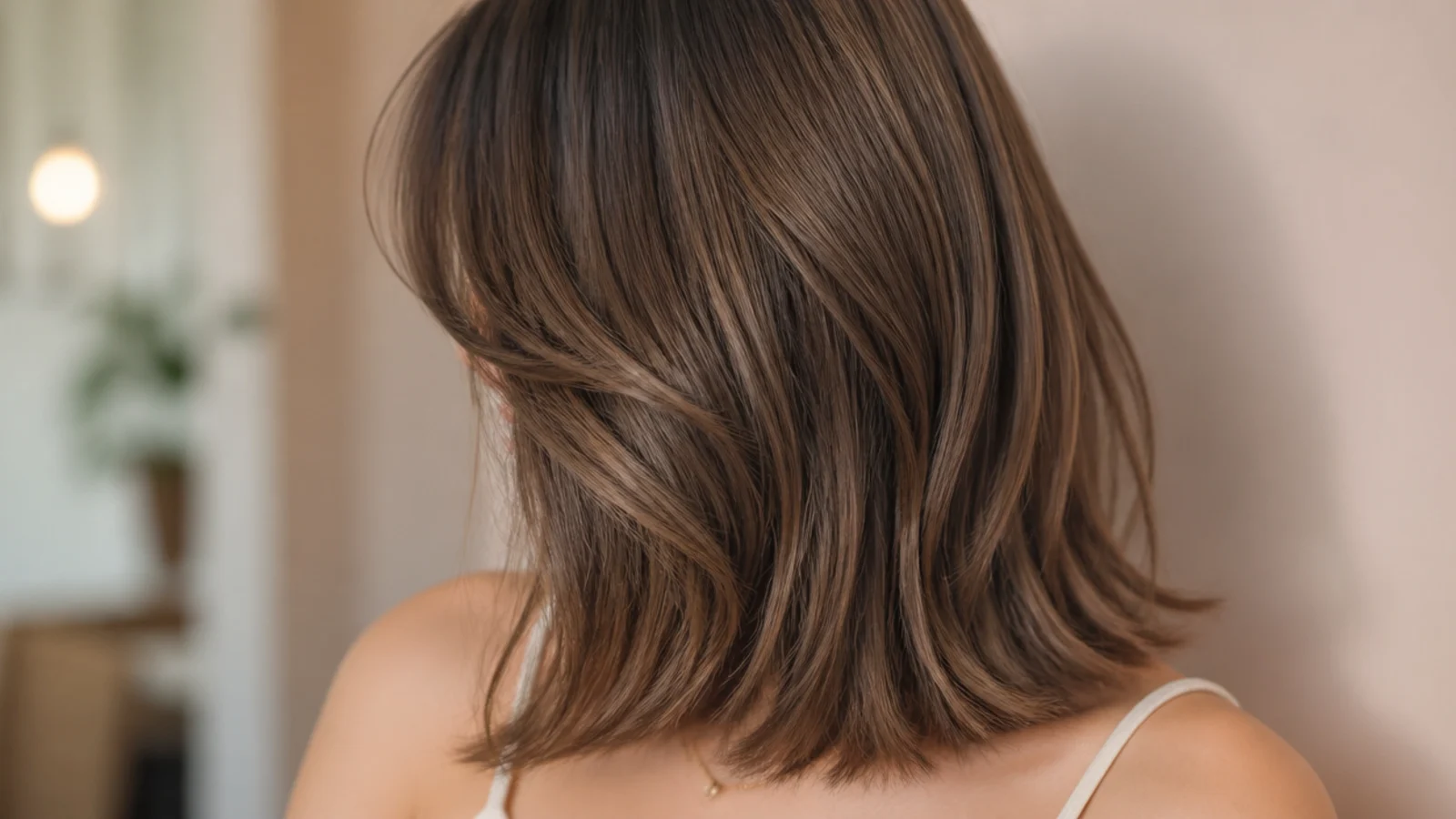
A bottleneck bang is narrower and shorter in the middle, around eyebrow level, then flares outward and downward to about the cheekbone at the sides, tracing the shape of a bottle neck. It is the middle ground between a full fringe and curtain bangs: more coverage across the forehead than curtain bangs give, far less commitment than a blunt fringe. It suits shoulder length hair specifically because the widening curve visually echoes where the length hits your shoulder. Expect about three minutes with a round brush to set the curve.
Who it suits: Anyone who wants forehead coverage without a full blunt fringe.
Tip: Say bottleneck, not curtain: the difference is a shorter center, and stylists cut them differently.
3. Wispy Bangs on Mid Length Fine Hair

On fine hair the danger is taking too much from the front and leaving the length behind it sparse. A wispy fringe solves it by pulling a shallow triangle, no deeper than an inch back from the hairline, then point cutting the ends so the fringe reads soft rather than see-through. Keep the rest of the cut nearly one length with two or three long invisible layers, because over-layering is what makes fine mid length hair look thin at the ends. Blunt-cut wispy bangs go stringy by lunchtime; point-cut ones do not. More on this in mid length haircuts for fine hair.
Who it suits: Fine or low-density hair that flattens under a heavy fringe.
Tip: Ask for a shallow triangle section only, so the fringe does not steal density from the crown.
4. Blunt Bangs With a Shoulder-Length Blunt Cut

One straight line across the forehead at eyebrow level, one straight line at the shoulder, and nothing softening either. It is the most graphic look on this list and the most expensive to maintain: the fringe needs trimming every two to three weeks before it drops into your lash line, and it needs five minutes with a flat brush and cool shot every morning or it splits at the cowlick. In exchange it gives more shape than any other option and makes thick straight hair look deliberately styled. Pair it with a truly blunt perimeter, not layers, or the two ideas fight each other.
Who it suits: Thick straight hair, oval and long face shapes, daily stylers.
Tip: Ask for the fringe cut dry at the end, so you see exactly where the line lands.
5. Side-Swept Bangs on a Mid Length Layered Cut
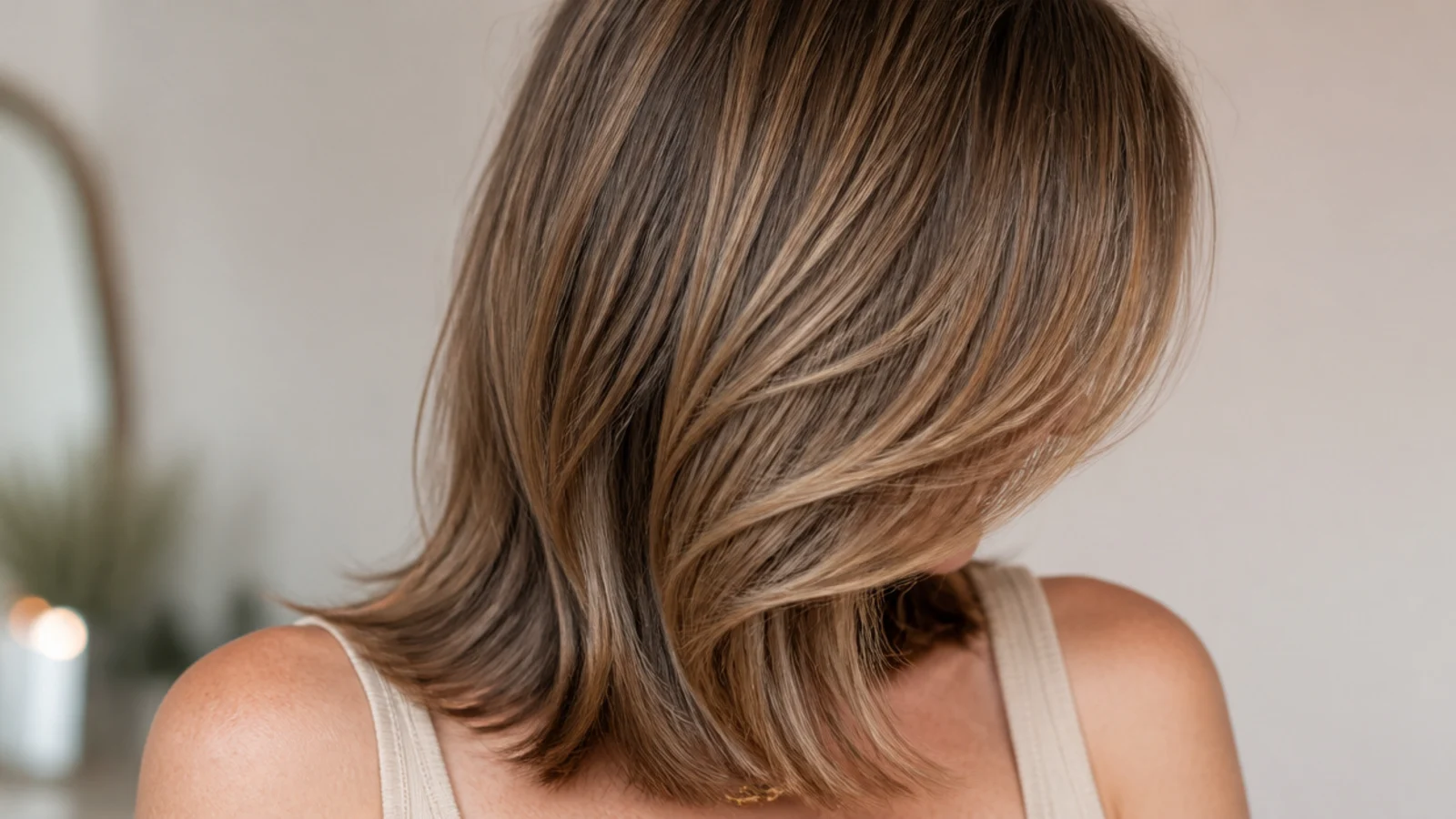
A deep side part with the fringe cut long, from brow on the short side sweeping down past the cheekbone on the long side, then blended into the first face-framing layer so there is no visible step. This is the most forgiving fringe if you have never had one, because on any bad day it simply reads as a long front layer. It sits best on a cut with three or four long layers behind it, which give the swept piece somewhere to land. The diagonal line also softens a square jaw. See the layering options in mid length haircut with layers.
Who it suits: First-time fringe wearers, square and round faces.
Tip: Part on the side opposite your natural fall so the sweep has lift instead of lying flat.
6. Curtain Bangs on a Round Face
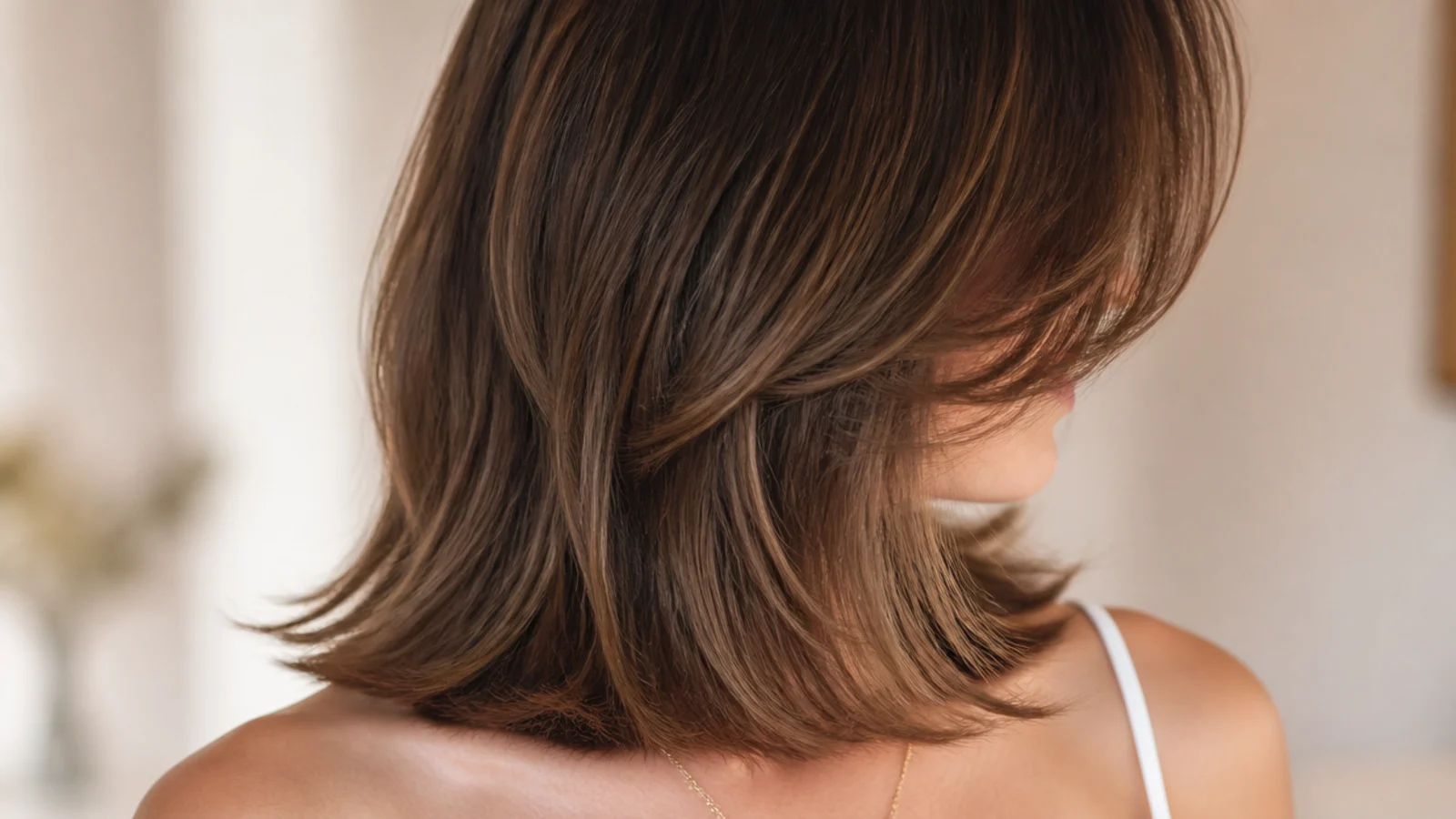
On a round face the job is to add vertical line and avoid cutting width across the widest part of the cheek. That means a long curtain bang: shortest point at the cheekbone at the earliest, ideally a little lower, falling to jaw or below at the outer edges, with a center part so two clean vertical lines run down the face. Never a straight blunt fringe at the brow, which draws a horizontal line and stacks width on width. Keep the length below the collarbone too, so the overall silhouette reads long rather than wide.
Who it suits: Round and full-cheeked faces wanting length without losing softness.
Tip: Say long curtain bangs, shortest point at the cheekbone, and no horizontal fringe line.
7. Arched Curtain Bangs for a Long Face

A long or oblong face benefits from the opposite move: bring the fringe up and across to shorten the visible forehead. Cut the center at brow level with a gentle arch rather than a hard straight line, then let the sides drop only as far as the cheekbone. That shorter, wider shape breaks the vertical run from hairline to chin and makes the face read more balanced. Add soft bends at the mid-lengths so width sits at the cheek rather than at the ends, and keep the overall length at or just above the collarbone.
Who it suits: Long, oblong and narrow face shapes with a high forehead.
Tip: Ask for an arch, not a straight line, so the fringe curves with your brow bone.
8. Curtain Bangs With Glasses
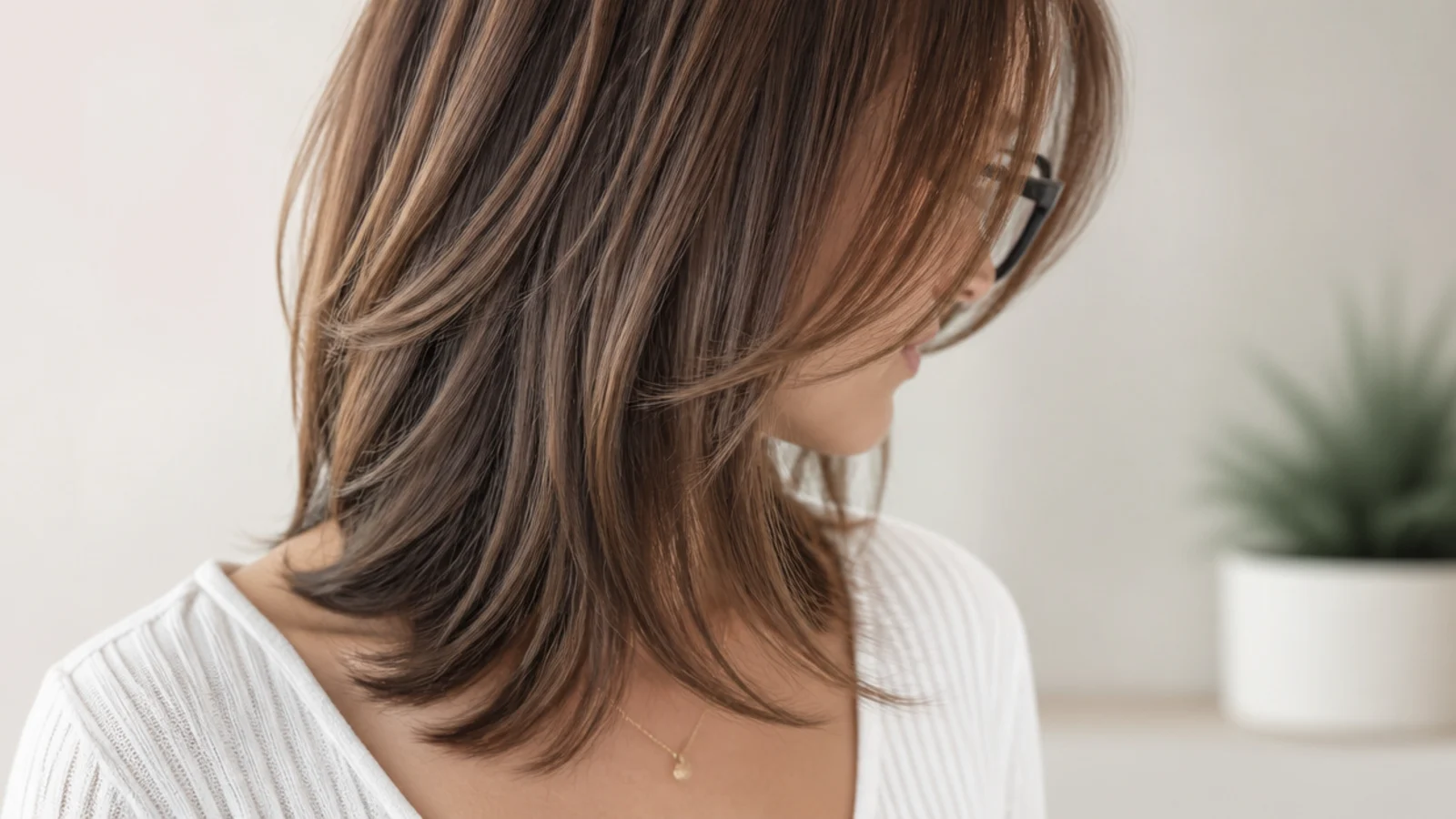
Almost nobody covers this and it is the reason a lot of fringes fail. Glasses occupy the exact zone a fringe wants to sit in, so a brow-level blunt bang lands on the frame, kinks, and collects lens smudge. The fix is a curtain bang cut to clear the top rim: shortest point at the cheekbone, parted center or slightly off-center, with the inner edges trained to sweep sideways rather than forward. Bring your actual glasses to the appointment and put them on before the fringe is cut dry.
Who it suits: Full-time glasses wearers who have avoided bangs because of them.
Tip: Wear your frames for the dry cut and ask the stylist to check the fringe sits above the top rim.
9. Choppy Bangs on a Mid Length Shag
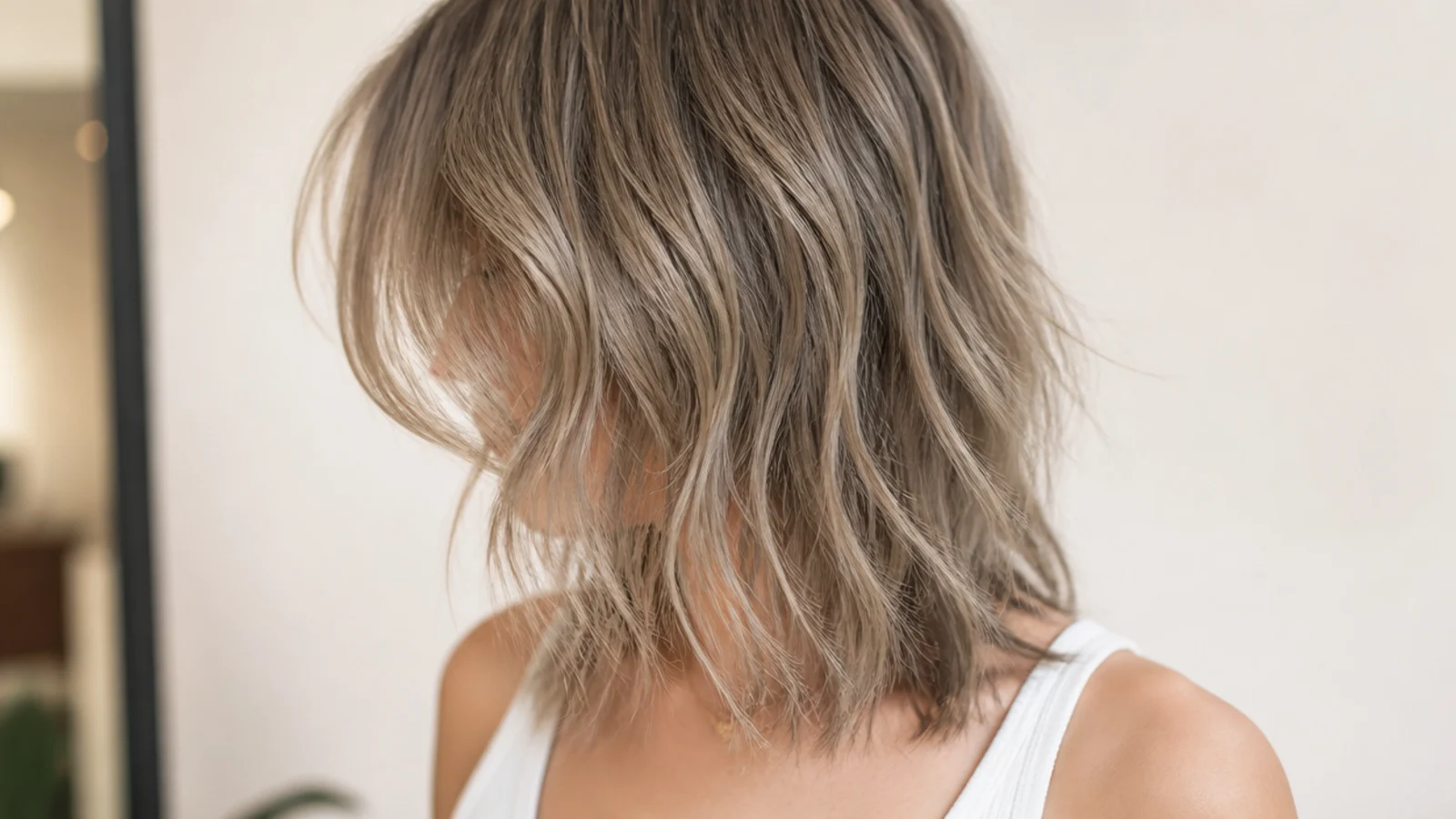
A shag stacks short layers at the crown and leaves the perimeter light, and the fringe has to match that energy or the cut looks half finished. Choppy bangs are point cut deep into the hair, a half inch or more at a time, so the ends land at different levels between the brow and the cheekbone. They need texture paste or a sea salt spray, roughly a dime-sized amount worked through with fingers, and they look better on day-two hair than freshly washed. Honest warning: choppy bangs are a poor choice on very fine hair, where the gaps read as thinness.
Who it suits: Medium to thick hair with natural wave and a lived-in aesthetic.
Tip: Ask for point cutting into the fringe, not thinning shears, which leave a fluffy regrowth line.
10. Birkin Bangs on Mid Length Waves
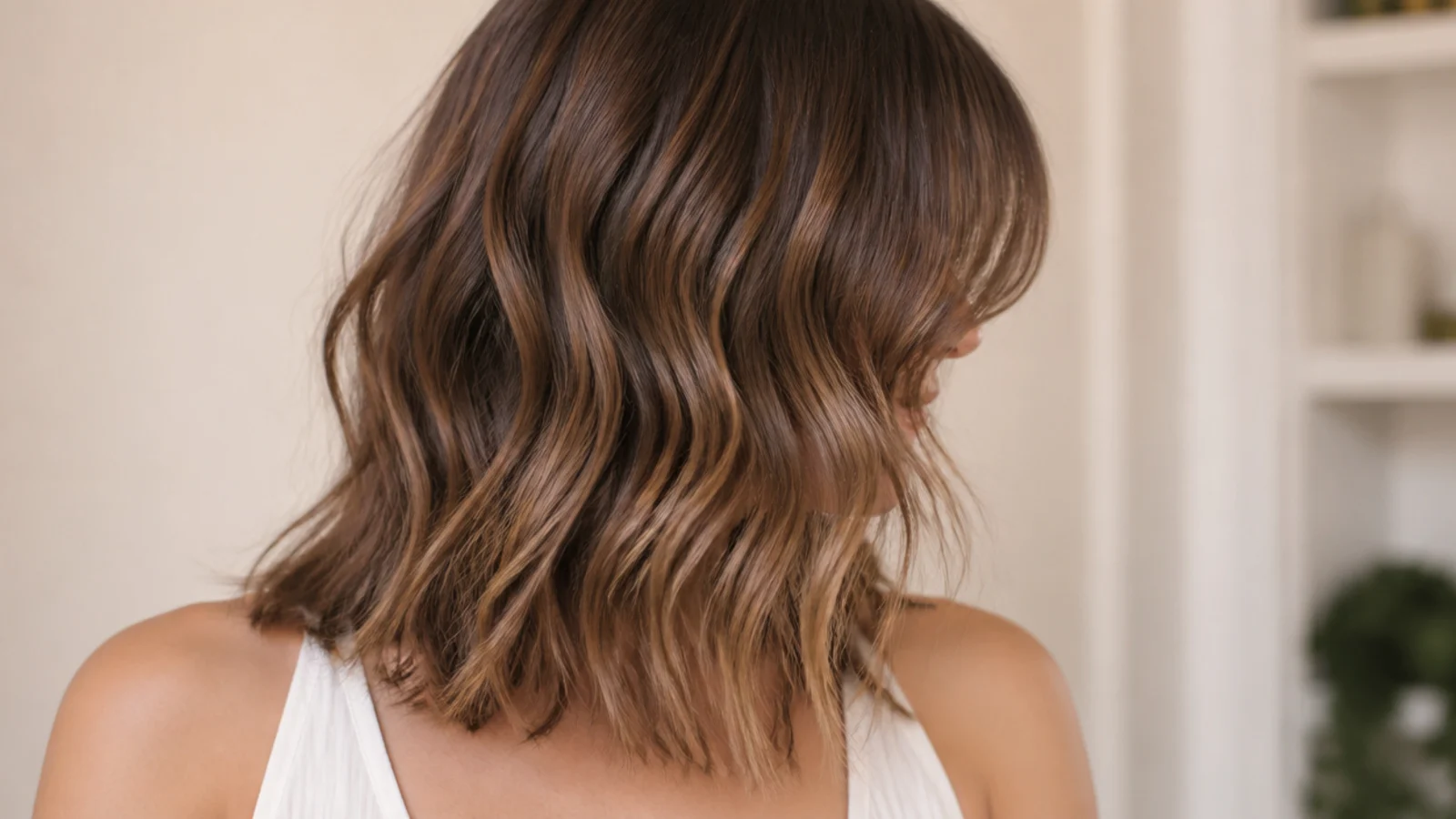
The Jane Birkin fringe is full and soft, cut to skim the lashes, with the ends left slightly uneven so it never reads as a hard blunt line. On waves it works because the natural bend stops the fringe from sitting flat, and the piecey separation it creates is the whole point of the look. Cut the length just below the shoulder with minimal layering so the weight balances the fullness in front. Wavy hair should be cut with the wave pattern visible rather than combed dead straight. There is more on wave-specific shaping in wavy mid length haircuts.
Who it suits: 2A to 2C waves, medium density, and anyone wanting a full fringe softened.
Tip: Ask for the fringe cut with the hair in its natural wave, not stretched flat under tension.
11. Curly Bangs on Mid Length Curly Hair
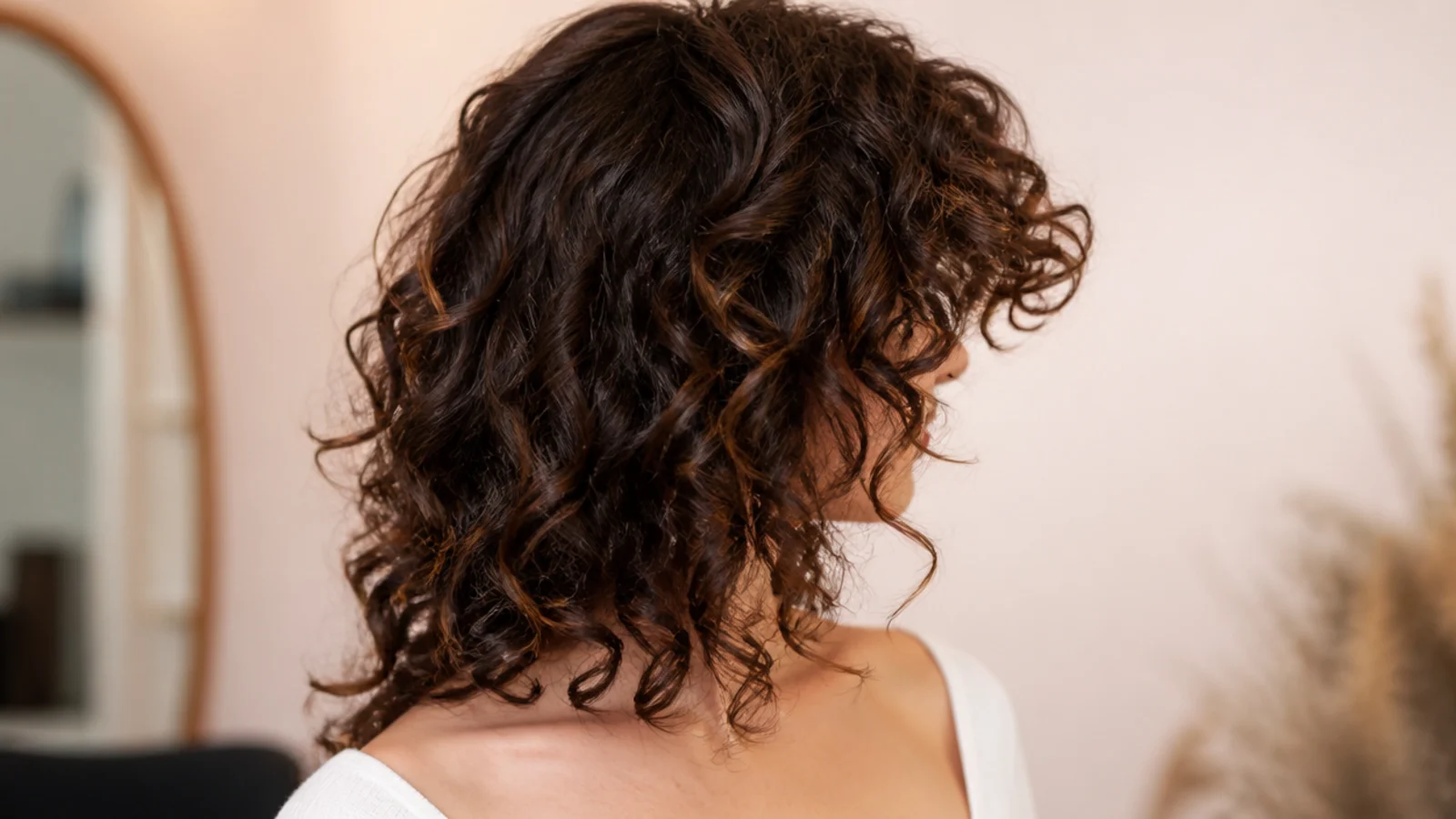
Curly bangs must be cut dry, curl by curl, or the spring-up will land them two to four inches shorter than you agreed. As a rule of thumb, 3A to 3B curls lose roughly a third of their stretched length when they dry. The shape to ask for is a soft rounded fringe that follows the curve of the forehead, cut a touch longer than you want it to sit. Behind it, keep the length at collarbone or just below and remove weight in the interior rather than the perimeter, which is what stops the triangle silhouette. See curly mid length haircuts for the cut underneath.
Who it suits: 2C through 3C curls with enough density to hold a defined fringe.
Tip: Say cut dry, curl by curl, and leave an inch of spring-up allowance on the fringe.
12. Baby Bangs With a Mid Length Blunt Lob

A micro fringe cut an inch or more above the brow, worn against a heavy blunt lob that hits just below the shoulder. It is the highest-risk look here and the least reversible: there is no tucking a two-inch fringe behind your ear, and it takes roughly eight to ten months to reach cheekbone length at the usual half inch of growth per month. It reads editorial on strong bone structure and high foreheads, and it needs almost no daily styling, which is its one practical advantage. Everything else on the mid length haircut board is easier to undo. Go in knowing the grow-out, not hoping about it.
Who it suits: High foreheads, strong brows, and people who genuinely like a bold cut.
Tip: Ask for it a half inch longer than the photo; you can always take more next visit.
13. Curtain Bangs on Thick Coarse Hair
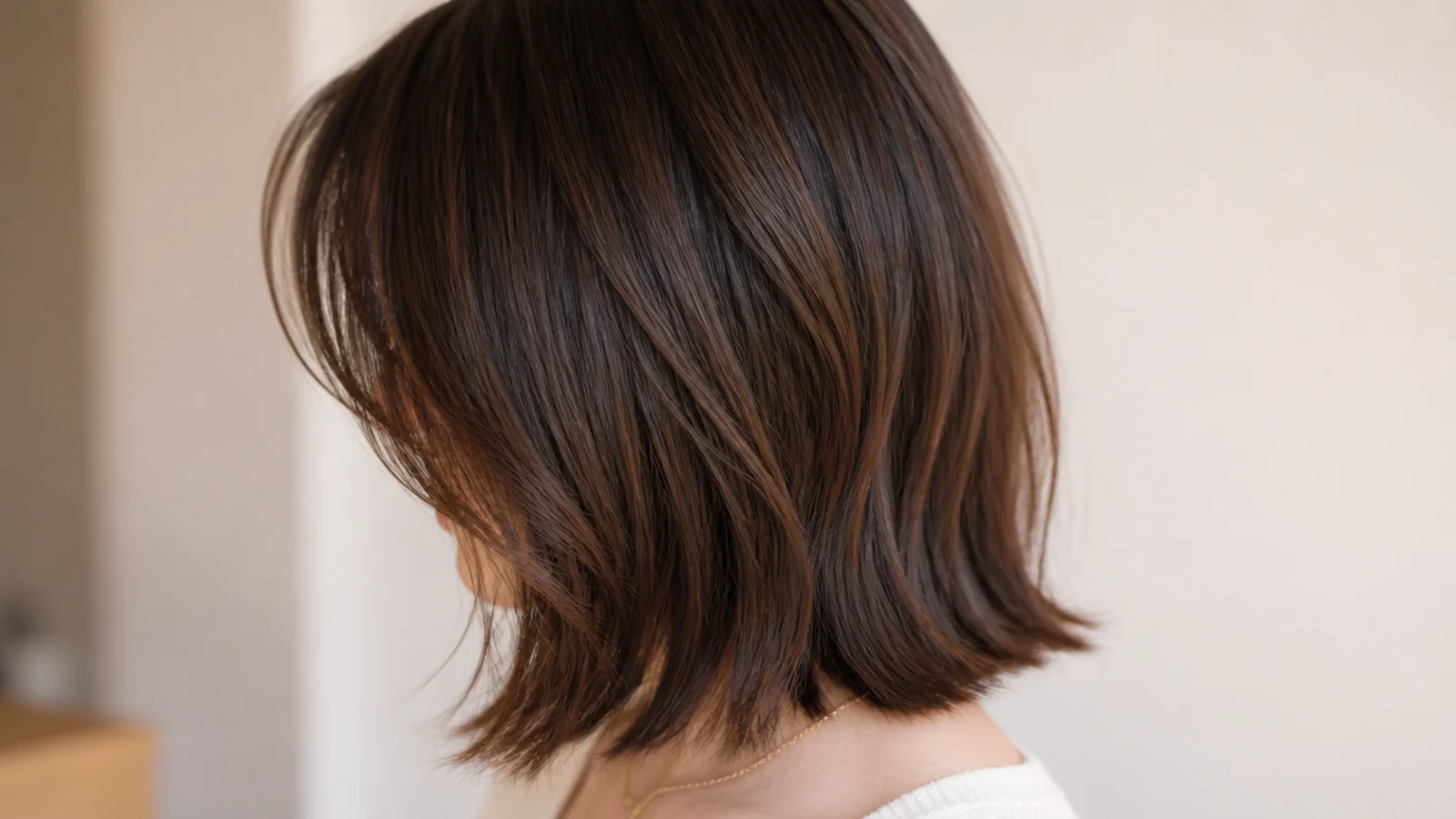
Thick hair does not fail at the fringe line, it fails behind it. Left dense, a curtain bang on coarse hair stands away from the head and creates a shelf. The fix is internal weight removal: the stylist slides the shears through the underside of the fringe section and through the interior of the front layers, taking bulk out without shortening the surface. Ask for a deeper fringe section too, about an inch and a half back, so the fringe has enough hair to lie down instead of one dense front row popping up. The layer plan matters just as much, so read mid length haircut with layers.
Who it suits: Coarse, high-density hair that puffs at the front.
Tip: Ask for weight removed from underneath the fringe, never thinning shears on the surface.
14. Wispy Bangs Over a Cowlick Front Hairline
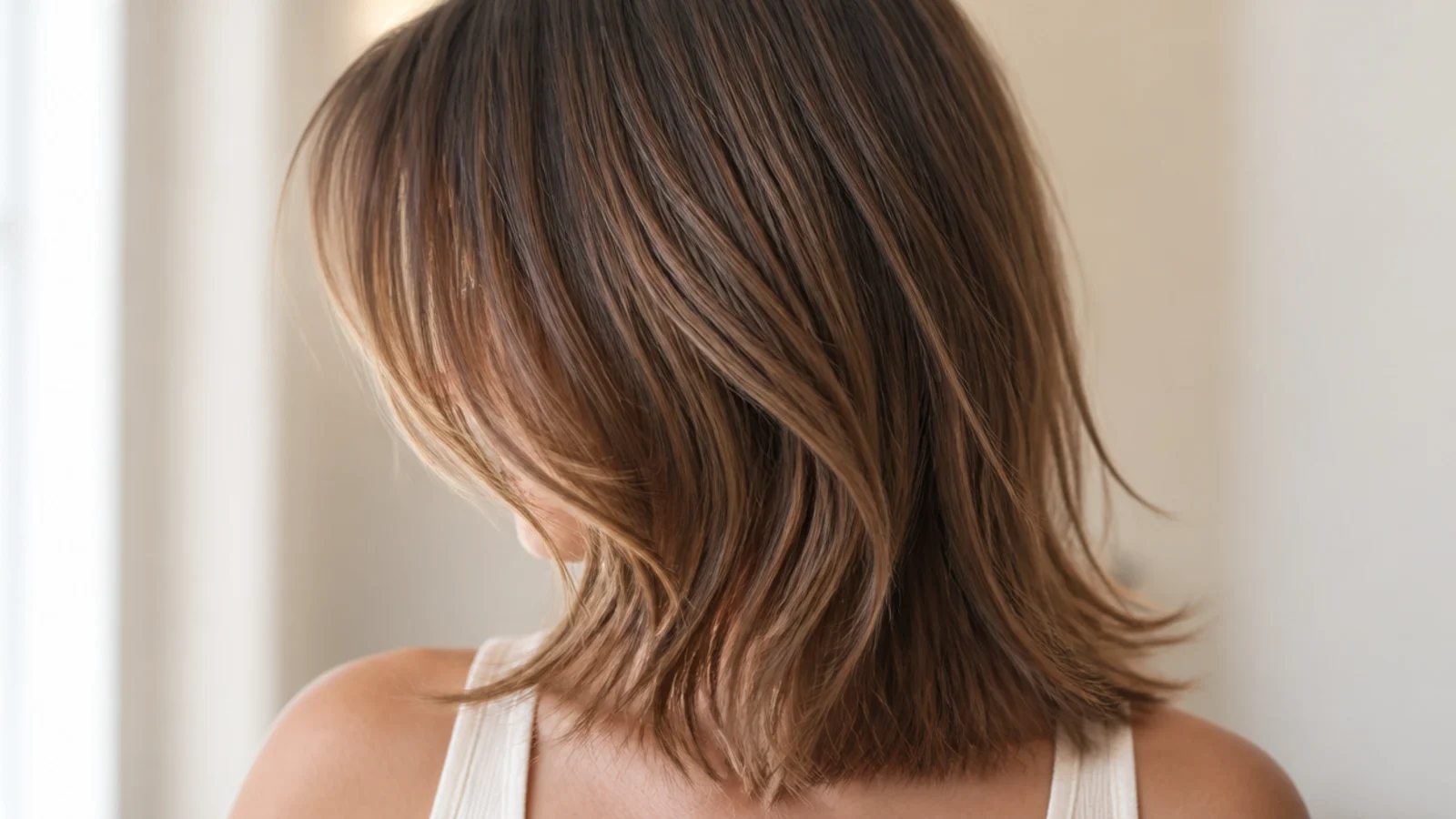
A cowlick at the front hairline is the single most common reason bangs will not sit, and it is barely covered anywhere. Do not fight it: a blunt fringe over a strong cowlick will split into a permanent part within an hour. Instead cut the fringe long, at least to the cheekbone, take the section deeper than usual so heavier hair from behind lies over the swirl, and let the fringe fall in the direction the cowlick already wants. Blow-dry the roots side to side for thirty seconds while damp, before the swirl sets.
Who it suits: Anyone with a swirl, double crown or stubborn natural front parting.
Tip: Tell your stylist where the cowlick is before the section is taken, not after the cut.
15. Feathered Bangs for a Square Jaw
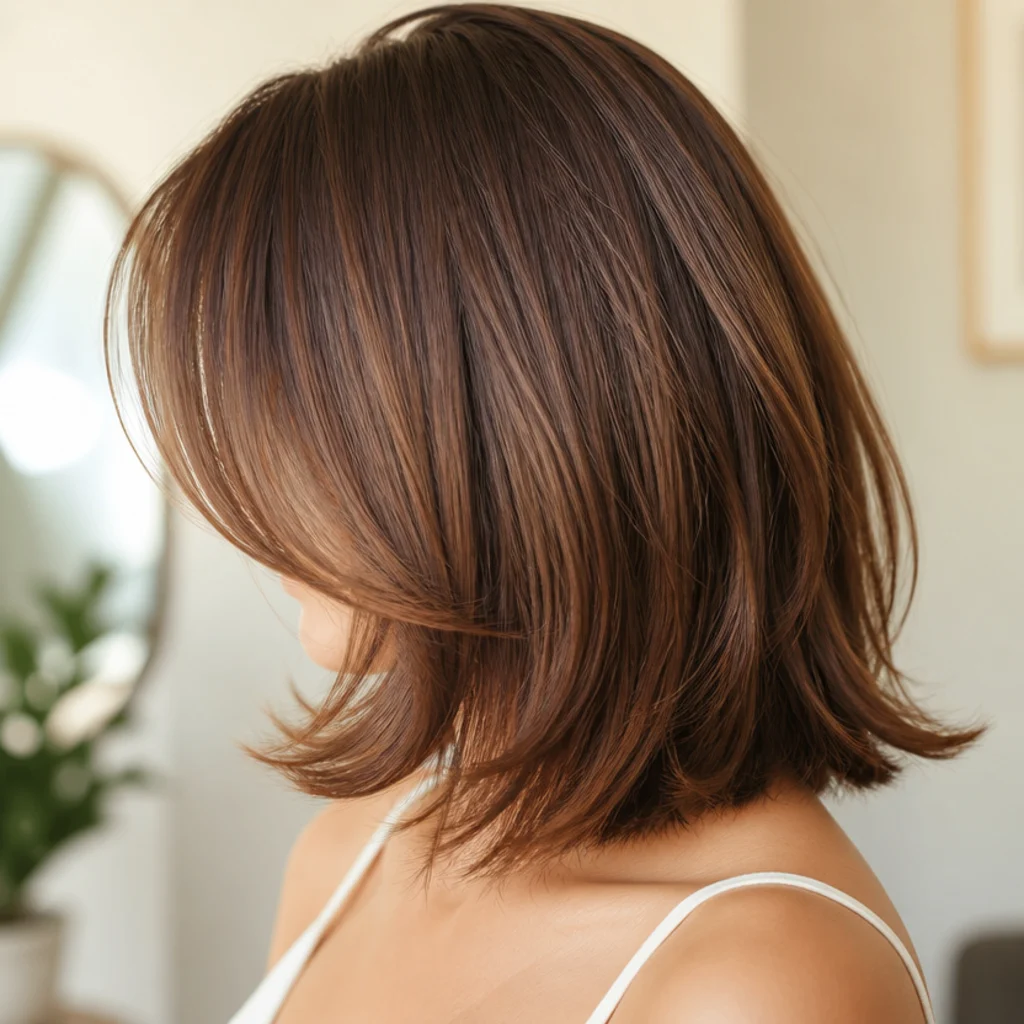
A square jaw wants soft diagonals near the face rather than any hard horizontal edge. Feathered bangs are cut in a fine, tapered sweep with the shears held vertically, so the ends break into fine pieces instead of a solid line, and they sit best when they connect into face-framing layers that start at the jaw and curve outward. The combination softens the corner of the jawline without hiding it. Keep the length just below the shoulder so the eye travels past the jaw rather than stopping at it, which is the same balancing logic used across the core mid length haircut guide.
Who it suits: Square and rectangular jawlines, medium to thick hair.
Tip: Ask for vertical point cutting on the fringe ends and face-framing that starts at the jaw.
16. Curtain Bangs on a Butterfly Cut
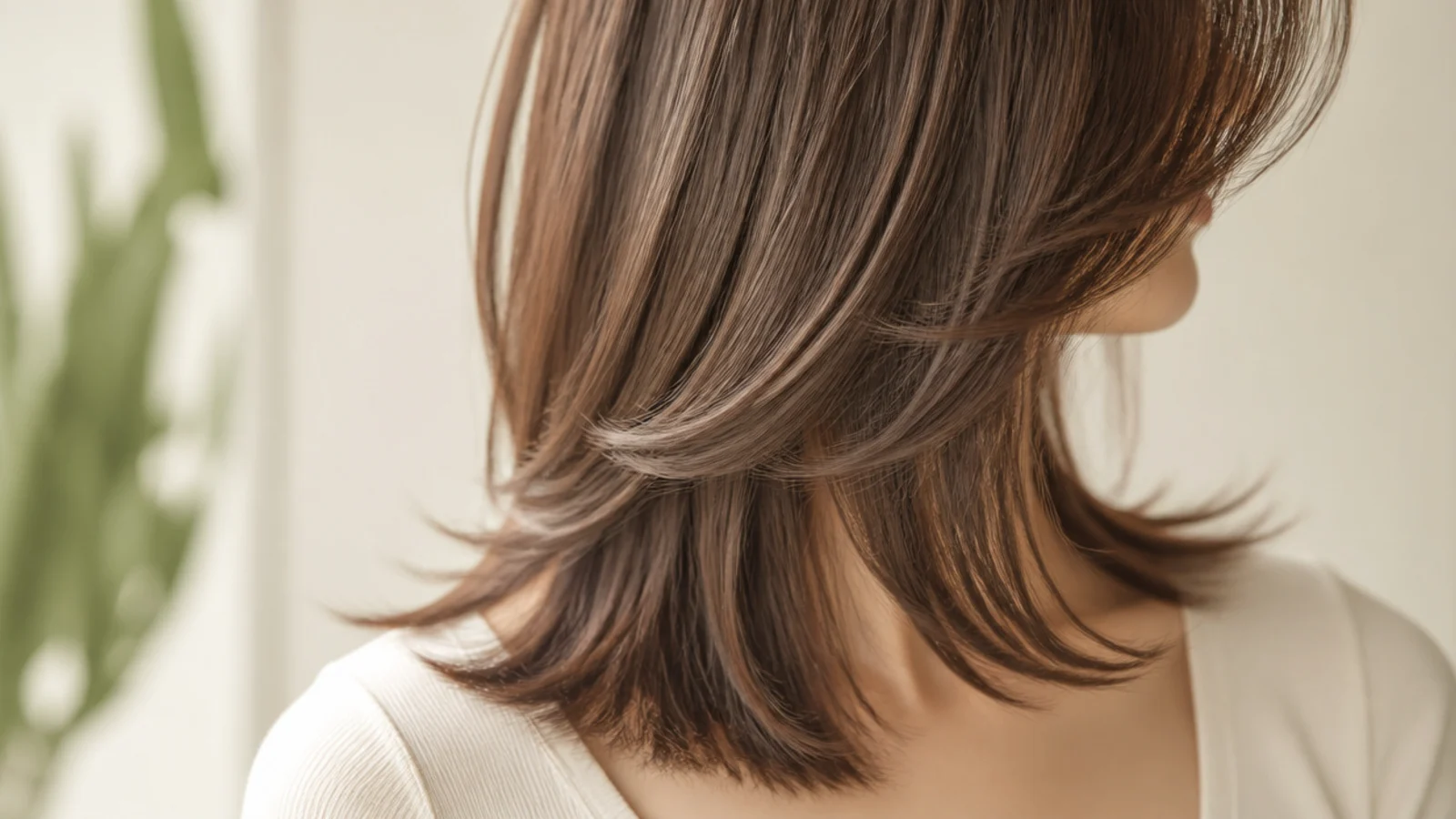
A butterfly cut layers the top section short, around chin length, while the underneath stays at collarbone or below, creating the illusion of a much shorter cut when styled with volume. Curtain bangs are the natural front edge of it, because the shortest crown layers need somewhere to blend forward. Ask for the shortest interior layer no higher than the chin, or the crown separates into an obvious shelf. It is a high-volume look that needs a round brush and about eight minutes, and it collapses on very fine hair without mousse.
Who it suits: Medium to thick hair that wants volume without losing collarbone length.
Tip: Ask for the top layers to connect into the fringe so there is no visible step at the temple.
17. Long Grown-Out Bangs Blended Into Face-Framing Layers
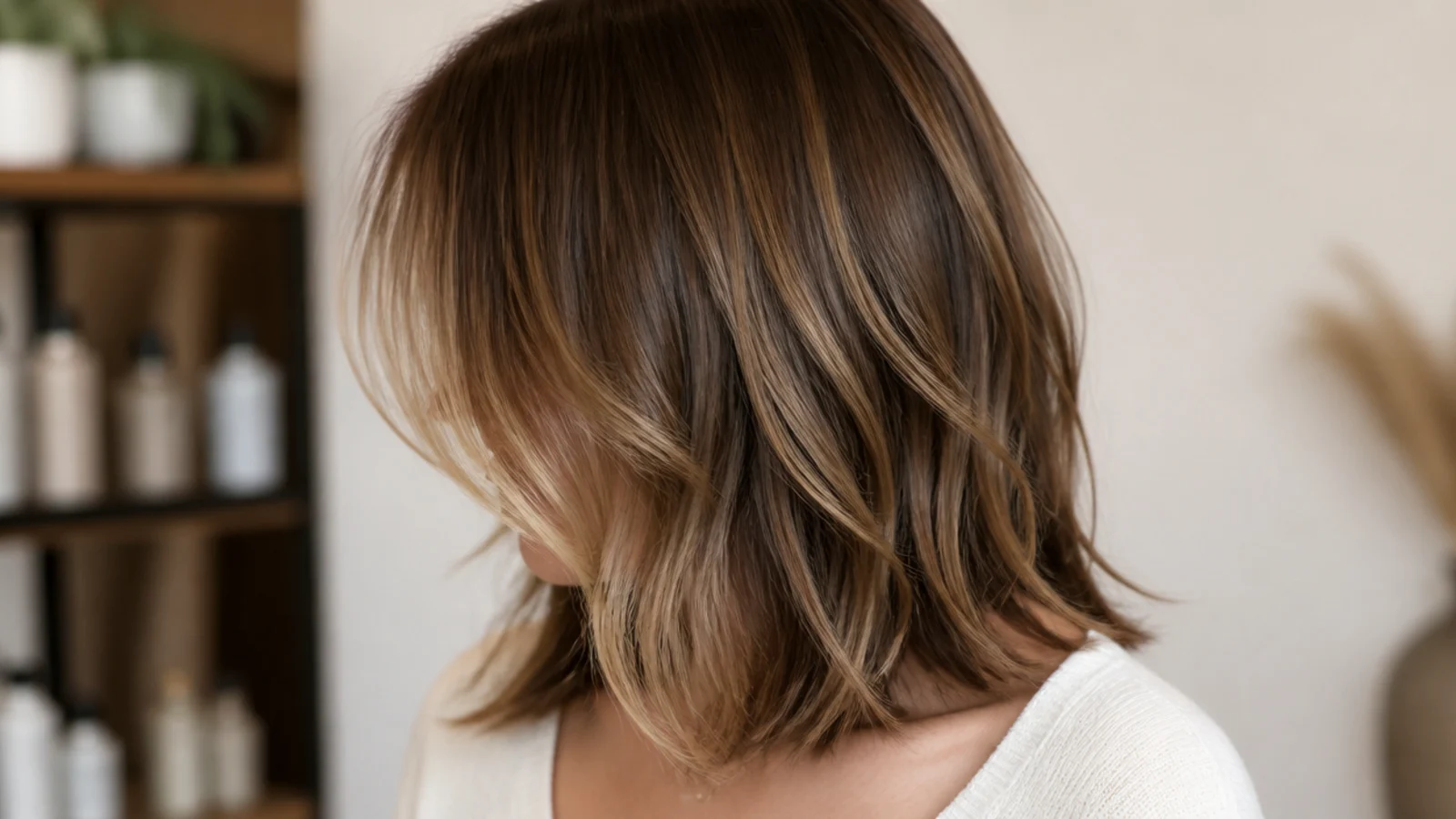
This is what curtain bangs become at month four, and it is worth asking for on purpose. The old fringe now reaches chin or jaw, so the stylist connects it into a face-framing layer that starts at the jaw and runs down to the collarbone, removing the step where the fringe used to end. Nothing gets shorter. It is the most low-maintenance version of a fringe on this list: no separate bang trims, no daily round brushing, and it still opens up the face. Trim the full cut every ten to twelve weeks and it holds.
Who it suits: Anyone growing bangs out, and low-maintenance wearers generally.
Tip: Ask to have the old fringe connected into a jaw-start face-framing layer, not trimmed back up.
18. Money Piece Face-Framing Instead of Bangs
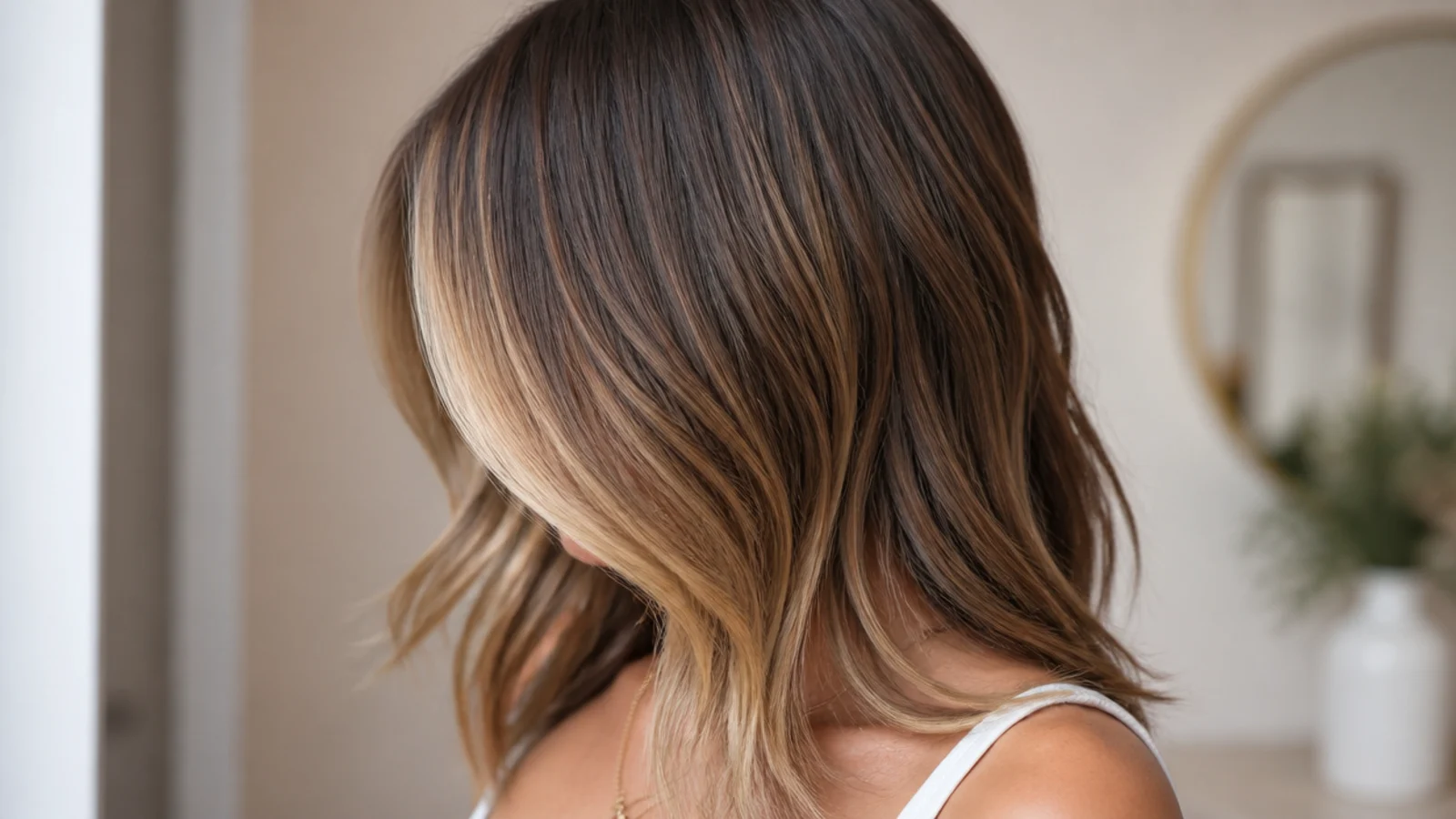
Readers constantly confuse three separate things: bangs are cut across the forehead, face-framing layers are cut shorter around the face, and a money piece is the two front sections lightened by color. If you want the opening-up effect of a fringe with zero cutting commitment, take the money piece instead: two brighter sections from the part down to about the collarbone, usually two to three shades lighter than the base. It costs a partial highlight, roughly the price band of a half head, and grows out with no awkward stage at all. It pairs neatly with the shapes in wavy mid length haircuts.
Who it suits: Anyone tempted by bangs but unwilling to commit to cutting them.
Tip: Ask for the lightened section to start at the part line and stop at the collarbone.
19. Curtain Bangs on Gray Mid Length Hair
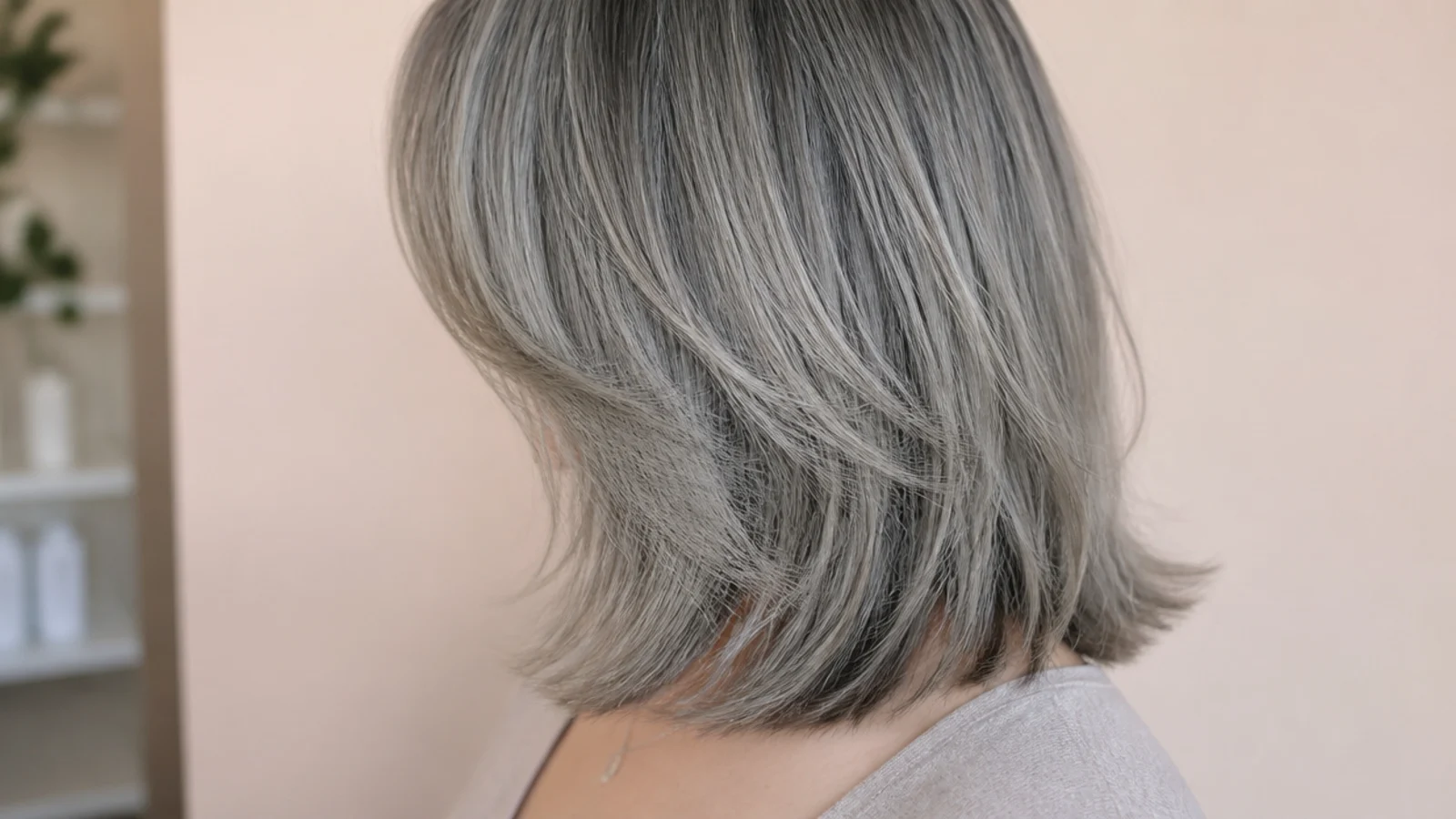
Gray hair is often coarser and more wiry at the front hairline, where regrowth is most stubborn, so a fringe cut too short there stands straight up. Cut curtain bangs long, from the cheekbone down to the jaw, and take the section deeper so surrounding hair weighs the front down. The soft diagonal also does the same job as a face-framing layer, drawing attention up toward the eyes. Keep the length at the collarbone rather than longer, because density usually drops with age and length exaggerates thin ends, a point covered further in mid length haircuts for fine hair.
Who it suits: Silver and salt-and-pepper hair, and coarser regrowth at the hairline.
Tip: Ask for a deeper fringe section so the wiry front hairline is weighed down by the hair behind it.
20. Full Fringe on Straight Mid Length Hair
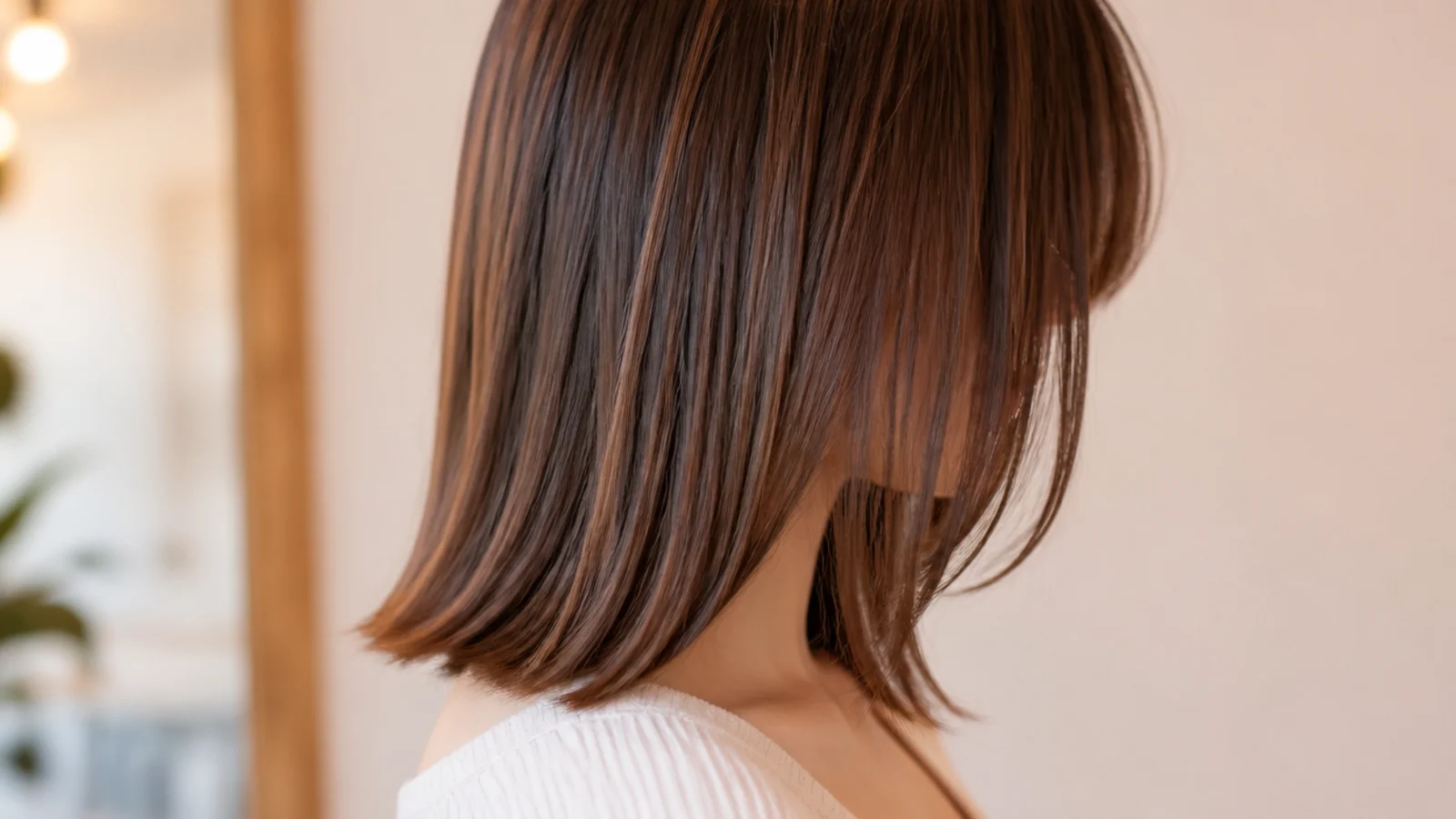
Straight hair holds a full fringe better than any other texture because there is no wave to break the line, and the payoff on a sleek collarbone cut is considerable. The trade-off is oil: a full fringe sits directly on the forehead and picks up sebum faster than the rest of your hair, so most wearers dry shampoo the fringe alone every second day and wash it in the sink between full washes. Cut it just below the brow rather than above it, so the first two weeks of growth land in the flattering window. More on sleek shapes in straight mid length haircuts.
Who it suits: Straight, medium to thick hair with a tolerance for daily styling.
Tip: Wash the fringe alone in the sink on non-wash days rather than dry shampooing it flat.
What Counts as Mid Length Hair With Bangs
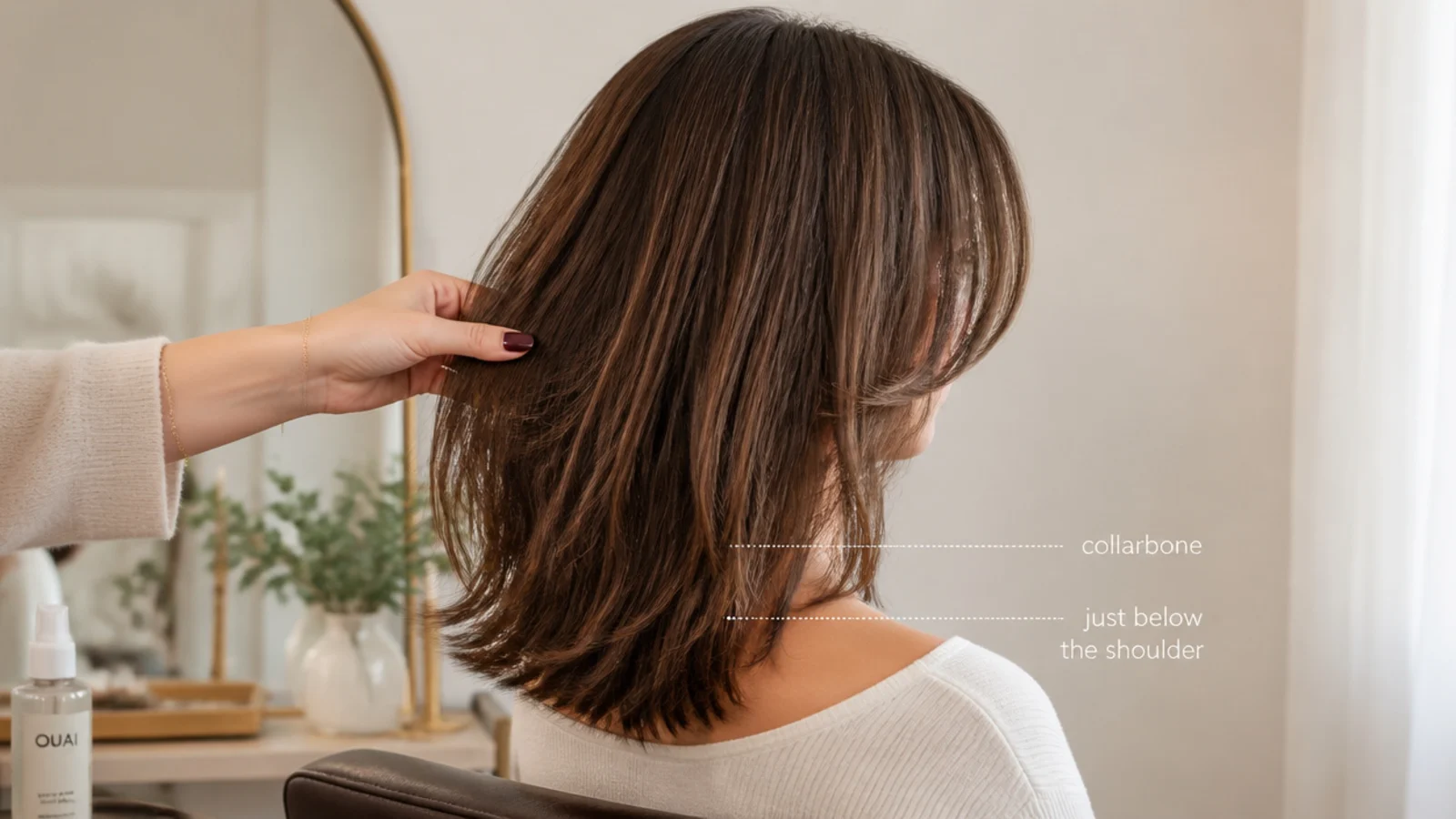
Mid length is a landmark, not a vibe. It starts at the collarbone and ends about an inch below the shoulder. Anything shorter is a bob or a lob; anything reaching the middle of the back is long hair. Name the landmark at the chair, because medium means different things to different stylists and the difference between collarbone and mid-back is four or five inches of hair you cannot get back that day. Height changes where that falls in inches: on a 5'2" frame collarbone length is often 12 to 14 inches from the crown, while on a 5'9" frame the same landmark can be 16 inches. Measure to the bone, not to the tape. This length matters for bangs specifically because it is the shortest length that still leaves enough hair behind the face to balance a fringe. On a chin-length bob a full fringe becomes the entire haircut, and on waist-length hair it reads as a small disconnected patch. Collarbone gives the fringe a background. If you are still deciding on the cut itself before adding a fringe, start with the mid length haircut hub and the core mid length haircut guide.
Bangs Ranked by How Hard They Are to Live With
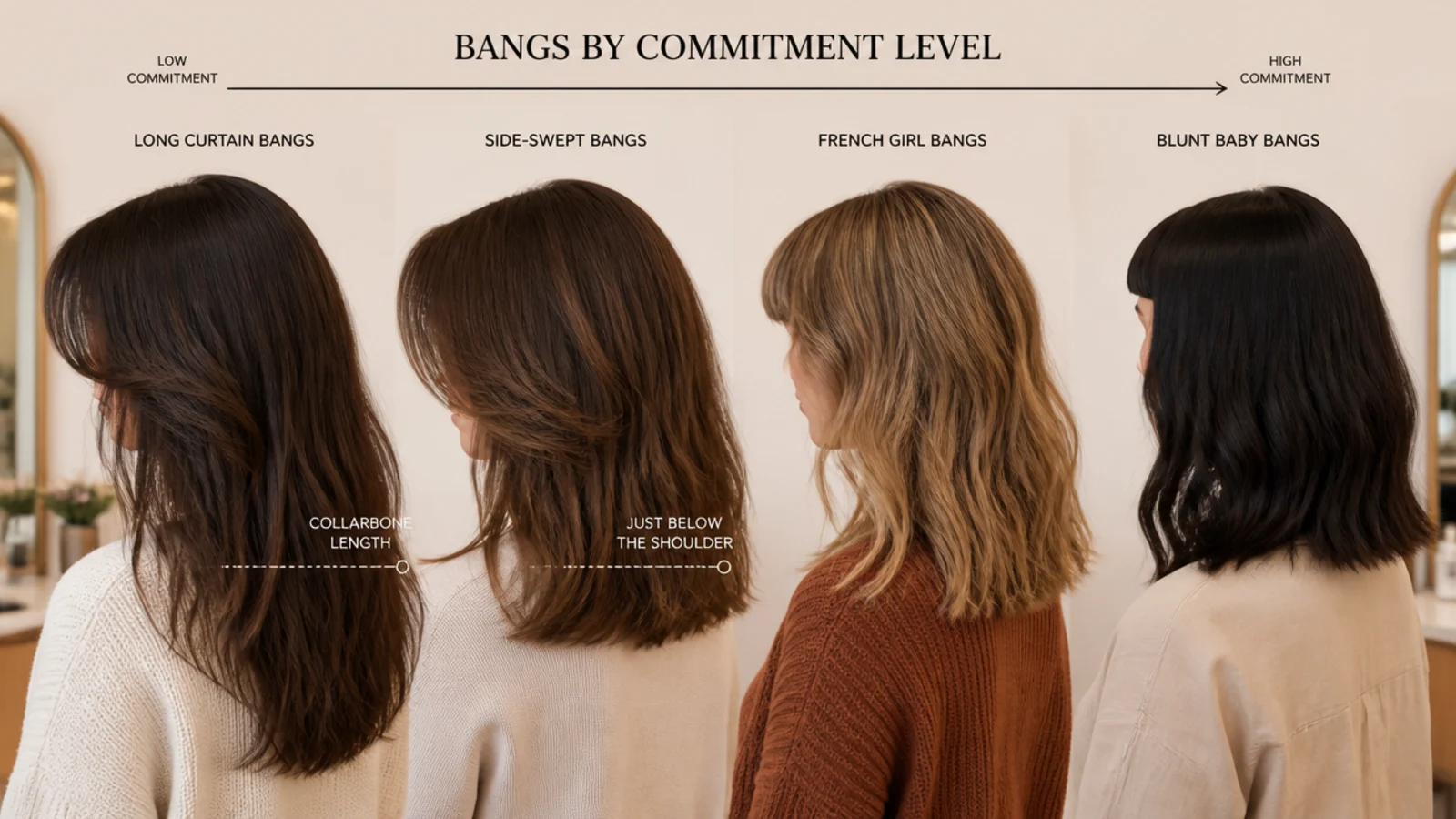
Every gallery shows you the photo and none of them show you the Tuesday morning. Here is the ladder, easiest first. A money piece is not a cut at all, so it is rung zero: color only, no grow-out phase. Long curtain bangs starting at the jaw are rung one: they can be tucked behind the ear from day one, they air-dry, and they blend into face-framing layers in roughly three to four months. Side-swept bangs are rung two: still tuckable, but they need a directional blow-dry or they fall into your eyes. Bottleneck and wispy bangs are rung three: real forehead coverage, a two to three minute daily round brush, trims every three to four weeks. Full blunt bangs are rung four: five minutes every morning, a trim every two to three weeks, and no way to hide them. Baby bangs are rung five, the point of no return, with eight to ten months of growth before they reach the cheekbone at the usual half inch per month. Pick the highest rung you would still be happy with on a day you overslept, then go one rung lower. Nobody has ever regretted cutting a fringe too long.
Mid Length Bangs by Face Shape
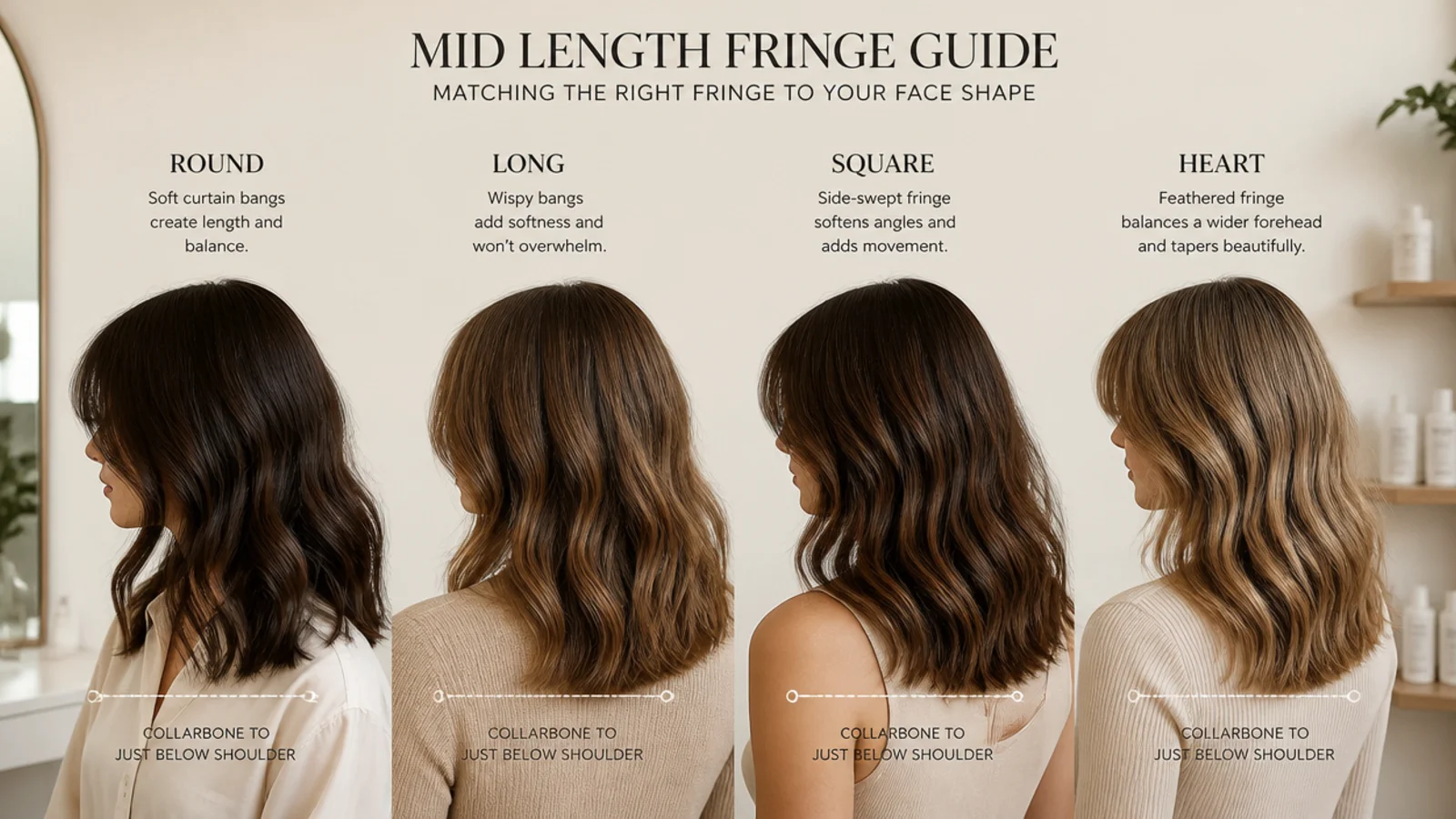
Face shape decides the angle of the fringe more than the type of it. Round faces want vertical line, so take long center-parted curtain bangs with the shortest point at the cheekbone or lower, and avoid any straight horizontal edge across the forehead. Long or oblong faces want the opposite: a shorter, arched fringe at brow level that shortens the visible forehead, with width built at the cheekbone rather than the ends. Square jaws want soft diagonals, so feathered or side-swept bangs blended into face-framing layers that start at the jaw and curve outward. Heart shapes carry width at the forehead and narrowness at the chin, so a wispy or bottleneck fringe that covers a little forehead while the length below the shoulder adds visual weight near the chin balances the two. Oval faces genuinely can wear any of them, which is why they dominate the inspiration photos and why copying a photo without checking your own proportions so often disappoints. Whichever shape you have, the length underneath should stay between the collarbone and just below the shoulder so the fringe stays the focal point.
Bangs on Fine, Thick and Curly Mid Length Hair
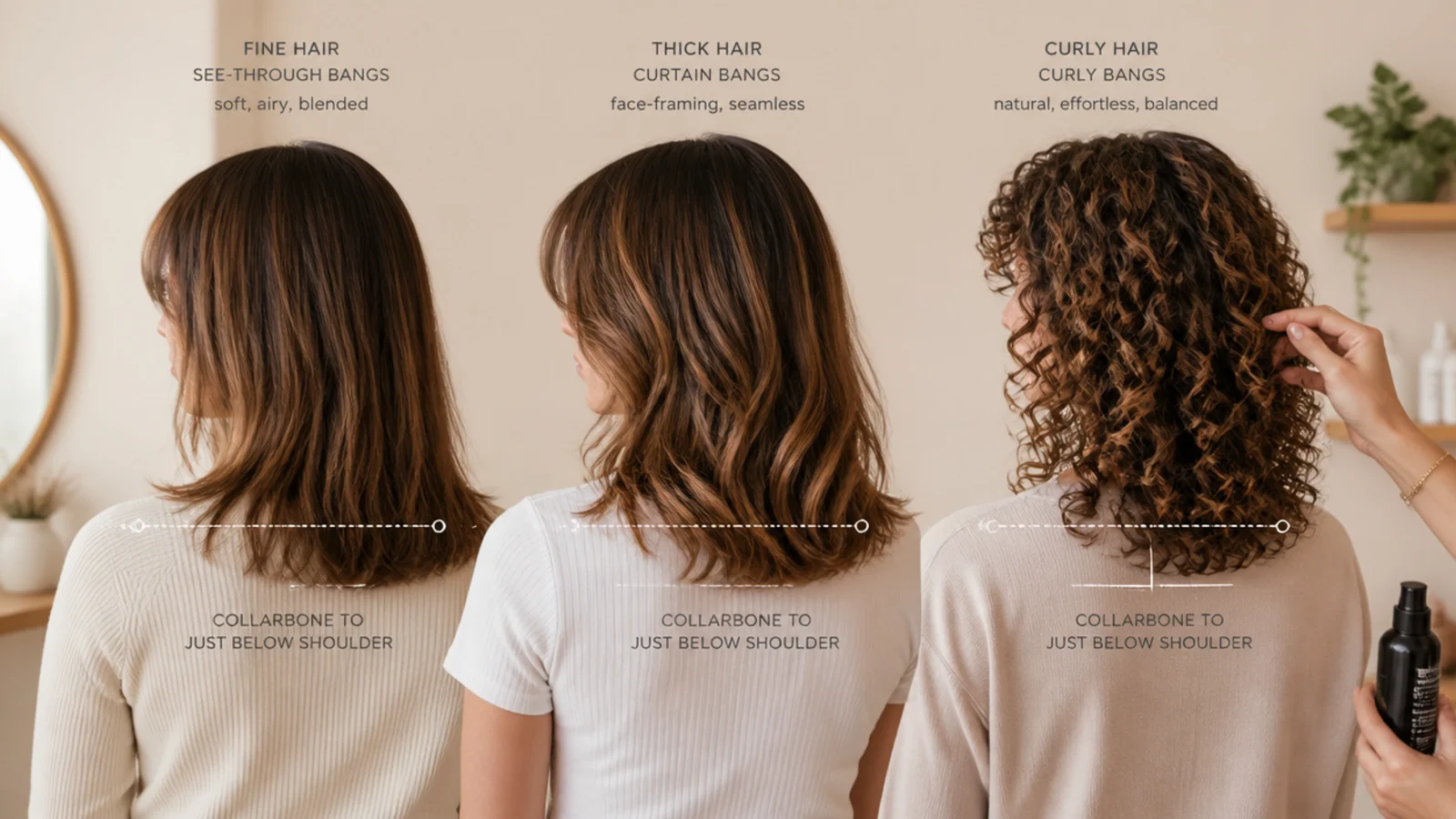
Hair type decides how much hair goes into the fringe section and how it gets cut. Fine hair wants a shallow section, no more than an inch back from the hairline, point cut rather than blunt cut, with fewer and longer layers behind it. Over-layering is the classic mistake on fine mid length hair: it leaves the ends sparse and makes the fringe look like it is floating in front of nothing. Thick coarse hair needs the opposite, a deeper section of about an inch and a half plus internal weight removed from underneath, or the fringe stands away from the head in a shelf. Curly hair has its own rule: cut dry, curl by curl, so the length lands where you agreed once each curl springs up, and remember that 3A to 3B curls lose roughly a third of their stretched length as they dry. Wavy hair sits between the two, and should be cut with the wave pattern intact rather than combed straight under tension. The texture-specific cuts underneath are covered in wavy mid length haircuts, curly mid length haircuts and mid length haircuts for fine hair.
How to Ask Your Stylist for Mid Length Hair With Curtain Bangs

Say this, out loud, before anything is wet: collarbone length, long invisible layers, face-framing starting at the jaw. Those three clauses cover the three decisions that actually change the outcome. Then add the fringe specifics: where the shortest point should land, named against your own face rather than in inches, so cheekbone, jaw or brow. Ask for the fringe to be cut dry at the end of the appointment, because hair shrinks up as it dries and a fringe cut wet on straight hair typically lands a half inch shorter than intended, and considerably more than that on curls. Ask whether weight is being removed from underneath or from the surface, and say no to thinning shears at the surface of a fringe: they leave a fluffy regrowth line you will fight for months. If you wear glasses, put them on before the fringe is cut. If you have a cowlick, point at it. Bring two photos, one of the length and one of the fringe, and say which parts of each you want, since a single photo is almost never both. Layer options are worth reviewing first in mid length haircut with layers.
Day-to-Day Styling, Trimming and Growing Bangs Out
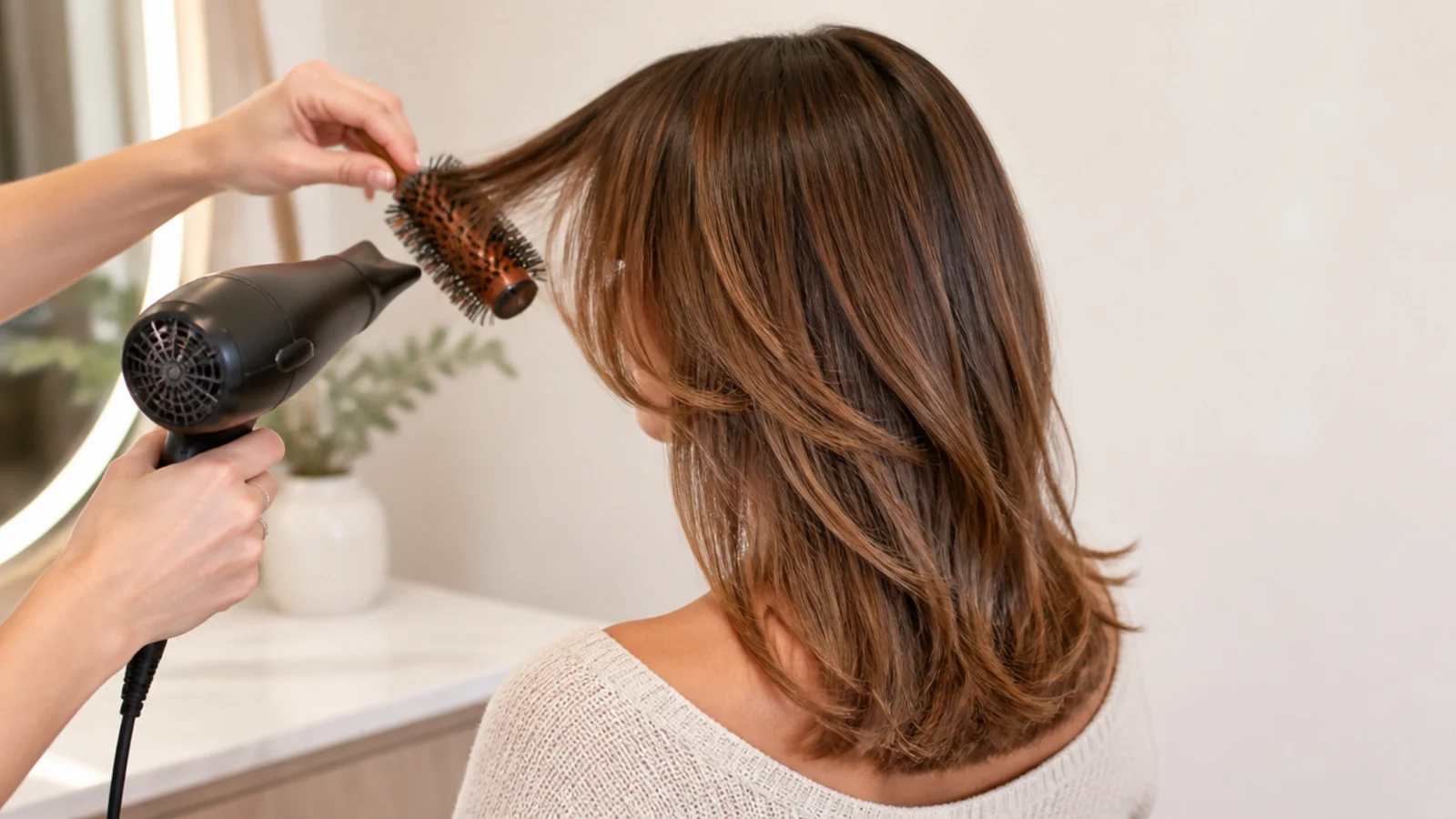
The fringe is the only part of your hair that needs attention every single day. Blow-dry it first, while the rest is still damp, because a fringe left to dry on its own sets in whatever direction the cowlick chooses. For curtain bangs, pull the section straight up with a round brush, dry it back and forth across the forehead for about twenty seconds, then split it to either side and cool it in place. That is the whole technique and it takes two minutes. Bangs also get oily faster than the rest of your hair because they sit against the forehead, so wash the fringe alone in the sink on non-wash days rather than dry shampooing it into flatness. Trim the fringe every three to four weeks and the full cut every eight to twelve weeks. To grow bangs out gracefully, do not stop cutting: have the fringe angled longer at the outer edges every visit until it reaches the jaw, then have it connected into a face-framing layer. At about half an inch of growth per month, a cheekbone curtain bang blends in around month three or four. For event styling on mid length hair with a fringe, the half-up shapes in half up graduation hairstyles and the pinned looks in sleek graduation hairstyles both keep the bangs forward where they belong.
Frequently Asked Questions
How often should I trim my bangs to maintain their shape?
Curtain bangs hold their shape for six to eight weeks and can usually be trimmed with your regular cut. A full blunt fringe needs trimming every two to three weeks, because at roughly half an inch of growth per month it drops into your lash line fast. Most salons do a bang trim between appointments free or for a small fee, so ask when you book the main cut.
Can I still pull my hair back with bangs, or will they always be in my face?
It depends on the fringe. Curtain bangs cut to jaw length tuck behind the ear or pin back flat, so a ponytail still works. Side-swept bangs also tuck. A full blunt fringe and baby bangs cannot be pulled back at all until they grow to cheekbone length, which takes eight to twelve months. If pulling your hair back matters, stay on the curtain end of the list.
What face shapes look best with curtain bangs versus full bangs?
Curtain bangs suit round, square, heart and oval faces because the diagonal sweep adds vertical line and softens hard corners. Full blunt bangs suit oval and long faces best, where a horizontal line at the brow shortens a tall forehead and balances the proportions. A full fringe on a round face stacks width on width, which is the single most common mismatch.
How do I prevent my bangs from getting oily faster than the rest of my hair?
Your fringe rests directly on forehead skin, so it picks up sebum and any face product you use. Wash the fringe alone in the sink on non-wash days, which takes about ninety seconds and beats dry shampoo, since dry shampoo builds up and flattens the fringe. Keep heavy face creams off the hairline and avoid touching or pushing the fringe during the day.
How can I grow out my bangs gracefully without that awkward in-between phase?
Keep cutting, do not stop. At each visit have the fringe angled longer at the outer edges so it merges toward the length instead of sitting as a separate block. Once it reaches the jaw, have it connected into a face-framing layer that starts at the jaw and runs to the collarbone. At about half an inch a month, a cheekbone-length curtain bang blends in around month three or four.
Are certain types of bangs better for hot or humid climates?
Yes. Humidity swells the hair shaft and lifts a blunt line, so a heavy straight fringe frizzes and separates within an hour outdoors. Long curtain bangs and side-swept bangs handle humidity far better because they are meant to look soft and piecey anyway. If you have wave or curl in a humid climate, avoid a blunt fringe entirely and let the fringe dry in its natural pattern.
Can I still have bangs if I have cowlicks or natural partings in my front hairline?
You can, but not any bangs. A blunt fringe over a strong cowlick will split into a permanent gap. Ask for a longer fringe cut to at least the cheekbone, taken from a deeper section so heavier hair from behind lies over the swirl, and let it fall in the direction the cowlick already wants. Blow-dry the roots side to side while damp to break the set.
What is the difference between curtain bangs, face-framing layers and a money piece?
Curtain bangs are cut across the front hairline and parted in the middle so they sweep both ways. Face-framing layers are shorter lengths cut around the face, usually starting at the chin or jaw, taken from hair that already reaches past the shoulder. A money piece is not a cut at all: it is the two front sections lightened by color, typically two to three shades brighter than the base.
How long does mid length hair with bangs take to style each morning?
Curtain bangs take about two minutes with a round brush, and many people air-dry them by simply splitting the section while damp. Bottleneck and wispy bangs take two to three minutes. A full blunt fringe realistically takes five minutes with a flat brush and a cool shot, every day, and it is the part of the routine people underestimate before they commit.
Do bangs work on fine or thinning hair at mid length?
Yes, with restraint. Take a shallow fringe section no deeper than an inch so you are not borrowing density from the crown, have the ends point cut rather than blunt cut, and keep the layers behind it long and few. Over-layering is what makes fine mid length hair look sparse at the ends. A wispy or long curtain fringe is the right pick; choppy bangs are not.
Which mid length haircut look are you saving?
If you take one thing from these 20 mid length haircut ideas with bangs, make it the commitment ladder. Start long, start soft, and start at the jaw: a curtain bang cut to jaw length can be tucked, pinned or blended into your layers on any day you hate it, and it disappears into face-framing pieces in about four months if you decide it is not for you. A blunt fringe gives you no such exit. Book a trim every three to four weeks for the fringe and every eight to twelve weeks for the length, and say the words out loud at the chair: collarbone length, long invisible layers, face-framing starting at the jaw. Browse the rest of the mid length haircut hub for the cut that goes underneath.