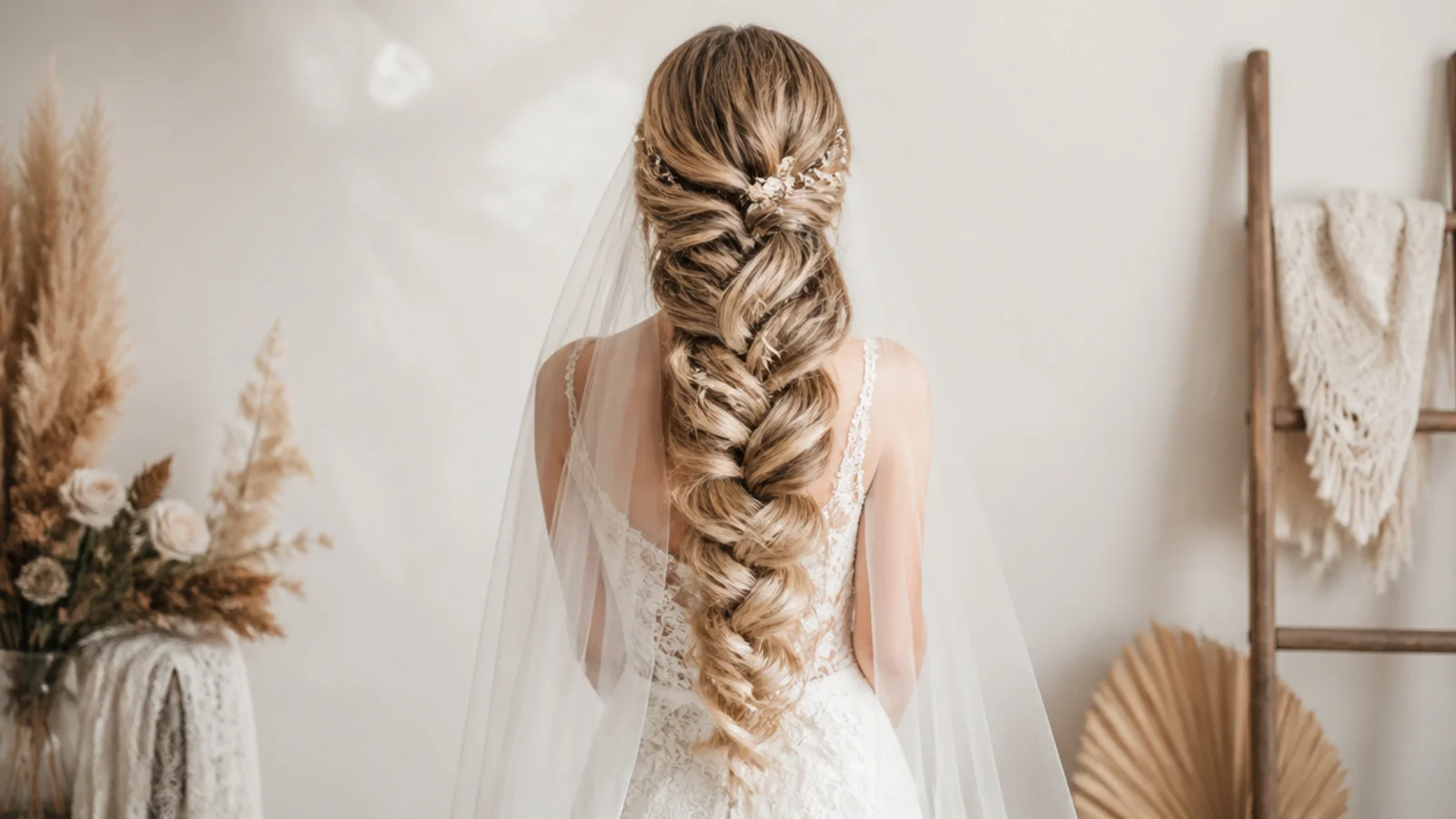
Quick Comparison
| Mermaid Braid Worn Down | Mermaid Braid Pinned Up | |
|---|---|---|
| Best gown necklines | Strapless, sweetheart, off-shoulder, scoop | High neck, illusion back, backless, halter |
| Veil compatibility | Works with blusher and cathedral if the comb sits above the braid | Works with every veil; the comb has a solid anchor |
| Hair length needed | Collarbone at minimum, mid-back to fan properly | Shoulder length upward, since the braid is coiled not displayed |
| Time to style | About 15 to 25 minutes once the hair is curled | About 30 to 45 minutes including pinning |
| Holds through dancing | Loosens; expect a re-pancake before the reception | Holds all night once pinned at the nape |
| Hot or humid venue | Hair sits on the neck and shows frizz at the hairline | Neck stays clear; far more comfortable outdoors |
| Fine hair | Needs texture spray and a Dutch base to look thick | Coiling stacks the braid, so it reads fuller |
| Photographs best | From behind and in profile; shows length | From every angle; shows the gown back |
| Touch-up during the day | Tug the outer edges wider; no pins needed | Push two pins back in; harder to fix alone |
1. Classic Mermaid Braid for a Strapless Gown
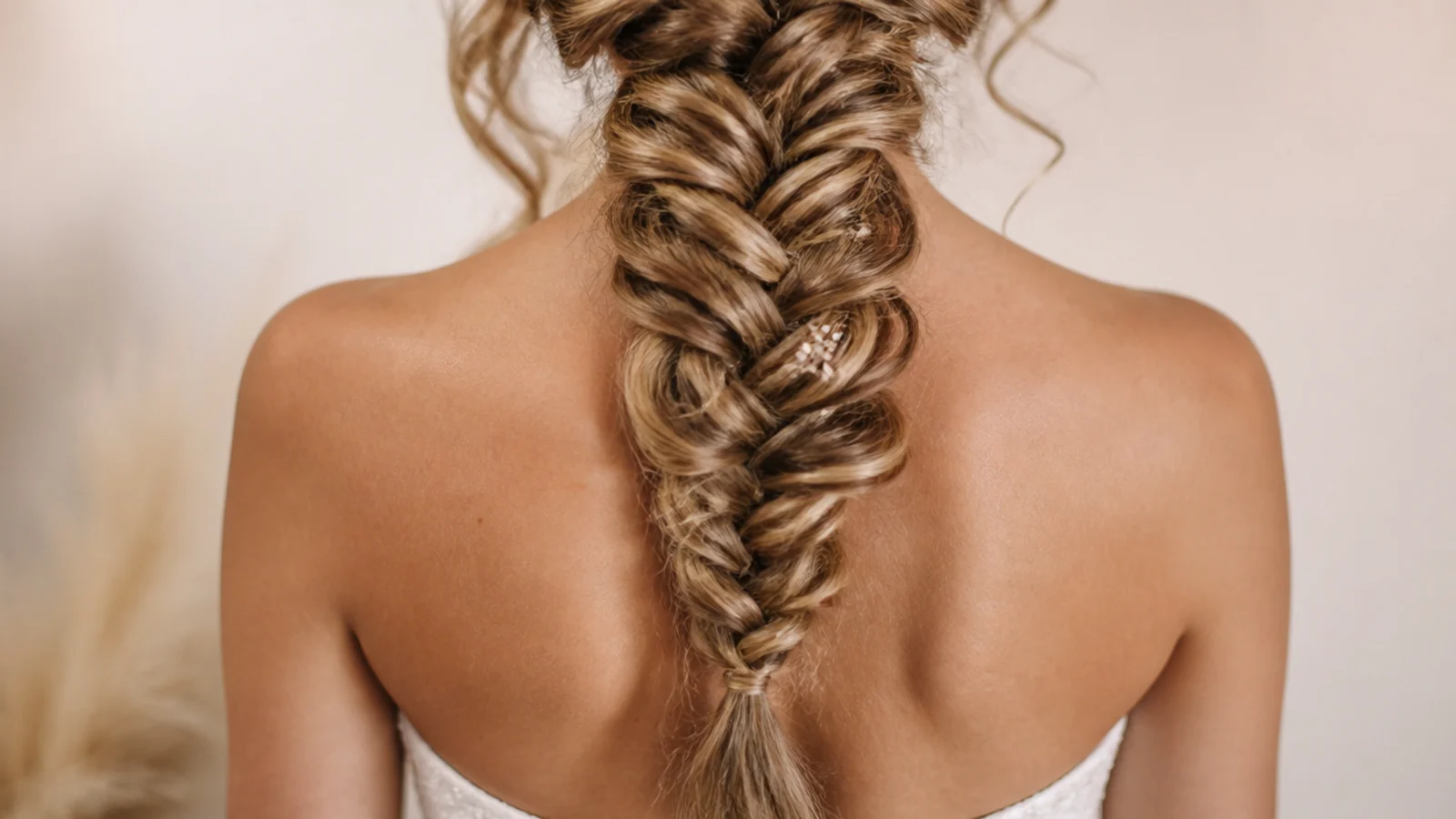
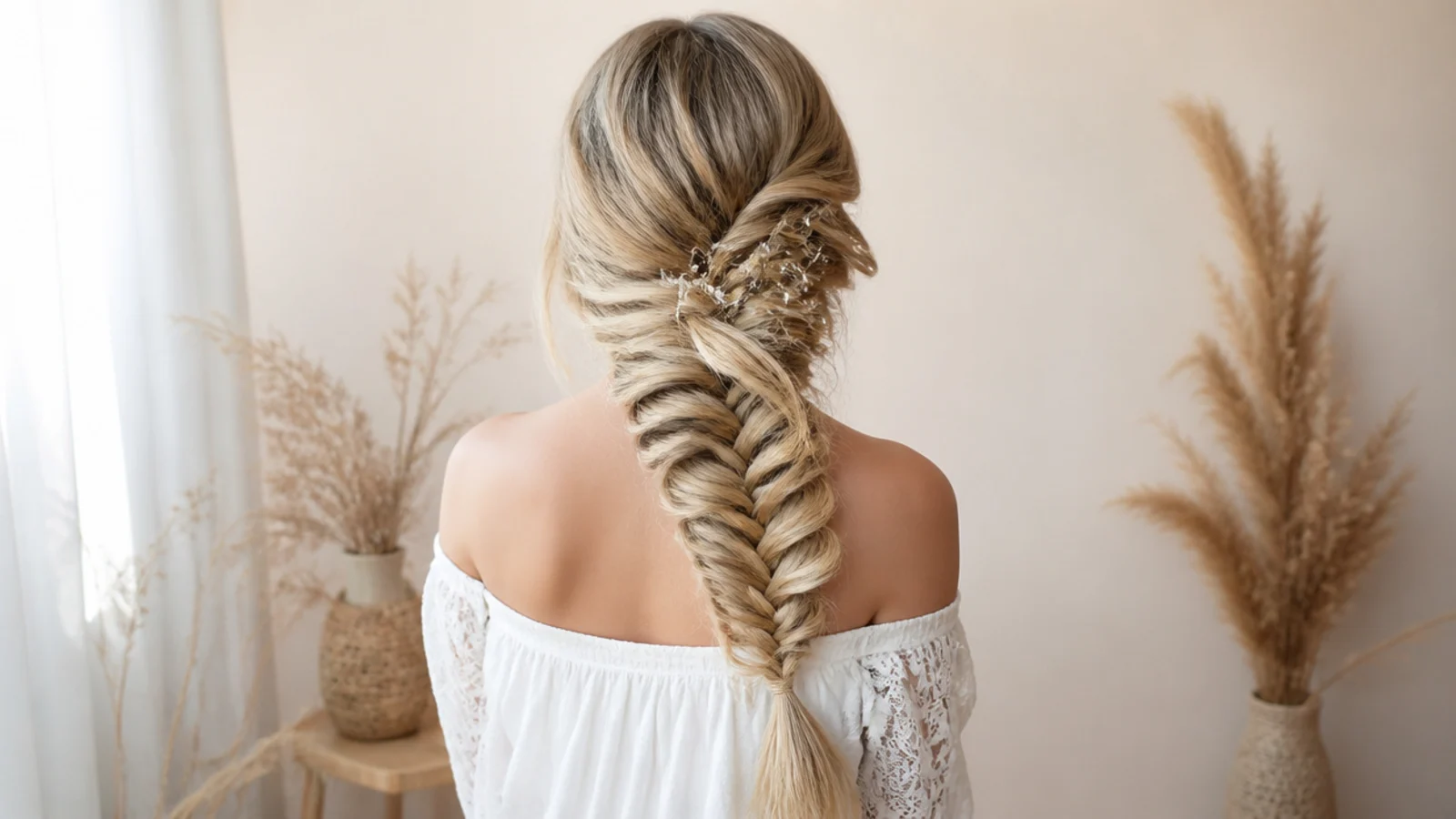
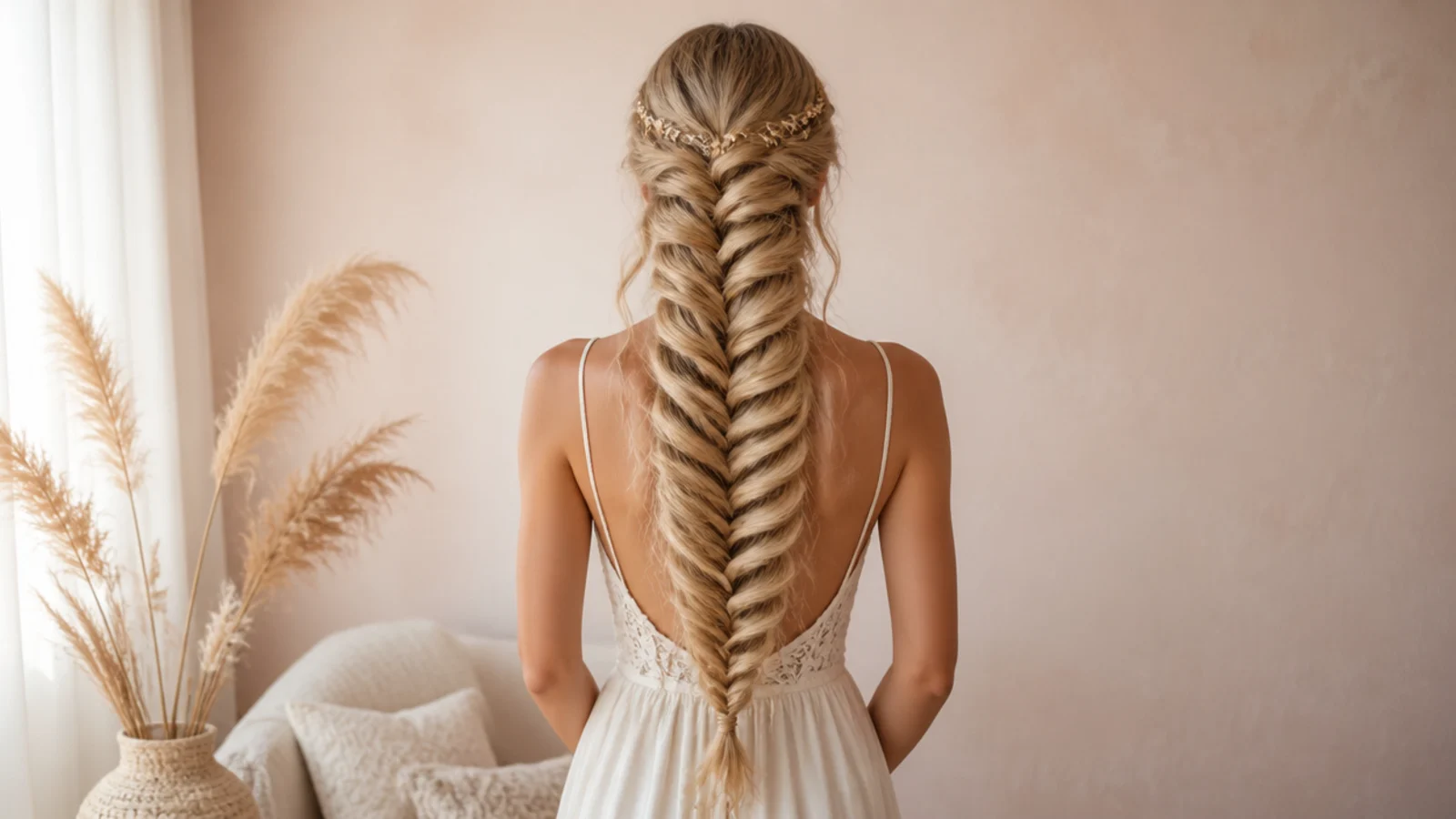
One fishtail started at the nape, worked straight down the center of the back, then pancaked from the tail up until it is roughly three fingers wide. On a strapless or straight-across neckline the braid becomes the only vertical line in the whole look, which is exactly what a bare shoulder frame wants. Start it low, at or just below the occipital bone, so the top of the braid does not compete with the gown edge. Curl the hair on a 1.25 inch iron first and brush the curls out, since that is what gives the fan enough body to stay open.
Who it suits: Hair past the shoulder blades, strapless and straight necklines.
Tip: Finish with a clear elastic, not a satin one, so nothing shows in the back-of-dress photos.
2. Side Mermaid Braid Over One Shoulder With a Cathedral Veil
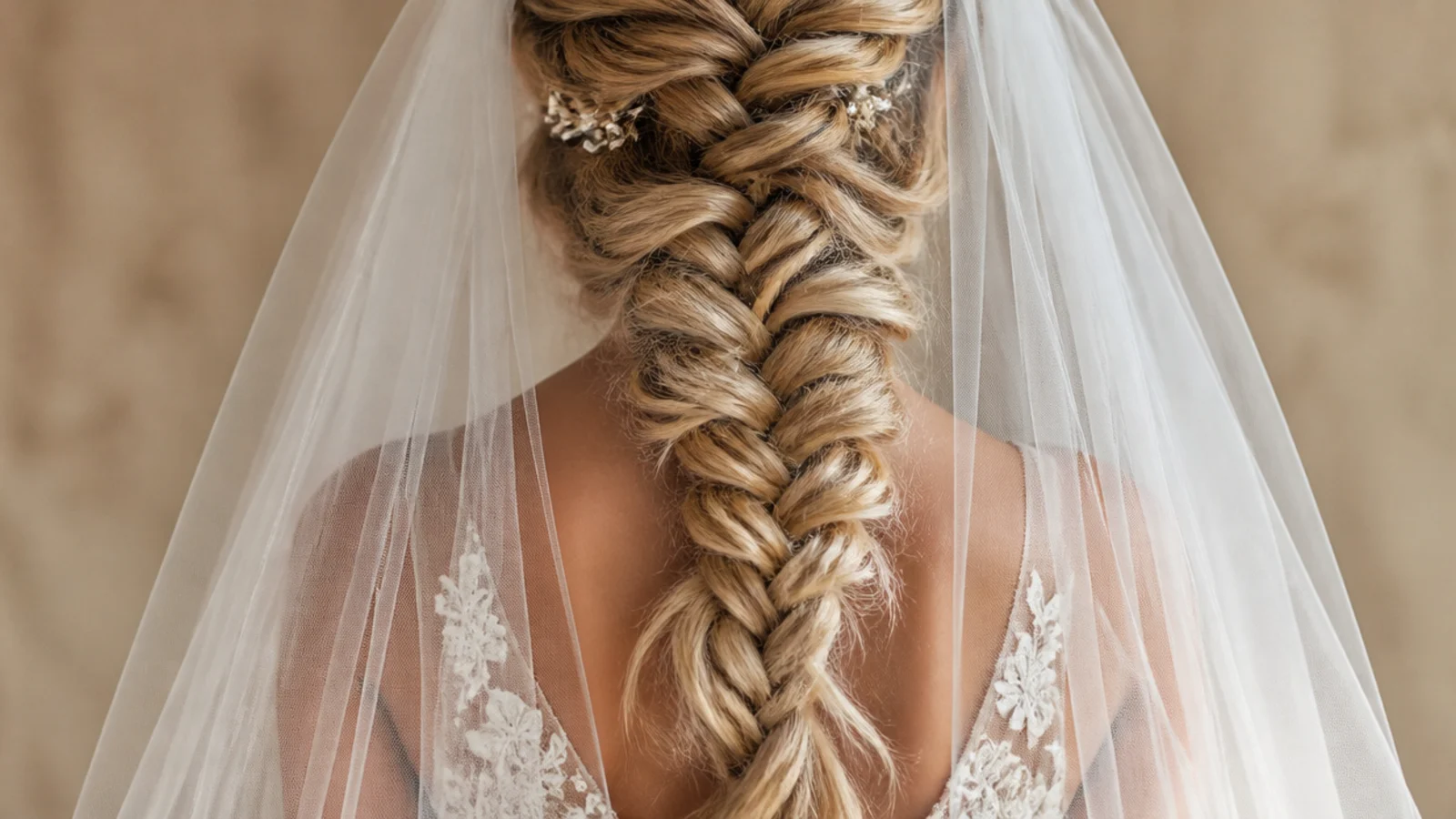
A deep side part, everything swept over the opposite shoulder, and the fishtail worked down the front of the collarbone. This is the single best mermaid braid for a cathedral veil, because the veil comb sits at the crown on the fuller side and the braid lives entirely in front, so the tulle never catches on the braid texture behind. Pancake only the outer edge, the one facing the camera, and leave the inner edge tighter so the braid lies flat against the shoulder instead of standing off the chest. Full breakdown in side mermaid braids.
Who it suits: Long veils, asymmetric necklines, round and square face shapes.
Tip: Part on the side your hair naturally falls toward, or it will creep back over during the ceremony.
3. Half-Up Mermaid Braid With a Blusher Veil
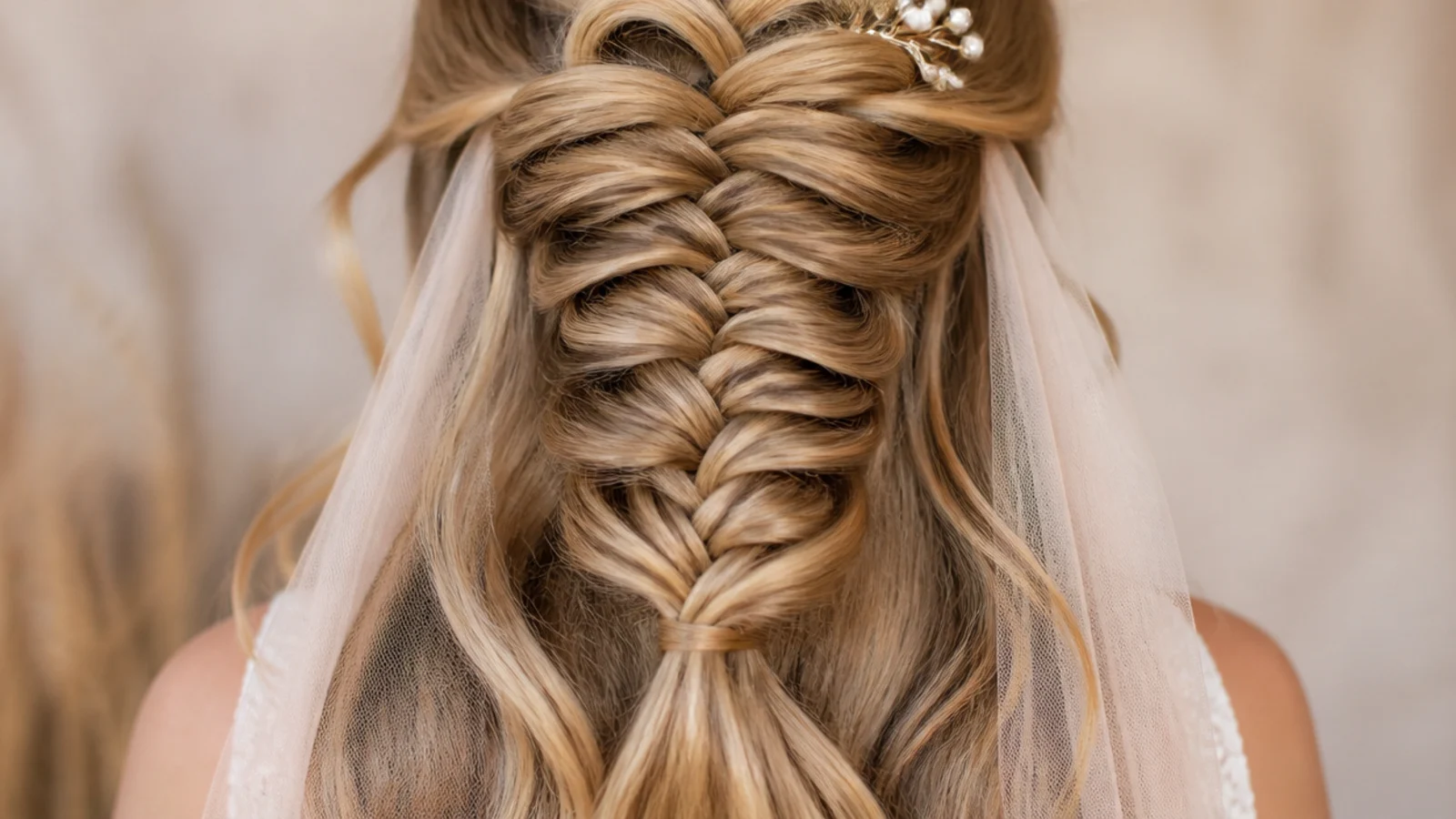
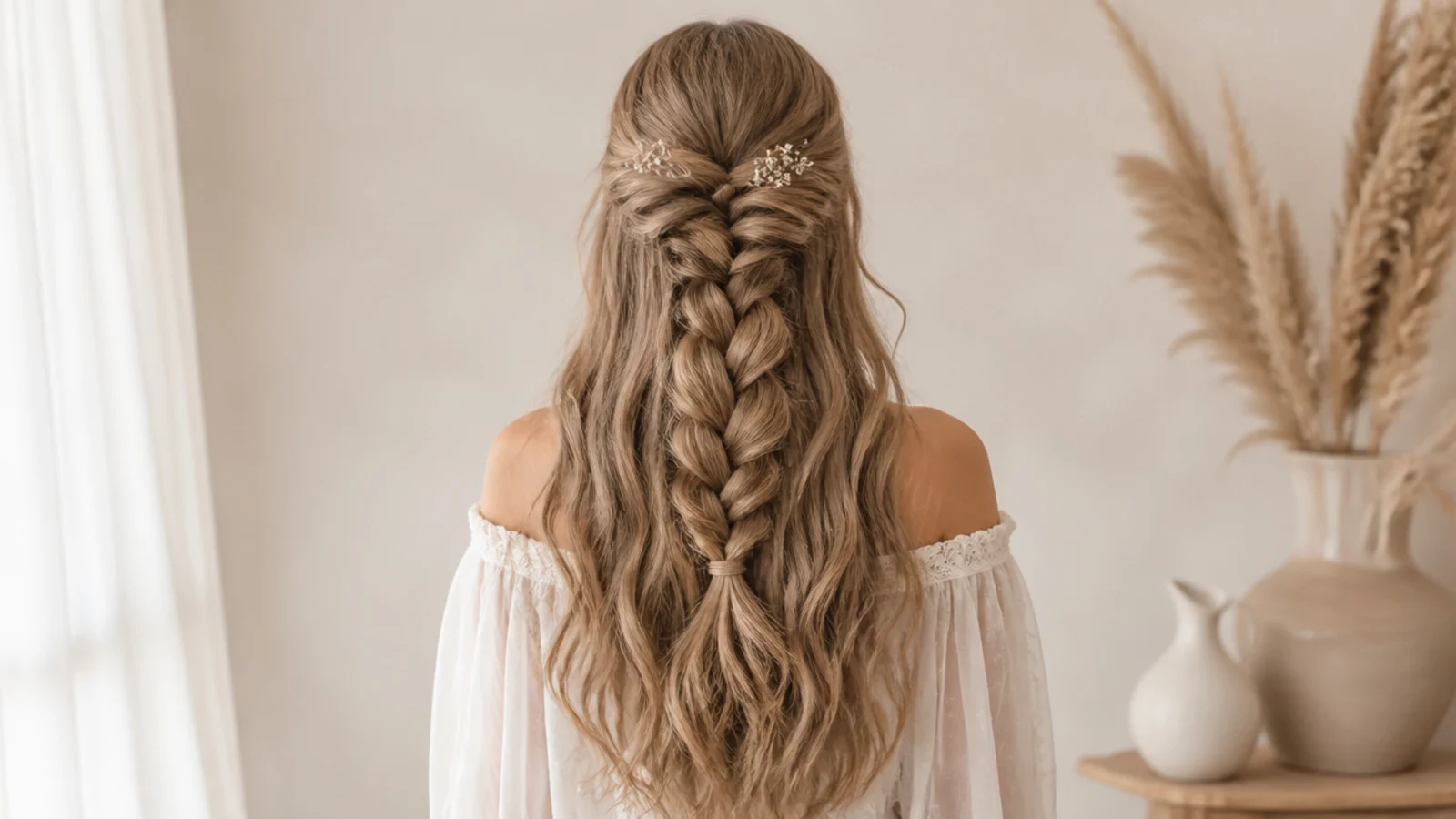
Take the top third of the hair from temple to temple, fishtail it back to the crown, pancake it wide, and leave the rest in loose waves. The half-up shape gives a blusher veil somewhere solid to anchor: the comb slides in under the braid where it is invisible from the front, and lifting the blusher will not drag the whole style backward. It is also the most forgiving choice if you are unsure about hair up versus hair down, since it reads formal from the front and relaxed from behind. See more constructions in half-up mermaid braids.
Who it suits: Brides torn between up and down, and anyone wearing a blusher.
Tip: Pin the braid tail flat with two crossed bobby pins before the veil comb goes anywhere near it.
4. Mermaid Braid Crown for a Garden Wedding
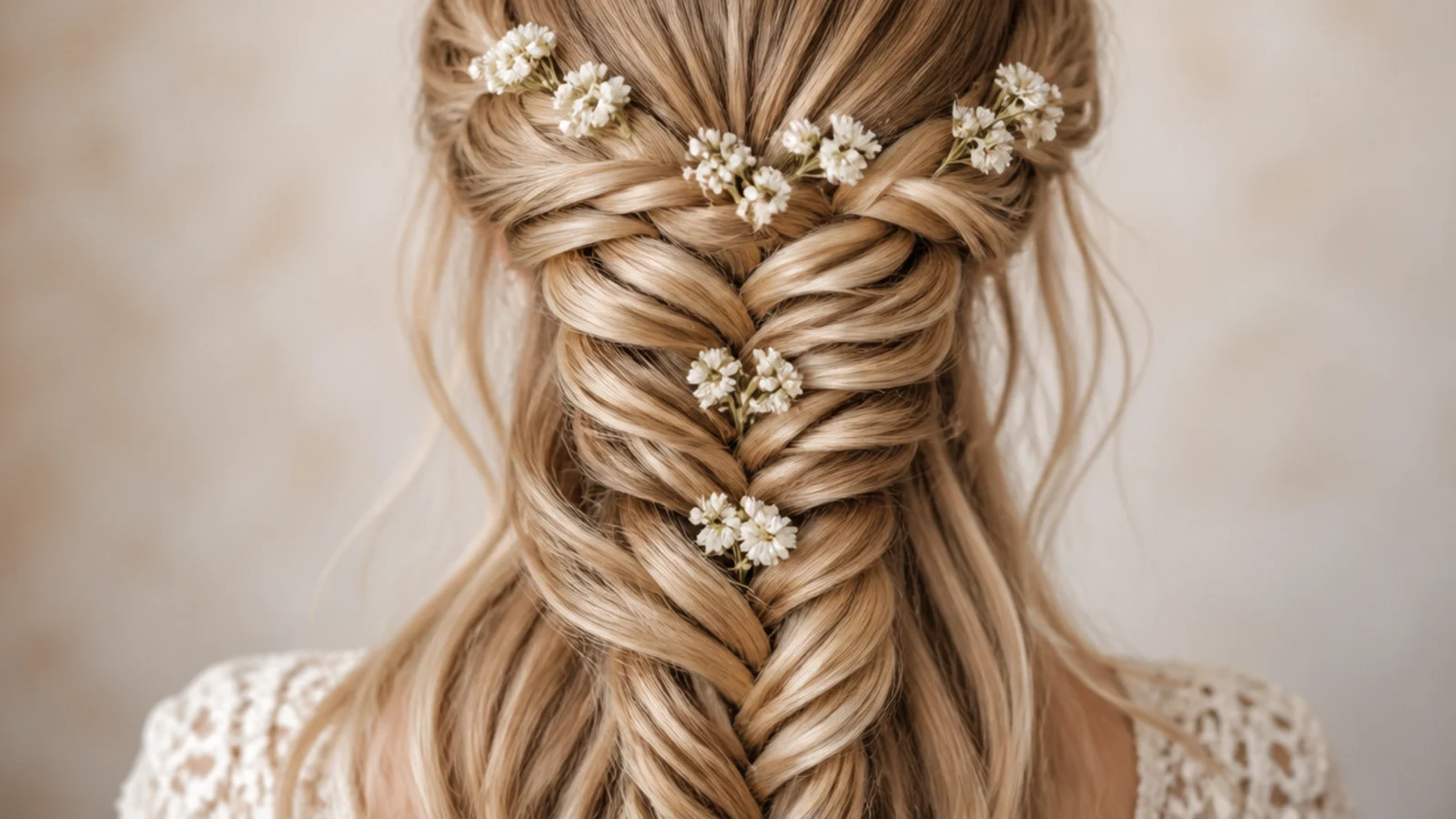
Two fishtails, one from each side, pancaked and then wrapped across the crown and pinned so they meet in a continuous halo. It needs real length, mid-back at minimum, because each braid has to travel from behind the ear all the way across the head. The reward is a hairline that reads like a headpiece without you buying one, which is why it suits outdoor and garden ceremonies where a formal tiara would look staged. Tuck three to five single stems, not a whole crown, into the pancaked gaps so the flowers look grown into the braid.
Who it suits: Mid-back length or longer, outdoor and garden ceremonies.
Tip: Pin into the braid seam, not through the fan, so the pancaked width stays open.
5. Low Mermaid Braid Bun for a High-Neck Gown
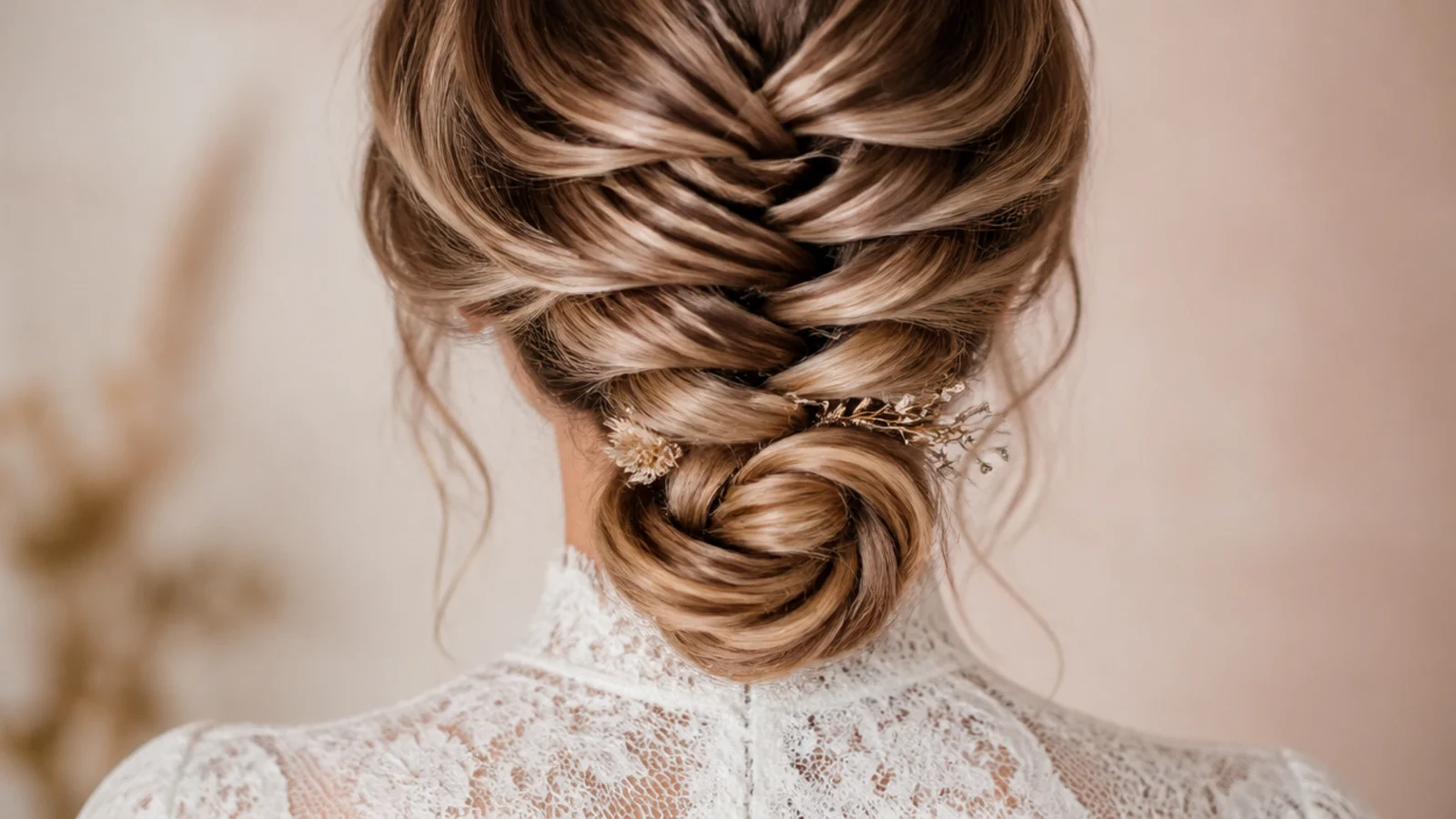
Braid a full fishtail, pancake it hard so it is wide and flat, then coil it at the nape and pin it into a bun. The coil turns a wide braid into a bun with visible texture, which is the whole reason to do it this way rather than with a rope braid. It is the right call under a high neck, illusion or covered-back gown, because a braid hanging down the back disappears against fabric detail and just adds bulk at the collar. Related shapes live in long hair updos that last.
Who it suits: High necklines, illusion backs, and anyone who wants the nape clear.
Tip: Pancake before you coil; once it is pinned into a bun you cannot widen it without unpinning.
6. Waterfall Mermaid Braid for a Beach Ceremony
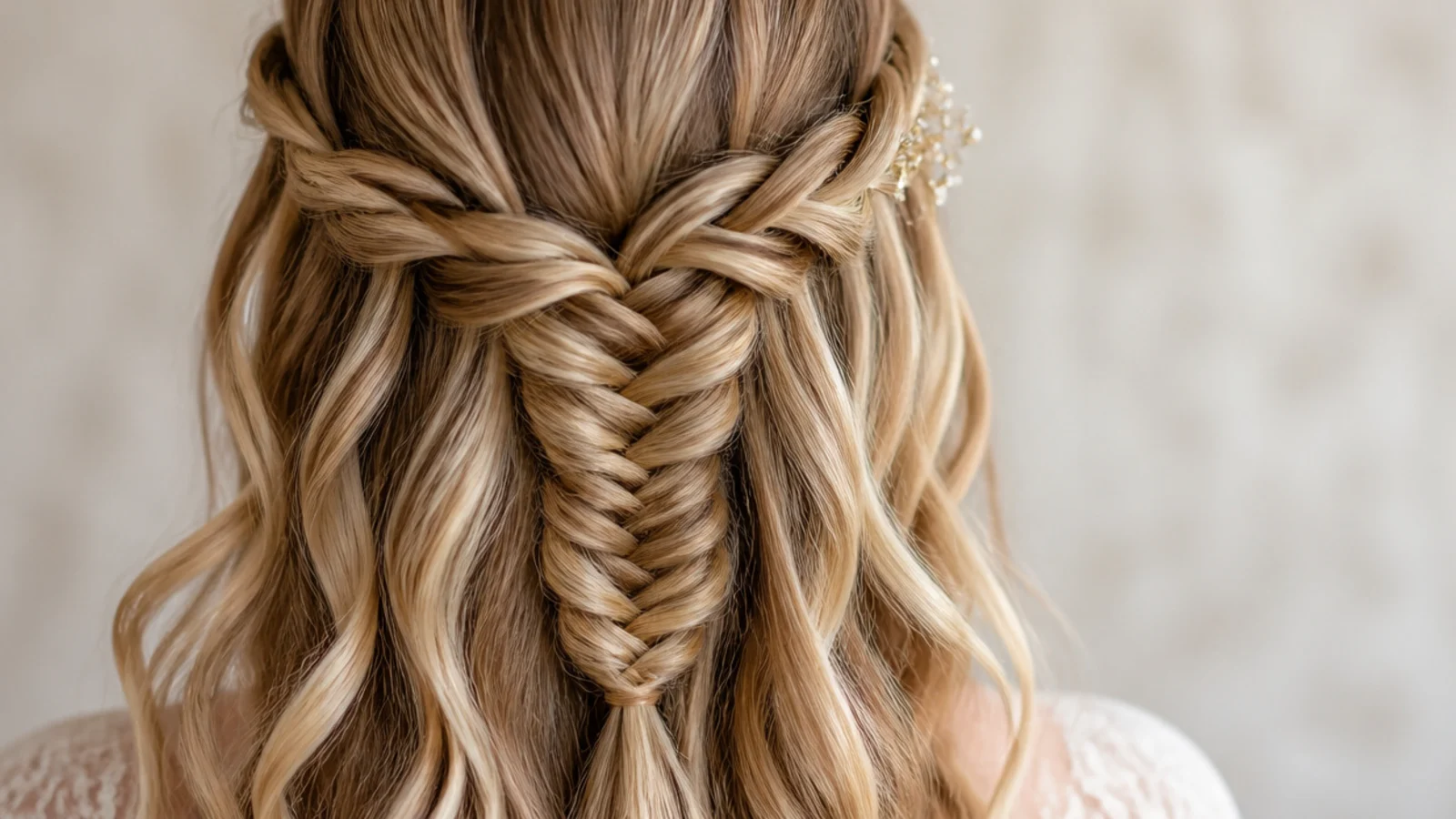
A waterfall braid runs across the back of the head, dropping small sections as it goes, and those dropped strands are then gathered into a mermaid braid at the back. Keep the dropped pieces small, because they become the braid later and oversized ones make the join look lumpy. For a beach ceremony this is the practical pick: the horizontal top braid holds the front off the face in wind while the loose lengths still move. Pair it with air-dried texture rather than a polished blowout, the same finish used in beach hairstyles. See the full method in waterfall mermaid braids.
Who it suits: Beach and coastal ceremonies, long smooth hair, windy venues.
Tip: Salt air flattens curl, so mist a sea salt spray at the roots before you start, not after.
7. Boho Mermaid Braid With Baby's Breath
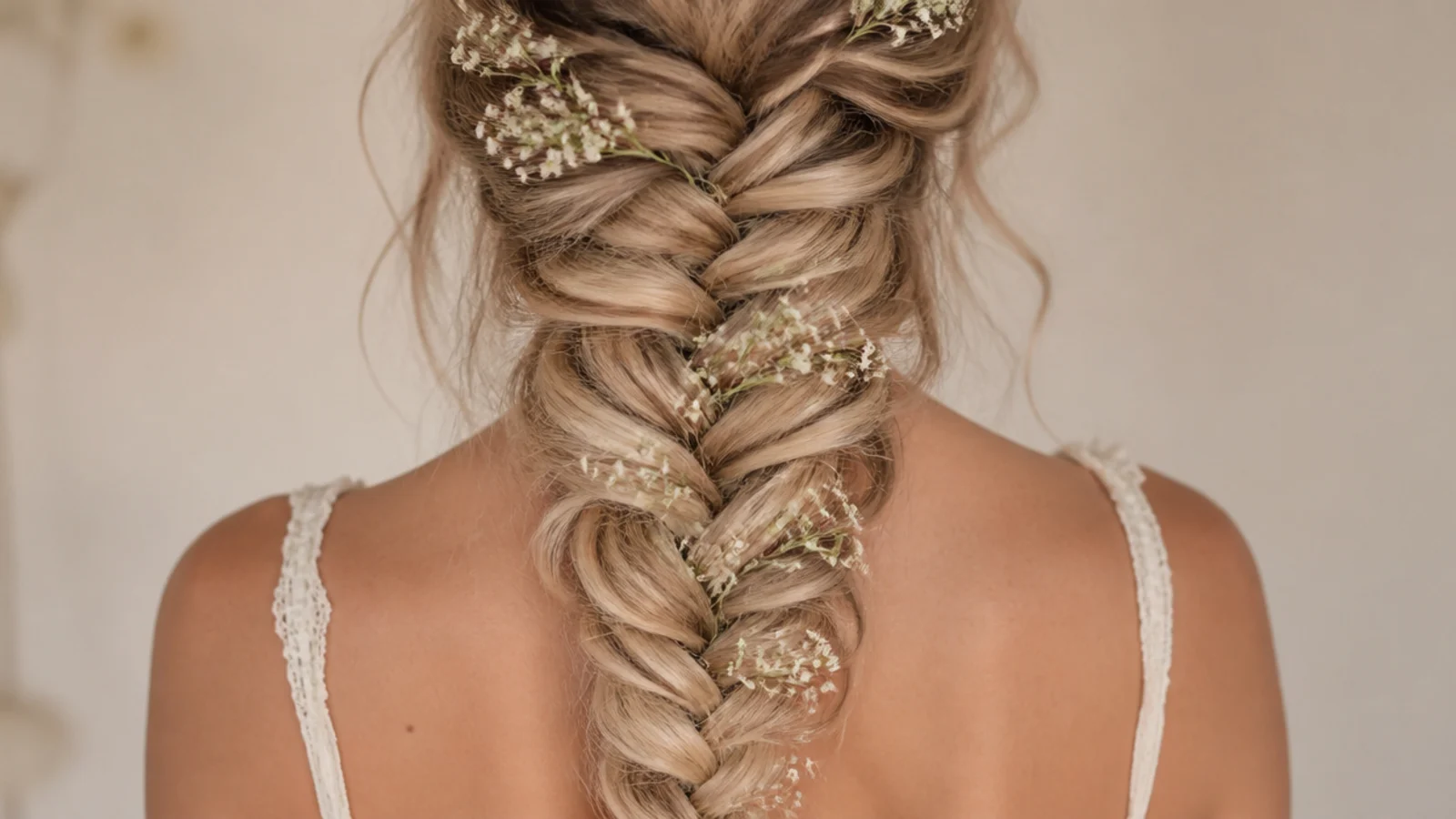
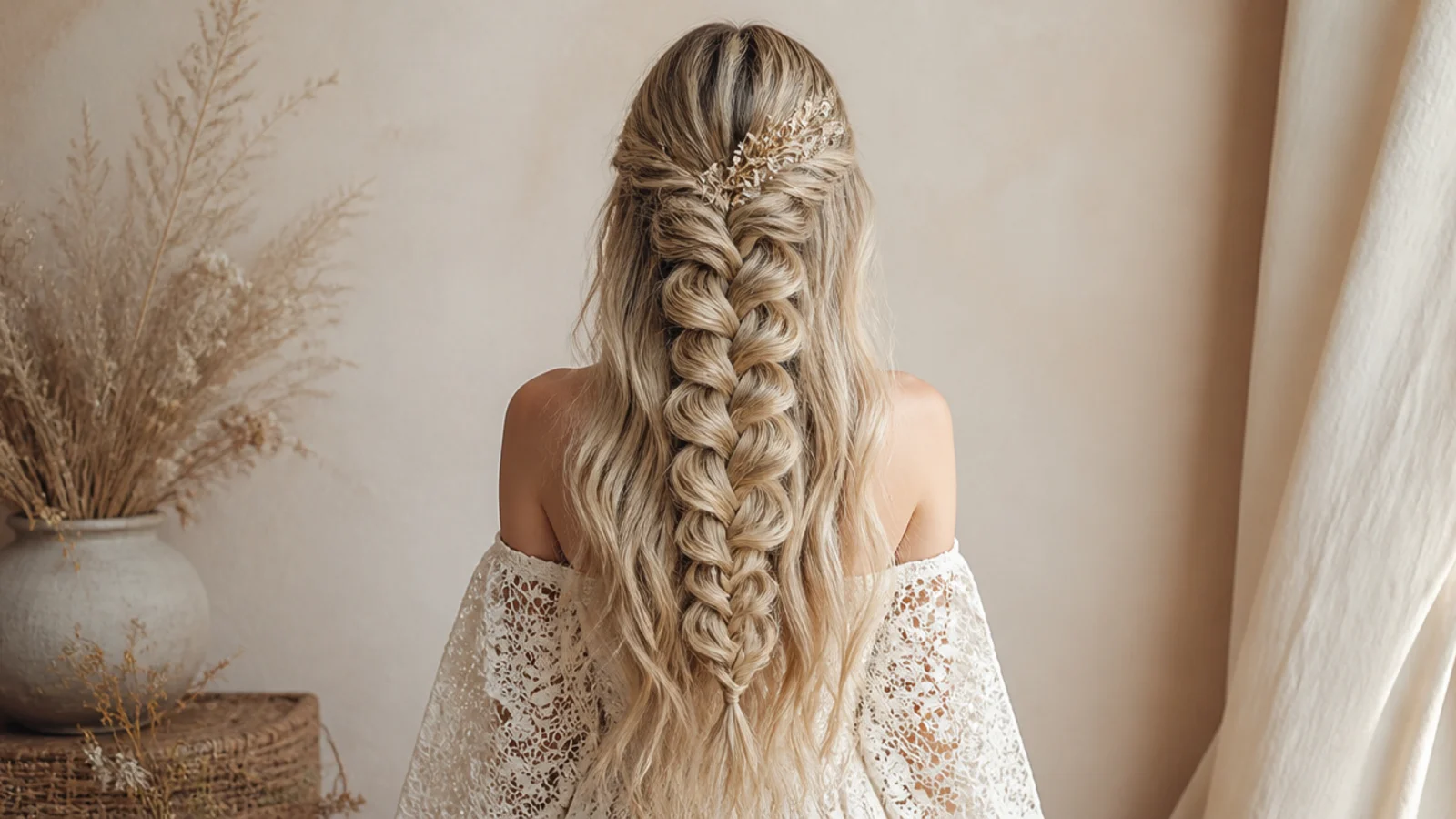
A deliberately loose fishtail with pieces pulled out around the hairline, pancaked unevenly so the fan is wider in some places than others, and threaded with baby's breath sprigs every few inches. The uneven width is the point: a perfectly symmetrical braid reads formal, and boho reads handmade. Cut the stems to about an inch and push them into the pancaked gaps rather than pinning them, so they sit inside the braid instead of on top. More of this finish in boho mermaid braids.
Who it suits: Barn, vineyard and festival-style weddings, wavy hair.
Tip: Baby's breath wilts fast in heat; ask the florist for stems in floral tape, not bare cuttings.
8. Double Mermaid Braid for Bridesmaids
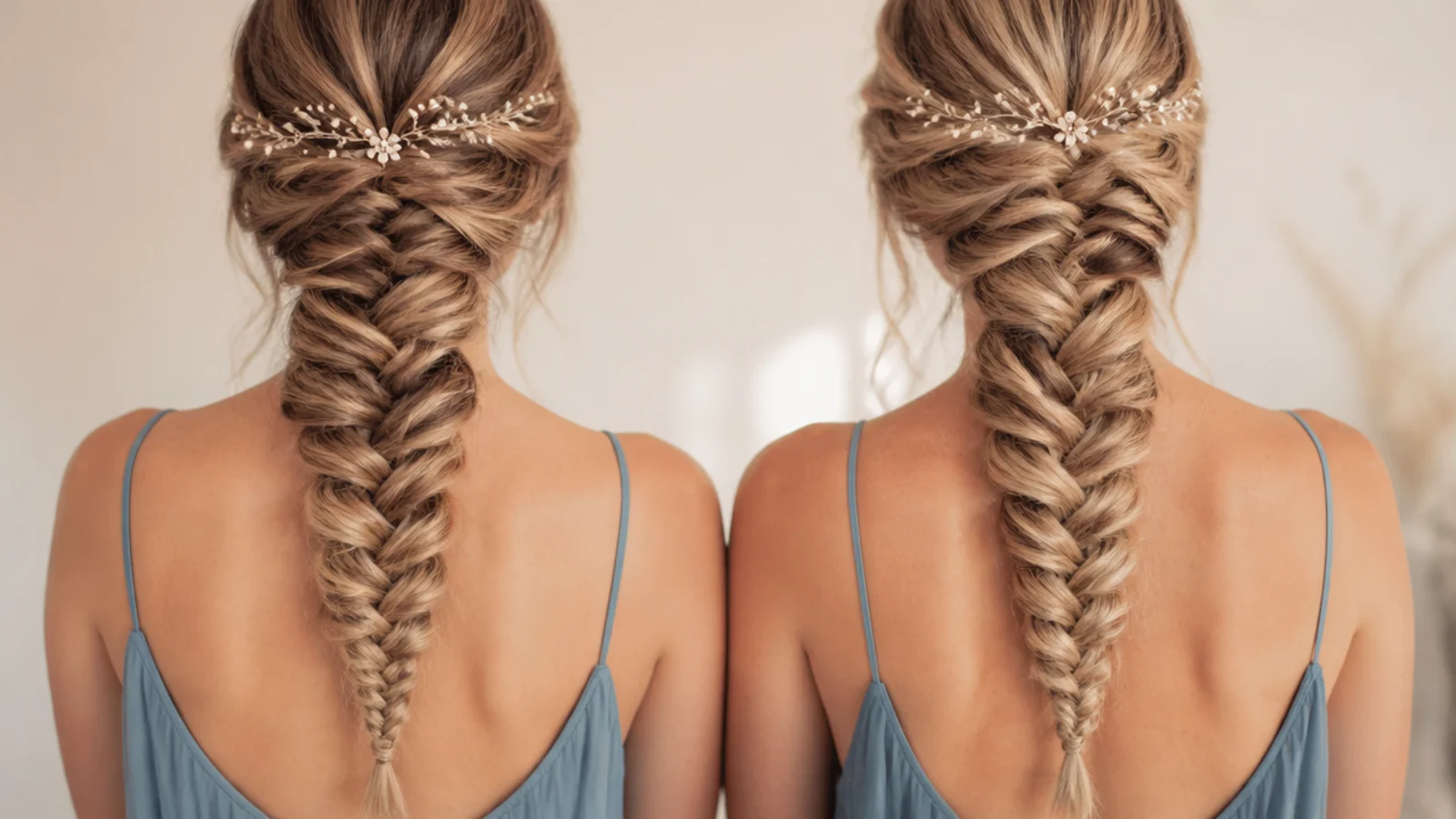
Two fishtails, one on each side of a center part, both pancaked and brought over the shoulders. It is the most repeatable bridal-party look there is, because two braids on two symmetrical sections are far easier to match across four or five people than one perfectly centered braid. Bridesmaids can do it on each other in about fifteen minutes a head with no heat and no stylist chair, in the spirit of easy braided hairstyles. Keep every braid the same width by agreeing on a rule first: pancake three tugs per crossover, no more.
Who it suits: Bridal parties, teenage and junior bridesmaids, no-stylist budgets.
Tip: Do them in pairs facing each other, so nobody is braiding blind behind their own head.
9. Mermaid Braid With a Pearl Hair Vine
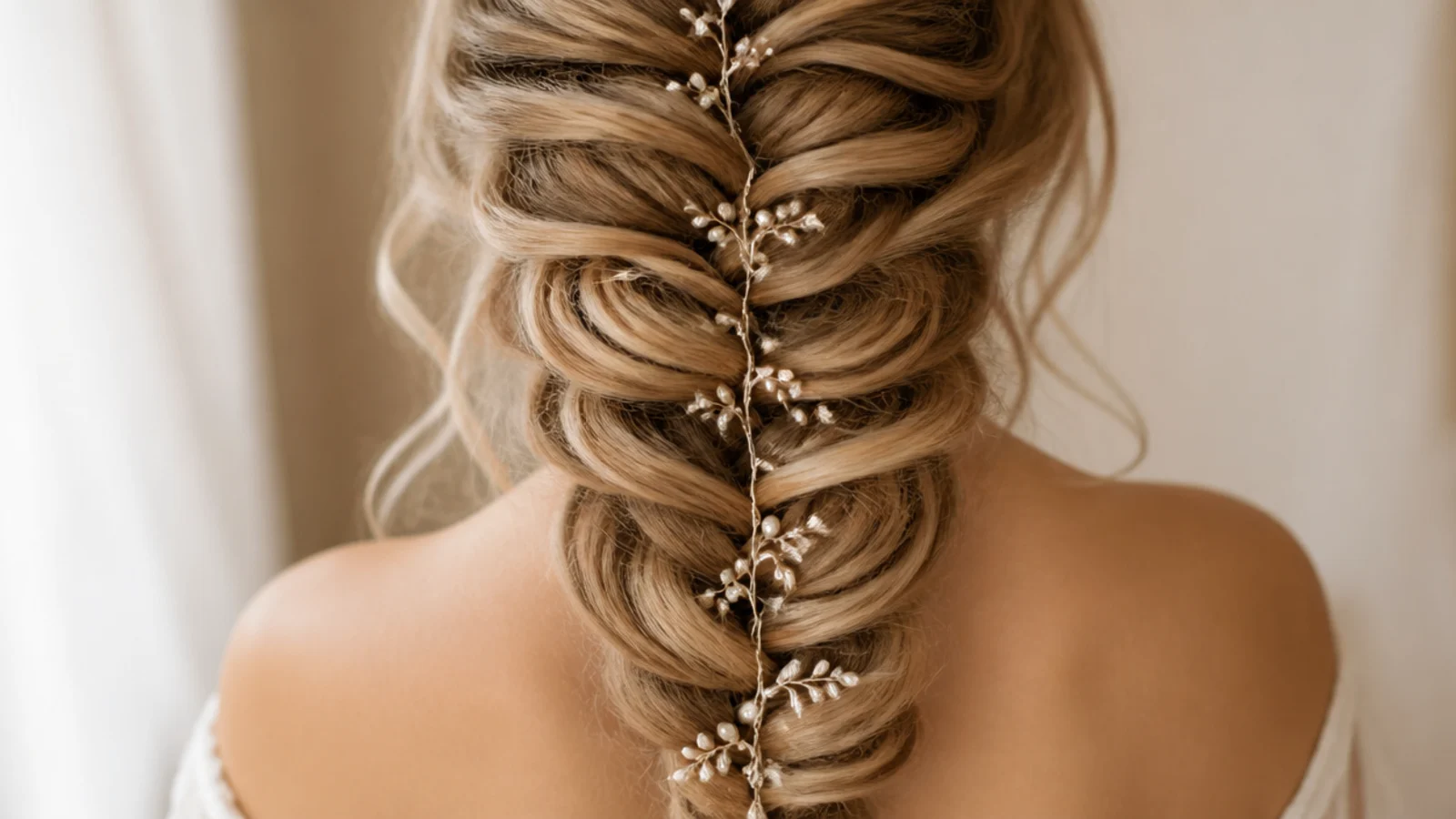
A flexible pearl or crystal vine woven down the seam of a pancaked braid, following the V of each crossover rather than wrapping around the outside. Because a mermaid braid has visible chevrons, a vine laid along the center line reads as though the pearls are growing out of the braid. This is the accessory that best matches a mermaid-silhouette gown, since both rely on repeated horizontal detail. Choose a vine on bendable wire, not a rigid comb, or it will fight the curve of the braid and pop up at the back.
Who it suits: Formal indoor weddings, mermaid and fit-and-flare gowns.
Tip: Weave the vine in while you braid, not after, so the wire is trapped and cannot slide down.
10. Loose Mermaid Braid With Tendrils for a Sweetheart Neckline
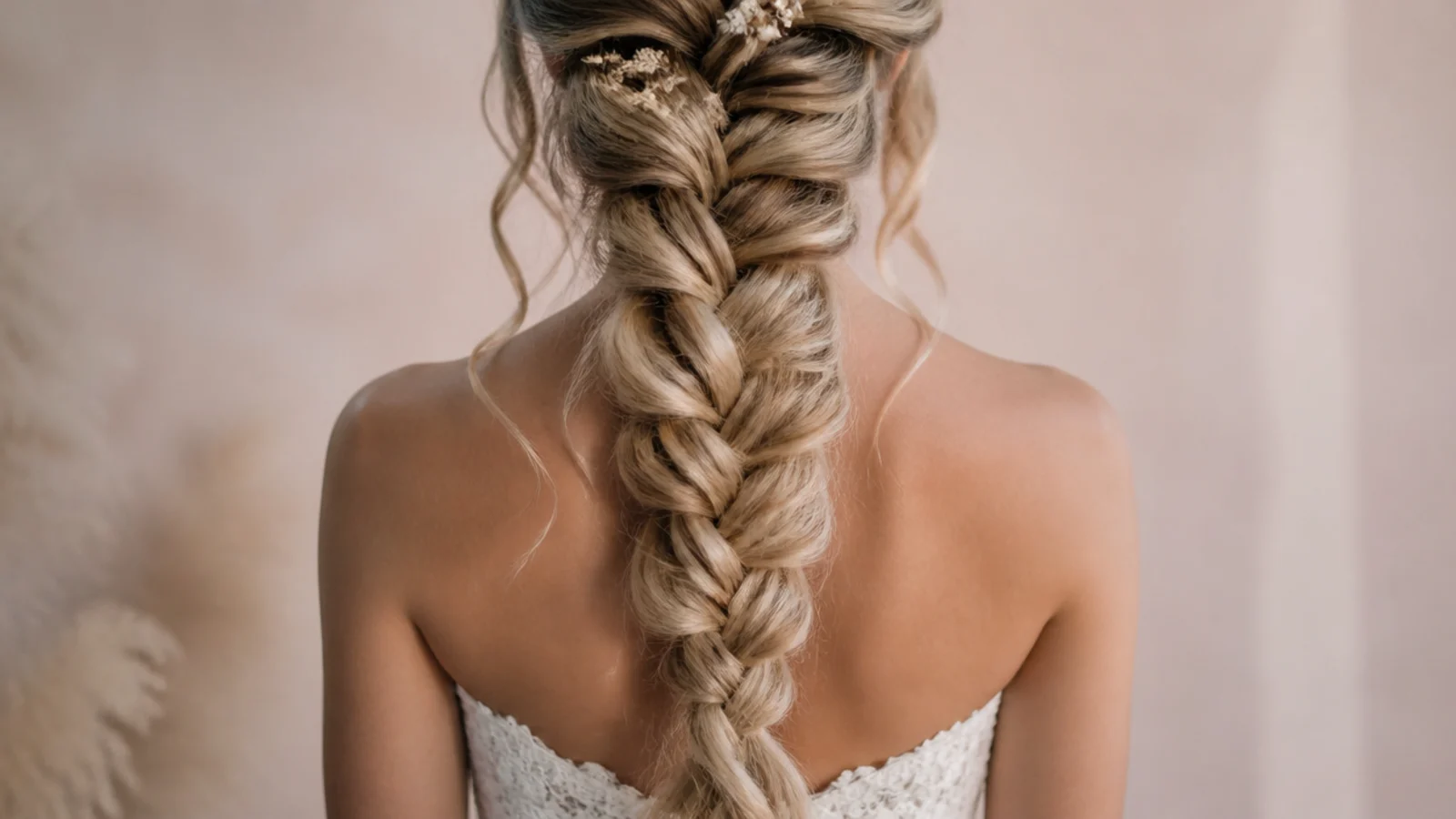
A soft fishtail started low with two face-framing pieces left out and curled away from the face on a 1 inch iron. The curved sweetheart neckline needs a curve to answer it, and straight-hanging hair or a tight braid gives it a hard line instead. Leaving tendrils out restores that softness at the jaw, the same trick that carries Hollywood waves. Braid loosely enough that you can slide a finger under any crossover, then pancake, since a tight braid under a soft neckline always looks like two different looks stacked on one person.
Who it suits: Sweetheart and scoop necklines, oval and heart face shapes.
Tip: Curl the tendrils last, after the braid is finished, or they will drop before the ceremony.
11. Mermaid Braid Ponytail for the Reception Change
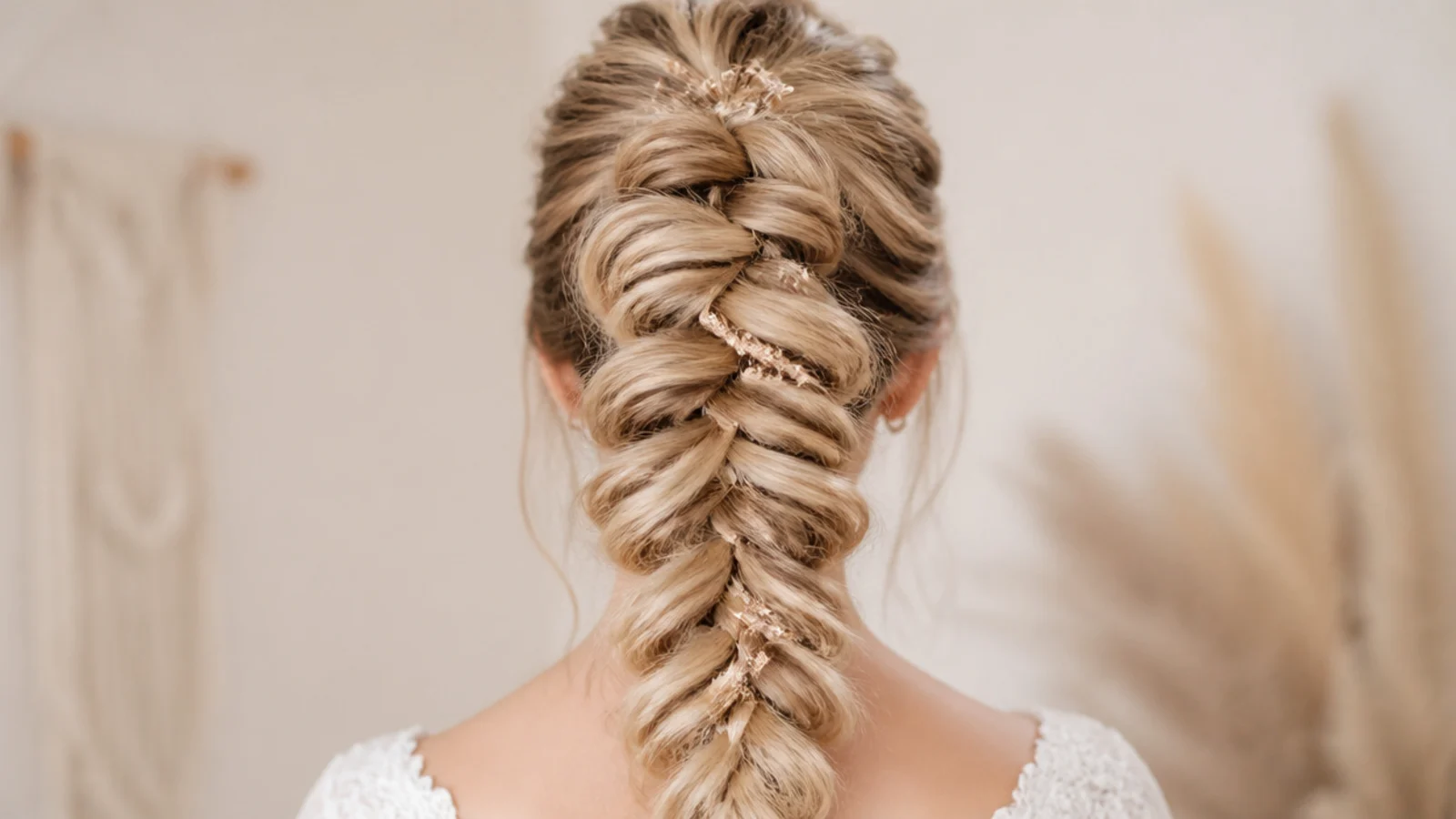
Gather a high ponytail at the crown, fishtail the tail, pancake it, and wrap a section of hair around the elastic to hide it. This is the second-look answer: it takes about ten minutes, it uses hair that has already been curled all day, and lifting everything off the neck is what most brides want by the time dinner ends. It also survives dancing better than any down style, since the weight is anchored at one high point rather than spread across the back. Placement options are compared in ponytail styles.
Who it suits: Reception changes, hot venues, brides who plan to dance.
Tip: Anchor the ponytail with two bobby pins crossed under the elastic before you braid the tail.
12. Dutch Mermaid Braid for Fine Hair
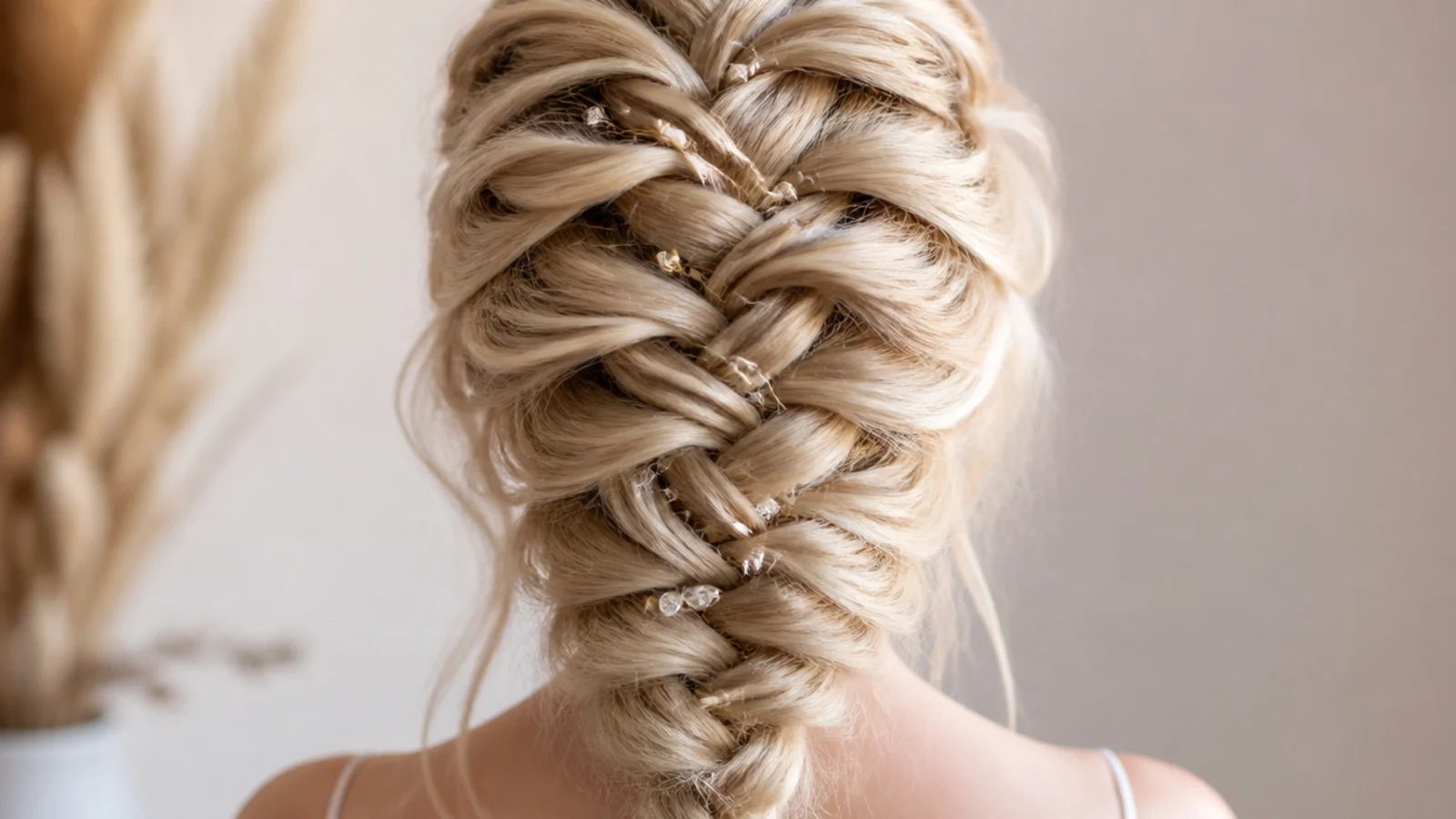
A Dutch, or inverted, fishtail crosses the strands under instead of over, so the braid sits proud of the scalp rather than sinking into it. On fine hair that raised construction is worth more than any product, because a braid that sits on top of the head catches light and casts a shadow, which reads as thickness. Work on day-two hair or mist texture spray through mid-lengths first, since freshly washed fine hair slips out of a fishtail within minutes. Pancake in very small increments here, a couple of millimeters at a time.
Who it suits: Fine, straight or freshly washed hair that will not hold a braid.
Tip: Backcomb lightly at the crown before you start; the braid needs something to grip.
13. Mermaid Braid With Clip-In Extensions for Shoulder-Length Hair
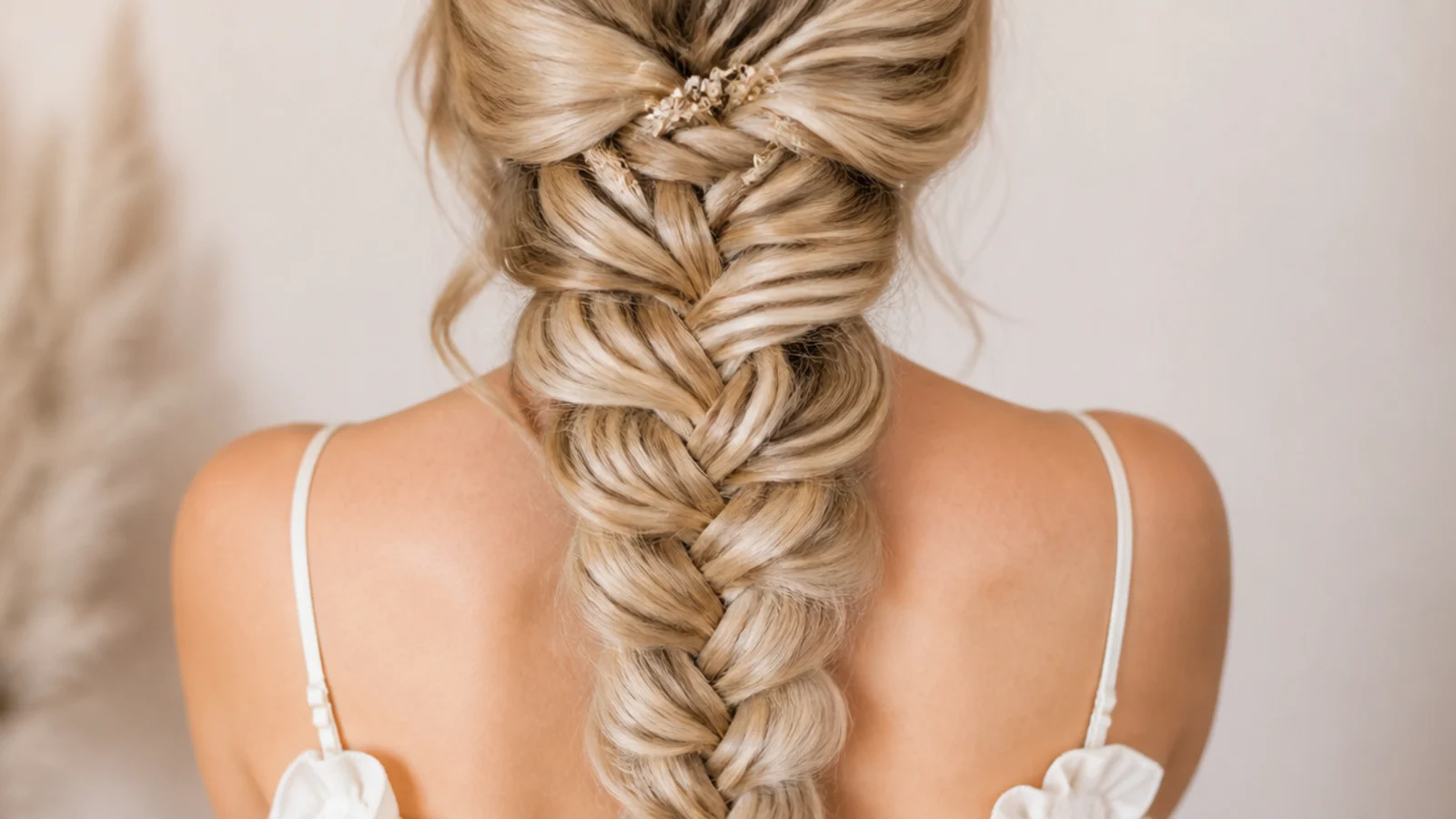
Three to five clip-in wefts placed below the crown, blended with a quick curl, then braided in as though they were your own hair. A mermaid braid needs length to fan properly, and shoulder-length hair usually runs out before the braid gets wide, which is why so many bobs end up in an updo by default. Wefts fix that. Match the color to your ends, not your roots, and clip them at least an inch below the parting so no track shows when the braid pulls the hair taut. See what length unlocks in long mermaid braids.
Who it suits: Bobs, lobs and shoulder-length hair, and anyone growing out layers.
Tip: Do the trial with the exact wefts you will wear; borrowed sets sit at a different height.
14. Braided Mermaid Halo for a Backless Gown
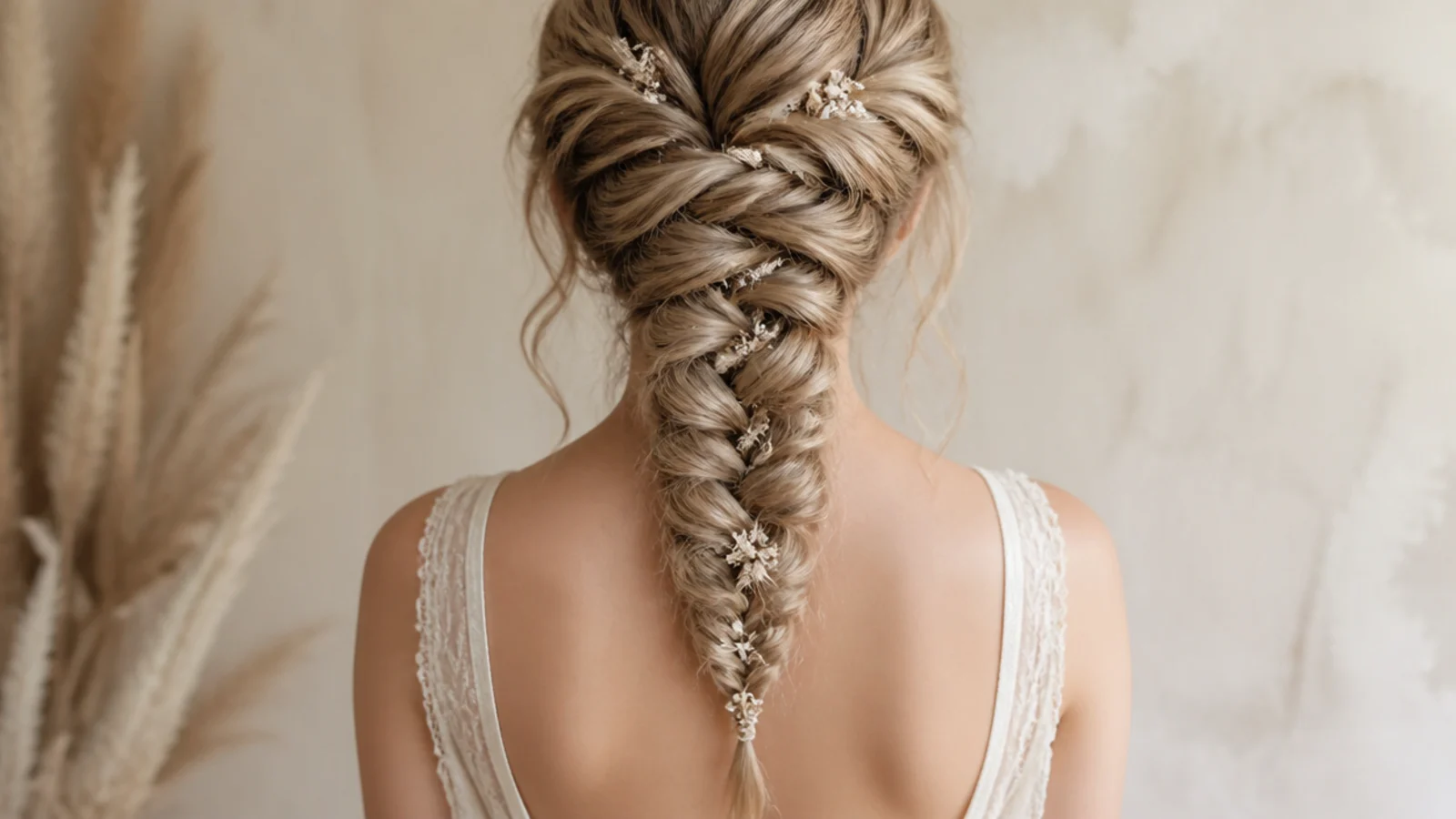
One long fishtail, pancaked wide, then lifted and pinned in a shallow arc across the back of the head so nothing hangs below the nape. A backless gown is the one silhouette where a down style actively works against the dress, since the whole design is the open back and a braid draws a line straight through it. Pinning the braid up keeps the mermaid texture visible while clearing the skin entirely. Keep the arc low and wide rather than high and tight, so it still reads soft from the front.
Who it suits: Backless, low-back and open-back gowns; long hair.
Tip: Use large-loop bobby pins in your hair color, since small pins will not hold a pancaked braid.
15. Mermaid Braid With a Juliet Cap Veil
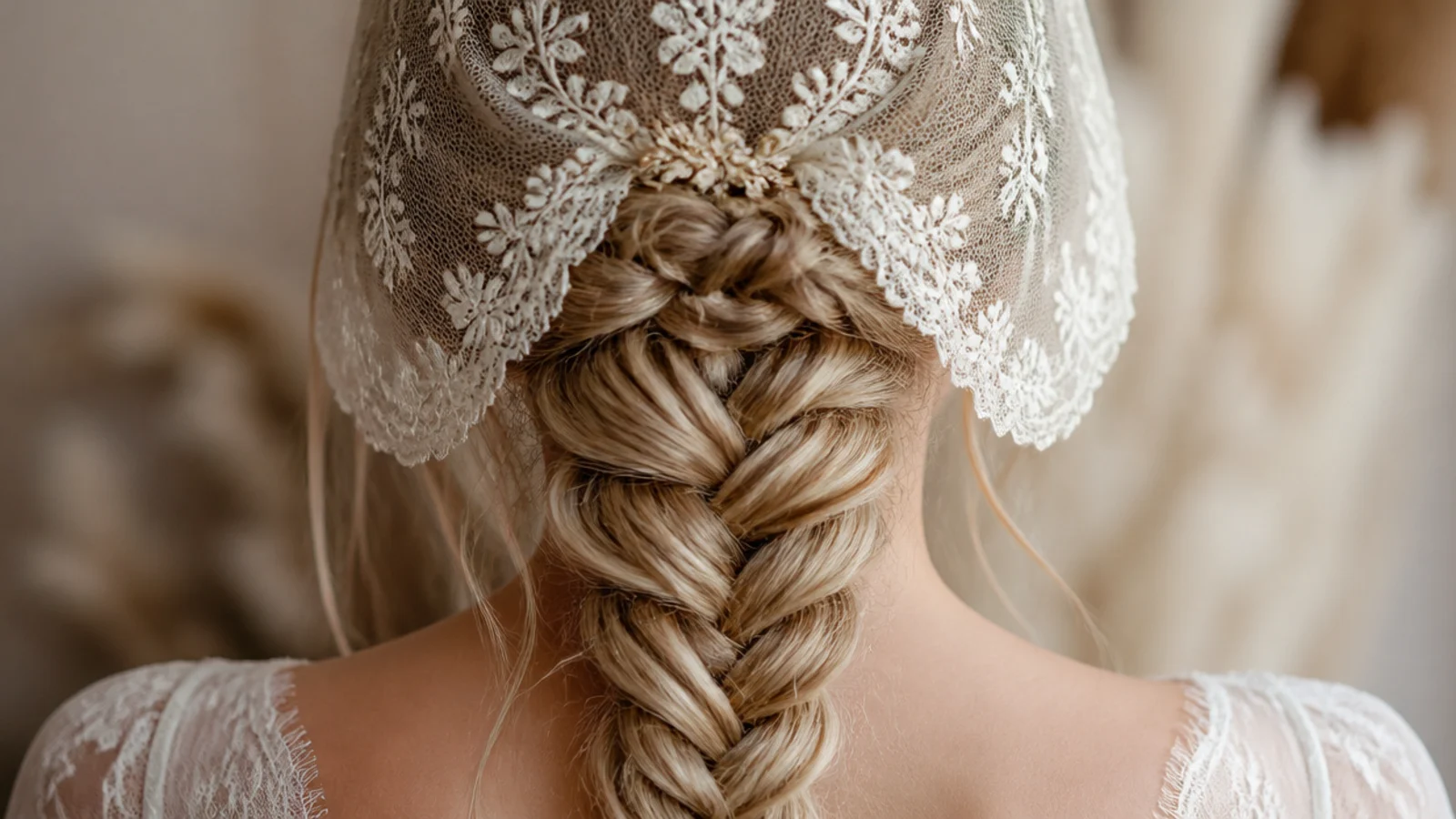
A Juliet cap sits flush on the crown, so the hair underneath has to be smooth and flat from the hairline back to the middle of the head. Braid low, starting at the nape, and leave the top completely uncurled and unteased. Then pancake only the lower two thirds of the braid, so the width appears below the cap rather than fighting it. This pairing suits 1920s and 1930s inspired gowns, where the flat crown and the wide braid create the same long vertical line the dress does.
Who it suits: Vintage gowns, Juliet caps, headbands and flat-crown headpieces.
Tip: Skip root volume entirely; any lift at the crown will make the cap perch instead of sit.
16. Twisted Mermaid Braid for Curly Hair
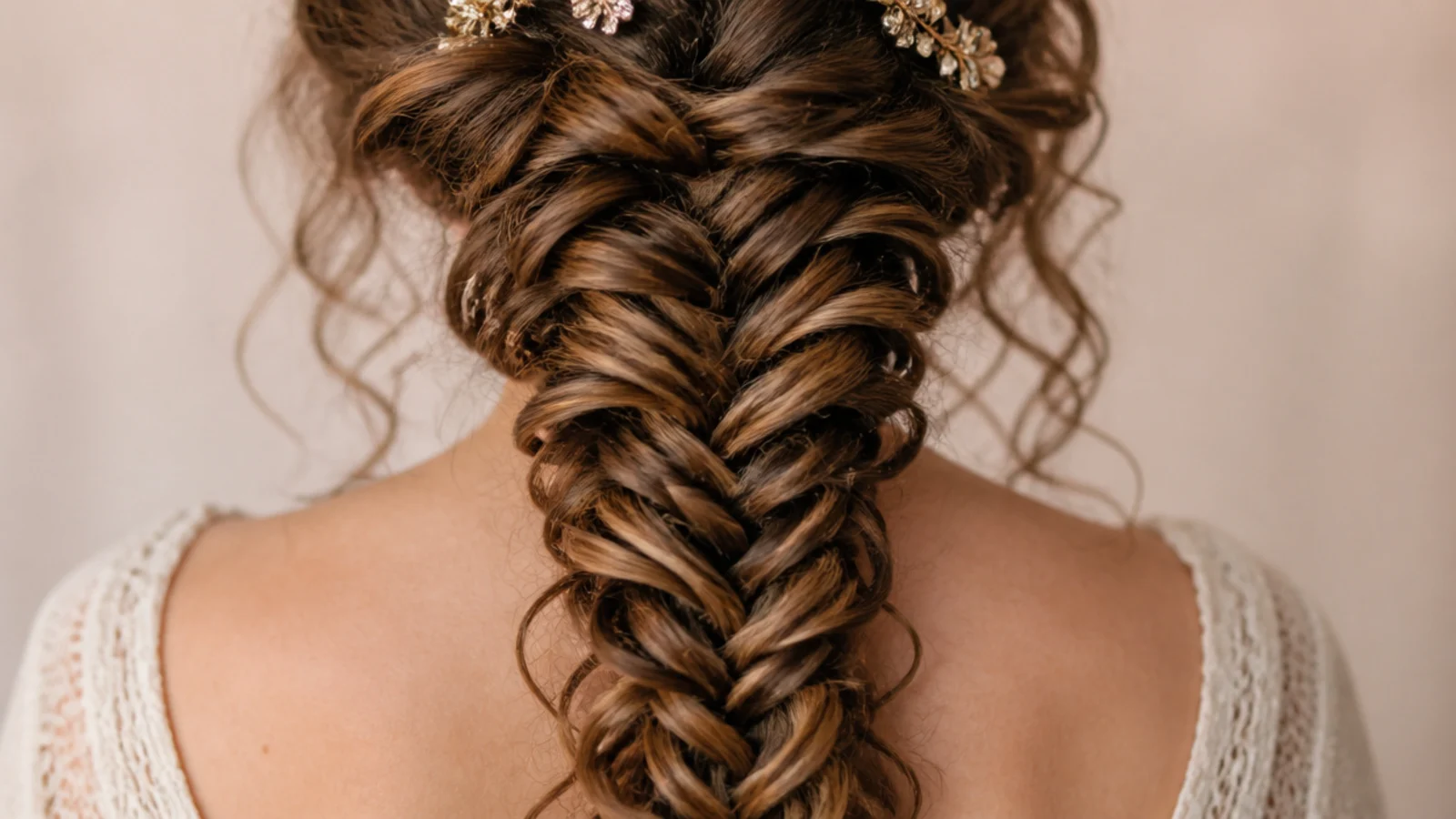
On curly and coily hair a fishtail already looks wide, so the work is definition rather than volume. Stretch the hair first with a blow dryer and a comb attachment or with two overnight braids, take slightly larger sections than you would on straight hair, and pancake gently, since curl pattern springs back and can close the fan again. Leave a few coils out at the hairline. Sealing with a light oil the night before beats any hairspray on the day, and the shape holds through humidity better than a wet set does.
Who it suits: Curly, coily and stretched natural hair.
Tip: Braid on stretched, not freshly moisturized hair; wet curls shrink and pull the braid crooked.
17. Mermaid Braid With Silk Ribbon as Your Something Blue
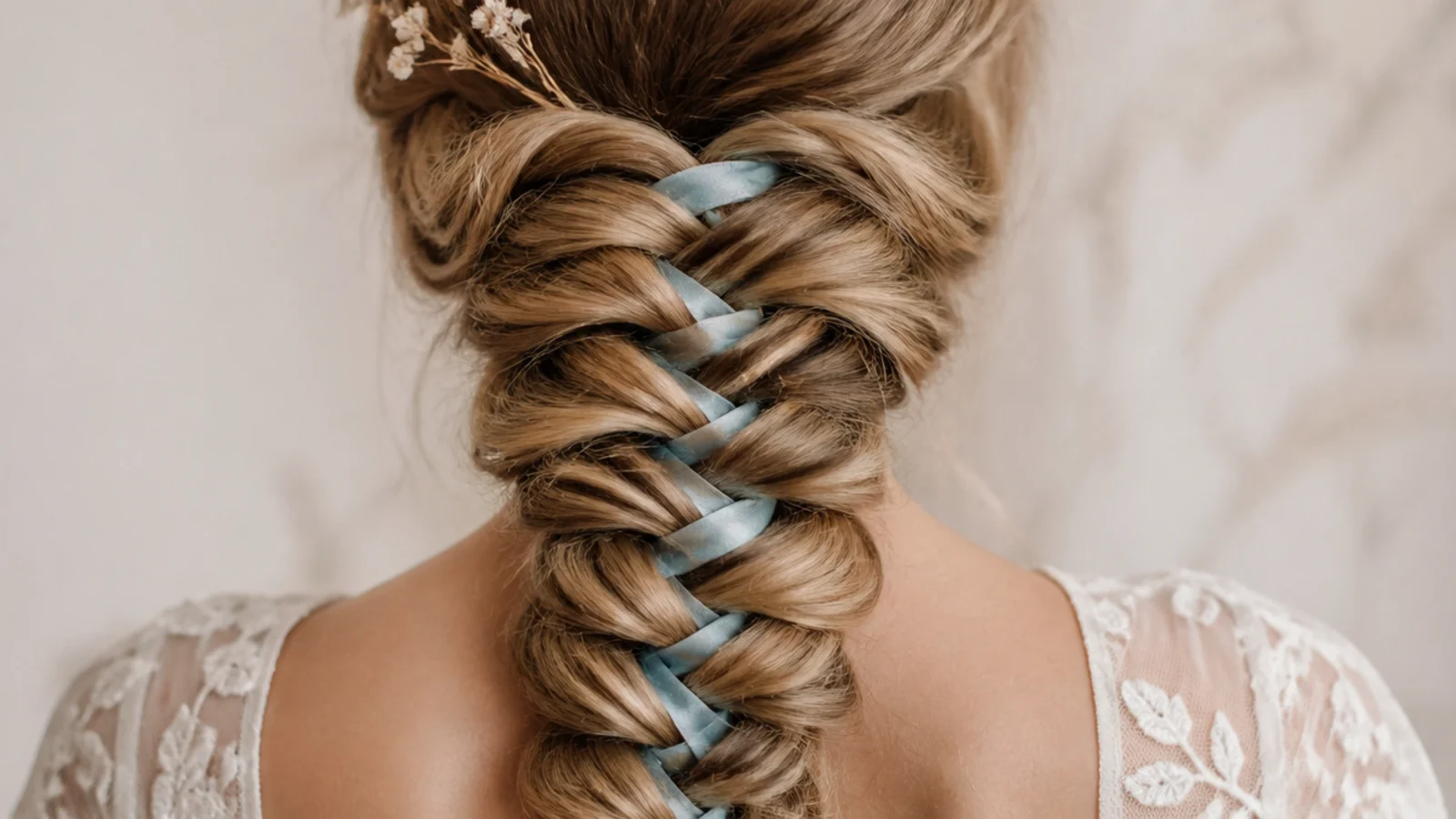
A narrow silk ribbon, around half an inch wide, folded into the braid as a fourth strand from the very first crossover. Woven from the start it appears and disappears through the chevrons, which is far prettier than tying a bow at the end. Pale blue makes it your something blue without anyone having to be told; ivory or champagne makes it purely textural. Silk holds a soft fold, while polyester ribbon springs open and shows a shiny edge in flash photography, so pay for the silk.
Who it suits: Traditional brides, flower girls, and anyone wanting a hidden detail.
Tip: Cut the ribbon at least a foot longer than your hair so you never run short mid-braid.
18. Mermaid Braid Chignon for a Winter Wedding
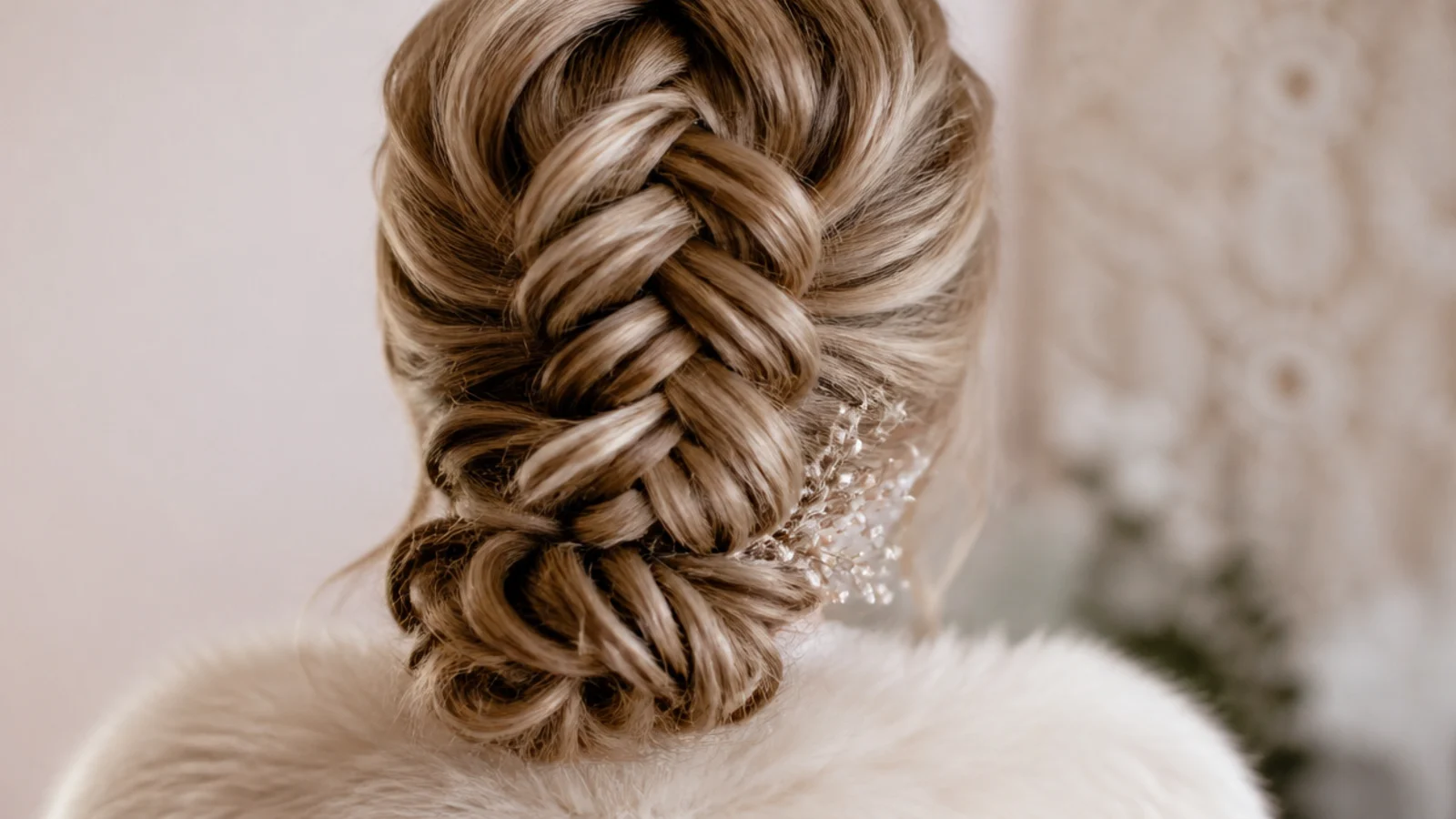
A wide fishtail folded up on itself twice and pinned into a low chignon that sits above the collar line. Winter weddings involve coats, faux fur wraps and car doors, all of which crush a down braid within an hour of leaving the house. Sitting the chignon above where a collar lands solves it. The folded braid keeps the mermaid chevrons visible on the outside of the bun, so it does not read as a plain rolled updo. Static is the real enemy indoors; a light oil on the palms smooths flyaways better than spray.
Who it suits: Winter and cold-weather weddings, brides wearing coats or wraps.
Tip: Pin the chignon higher than feels right; a coat collar will push it down over the day.
19. Deconstructed Mermaid Braid for an Elopement
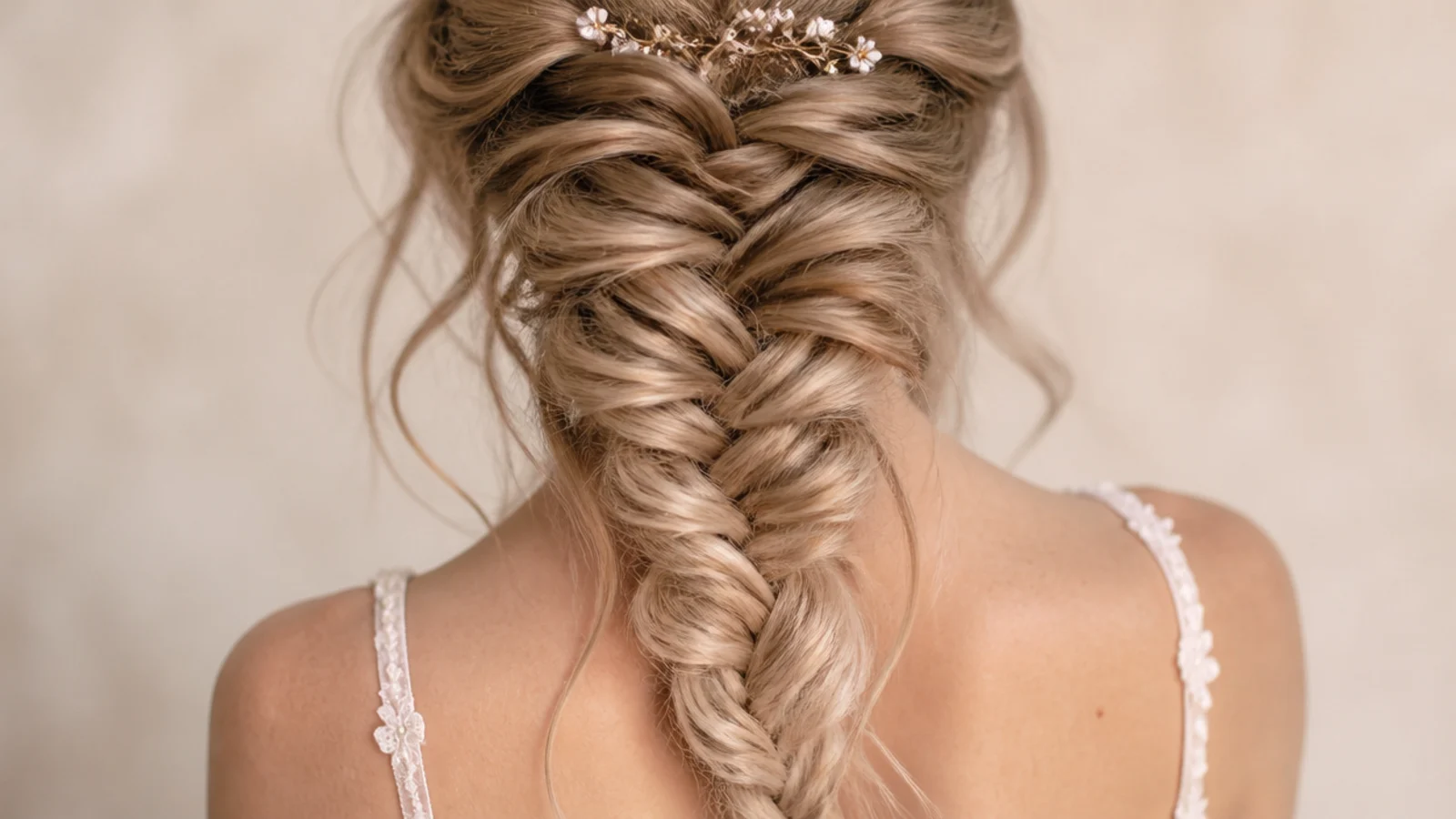
A fishtail braided loosely, pancaked until it is genuinely falling apart at the edges, and then teased at the crown so the whole thing looks slept in. For an elopement or a courthouse ceremony this is the correct amount of hair: recognizably done, but not so structured that it looks out of place in a small room or on a hiking trail. Take the braid down an inch or two from the ends so it finishes in loose hair rather than a hard elastic line. Sleep in it loosely braided the night before and you will start the morning with the waves already in place, exactly as in heatless curls overnight.
Who it suits: Elopements, courthouse ceremonies, second weddings, small ceremonies.
Tip: Pull pieces out at the front last, in a mirror, so the face-framing looks intentional.
20. Two-Tone Mermaid Braid for Balayage Hair
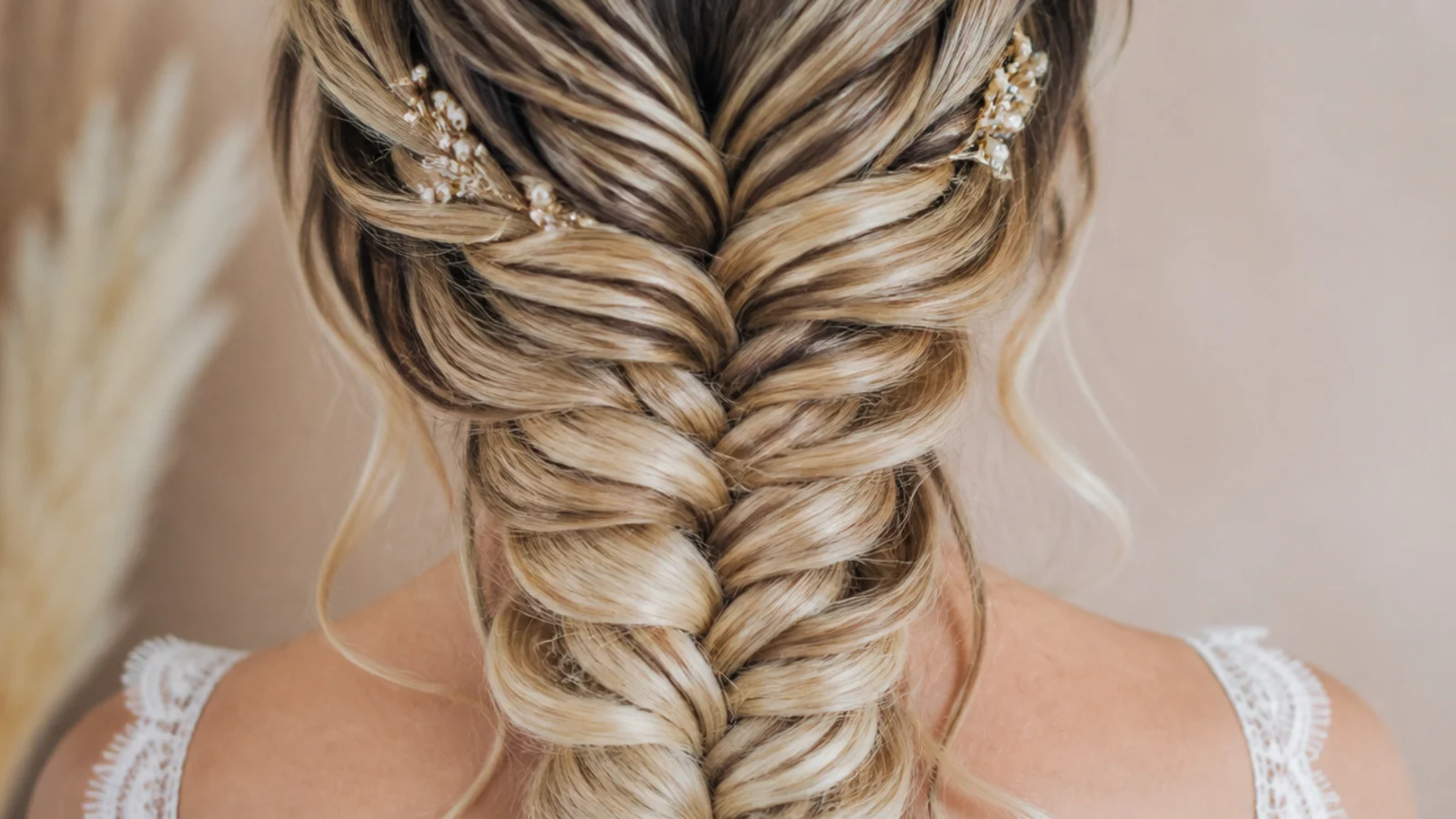
If your color is balayage or highlighted, a fishtail is the braid that shows it best, because each crossover lifts a different strand to the surface and the light and dark pieces alternate down the length. Split your sections deliberately, keeping lighter pieces on the outside edges, and the pancaked fan will look dimensional rather than muddy. This is the strongest argument for a mermaid braid over a three-strand plait at a wedding, where every photograph is taken in a different light. Book any color touch-up two weeks out, never the week of, and see how the tones behave in balayage brunette.
Who it suits: Balayage, ombre, money piece and highlighted hair.
Tip: Gloss rather than re-highlight before the wedding; fresh lightener leaves hair too slippery to braid.
What a Mermaid Braid Is and Why It Suits a Wedding
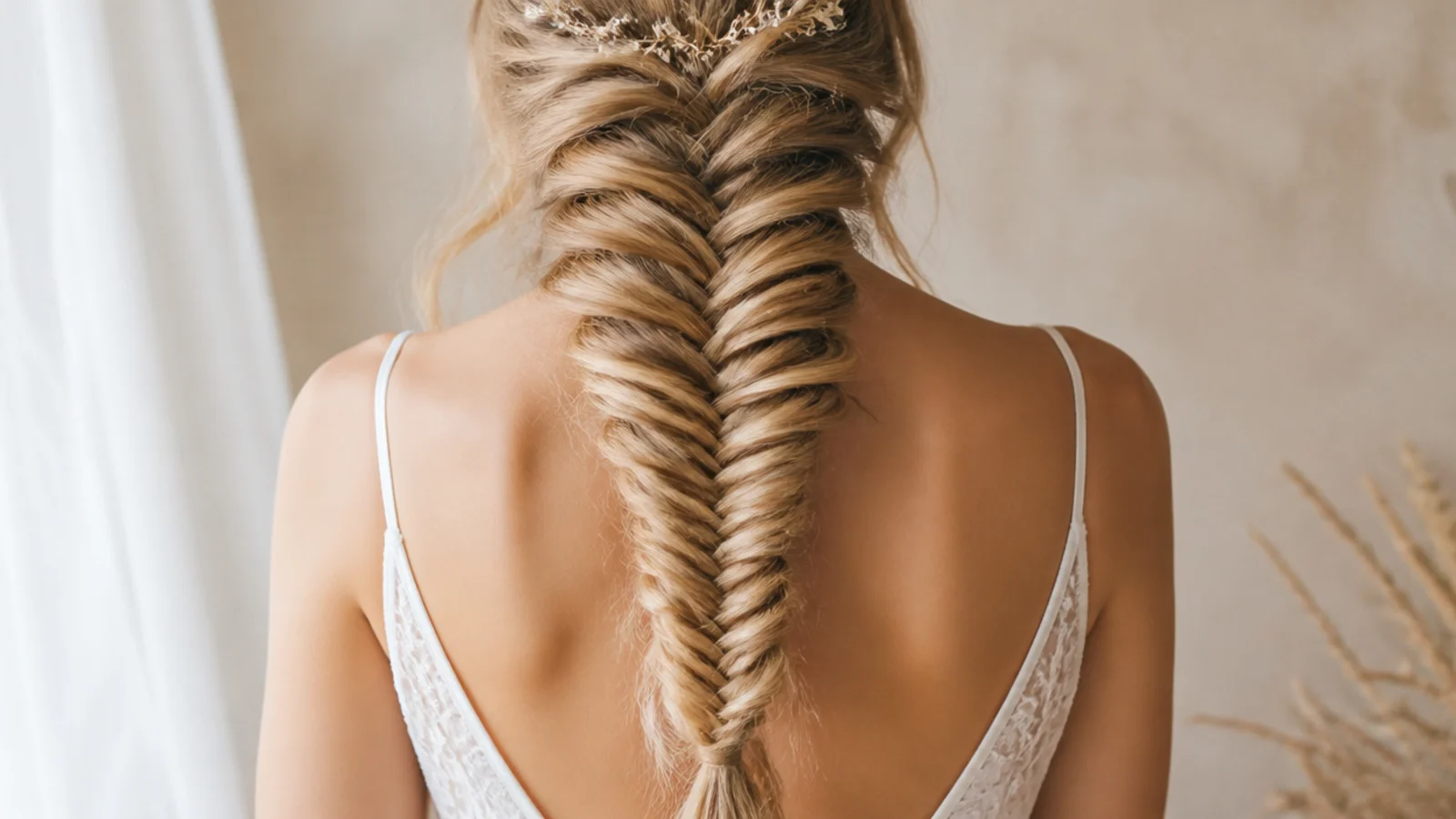
A mermaid braid is a fishtail braid that has been pancaked, meaning the outer edge of every crossover is tugged loose until the braid spreads wide and flat instead of hanging as a rope. Done properly it fans like a tail, which is where the name comes from. Nothing about the braiding itself is different from a standard fishtail: you split the hair in two, take a thin piece from the outside of one half and cross it over to the other, and repeat. The width is entirely a finishing step. For a wedding this matters because a fishtail alone photographs as a narrow dark line, while a pancaked one photographs as texture, catching light along every chevron. It is also the rare style that reads formal with hair down, which is why it keeps appearing in bridal galleries alongside chignons. If you want the base technique before choosing a bridal version, start with mermaid braids.
Choosing a Mermaid Braid by Gown Neckline and Silhouette
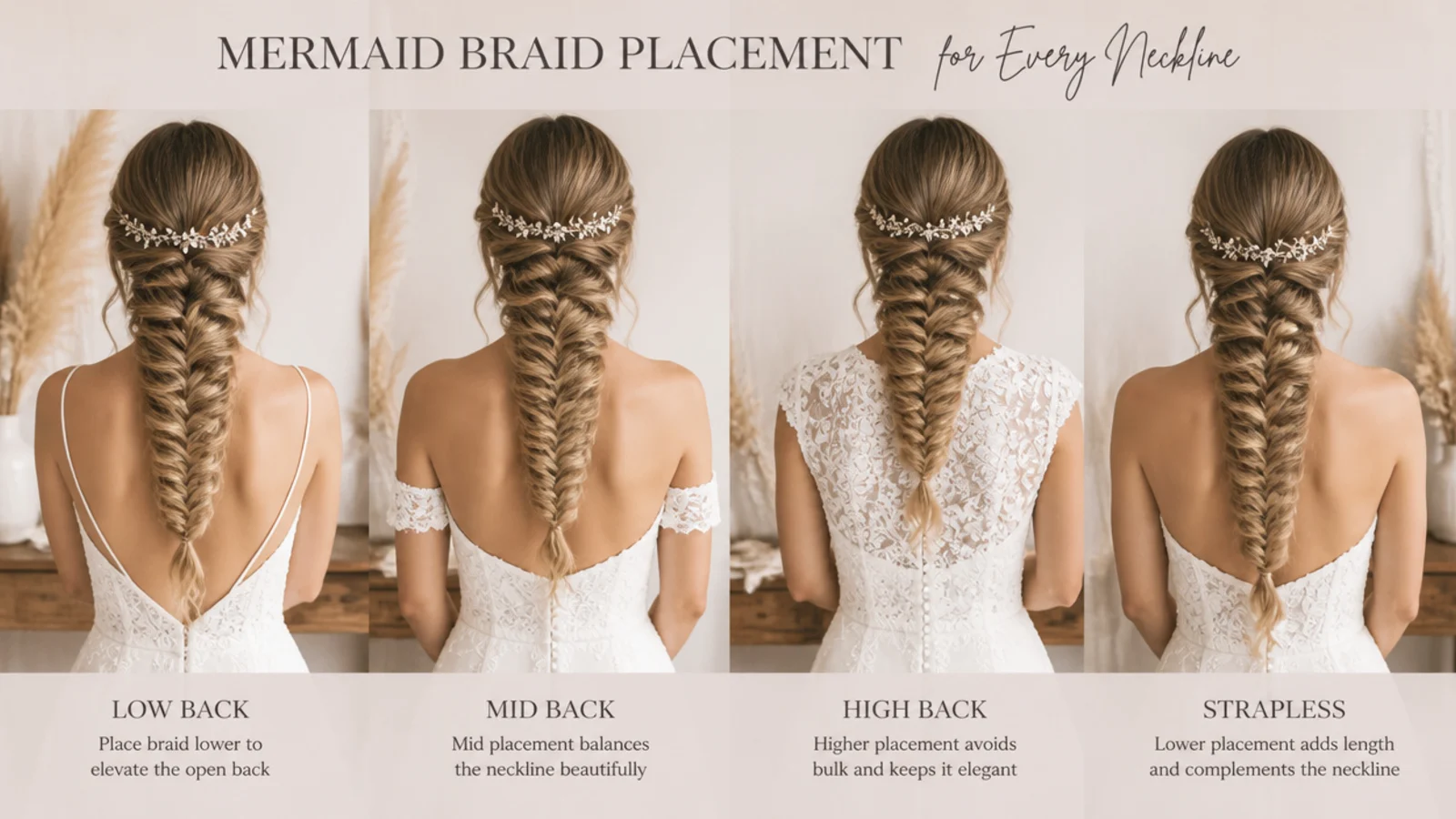
Match the braid to the gown before you match it to your face. A strapless or straight-across neckline leaves a wide empty frame, so a center-back braid or a braid over one shoulder gives it a vertical line to answer. A sweetheart neckline is already curved, so it wants softness: braid loosely and leave two curled tendrils at the jaw. High necks, illusion panels and heavily beaded backs are the ones where a down braid disappears, because the fabric detail and the braid texture cancel each other out; pin the braid up instead. Backless gowns follow the same rule for the opposite reason, since the open back is the design and a braid drawn through it competes. Fit-and-flare and mermaid-silhouette gowns pair naturally with a pearl vine woven along the braid seam, because both rely on repeated horizontal detail. Bring a photo of the gown to the trial, not a description.
How to Pancake a Mermaid Braid So It Fans Like a Tail
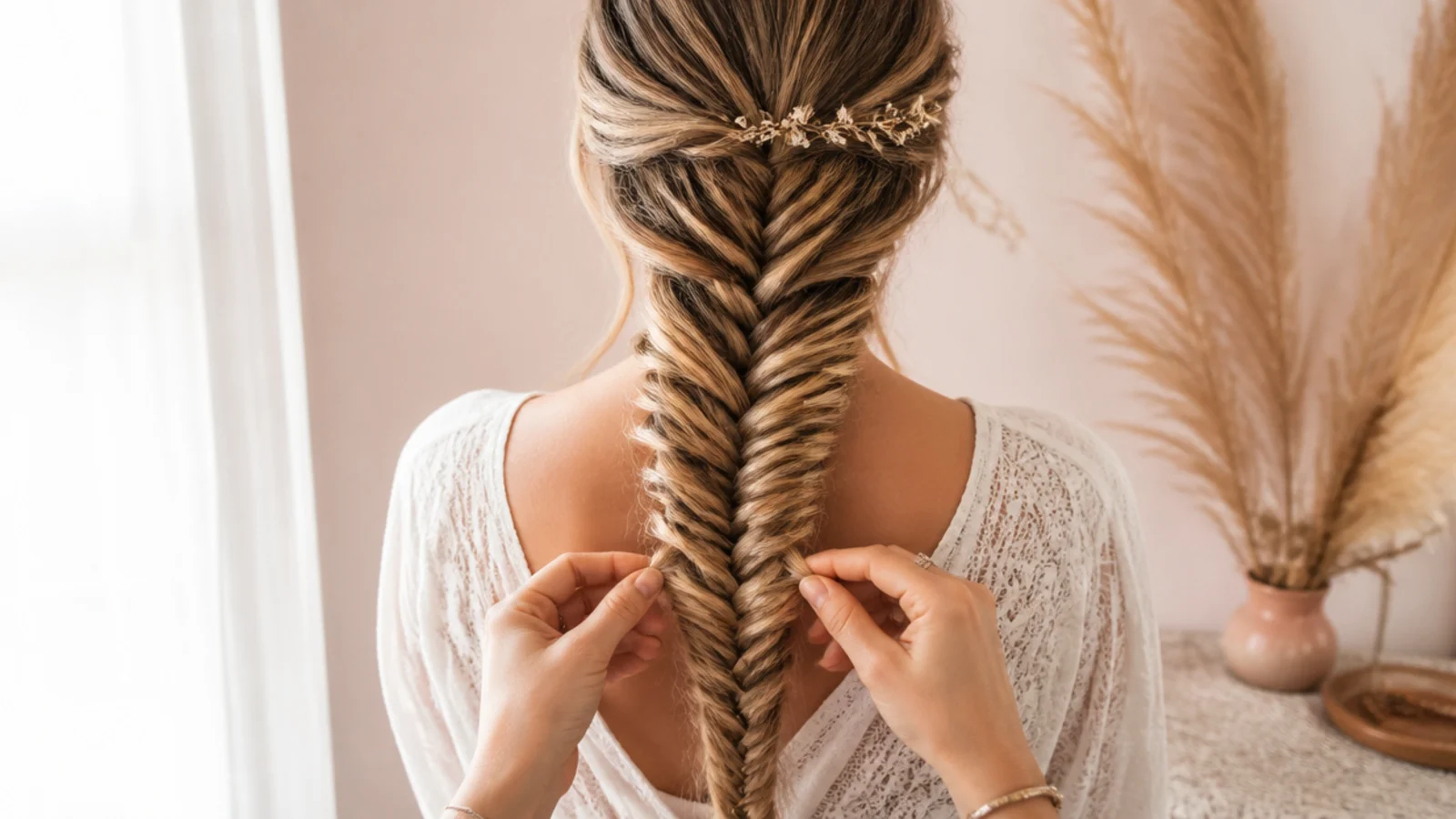
Pancaking is the whole technique, and it goes wrong in one specific way: people pull too much at once near the top. Work from the bottom of the braid upward, and tug only the outer edge of each crossover, a few millimeters at a time. Do a full pass down one side, then a full pass down the other, then a second round of small pulls if you want it wider. Pulling a centimeter in one go collapses the crossover above it and the braid sags into a loop. Hold the elastic or the braid end firmly in your other hand while you pull, since tension from below is what stops the whole braid unraveling upward. Curl the hair on a 1 to 1.25 inch iron and brush the curls out before you braid, because loose waves give the fan the body it needs to stay open. Set with a flexible hold hairspray, never a freeze spray, which cracks visibly when the braid moves. If you would rather skip heat entirely, compare the overnight options in heatless curl tools compared.
Mermaid Braids on Fine or Slippery Hair
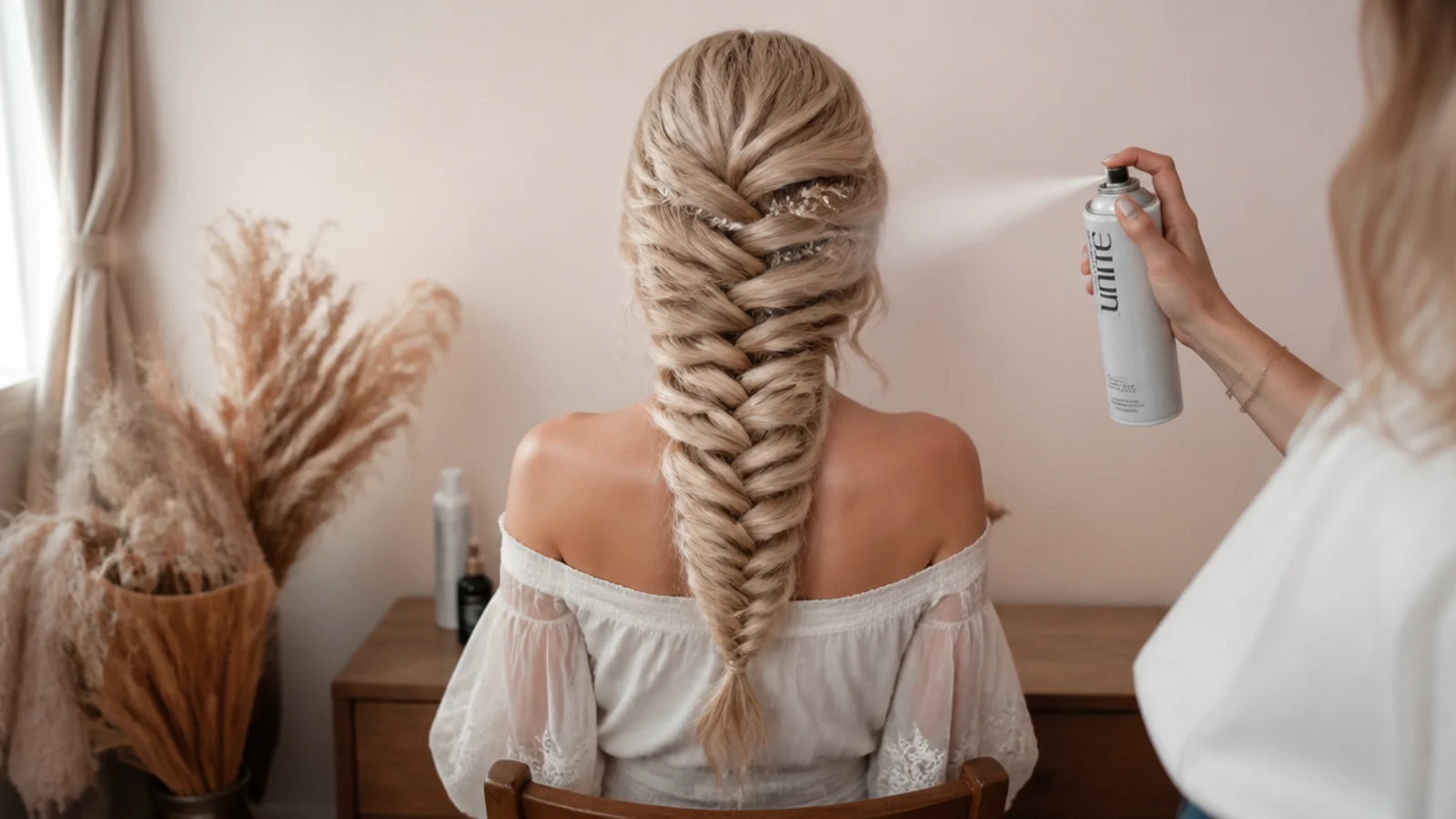
Freshly washed hair is the most common reason a wedding braid falls out by the ceremony. Clean, conditioned hair has nothing to grip, and a fishtail relies on friction between very thin strands. The fix is to wash the day before, not the morning of, and to work on day-two hair. If that is not possible, mist a texture or volumizing spray through the mid-lengths and ends and let it dry fully before braiding. Fine hair also benefits from the Dutch version, crossing strands under so the braid sits raised off the scalp and casts a shadow, which is what actually reads as thickness in photos. Take smaller sections than you think you need, because thin crossovers pancake wider than thick ones. Backcomb lightly at the crown before you start. For a broader look at what different hair types hold, see hairstyles for your hair type.
Wearing a Veil With a Mermaid Braid
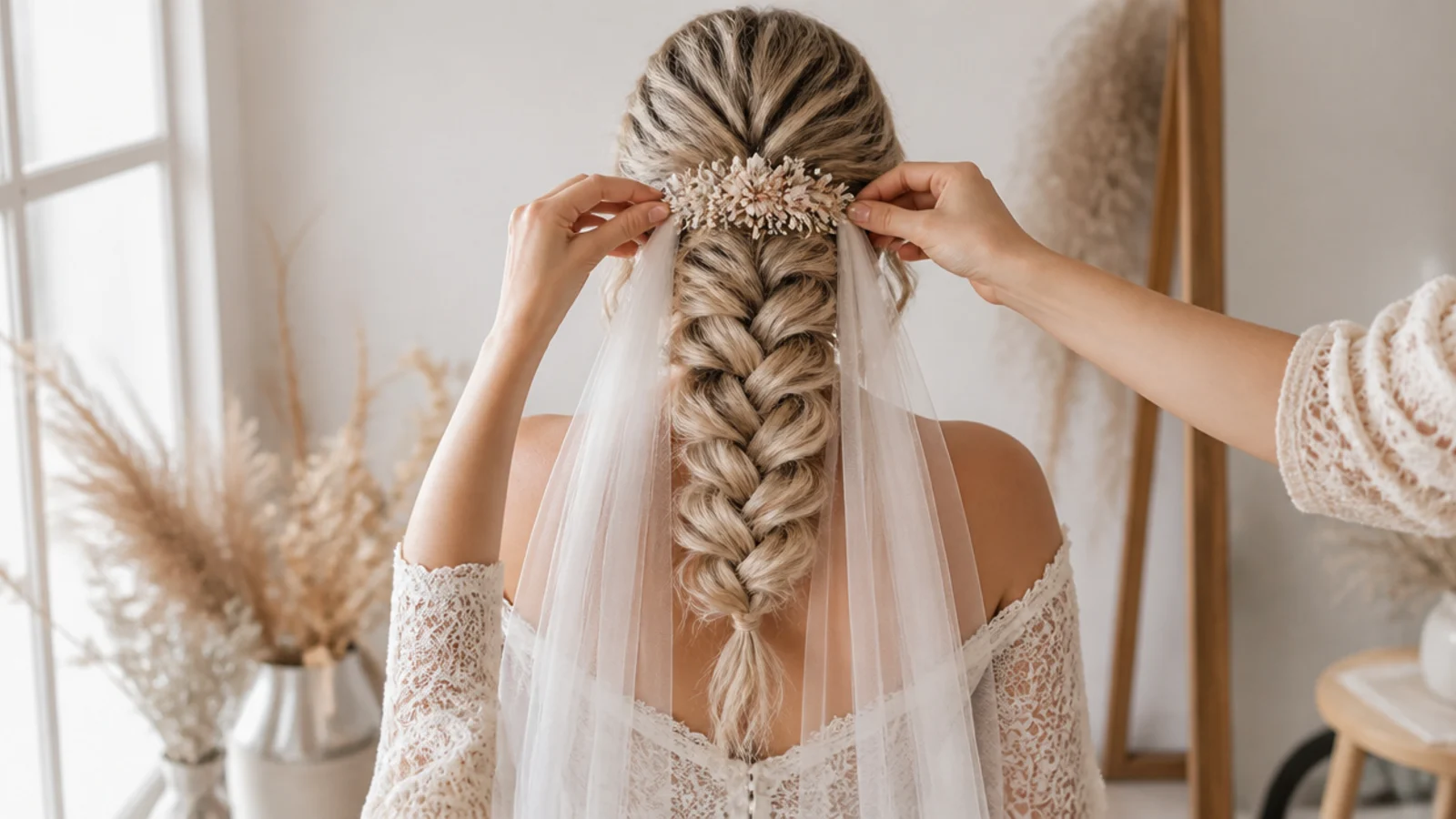
The rule is simple: the comb goes above the braid, never through it. Pushing a comb into a pancaked braid crushes the fan flat exactly where it is most visible, and the teeth have nothing solid to grip because the braid is deliberately loose. Set the comb into a small backcombed patch at the crown or just under the half-up section, then let the tulle fall over the braid. A cathedral or chapel veil works best with a side braid, since the length of tulle then falls down the empty side and never drags across braid texture. A blusher needs a half-up braid so lifting it does not pull the whole style back. If you plan to remove the veil before the reception, practice taking it out at the trial with the braid finished, because that removal is what most often leaves a visible dent. Longer down styles are covered in long mermaid braids.
Making a Wedding Mermaid Braid Last All Day
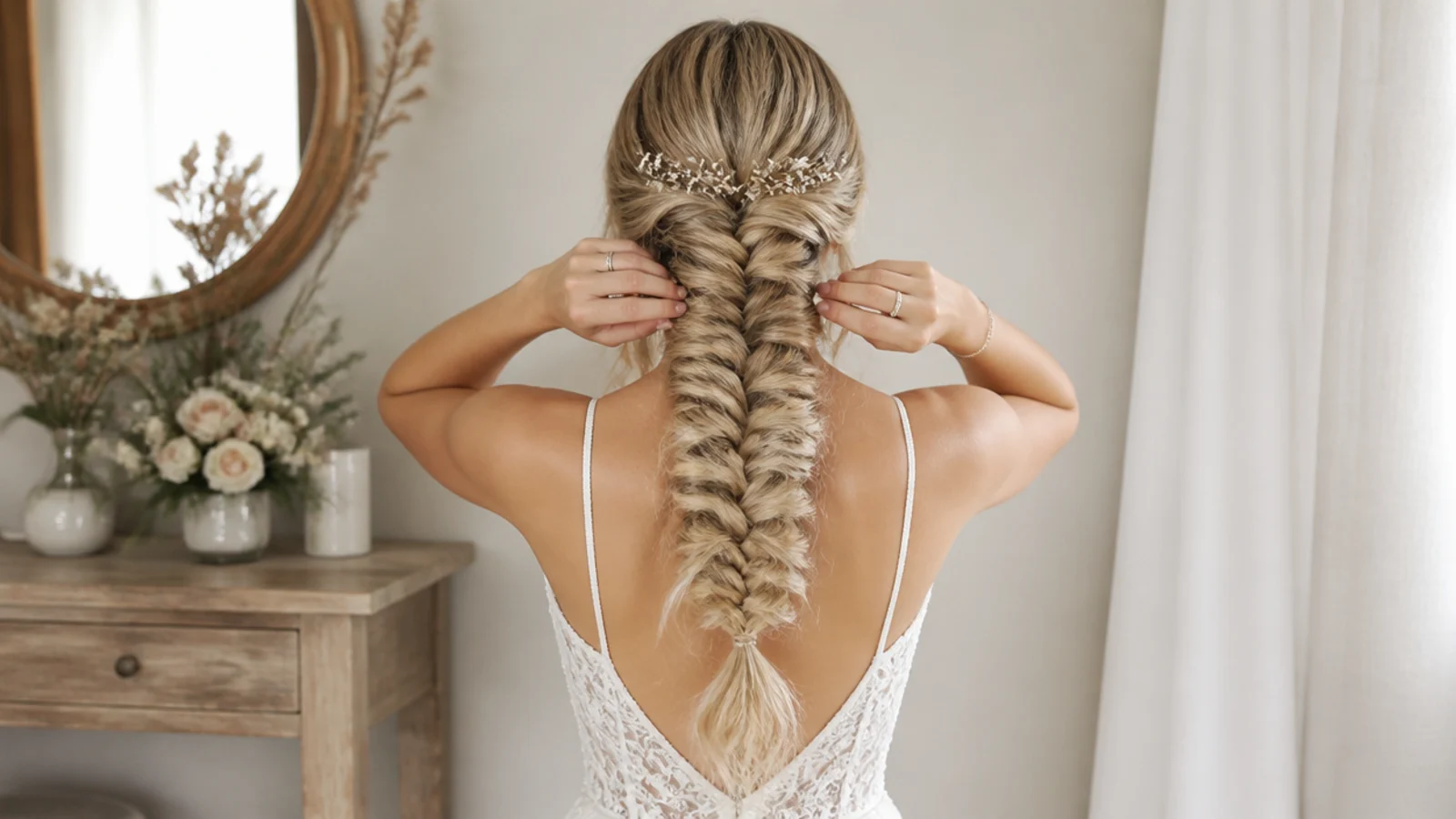
A mermaid braid does not fail suddenly, it narrows gradually, so plan one touch-up rather than hoping it holds. Between the ceremony and the reception, tug the outer edges wider again from the bottom up. It takes under a minute and needs no mirror if someone else does it. Finish the braid with a clear elastic, which vanishes in photographs, and carry a spare plus six bobby pins in your color. Sleep in the braid loosely the night before if you want next-day waves as your backup plan, and if you are trialing the style, wear it for a full day first to learn where it slips. Anti-humidity spray matters more than hold spray at an outdoor venue. For more on styles that survive a long day, read cute hairstyles that last all day and long hair updos that last.
Frequently Asked Questions
What are mermaid braids?
A mermaid braid is a fishtail braid that has been pancaked, meaning the outer edge of each crossover is pulled loose until the braid fans wide and flat like a tail. The braiding itself is a standard fishtail with two sections; the width comes entirely from the finishing step. Confusingly, the same name is also used for a protective style installed with extensions.
Can you wear a veil with a mermaid braid?
Yes, as long as the comb sits above the braid rather than inside it. Pushing a comb into a pancaked braid crushes the fan and finds nothing solid to grip. Anchor the comb in a small backcombed patch at the crown, or under a half-up section, and let the tulle fall over the braid. Side braids pair best with cathedral length veils.
How long does a mermaid braid last?
On natural hair a mermaid braid holds its shape for a full day and stays wearable for about three days to a week if you sleep in it carefully. It narrows gradually rather than falling out, so plan one re-pancake between ceremony and reception. The extension version of mermaid braids is different and lasts roughly six to eight weeks with proper care.
Are mermaid braids the same as boho braids?
No. The distinction stylists draw is that mermaid braids are not braided all the way to the ends, which is what creates the loose flowing finish, while boho braids are braided down and then accessorized with beads and feathers. In practice boho reads organic and messy, and mermaid reads uniform and aquatic. Boho suits festivals and beaches; mermaid suits formal occasions.
Will a mermaid braid work on fine hair?
It works well on fine hair, but not on freshly washed fine hair, which is too slippery to hold a fishtail. Wash the day before and braid on day-two hair, or mist texture spray through the mid-lengths and let it dry first. Use the Dutch version so the braid sits raised off the scalp, and take small sections, since thin crossovers pancake wider.
How do you make a mermaid braid look thicker?
Curl the hair on a 1 to 1.25 inch iron and brush the curls out before braiding, because loose waves give the braid body. Then pancake from the bottom up, tugging the outer edge of each crossover a few millimeters at a time rather than a centimeter at once. Clip-in extensions add length rather than width, but they help the fan reach further down the back.
How far in advance should you trial a wedding mermaid braid?
Book the trial far enough ahead that you can book a second one if the first is wrong, and go with your veil, your earrings and a top with your actual gown neckline. Wear the finished style for the rest of the day to learn where it slips and how fast it narrows. Schedule any color touch-up about two weeks before the wedding, never the same week.
How do you sleep with a mermaid braid the night before?
Braid it loosely, secure the end with a soft elastic, and sleep on a satin or silk pillowcase to cut friction and frizz. You will wake up with soft waves already through the hair, which gives the morning braid the texture it needs. This is also the easiest backup plan: if the styled braid does not work on the day, the overnight waves stand alone as a look.
Can bridesmaids do mermaid braids themselves?
Yes, and double mermaid braids on either side of a center part are the most repeatable option across a group, because two symmetrical sections are far easier to match than one centered braid. Have people work in pairs facing each other rather than reaching behind their own heads. Agree on a pancaking rule first, such as three small tugs per crossover, so every braid ends the same width.
Which mermaid braids look are you saving?
If you take one thing into your trial from these 20 mermaid braids, make it the pancaking. Everything else about a bridal fishtail is standard braiding, but the width is what turns it into a mermaid braid, and it is the step stylists rush when they are behind schedule. Ask for the fan pulled wider than feels right in the mirror, because it always tightens over the next hour and always photographs narrower than it looks in person. Book the trial with your veil, your earrings and a top with your actual neckline in hand. Then browse the rest of the mermaid braids hub, or go straight to side mermaid braids if you already know you want it over one shoulder.