Quick Comparison
| Contain the Frizz (Braids, Twists and Buns) | Work With the Frizz (Waves, Half-Updos and Volume) | |
|---|---|---|
| What it does | Physically encloses swollen strands so they cannot expand | Defines and separates the texture so swelling reads as volume |
| Best frizz type | All-over swelling, mid-length triangle, ends-only fraying | In-the-curl frizz and halo frizz on defined waves or curls |
| Humidity hold | 8 to 12 hours, holds above 70 percent humidity | 4 to 8 hours, softens as the dew point climbs |
| Time to style | 2 to 10 minutes on dry or damp hair | 15 minutes of styling plus 2 to 4 hours of drying |
| Products needed | Leave-in and an elastic, or nothing at all | Leave-in, curl cream and gel layered in that order |
| Minimum length | 8 to 14 inches depending on the braid | 5 to 7 inches, so it works on a bob |
| Main failure mode | Slips loose at the nape; tension frizz at the part if pulled tight | Goes fluffy if touched while drying or under-gelled |
| Mid-day rescue | Mist with water, smooth with damp palms, re-pin | Scrunch with a drop of oil and water; never brush |
| Long-term effect on hair | Protective if loose; damaging if worn tight daily | Improves definition over weeks as hydration builds |
1. Finger-Raked Messy Bun for Frizzy Hair
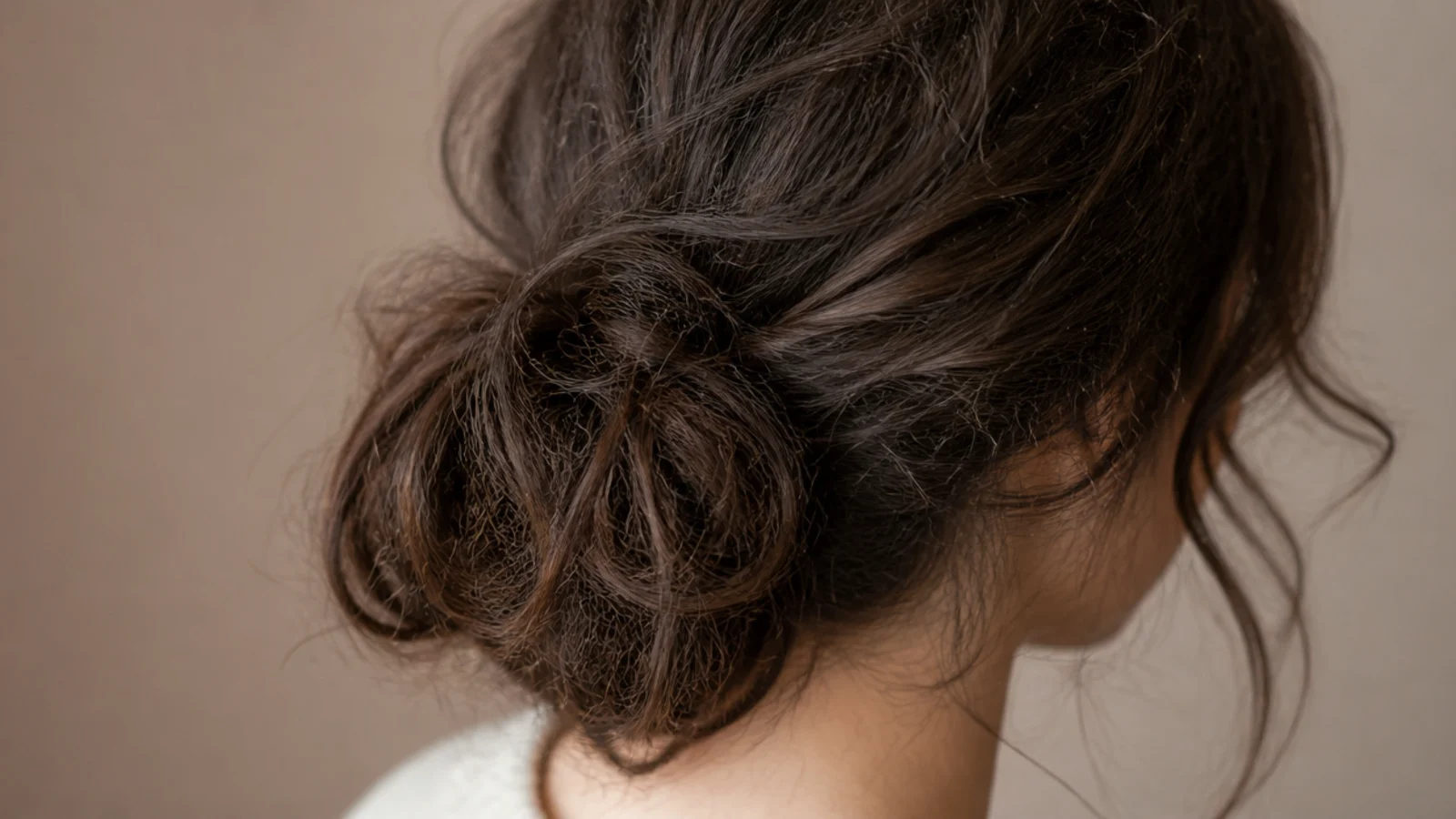
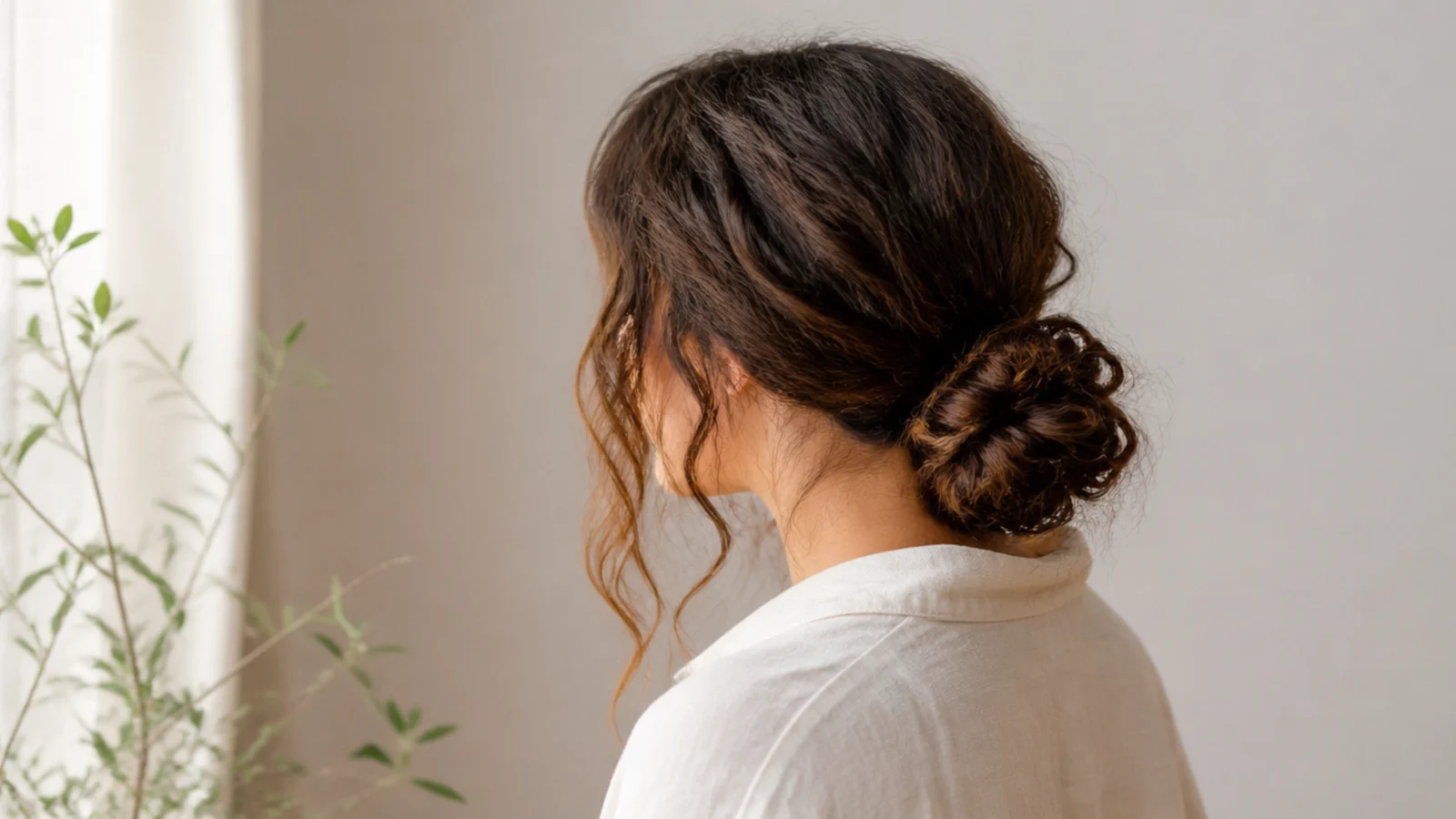
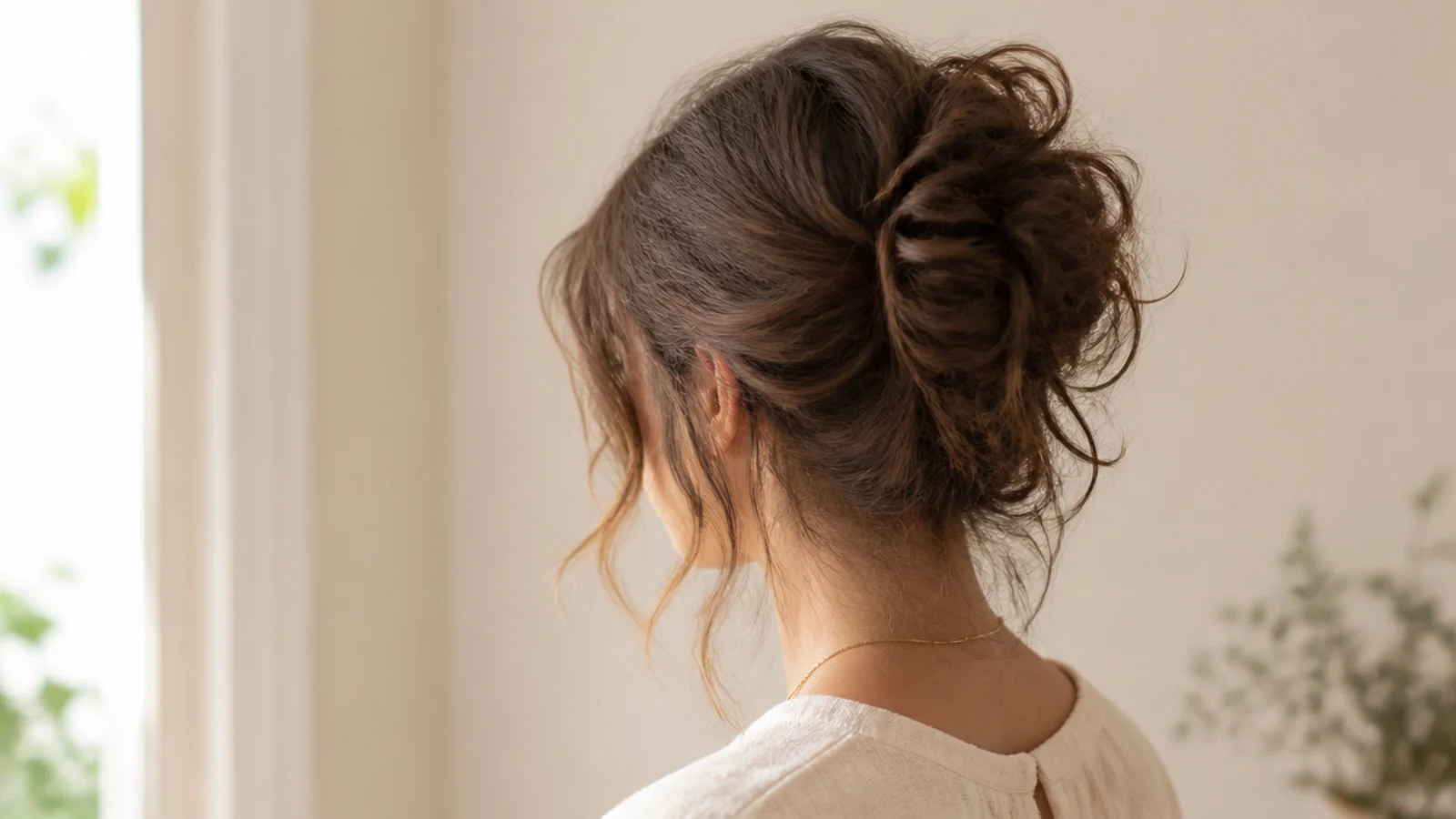
The two-minute default for any frizz day, and the whole trick is that a brush never touches it. Rake the hair up with your fingers to a spot just above the occipital bone, twist the length twice, then wrap and secure with a silk scrunchie. Fingers gather the hair without breaking the cuticle alignment the way bristles do, so the surface stays calmer. Leave a half-inch section loose at each temple. Needs 8 inches of hair minimum. Holds 6 to 8 hours, and it improves as it loosens rather than falling apart.
Who it suits: Every texture, every density, and anyone with two minutes.
Tip: If the crown puffs by mid-afternoon, smooth a pea of cream on your palms and press, never stroke.
2. Loose French Braid on Damp Frizzy Hair
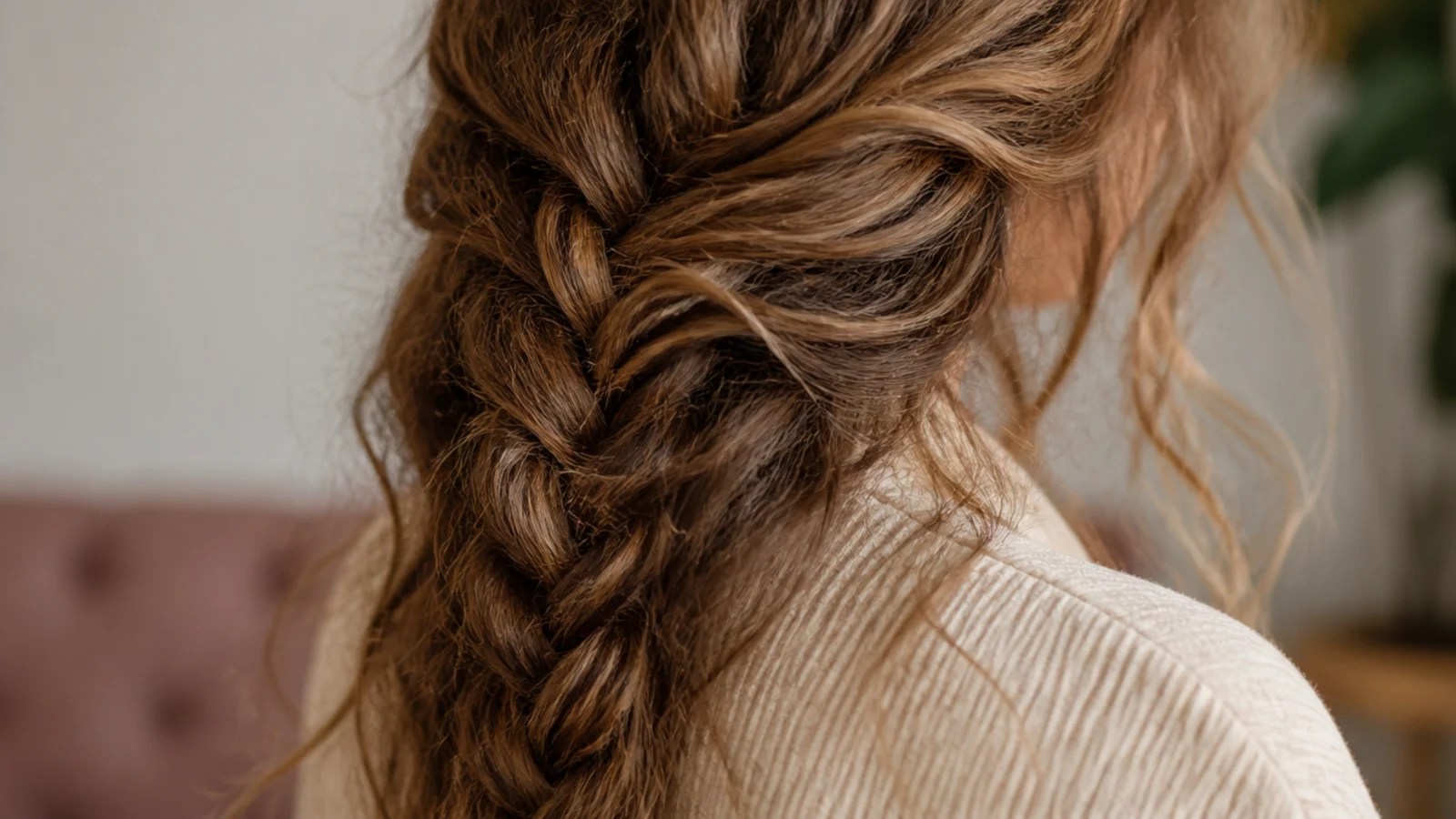
Braiding damp rather than dry is the difference between a neat braid and a fuzzy one, because damp cuticles lie flatter and the braid sets that alignment as it dries. Work a coin of leave-in through the length first, part at the crown and French braid down the back, keeping tension loose enough to fit a finger under each cross. Takes 5 minutes with practice. Needs 10 inches. Holds all day at any humidity, and it doubles as an overnight setter for waves the next morning.
Who it suits: Fine and thick frizzy hair alike, and anyone with a long commute in the rain.
Tip: Braid to about 2 inches from the ends and stop; braiding the very ends is what makes them fray.
3. Double Dutch Braids for Thick Frizzy Hair
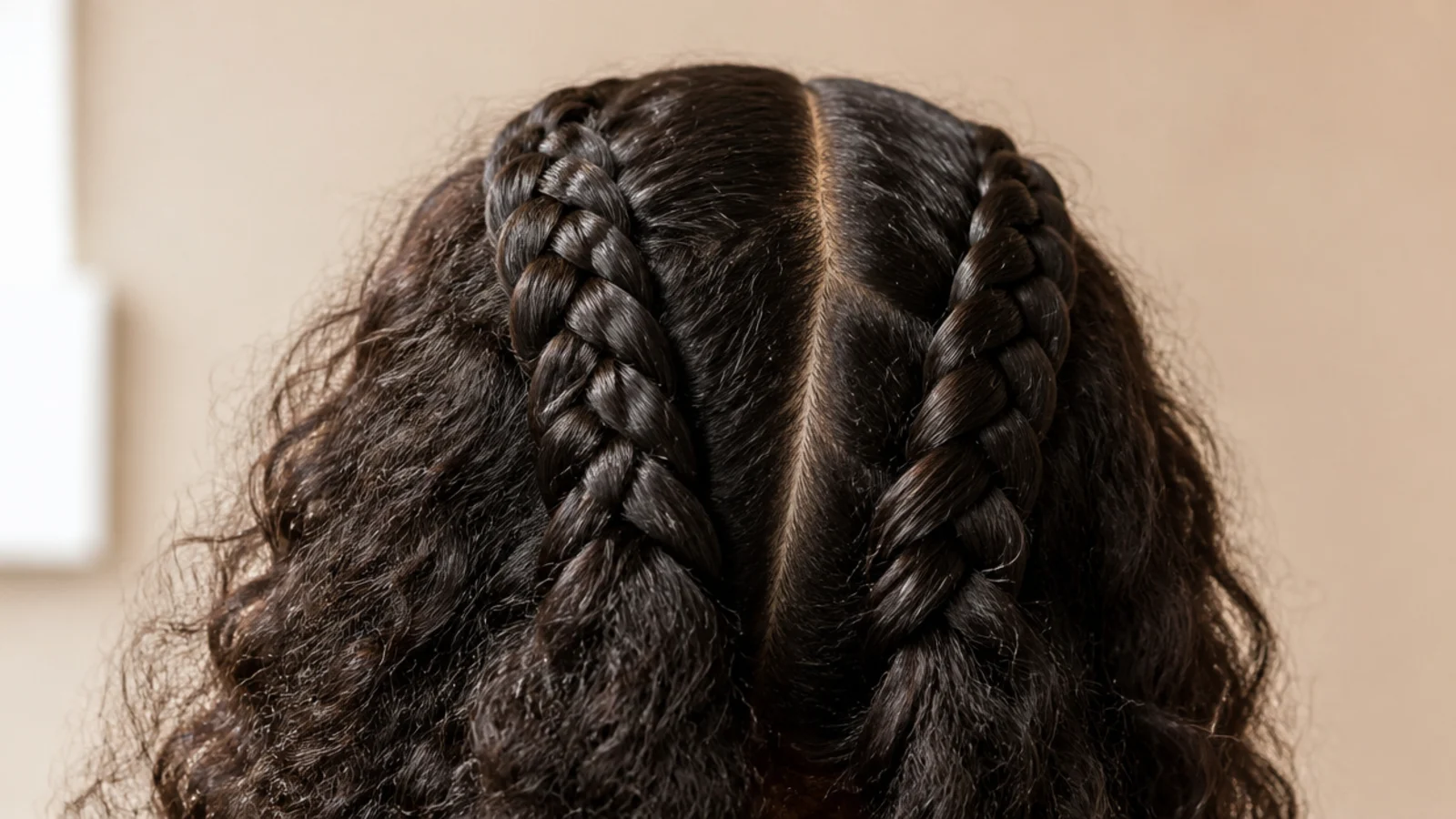
Two braids halve the bulk each one has to hold, which is why this beats a single braid on dense hair. Part straight down the center, then Dutch braid each side by crossing sections under instead of over so the plait sits raised on the surface. Takes 8 to 10 minutes at first, 5 once it is muscle memory. Needs 9 inches. This is the highest hold style on the list: it survives rain, gym sessions and 90 percent humidity. More braid variations sit in easy mermaid braids.
Who it suits: Thick, coarse and high-density frizzy hair that overwhelms a single braid.
Tip: Do not tighten at the hairline to smooth baby hairs; tension frizz at the part is permanent damage.
4. Side Fishtail Braid for Long High-Porosity Hair
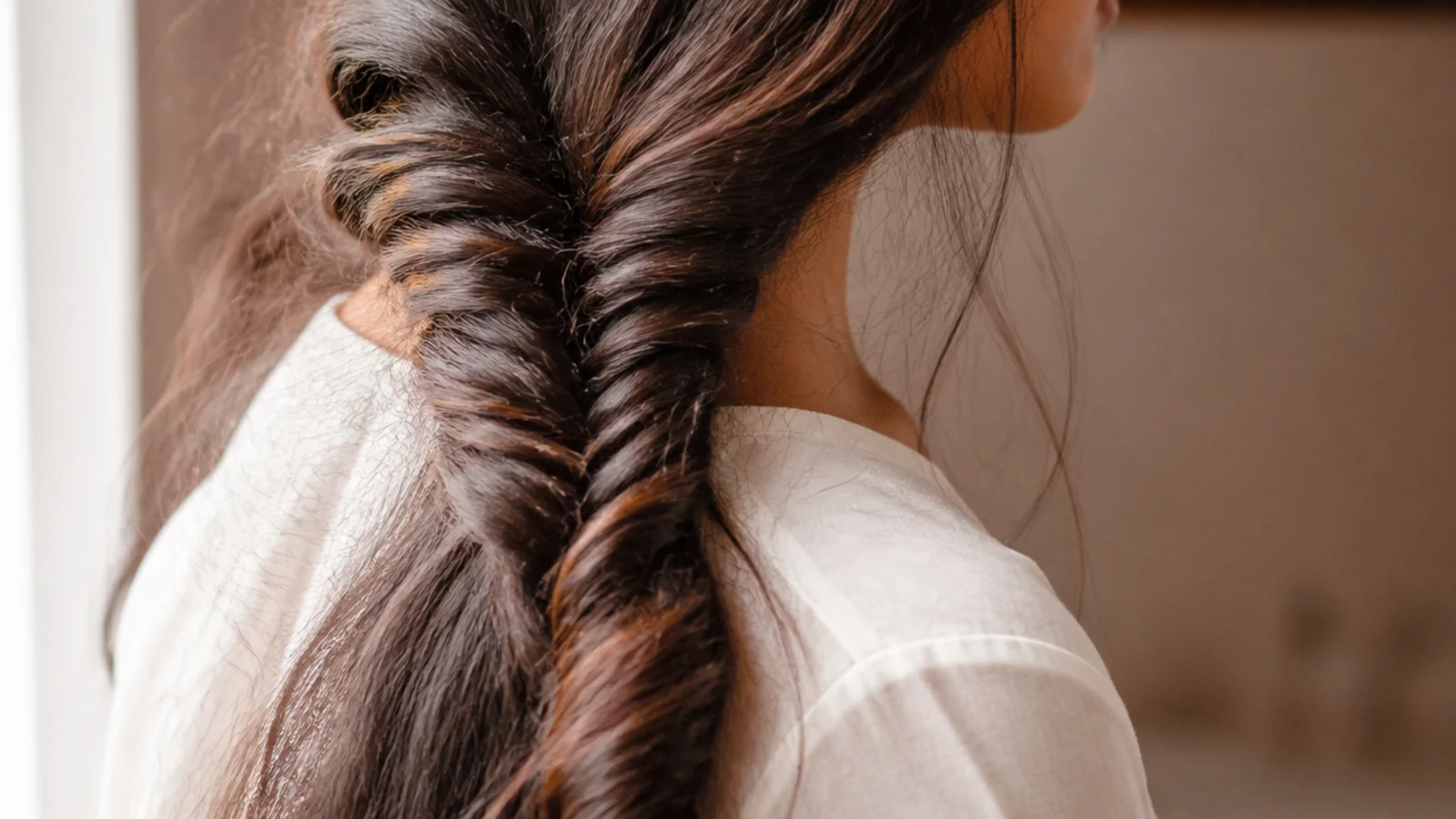
High-porosity hair, the kind that soaks up water in seconds and dries fast, frizzes most along the mid-lengths, and a fishtail hides exactly that zone. Sweep everything to one shoulder, split in two, and cross thin quarter-inch pieces from the outside of each half to the inside of the other. Takes 8 minutes. Needs 12 inches. Holds 8 hours, then goes soft rather than messy. Pancake the edges gently once it is tied, which makes it look fuller and disguises any strand that has already escaped.
Who it suits: Long, high-porosity, color-treated or fast-drying frizzy hair.
Tip: Mist the braid with water and smooth once at the four-hour mark rather than re-braiding it.
5. Half-Up Claw Clip Twist for Shoulder-Length Frizz
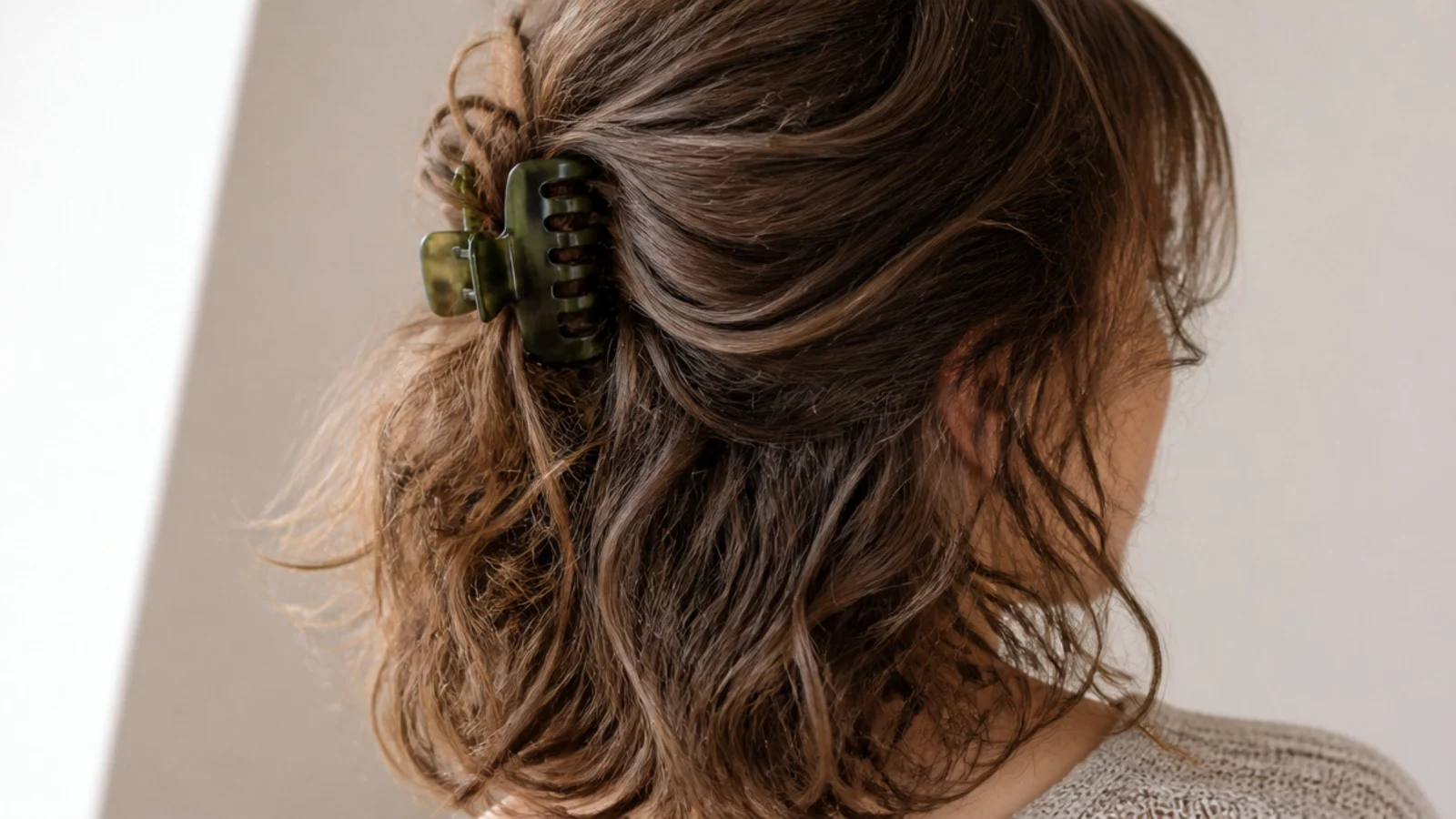
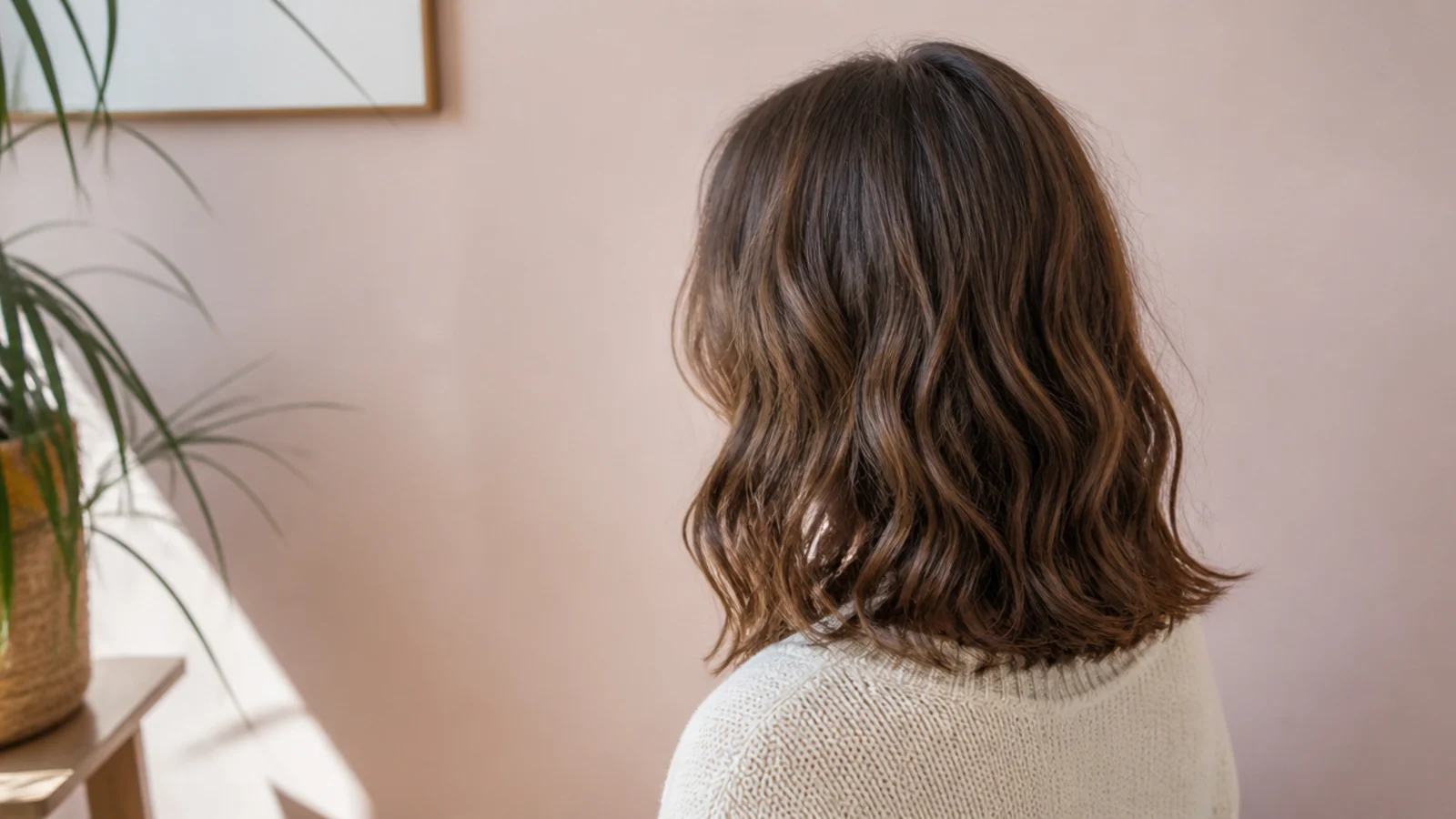
The fastest way to look intentional on a bad frizz day: it clears the frizziest crown section while letting the lengths do whatever they want. Take the top third from temple to temple, twist it once away from your face, fold the twist up and clamp a 3-inch matte claw clip over the fold. Takes 60 seconds. Needs 6 inches, so it works on a bob. Holds 5 hours before the twist slips. Pair it with air-dried texture from frizzy wavy hair for the best version.
Who it suits: Chin to shoulder length, and anyone whose frizz sits mostly at the crown.
Tip: Matte clips grip frizzy hair; glossy acrylic ones slide out within the hour.
6. Low Slicked Bun with Gel on Frizzy Hair
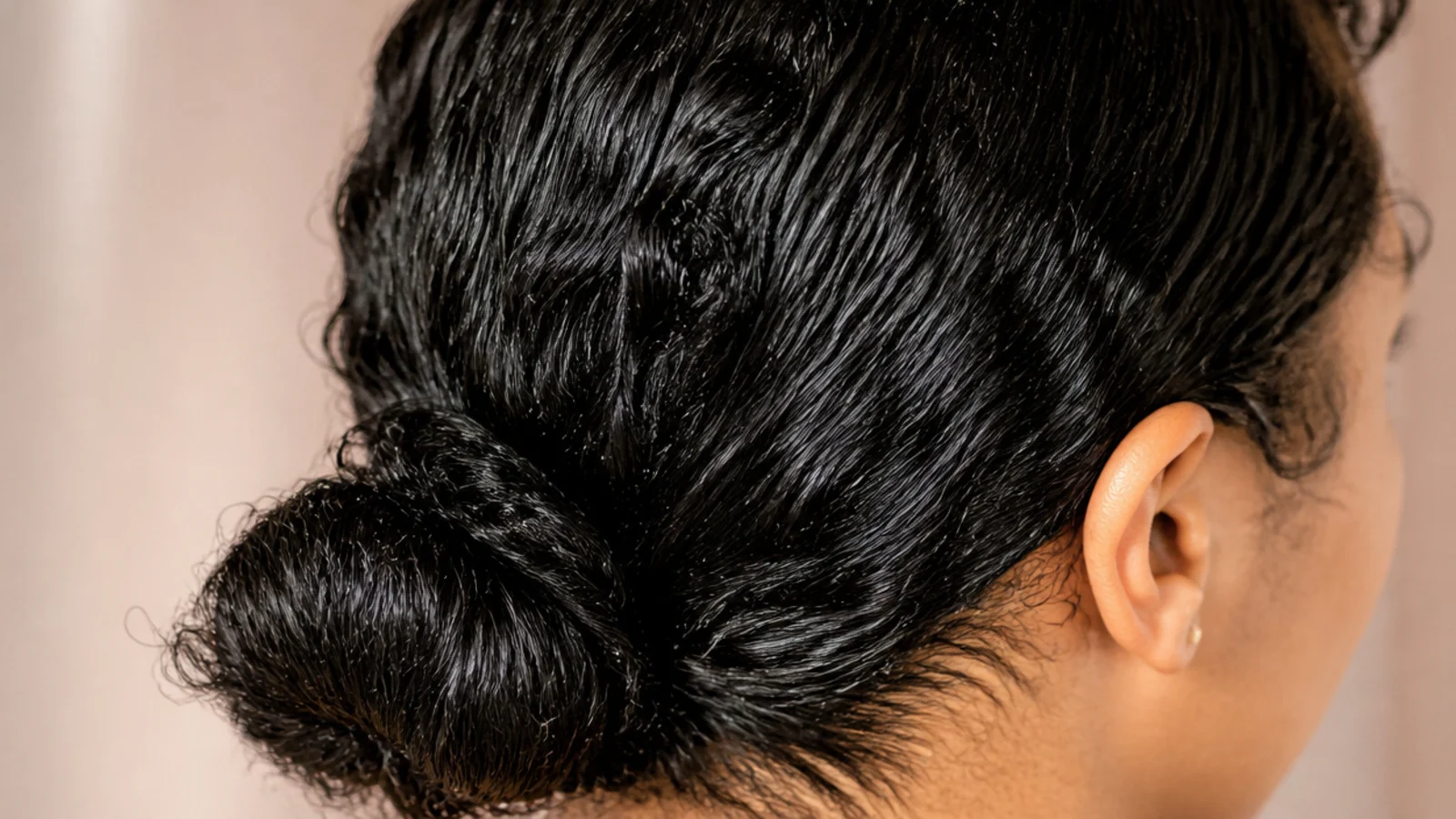
The one genuinely sleek look here, and it only works if you wet the hair first. Dampen the front and sides with a spray bottle, work a quarter-sized blob of a firm-hold gel through, brush back with a soft boar bristle brush and coil into a bun at the nape. Takes 6 minutes. Needs 8 inches. Holds 10 to 12 hours because the gel forms an actual cast around the strands. Wet hair plus gel is non-negotiable; on dry hair the gel just sits on top of the frizz and flakes.
Who it suits: Offices, interviews, weddings, and anyone who needs polish for one evening.
Tip: Do this no more than twice a week; nightly scalp tension makes crown frizz worse over months.
7. Bouffant Ponytail That Works With Crown Frizz
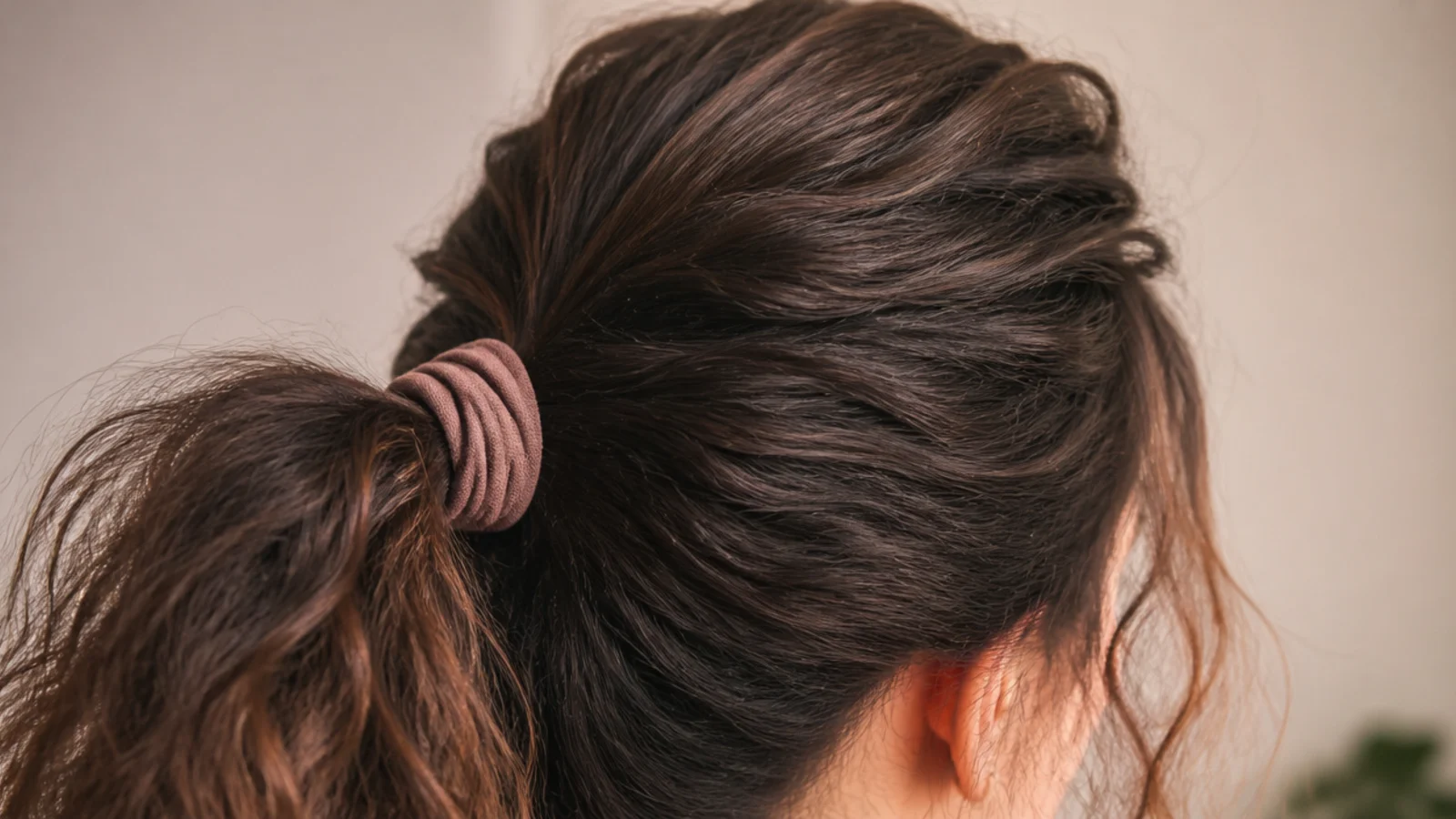
Instead of fighting crown puff, this style promotes it to a design feature. Backcomb the top 3 inches lightly at the roots, smooth only the very surface layer over the top with your palm, then gather everything into a mid-height ponytail. Takes 4 minutes. Needs 8 inches. Holds 6 hours. The logic is that a smoothed crown next to frizzy lengths looks like a mistake, while a deliberately lifted crown reads as volume. Wrap a half-inch strand around the elastic to hide it and pin underneath.
Who it suits: Halo and crown frizz, fine hair that goes flat, and 1970s-leaning outfits.
Tip: Backcomb with a fine-tooth comb at the roots only; teasing mid-length shreds the cuticle.
8. Air-Dried Waves with Scrunch-Out-the-Crunch
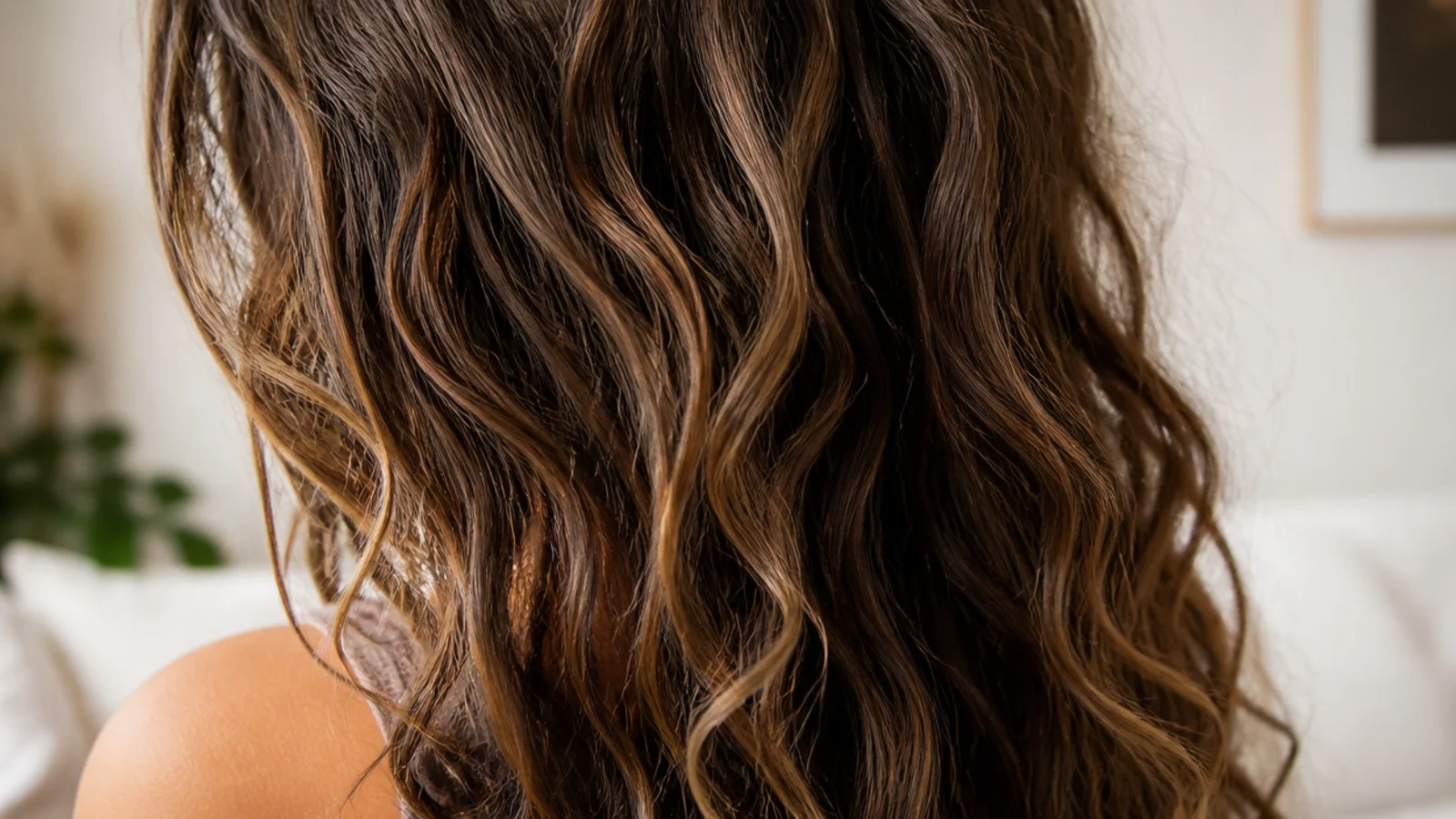
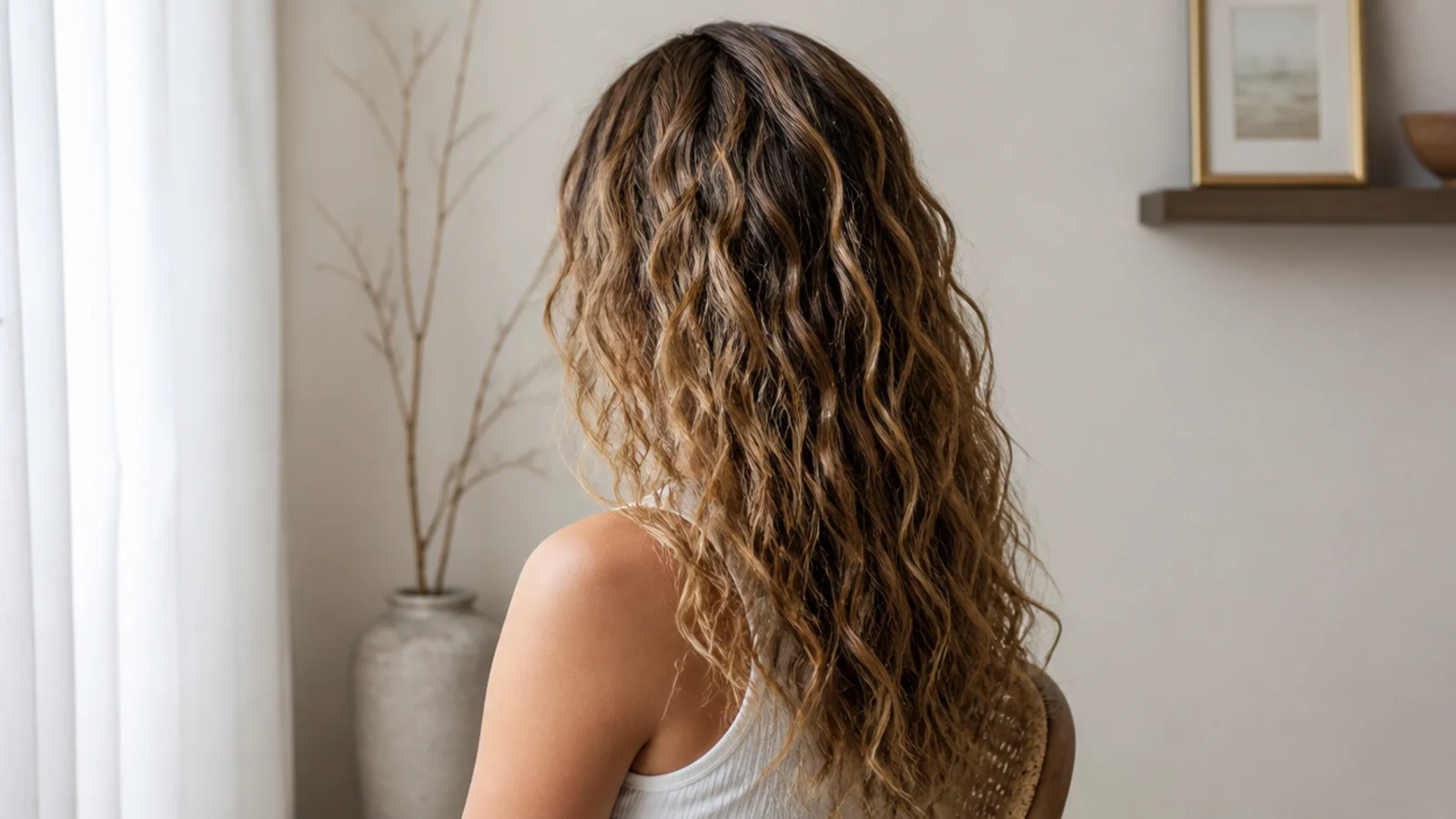
Not a styled look so much as a method, and it is the single biggest upgrade for wavy frizzy hair. On soaking wet hair, rake in leave-in, then a curl cream, then a light gel, scrunching upward after each. Let it dry fully, which takes 2 to 4 hours, and it will feel crunchy. Then scrunch that cast out with oiled palms and the waves stay defined while the crunch disappears. Needs 6 inches. Holds 2 days. Full method in frizzy wavy hair.
Who it suits: 2A through 2C waves, and anyone whose air-dried hair currently dries fluffy.
Tip: Do not touch the hair at all while it dries; every touch on damp hair creates frizz.
9. Plopped Curls in a Cotton T-Shirt
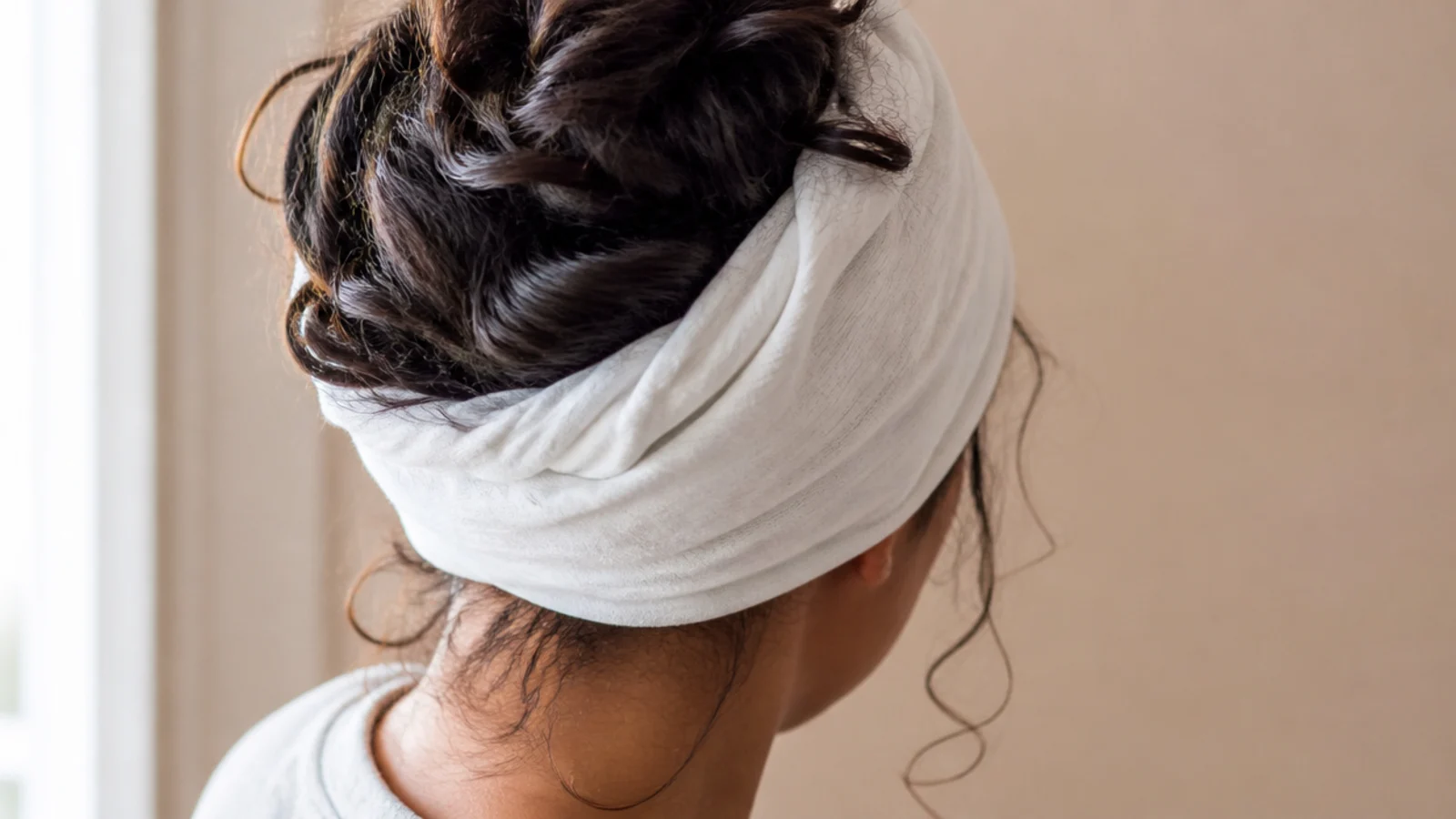
Plopping means piling wet, product-loaded curls onto a flat cotton t-shirt spread on a bed, flipping the shirt up over the head and tying the sleeves at the nape. It holds the curl in its coiled shape while gravity would otherwise stretch it, and cotton absorbs without the friction of terry loops. Leave it 20 to 30 minutes, no longer, or the roots stay wet and go flat. Needs 6 inches. Result holds 2 days. See more in frizzy curly hair.
Who it suits: Curls and tight waves that lose definition at the roots.
Tip: If your crown comes out flat, plop for 15 minutes and clip the roots after with duckbill clips.
10. Twisted Halo Crown Braid for Humid Days
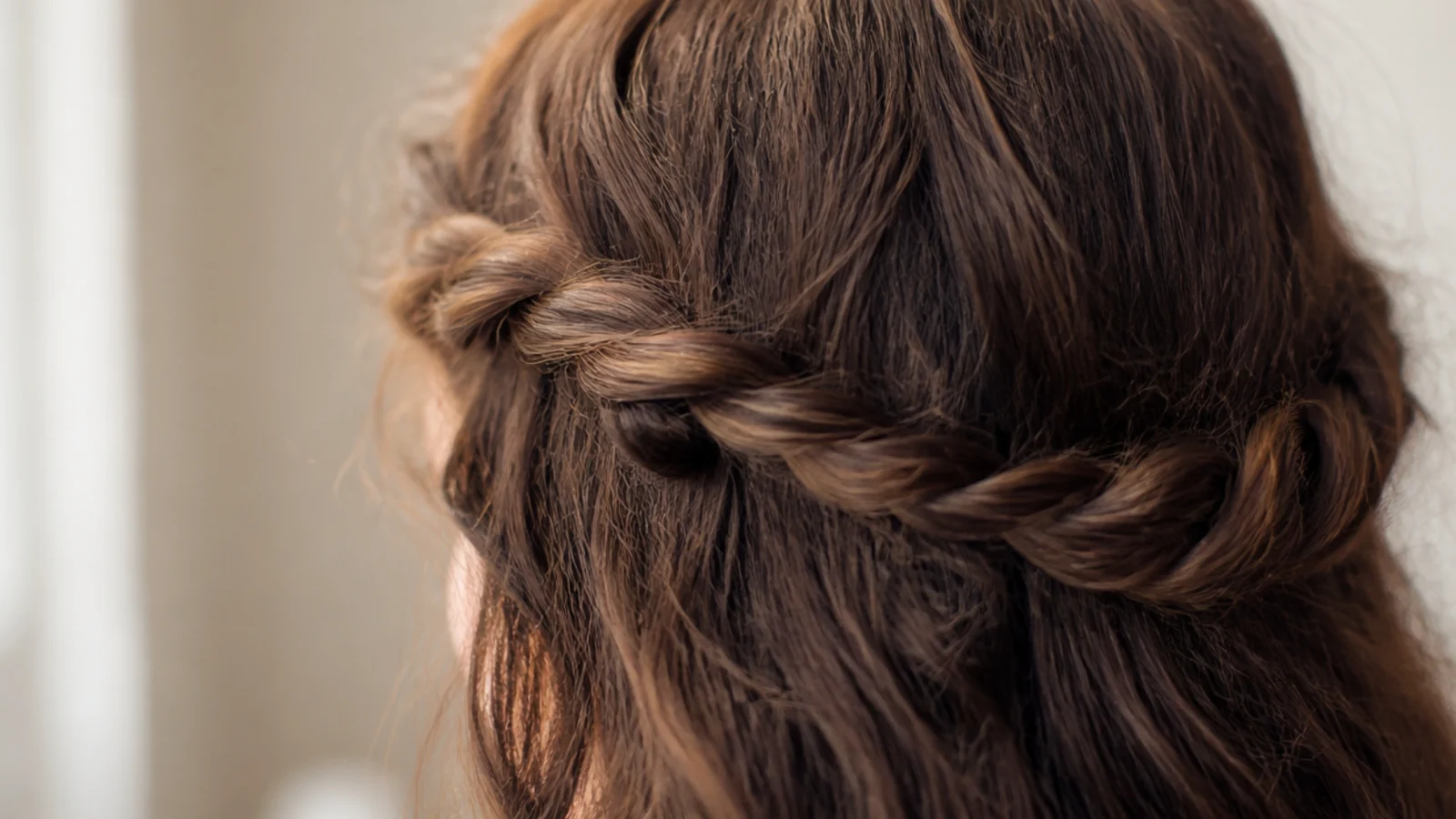
Every strand ends up pinned, which is why this is the most humidity-proof look on the list. Split the hair down the middle, braid or rope-twist each half loosely, then wrap the left braid over the crown to the right ear and the right braid over to the left, pinning with 8 to 10 bobby pins crossed in Xs. Takes 10 minutes. Needs 14 inches. Holds 12 hours in 80 percent humidity. It also buys a full day out of third-day hair that is past washing.
Who it suits: Long hair, tropical weather, outdoor weddings and festival days.
Tip: Spray the bobby pins with dry shampoo first so they grip slippery, product-coated hair.
11. Braided Headband Across a Frizzy Front Hairline
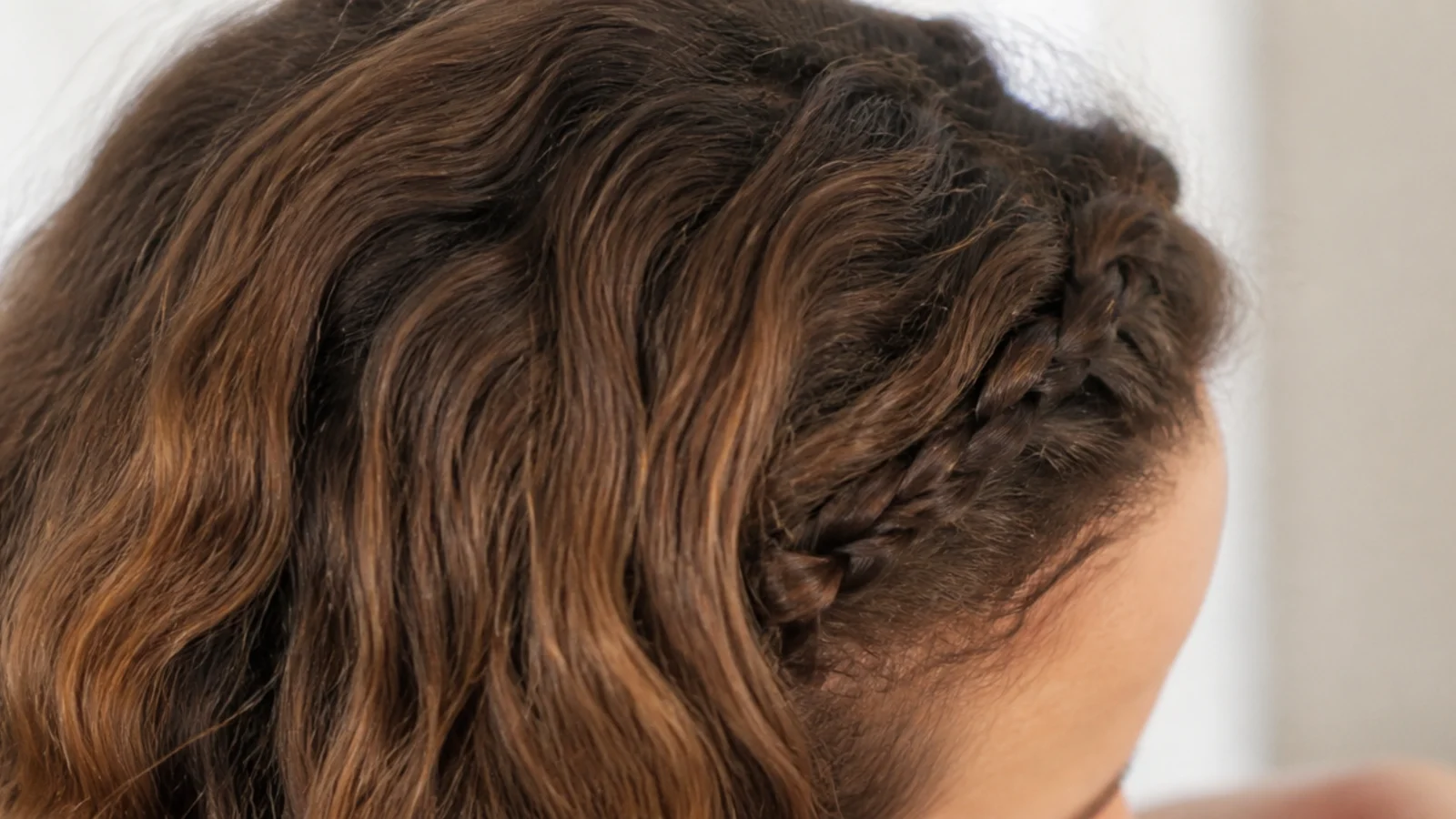
The frizz you see in the mirror is mostly the halo at your hairline, and a thin braid laid across it covers exactly that band. Take a one-inch section above one ear, braid it tightly, pull it across the front of your head like a headband and pin it behind the opposite ear. The rest stays loose. Takes 4 minutes. Needs 10 inches so the braid reaches across. Holds 7 hours. It is the highest ratio of visual improvement to effort of anything here.
Who it suits: Halo frizz, growing-out bangs, and second-day hair.
Tip: Anchor with two pins crossed at the ear, not one; a single pin pivots and drops by lunch.
12. Two-Strand Rope Twist Low Pony
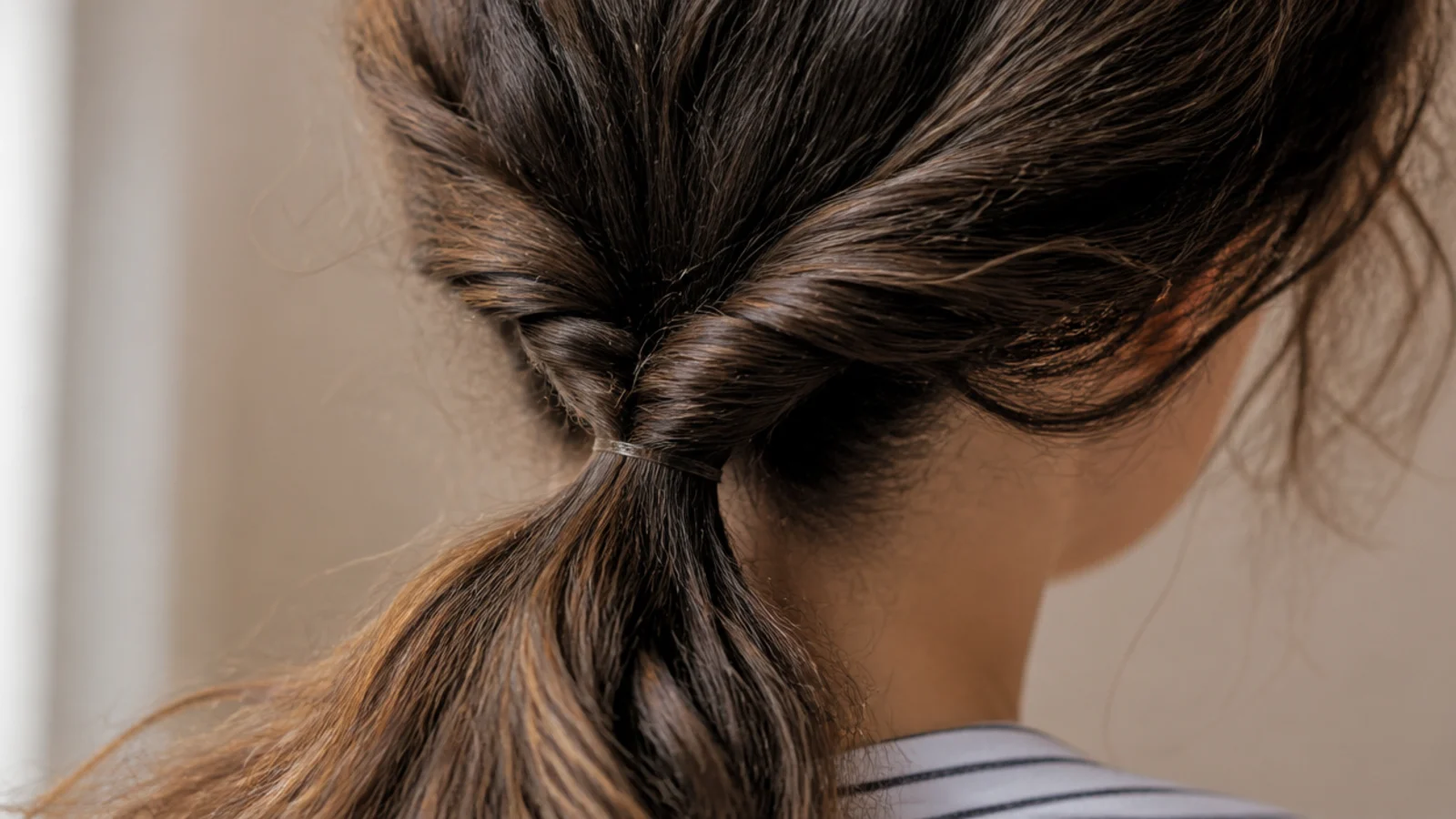
Easier than a braid and better at containing frizz, because twisting compresses the strands against each other instead of interlacing them with gaps. Tie a low ponytail, split it in two, twist each half clockwise until it is firm, then wind the two halves around each other counterclockwise and tie the end. The opposing directions are what stop it unraveling. Takes 3 minutes. Needs 9 inches. Holds 8 hours. It looks far more complicated than it is, which is the entire appeal.
Who it suits: Anyone who cannot braid, plus medium and thick textures.
Tip: Twist each half harder than feels necessary; a loose rope twist unwinds within the hour.
13. Bubble Ponytail on Second-Day Frizzy Hair
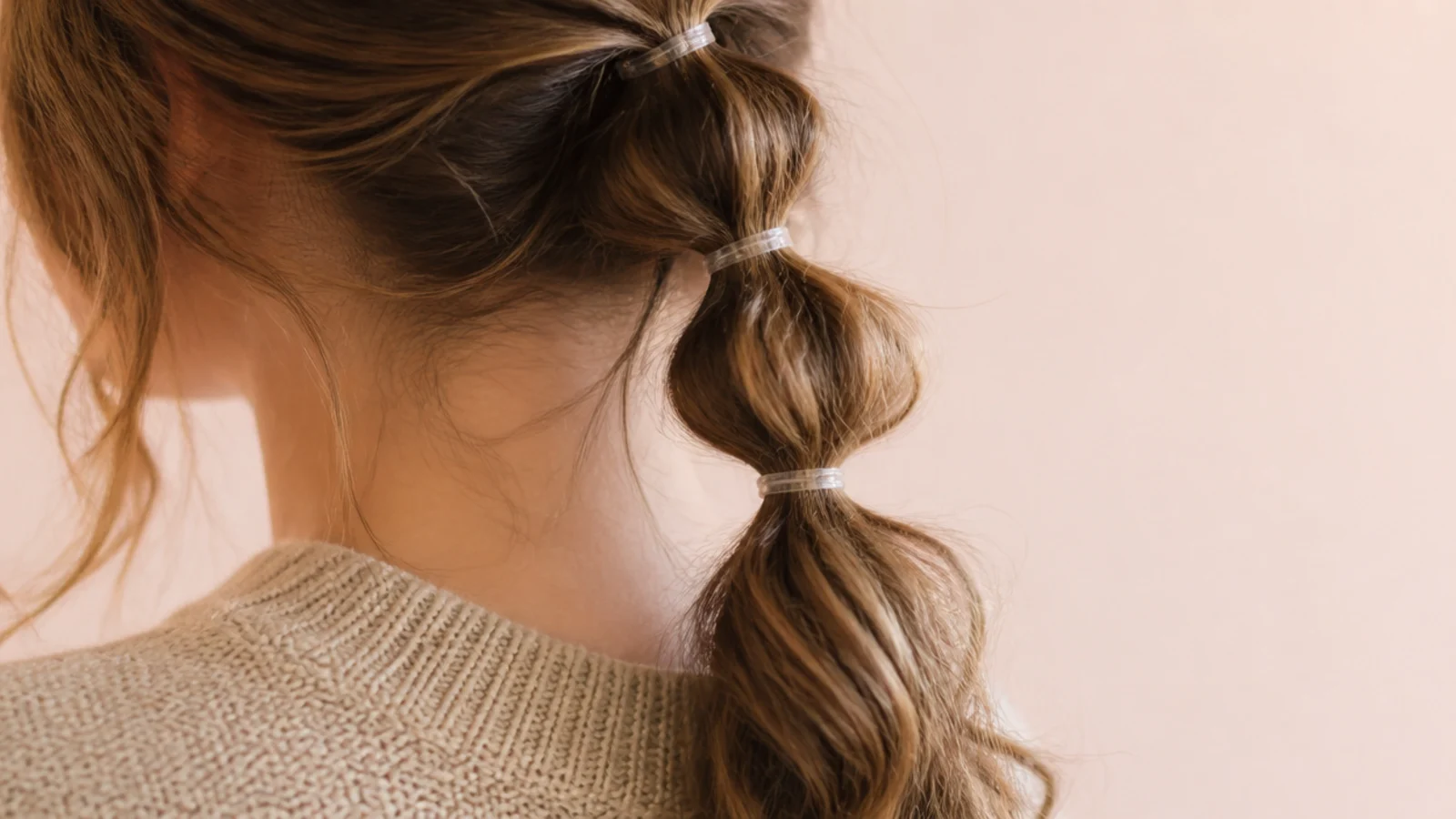
Frizz reads as fuzz when it is uncontained and as volume when it is segmented, and the bubble pony exploits that. Tie a ponytail, then add clear elastics every 2 to 3 inches down the length and gently pull each section outward to round it. Four to five bubbles is the sweet spot. Takes 5 minutes. Needs 12 inches. Holds 8 hours. It is genuinely better on day-two hair, since a little grip helps the bubbles keep their shape instead of collapsing.
Who it suits: Long, thick, second-day and third-day frizzy hair.
Tip: Use clear polyurethane elastics, not metal-crimped ones; the metal barrel snaps frizzy strands.
14. Silk Scarf Headwrap for a Bad Frizz Day
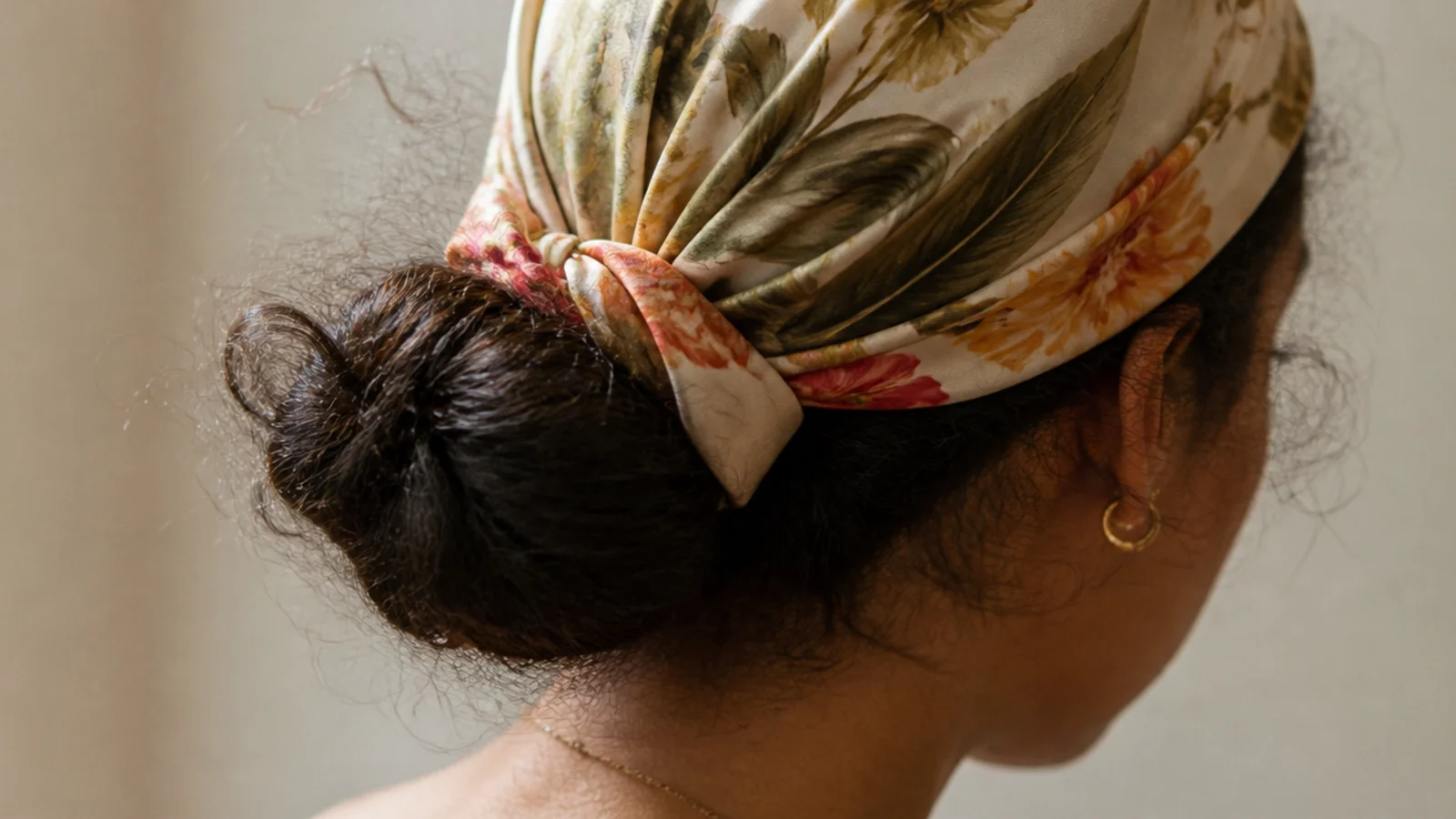
A 27-inch silk square folded into a 2-inch band, laid over the crown and tied under the hair at the nape, covers the entire frizz-prone front section in about 40 seconds. Silk matters here rather than cotton or polyester: it does not wick moisture out of the hair or roughen the cuticle against the scalp. Pair it with a low bun or loose lengths. Needs any length. Holds as long as the knot does. This is the legitimate answer on a day when nothing else is working.
Who it suits: Wash-day-overdue hair, rain, and days you have no time at all.
Tip: Tie the knot on hair, not skin; a knot resting on the nape hairline creates breakage over time.
15. Beanie-Friendly Low Side Braid for Rainy Days
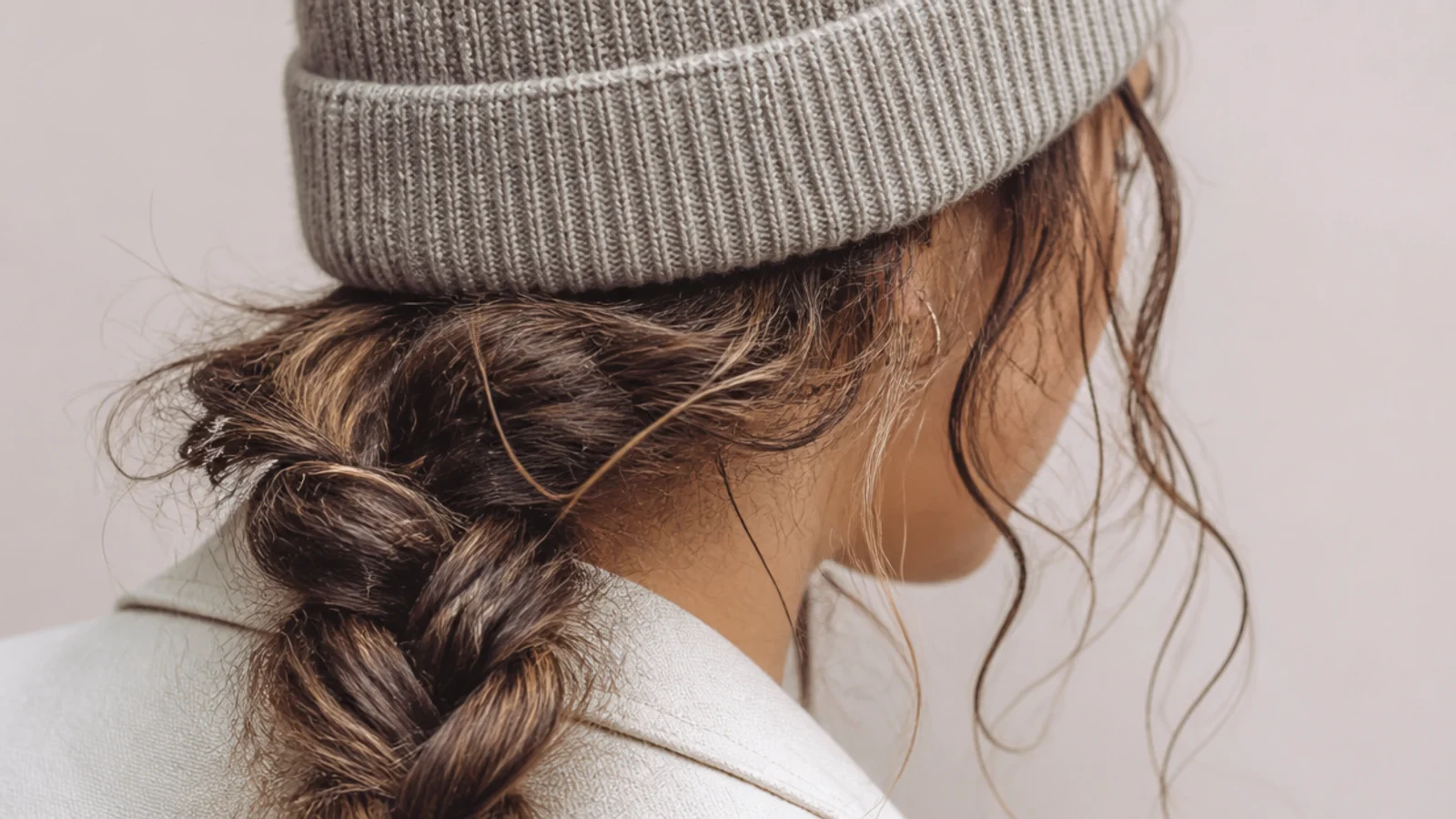
Hats flatten the crown and create hat frizz, so the braid has to start low. Gather everything at ear height on one side, plait a simple three-strand braid and tie it, then pull the beanie on so the brim sits above the braid line rather than crushing it. Leave two face-framing pieces out and dampen them with a drop of cream so they curl rather than fluff. Takes 3 minutes. Needs 10 inches. Holds through a whole rainy day, which nothing loose will.
Who it suits: Winter, rain, high dew point mornings and cold commutes.
Tip: Choose a satin-lined beanie; ribbed acrylic against dry hair generates static and flyaways.
16. Deep Side Part with Mini Claw Clips at the Crown
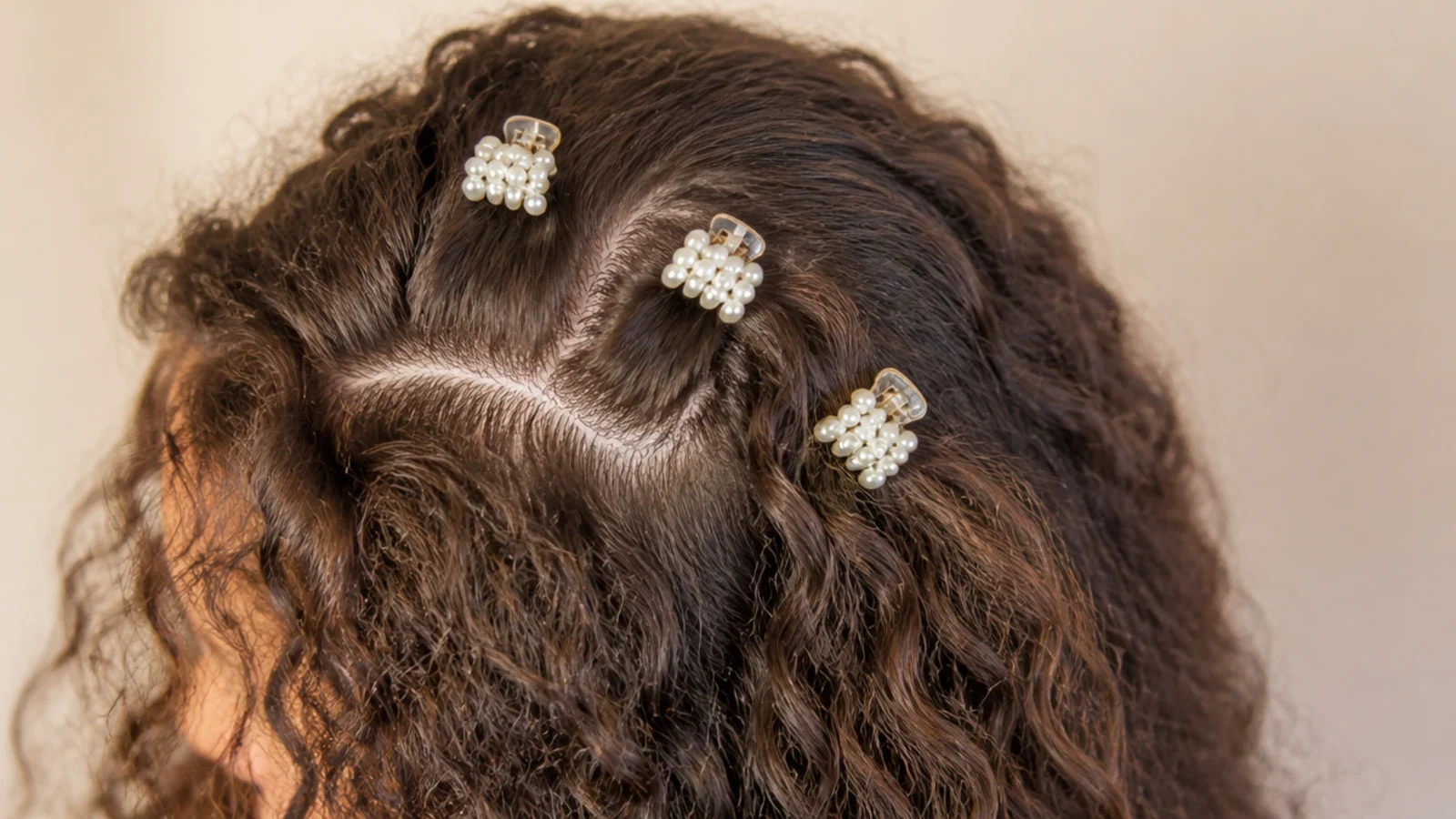
Three or four 1-inch clips set in a line along a deep side part pin down the exact strands that stand up, and they read as jewelry rather than as damage control. Part deeply from the arch of one eyebrow, sweep the heavy side across and clip small sections along the part line, spacing them evenly. Takes 90 seconds. Needs 5 inches, so bobs qualify. Holds 6 hours. Pearl or gold clips look considered; plain plastic ones look like you were holding your hair back to cook.
Who it suits: Short to medium frizzy hair and anyone who wants zero-heat, zero-product styling.
Tip: Clip over the part line, not the shiny surface; clips on flat hair leave a visible dent.
17. Sleek Middle-Part Low Chignon for Fine Frizzy Hair
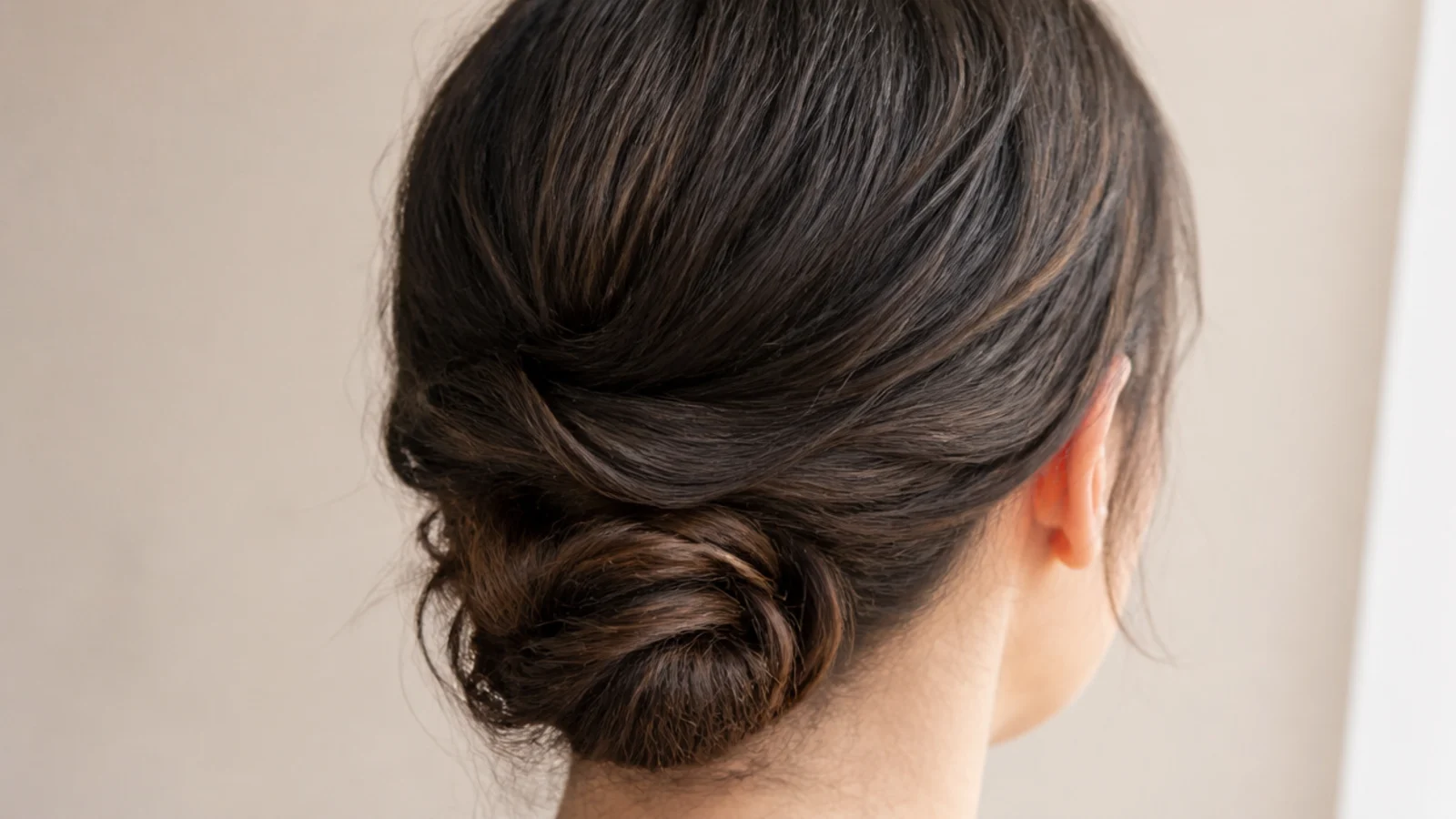
Fine frizzy hair has thousands of short broken strands standing up from the crown, and a chignon works because it needs very little bulk to look full. Part in the middle, smooth a serum over the crown surface only, gather at the nape, roll the length upward into a soft cylinder and pin with 6 U-pins. Takes 7 minutes. Needs 10 inches. Holds 9 hours. Fine hair holds a chignon better than a bun because a roll grips itself, while a bun relies on an elastic that slips.
Who it suits: Fine and medium density frizzy hair, and formal events.
Tip: Serum on the crown surface only; anything below the ears weighs fine hair into stringiness.
18. Overnight Loose Braid Waves, No Heat
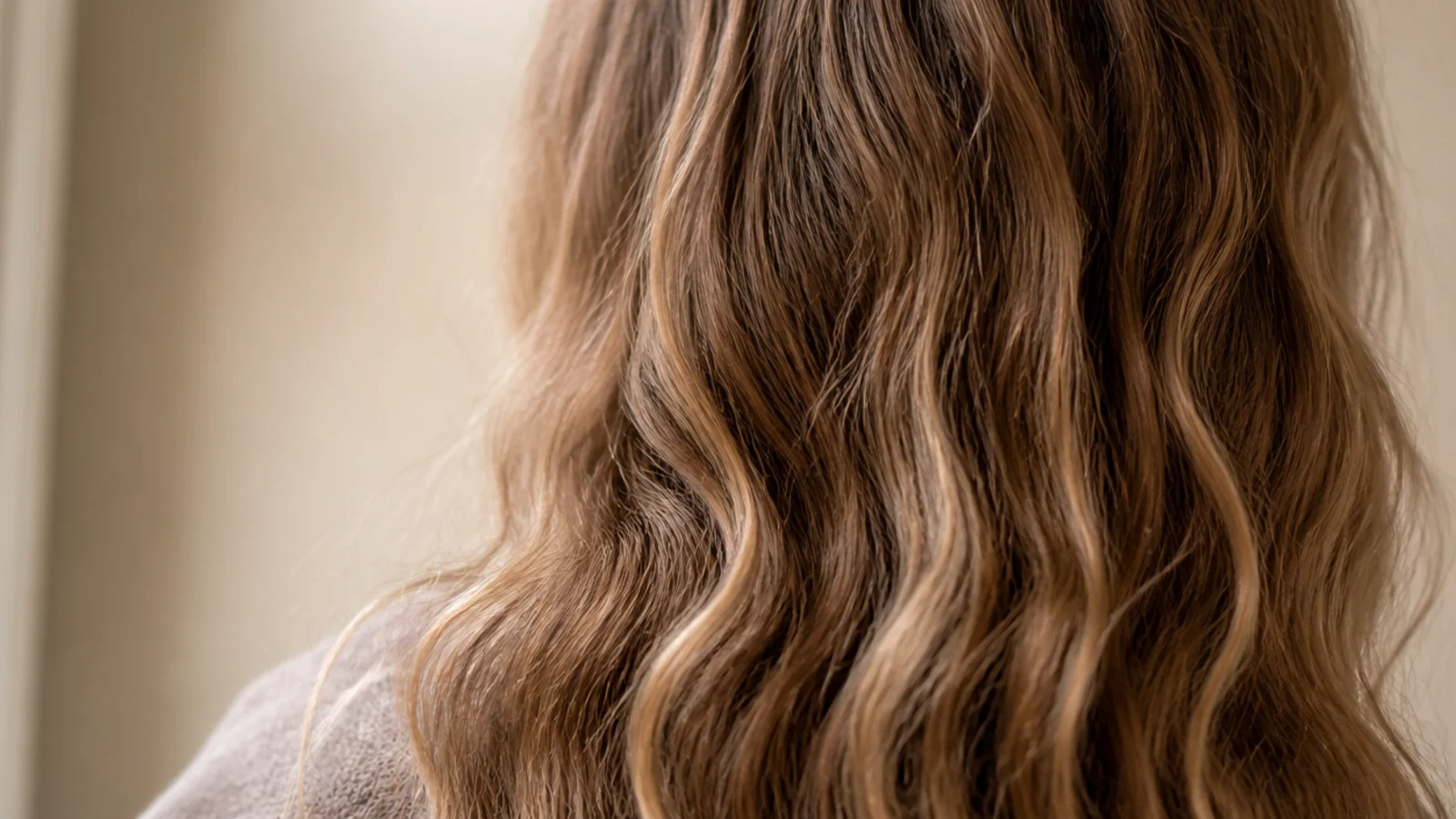
Two loose braids slept in on 80 percent dry hair give soft S-waves by morning and, more usefully, stop the friction that creates overnight frizz in the first place. Damp-not-wet is the key ratio: soaking hair will still be wet at 7am and will fluff as it finishes drying. Unravel gently and separate with oiled fingertips, never a brush. Takes 4 minutes at night, 2 in the morning. Needs 10 inches. Holds all day. Braid technique carries over from mermaid braids for curls.
Who it suits: Anyone avoiding heat, and straight-ish hair that frizzes without holding a wave.
Tip: Sleep on a satin pillowcase as well; the braid protects the length, not the crown.
19. High Messy Top Knot for Day-Three Frizzy Hair
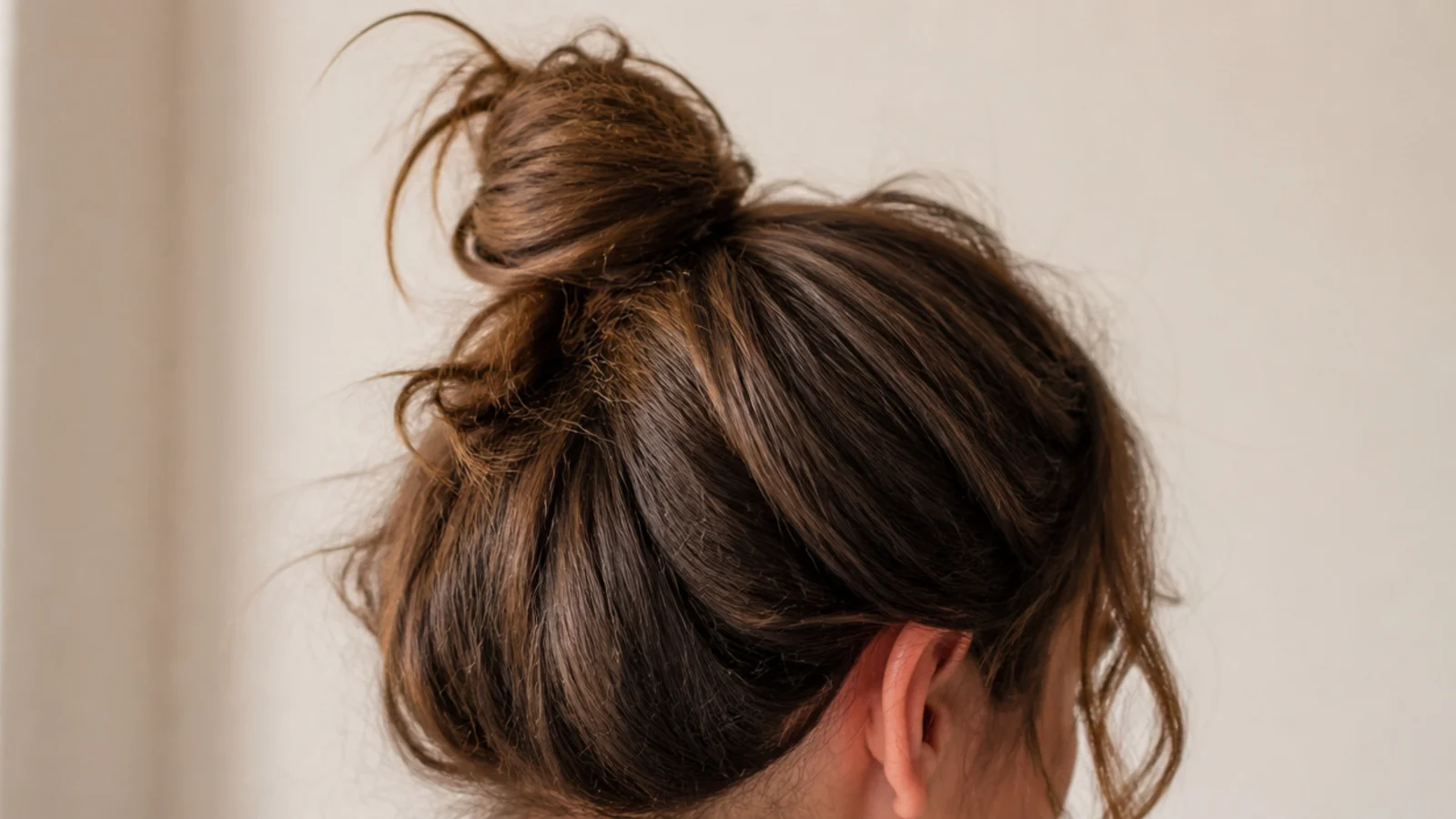
By day three the roots have enough natural grip to hold a knot with a single elastic, and the frizz that has developed actually helps the knot stay put. Flip your head forward, gather at the very top, twist and coil into a knot, then secure and shake out two tendrils at the ears. Takes 2 minutes. Needs 9 inches. Holds 7 hours. Keep it genuinely high, above the crown, because a top knot placed mid-head sits directly on the puffiest area and emphasizes it.
Who it suits: Day-three hair, gym mornings and anyone stretching a wash.
Tip: Do not add dry shampoo before this style; powder on frizzy hair is what makes it feel like straw.
20. Diffused Half-Updo That Shows the Texture
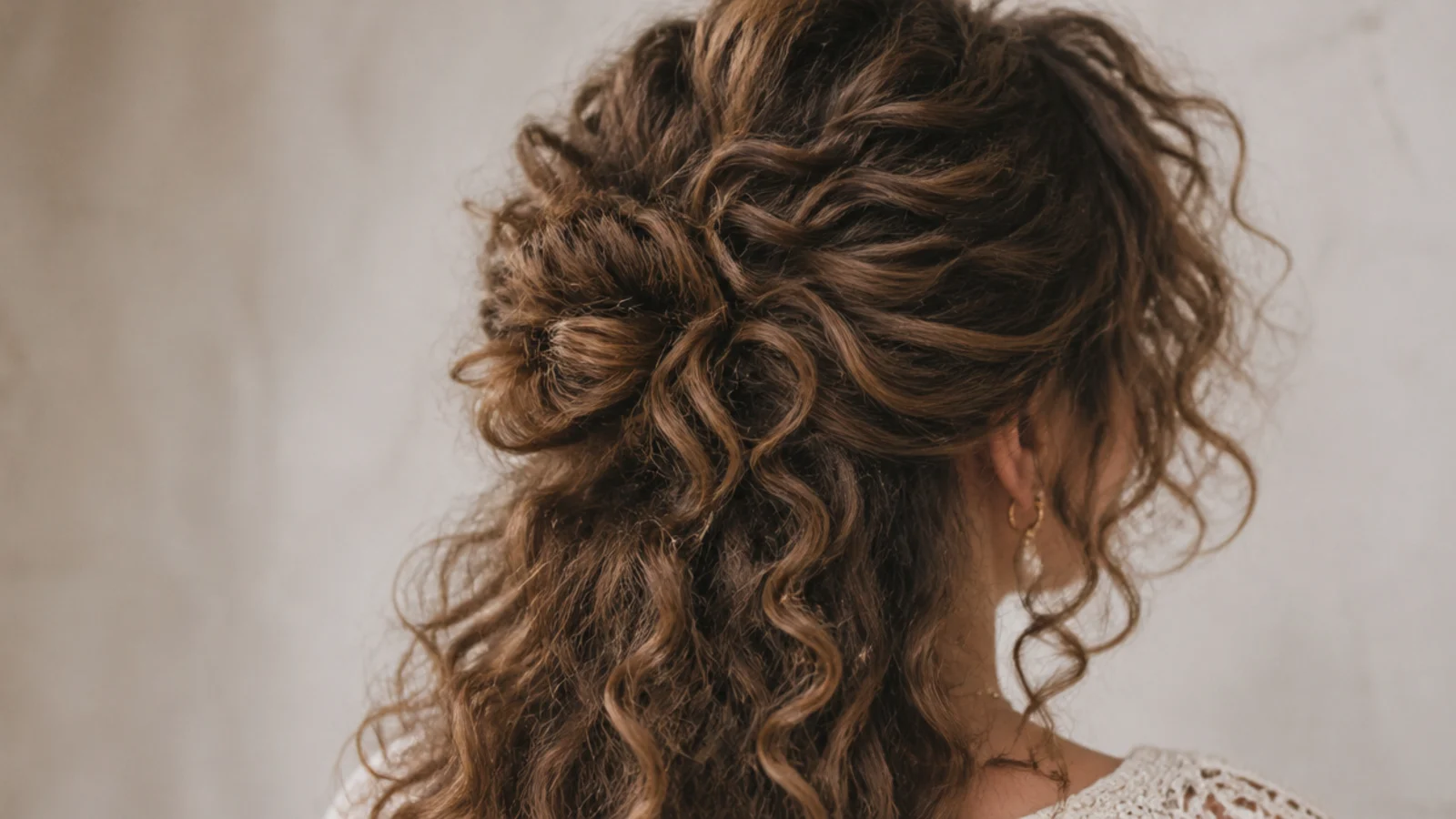
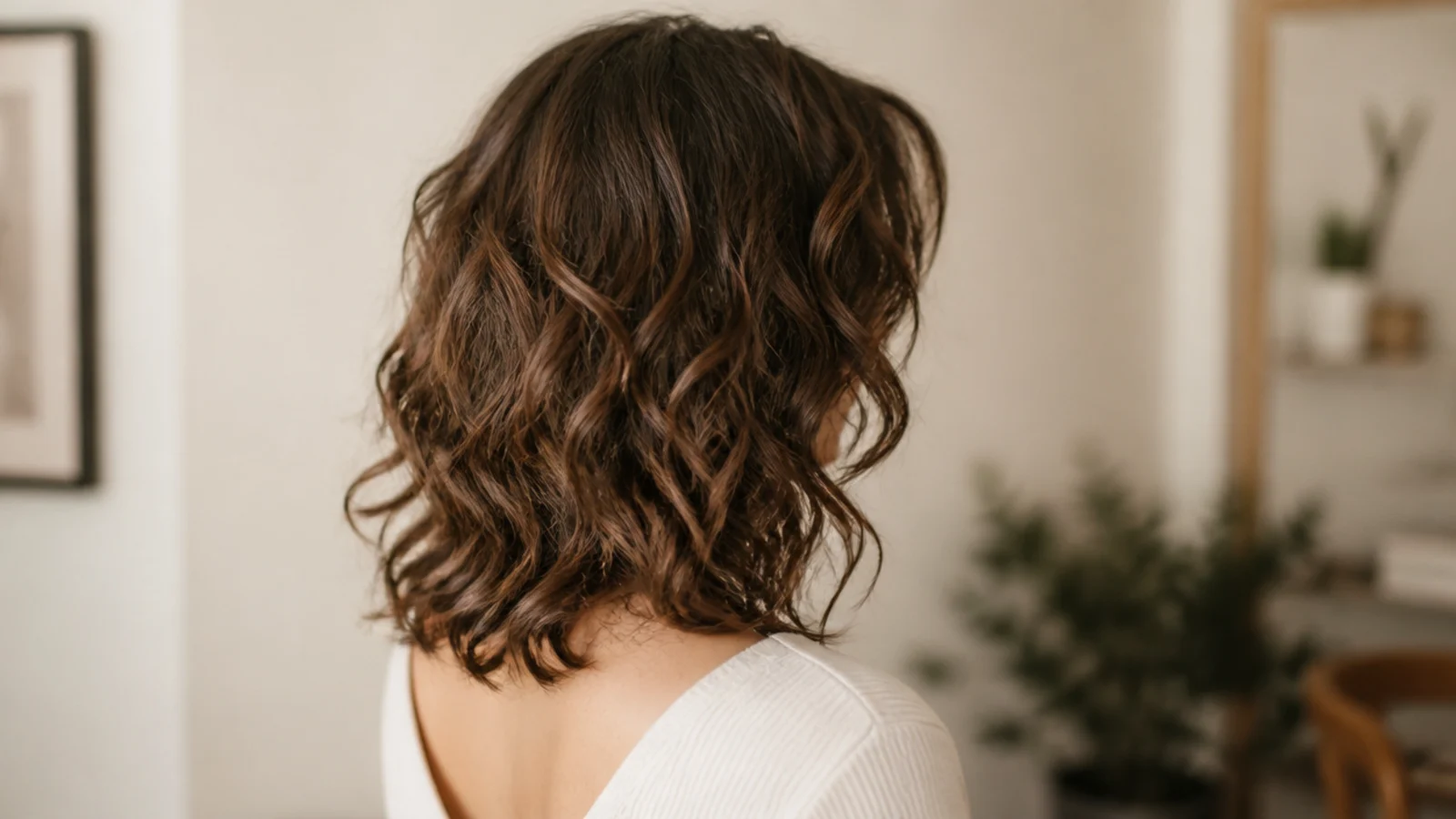
Diffuse on low speed and medium heat with the bowl cupped against the hair rather than moved around, hovering for 30 seconds per section until roughly 80 percent dry. Then take the top section back and secure it with a small claw. Moving the diffuser is what causes crown frizz, not the dryer itself. Takes 15 minutes. Needs 7 inches. Holds 2 days. The half-updo is the best way to show curl definition at the back while keeping the frizziest crown lifted and controlled.
Who it suits: Curly and coily frizzy hair, and anyone who cannot wait 3 hours to air dry.
Tip: Stop diffusing at 80 percent and let the last 20 percent air dry; over-drying reopens the cuticle.
Why Frizzy Hair Frizzes: The Moisture Mechanism
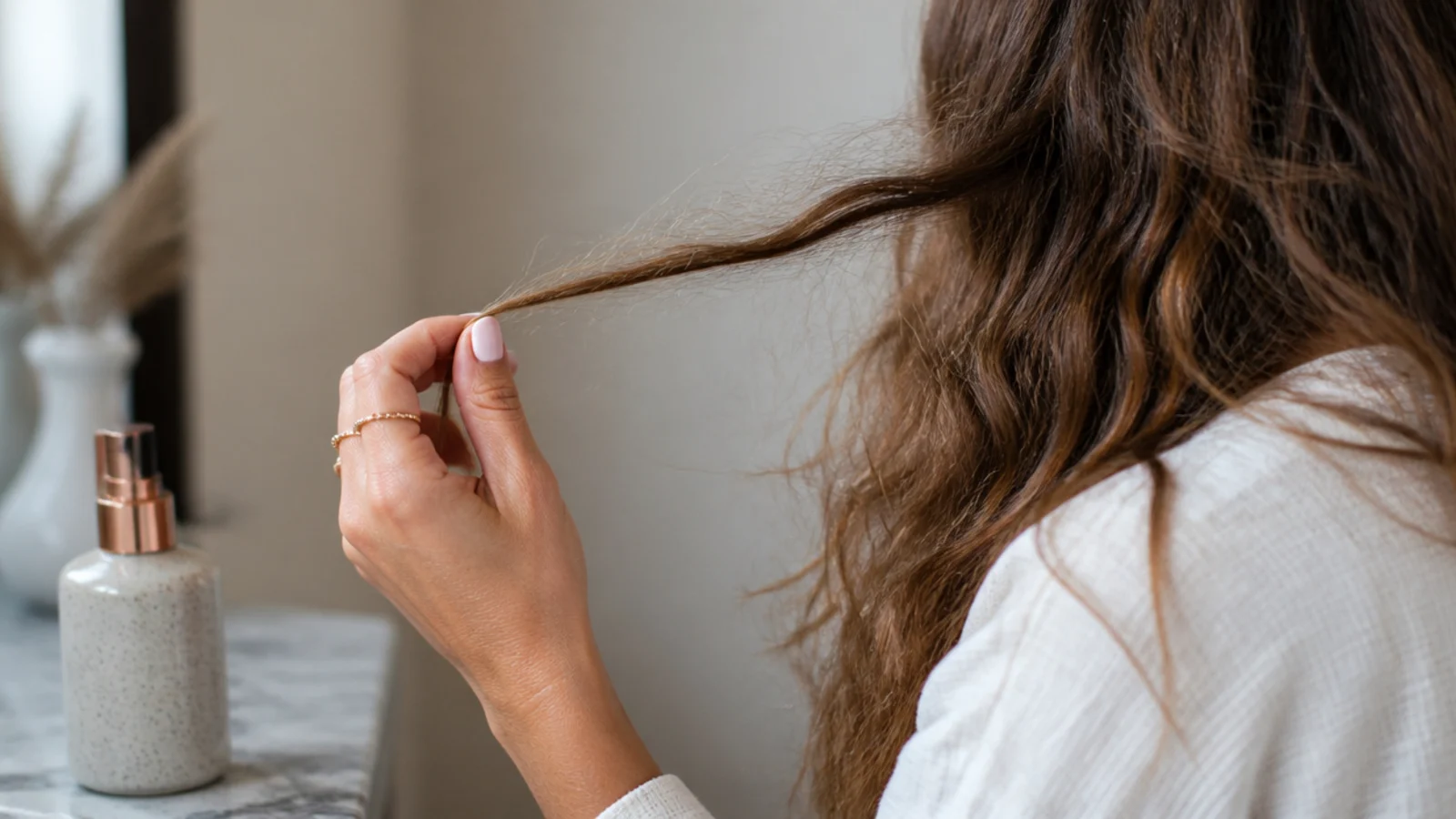
Each hair is wrapped in overlapping cuticle scales, like roof shingles. When hair is hydrated and the scales lie flat, light reflects evenly and strands sit parallel to each other. When hair is dry, those scales lift, and lifted scales do two things at once. They catch on neighboring strands so the hair cannot lie in one direction, and they expose the inner cortex, which is thirsty and pulls water vapor straight out of the air. The strand swells unevenly along its length and bends away from the rest. That is frizz. It follows that frizz is a hydration problem wearing a humidity costume, which is why anti-frizz sprays used on parched hair stop working within the hour. The durable fix is two-part: hydrate so the cortex is not desperate for atmospheric water, then seal so the scales stay closed. A style can only ever be the third step. The care sequence lives in frizzy hair.
Which Frizz Do You Have? A 30-Second Diagnosis
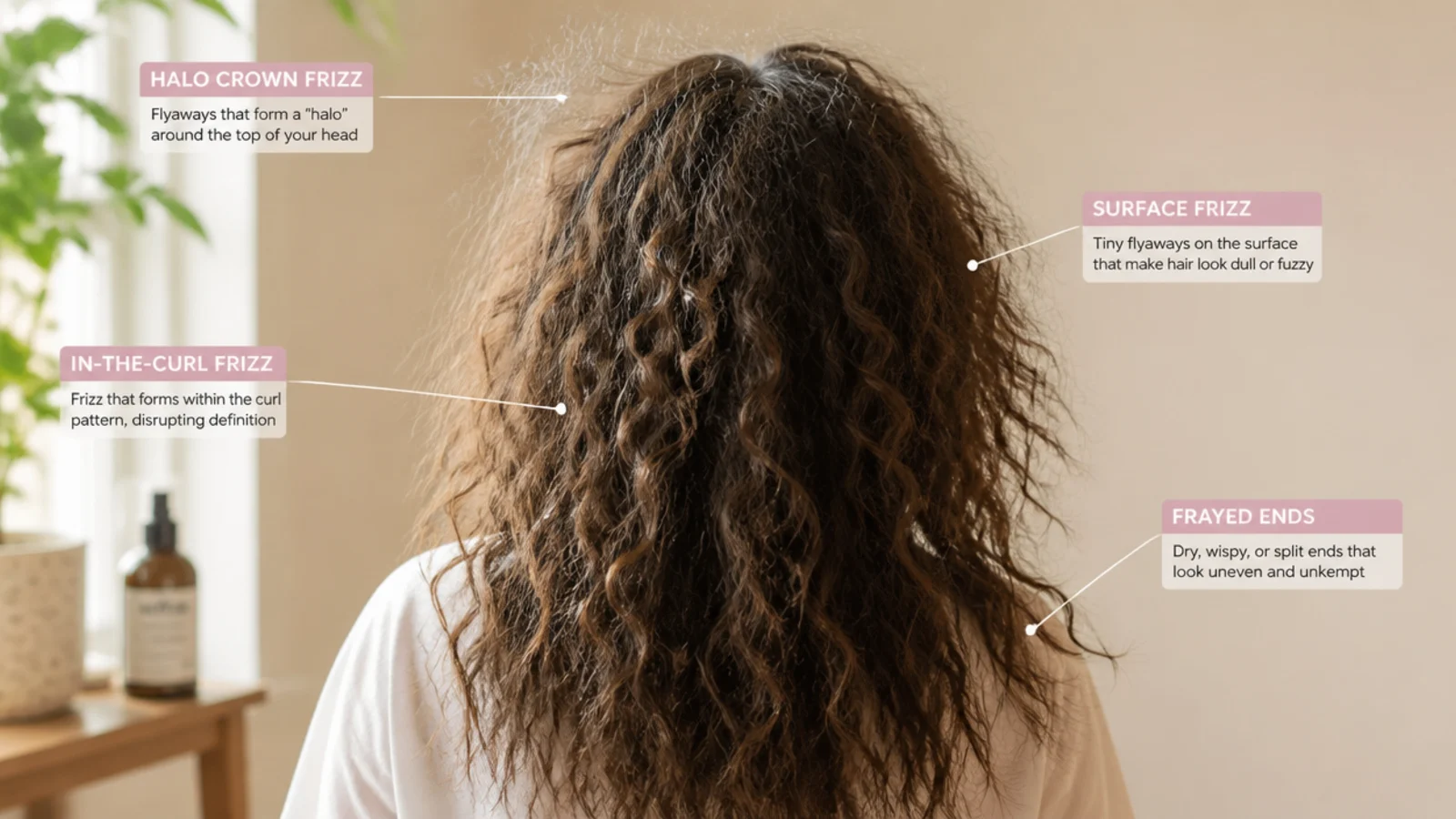
Most advice fails because it treats frizz as one condition. Stand under a lamp and look at where the fuzz actually is. Halo frizz sits in a fine cloud above the crown and is usually short new growth or breakage, so it responds to a clip, a headband braid or a scarf rather than to more product. Surface frizz runs along the top layer of otherwise smooth hair and responds to a sealing serum and a microfiber towel. In-the-curl frizz makes curls look undefined and fluffy rather than fuzzy on top, and it needs gel over cream on soaking wet hair. Ends-only frizz means the ends are frayed and no product will fix it; that is a scissors problem, every 8 to 12 weeks. Humidity swelling affects the whole head at once and only on damp days, and containment styles are the answer there. Match the style to the location and everything on this list gets easier. Type-specific looks sit in frizzy hair hairstyles.
The Wash-Day Routine That Makes Every Style Here Work
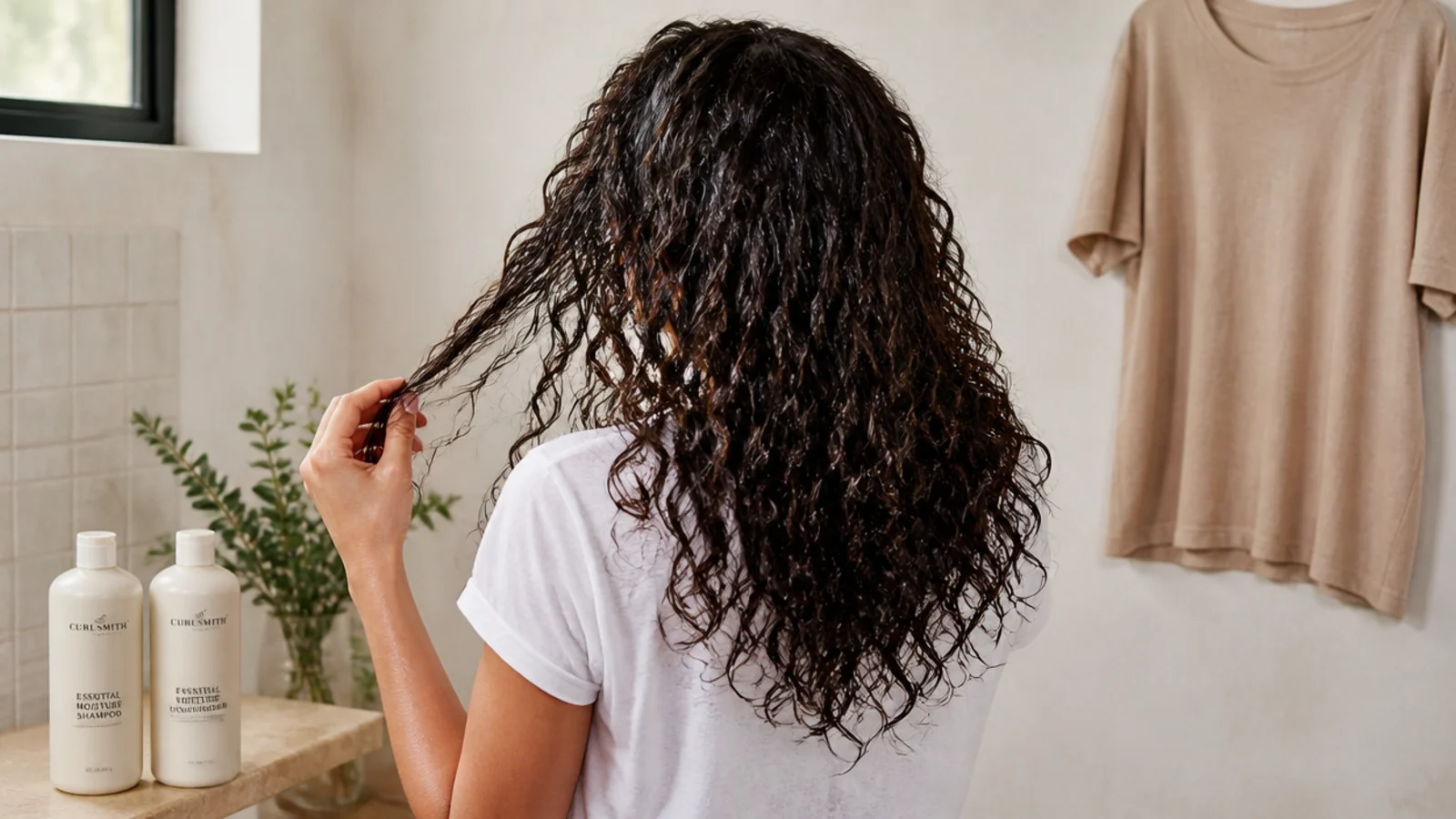
Wash 2 to 3 times a week in lukewarm water, not hot, and put the shampoo on the scalp only, letting the runoff clean the lengths. Condition mid-lengths to ends, then detangle in the shower with a wide-tooth comb while the conditioner is still in, because that slip is the only time a comb is safe on frizzy hair. Rinse cool at the end to encourage the cuticle to close. Then the step almost everyone gets wrong: apply your stylers to soaking wet hair, not towel-dried damp hair. The water is what carries product evenly down every strand, and on damp hair the same amount of cream lands in patches. Squeeze out excess with a microfiber towel or a cotton t-shirt, never terry, whose looped pile literally hooks the lifted cuticle and lifts it further. Add a deep treatment weekly, covered in hair mask for frizzy hair.
Leave-In, Cream, Gel: What Each Product Actually Does
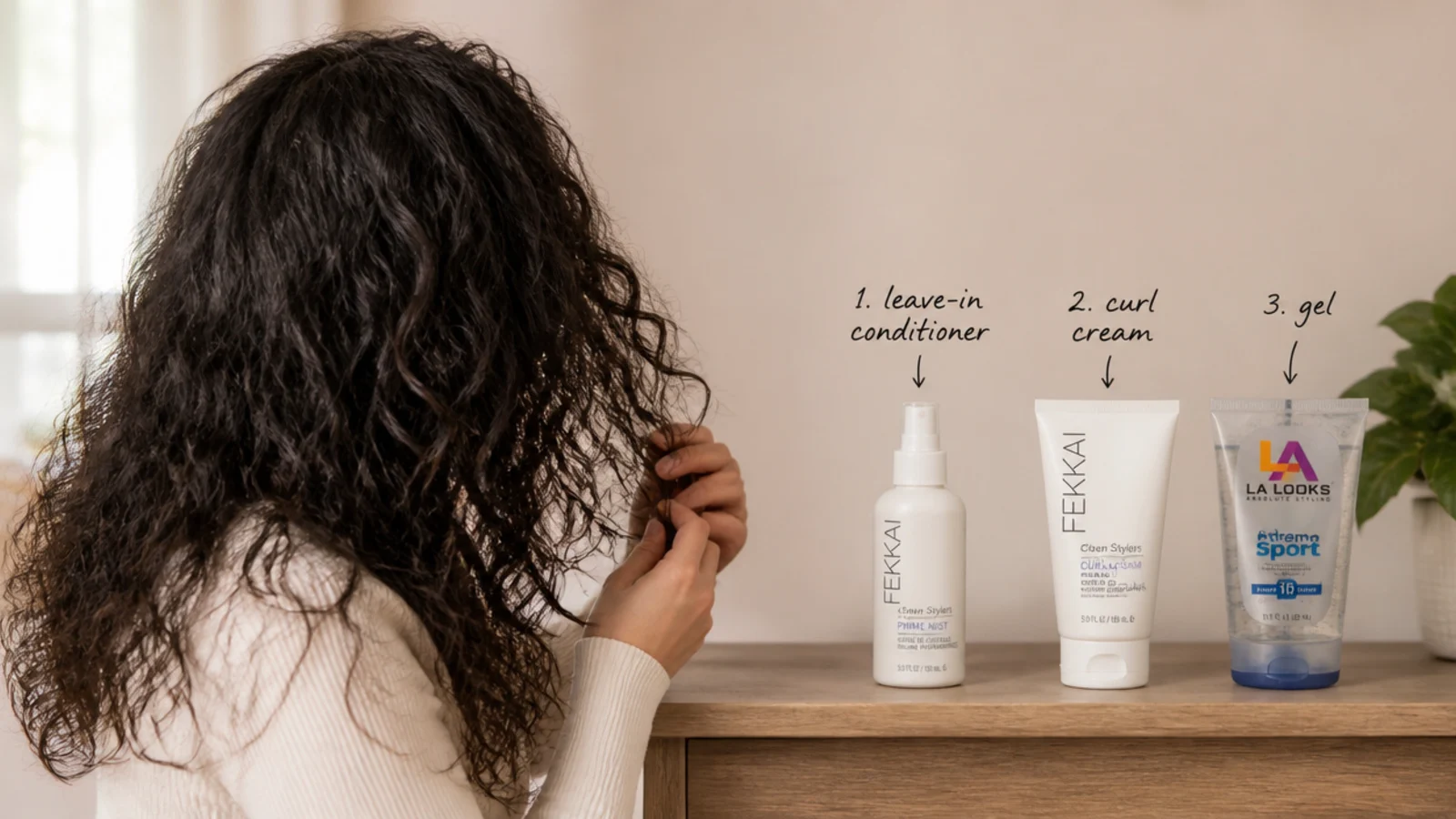
Three product types, three jobs, one correct order. Leave-in conditioner hydrates, which is the step that addresses the actual cause, and it goes on first at roughly a quarter-sized amount for shoulder length and a half-dollar for waist length. Curl cream defines and adds weight, grouping strands into waves or curls instead of leaving them individual, and it goes second. Gel seals, forming a thin cast around the whole style that holds until you deliberately break it, and it goes last. Layering out of order is why products pill: gel under cream traps the cream on the outside where it rubs into little balls. Wait 30 seconds between layers so each one settles. If your hair is fine, halve the cream or skip it and go leave-in straight to gel. If it is coarse and high-porosity, add an oil after the gel to lock the whole thing down. Wave-specific amounts are in frizzy wavy hair.
Cuts and Layers That Hide Frizz vs Cuts That Cause It
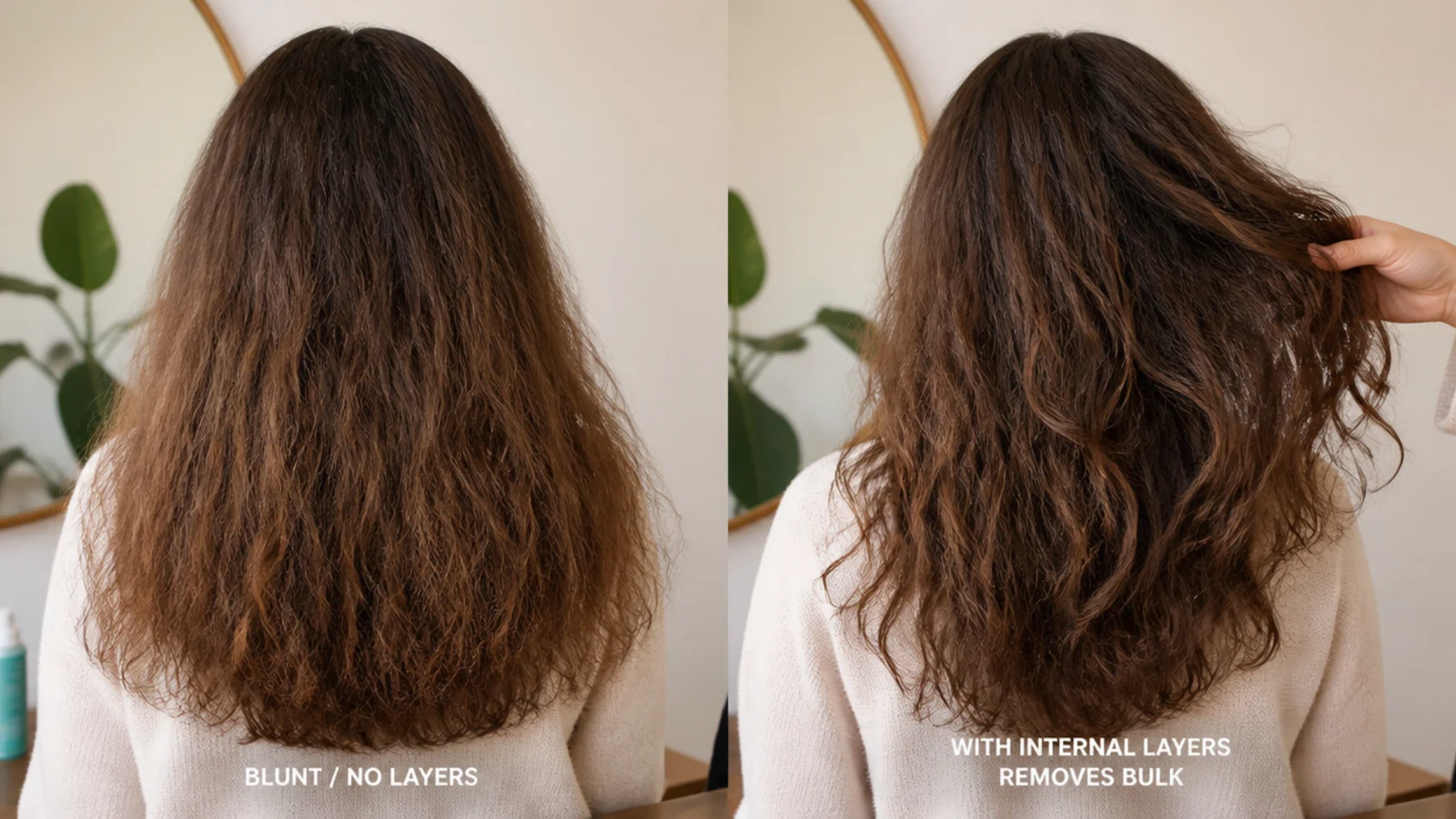
A blunt, heavy perimeter looks like a good idea on frizzy hair because weight pulls the length down, but the ends themselves end up thick and dense, and every frayed strand along that hard line shows. Internal layers do the opposite: the stylist removes bulk from inside the shape while leaving the outline intact, so volume redistributes down the head instead of piling into a triangle. Ask for internal or invisible layers, point-cut ends, and explicitly say no thinning shears, which chop strands at random mid-lengths and create thousands of short pieces that become new halo frizz within six weeks. Face-framing pieces starting at the jaw give the eye somewhere soft to land. Curtain bangs work on frizzy hair only if they are cut long enough to tuck. Trim every 8 to 12 weeks for ends-only frizz. Cut ideas are in mid-length haircut layers and curly mid-length haircut.
Humidity, Sleep and the Daily Habits That Decide Your Frizz

Check the dew point rather than the humidity percentage, because dew point tells you how much water is actually in the air. Below about 45 degrees Fahrenheit the air is dry and your hair needs more cream and less gel or it will feel brittle. Between 45 and 60 is the comfortable middle where most routines behave. Above 60 the air is loaded, so cut the humectants, add a firmer gel and pick a containment style from the table above. At night, friction against cotton is doing more damage than the weather: sleep on silk or satin, or in a loose braid or a silk-lined bonnet, and you will wake with a fraction of the frizz. During the day, keep your hands out of your hair, since every touch on damp or humid hair separates strands that were grouped. Refresh with a water mist and a drop of oil rather than more cream. Overnight setting ideas are in half-up mermaid braids.
Frequently Asked Questions
Why is my hair so frizzy?
Because the cuticle scales on each strand are lifted rather than lying flat, usually from dryness, heat, hard water, over-washing or mechanical friction from brushing and towels. Lifted cuticles pull moisture out of humid air, so the strands swell unevenly and separate. Humidity is the trigger, but dryness is the underlying cause, which is why hydrating works better than smoothing.
Does frizzy hair mean damaged hair?
Not necessarily. Healthy hair frizzes too, especially curly and coily textures where the cuticle is naturally raised along the bends of each curl. Frizz becomes a damage signal when it appears mainly at the ends, when strands snap easily, or when it developed suddenly after bleaching or heat styling. Diagnose by location: ends-only fraying is damage, all-over swelling on a humid day is not.
Can straight hair be frizzy?
Yes. Straight hair frizzes as surface frizz, a fine layer of strands standing up along the top of otherwise smooth hair, plus a halo at the crown from short new growth and breakage. The mechanism is identical, and so is the fix: hydrate, seal with a light serum, avoid terry towels, and sleep on silk. Straight hair usually needs lighter products than wavy hair to avoid looking greasy.
Can low porosity hair be frizzy?
Yes, and it frizzes for the opposite reason to most hair. Low porosity cuticles lie tightly closed, so water and conditioner sit on the surface instead of absorbing, leaving the inside of the strand dry even after a mask. Use lightweight liquid products, apply to soaking wet hair, and add gentle heat under a shower cap for 15 minutes so the mask can actually get in.
Should I brush frizzy hair before or after styling?
Before, and only when it is wet and coated in conditioner. Brushing or combing dry frizzy hair separates every grouped strand and shatters the curl or wave pattern, which is exactly what makes hair look fluffy rather than defined. Use a wide-tooth comb or your fingers in the shower, then never touch it with a brush again until the next wash.
Can I air dry frizzy hair without getting frizz?
Yes, if you do not touch it. Apply leave-in, cream and gel to soaking wet hair, scrunch upward, then leave it completely alone for the 2 to 4 hours it takes to dry. Handling damp hair is the single biggest cause of air-dry frizz. Once it is fully dry and crunchy, scrunch the cast out with a drop of oil on your palms and the definition stays while the crunch goes.
What hairstyle is best for frizzy hair in humidity?
A containment style where every strand is enclosed and pinned. Double Dutch braids, a twisted halo crown braid and a gelled low bun all hold above 70 percent humidity for 8 to 12 hours. Loose styles, half-updos and air-dried waves will soften as the dew point climbs past 60 degrees Fahrenheit. Braid on damp hair rather than dry so the braid sets the cuticle as it dries.
How often should I wash frizzy hair?
Two to three times a week for most people. Washing daily strips the natural oils that keep the cuticle sealed, and washing less than twice weekly lets product and sebum build up so the scalp gets itchy and the lengths go limp. Use a sulfate-free shampoo on the scalp only, and stretch the days between with a water mist refresh rather than dry shampoo.
Do tight hairstyles make frizz worse over time?
Yes. Slicked ponytails, tight buns and hard-pulled braids create constant tension along the hairline and crown, and over months that produces breakage which then shows up as new halo frizz. Keep sleek styles to twice a week, always leave enough slack to fit a finger under the braid or elastic, and use fabric scrunchies rather than metal-crimped elastics.
Which frizzy hair look are you saving?
If you take one thing from these 20 hairstyles for frizzy hair, make it the order of operations. Soak the hair, layer leave-in then cream then gel, dry without terry cloth, and only then decide whether today is a containment day or a texture day. Braids, twists and low buns hide swelling; half-updos, plopped curls and air-dried waves put it on display, and both are correct answers. Sleep on silk or in a loose braid so tomorrow starts from a better place than today did. When you want the deeper care routine, read frizzy hair and the hair mask for frizzy hair guide, or browse the whole frizzy hair board for more looks to save.