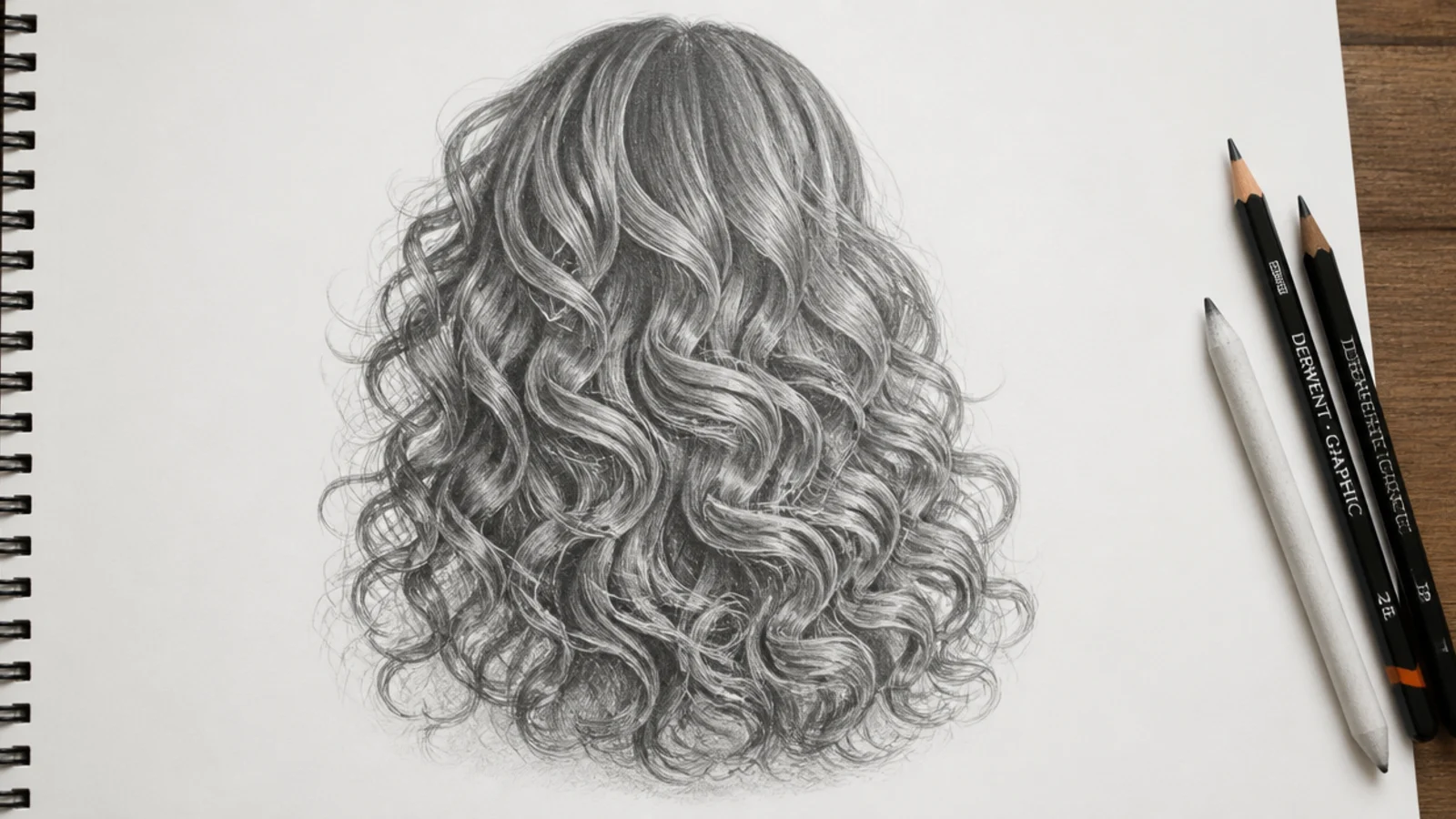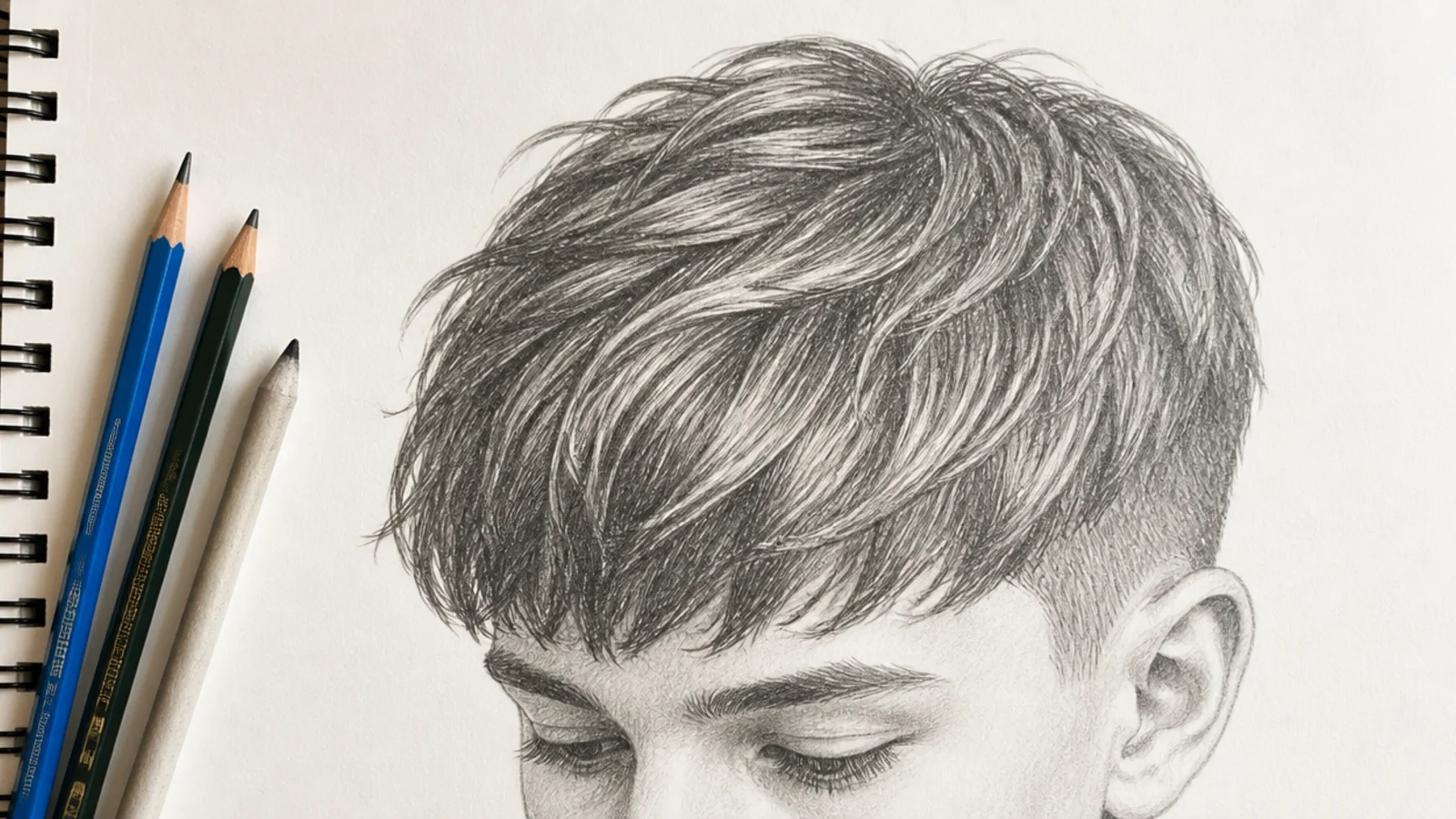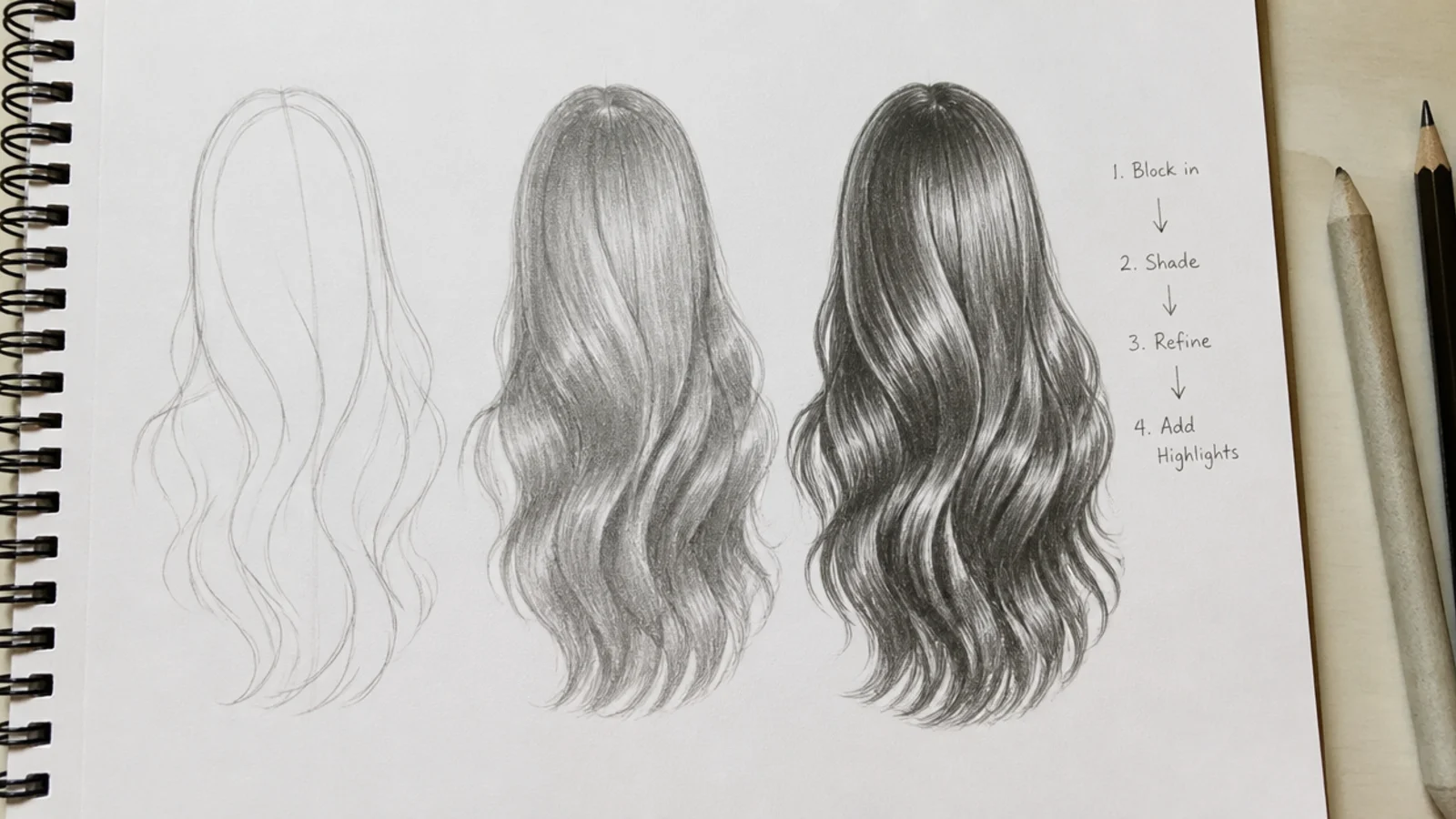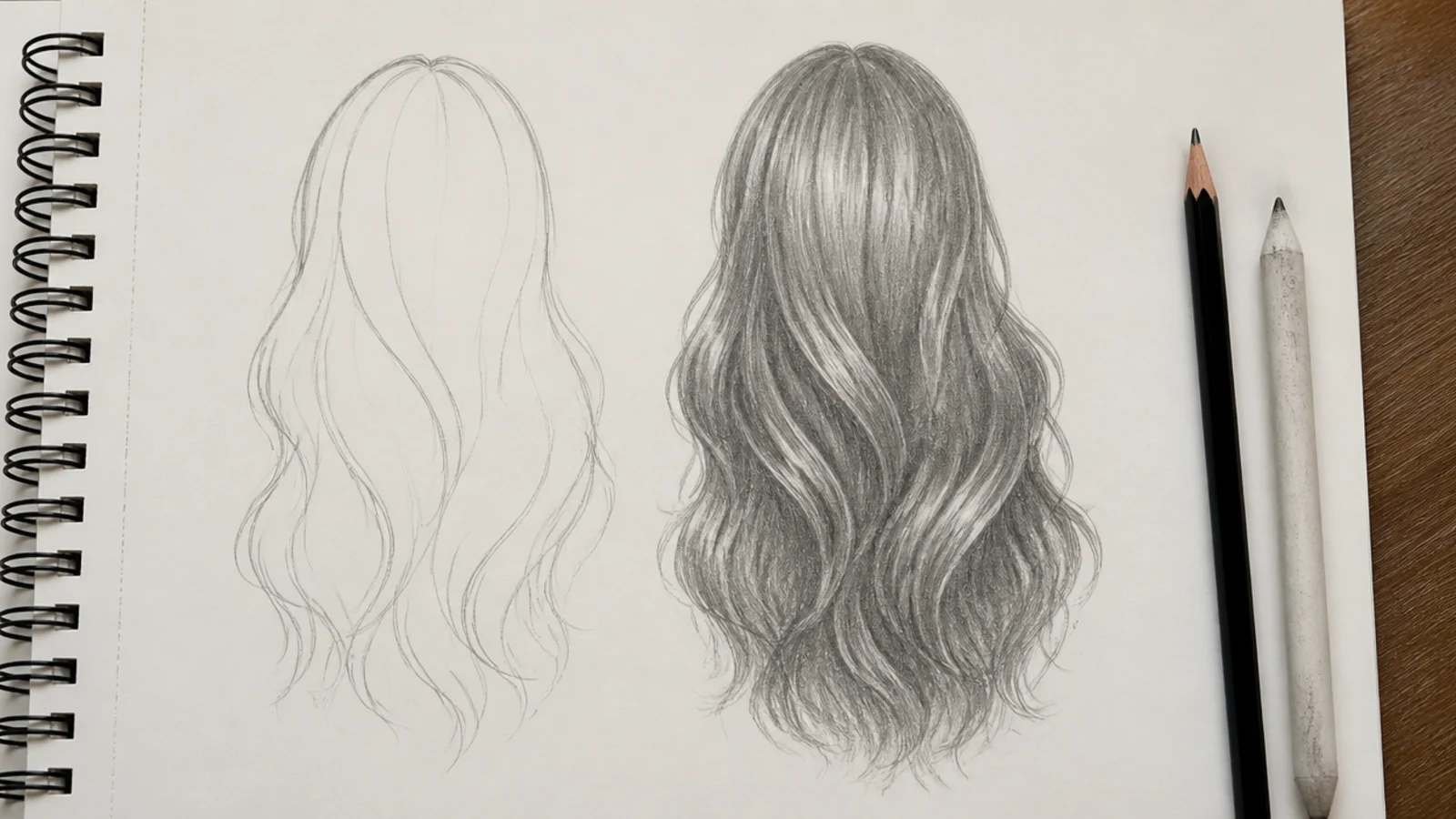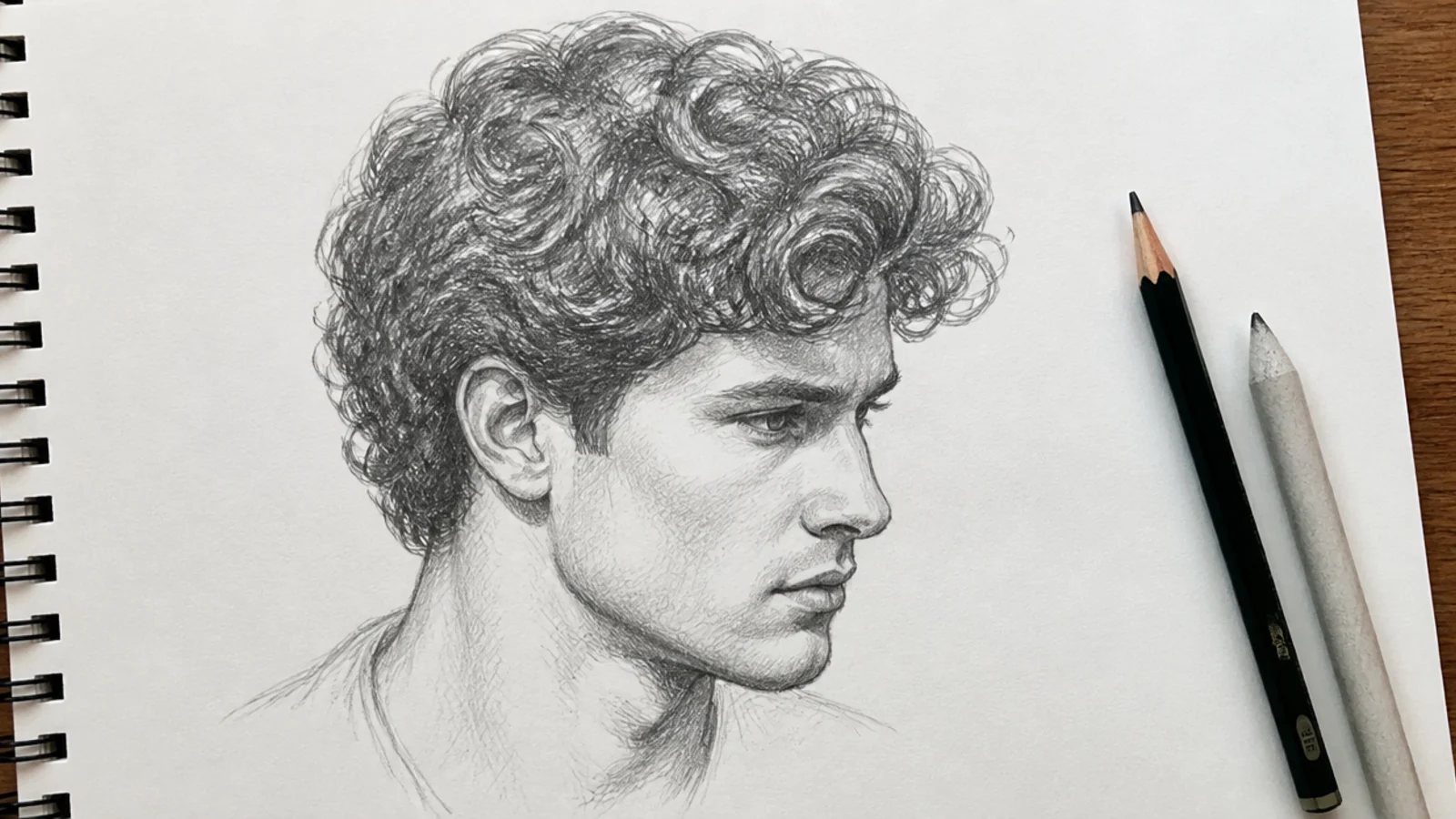
Quick Comparison
| Male Curly Hair Sketch | Female Curly Hair Sketch | |
|---|---|---|
| Hairline shape | Higher and angular, often an M with temple recessions | Lower and rounded, a smooth continuous curve |
| Silhouette width | Hugs the skull closely except in afros and locs | Swells well beyond the skull on most curl types |
| Typical length drawn | 1 to 5 inches, with locs and shoulder curls as exceptions | 4 to 18 inches, so the flow travels farther |
| Edge treatment | Often crisp and lined up at the forehead and sideburns | Soft, broken and feathered all the way around |
| Neck and nape | Faded or tapered, showing skin | Usually covered by falling hair |
| Value contrast | Higher; short hair shows scalp shadow through it | Softer gradients across a bigger continuous mass |
| Number of curl ribbons | Fewer and shorter, often 10 to 30 visible | Many more, frequently 40 plus at length |
| Most common mistake | Drawing the hairline as a clean arc, which feminizes the face | Outlining coils as closed loops instead of shading ribbons |
| Best pencil for the darks | 6B in small pockets between clumps | 4B broadly, with 6B reserved for the underside |
1. Tight 4C Coils on a High-Top Fade
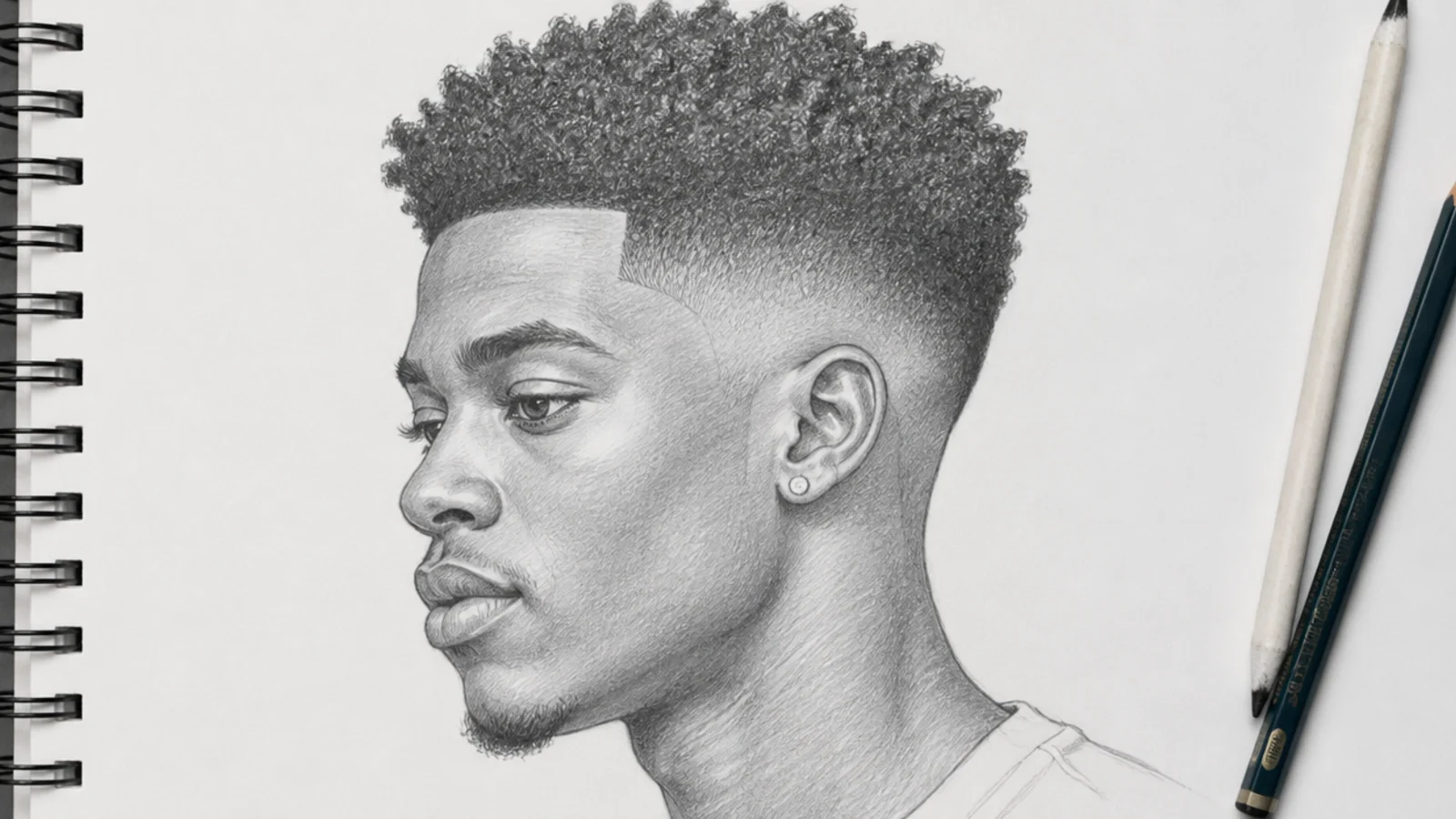
Block a squared-off column about 3 inches tall sitting flat on top of the skull, with the sides shaved to almost nothing. The coils are too small to draw individually, so build the surface from clustered 4B scribble clumps roughly 3mm across, leaving 6B pockets where clumps meet. Keep the top plane lighter than the sides so the block reads three-dimensional. The fade is a graded wash from 2B at the temple down to bare paper at the ear. Pattern spacing by curl type is broken down in curly hair sketch.
Who it suits: Character artists drawing 80s and 90s references or modern Black male leads.
Tip: Draw the flat top edge as a broken bumpy line, never a ruled straight one.
2. Loose 3A Curly Fringe Falling Over the Forehead
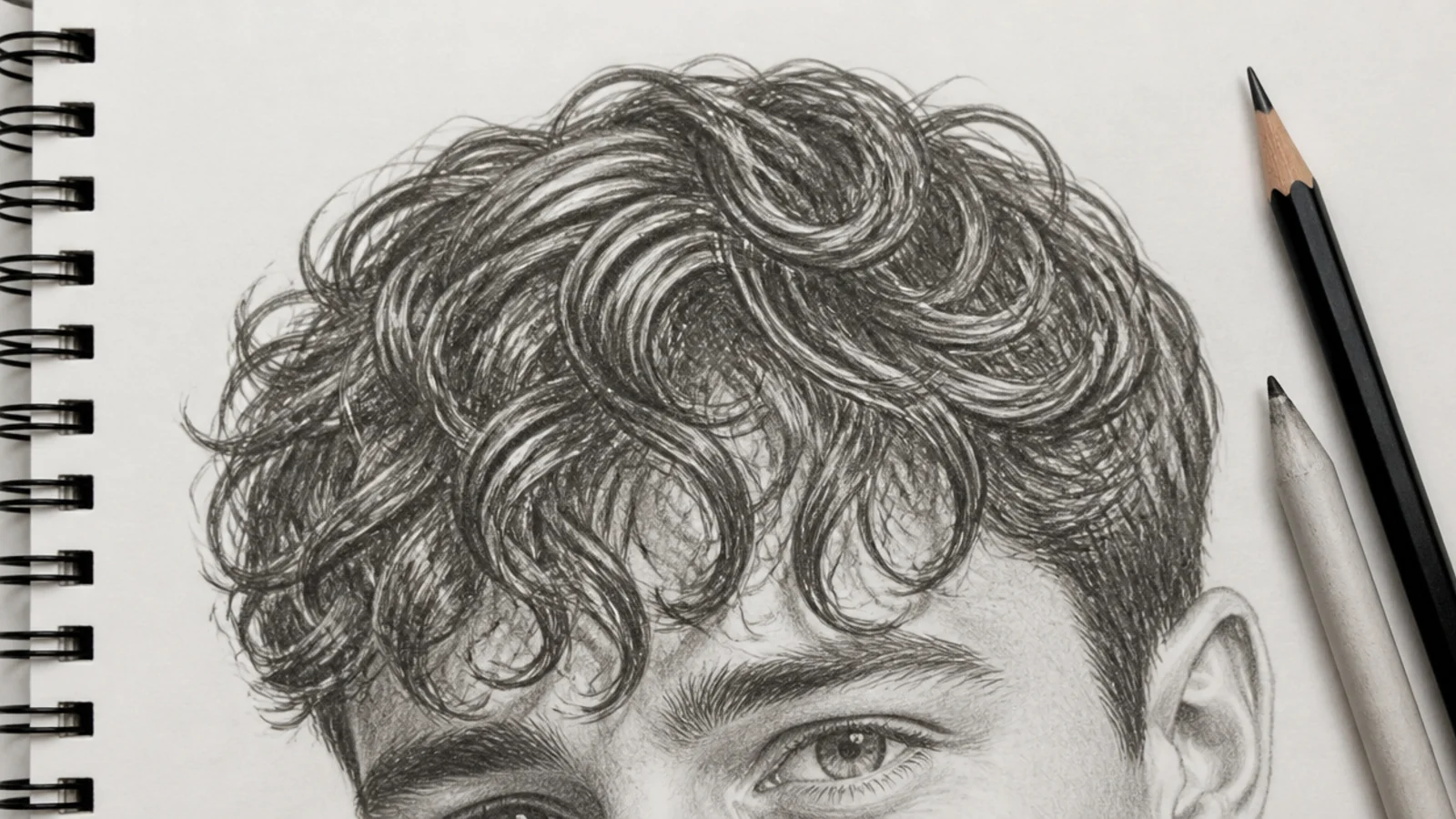
The easiest male curly look to draw and the best first attempt. Five or six loose S ribbons about 2 inches long drop from a part just off center and land halfway down the forehead. Each ribbon needs a light front face and a 4B shadow face where it twists away. Leave real gaps between the ribbons so forehead skin shows through, because solid fringe is what makes hair read as a helmet. More fringe variations sit in boy hair sketch.
Who it suits: Beginners, and soft or romantic-lead male characters.
Tip: End each ribbon with a short flick, not a blunt stop, or it reads like a cut fabric strip.
3. Shoulder-Length 3B Curls in Three-Quarter View
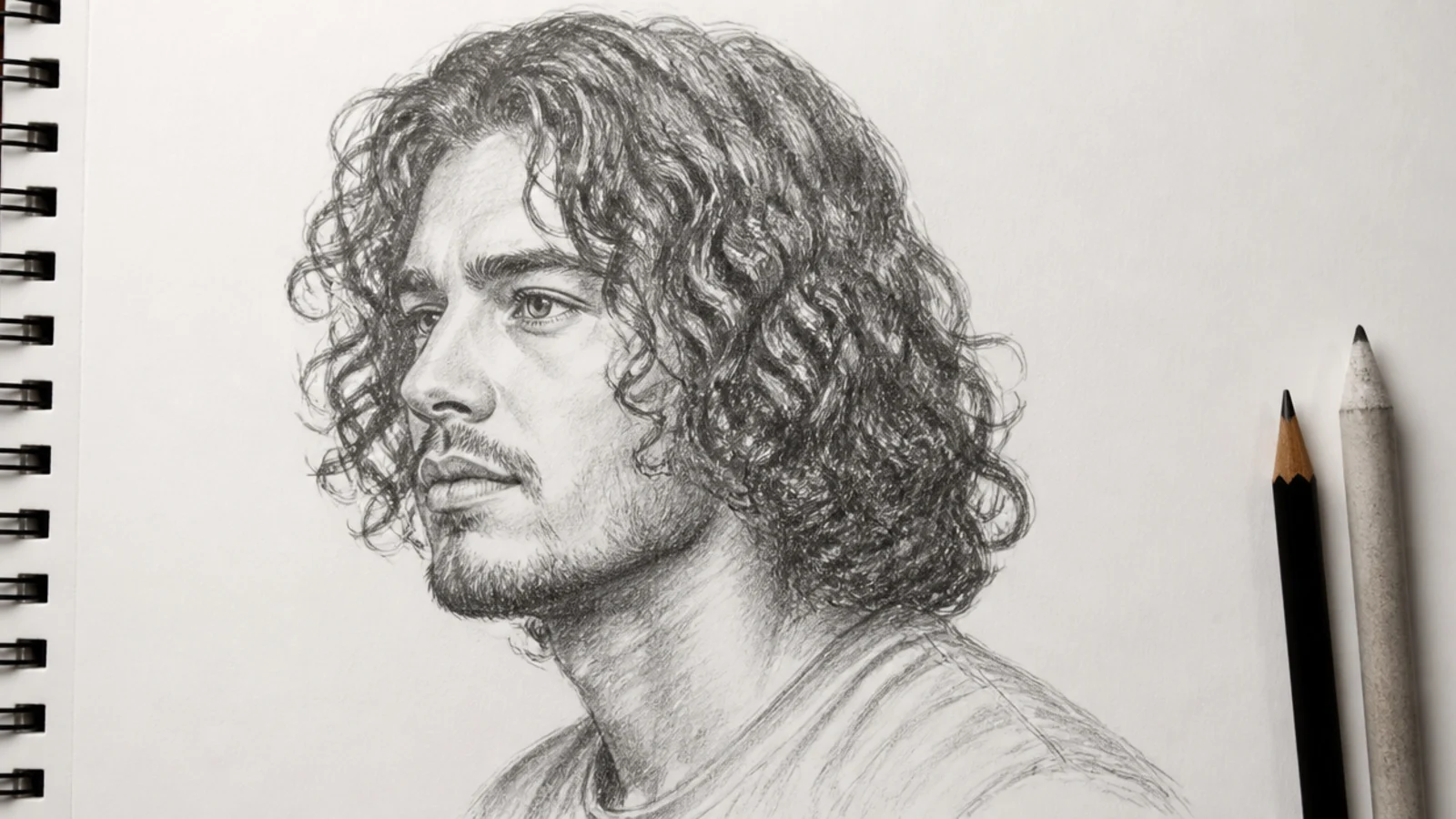
The hardest angle and the most useful to own. In three-quarter view the far side of the head shows a narrow band of hair while the near side shows the full mass, so the silhouette is asymmetric by design. Draw a 2H egg for the skull, then swell the curl mass about half an inch beyond it all the way around. Spiral ribbons roughly 1 inch wide fall to the collarbone, tightening near the face and loosening at the back. Longer flow is covered in long hair sketch.
Who it suits: Portrait practice and character turnaround sheets.
Tip: Keep the far-side hair thinner than feels right; beginners always draw it too wide.
4. Curly Undercut with Hard Shaved Sides
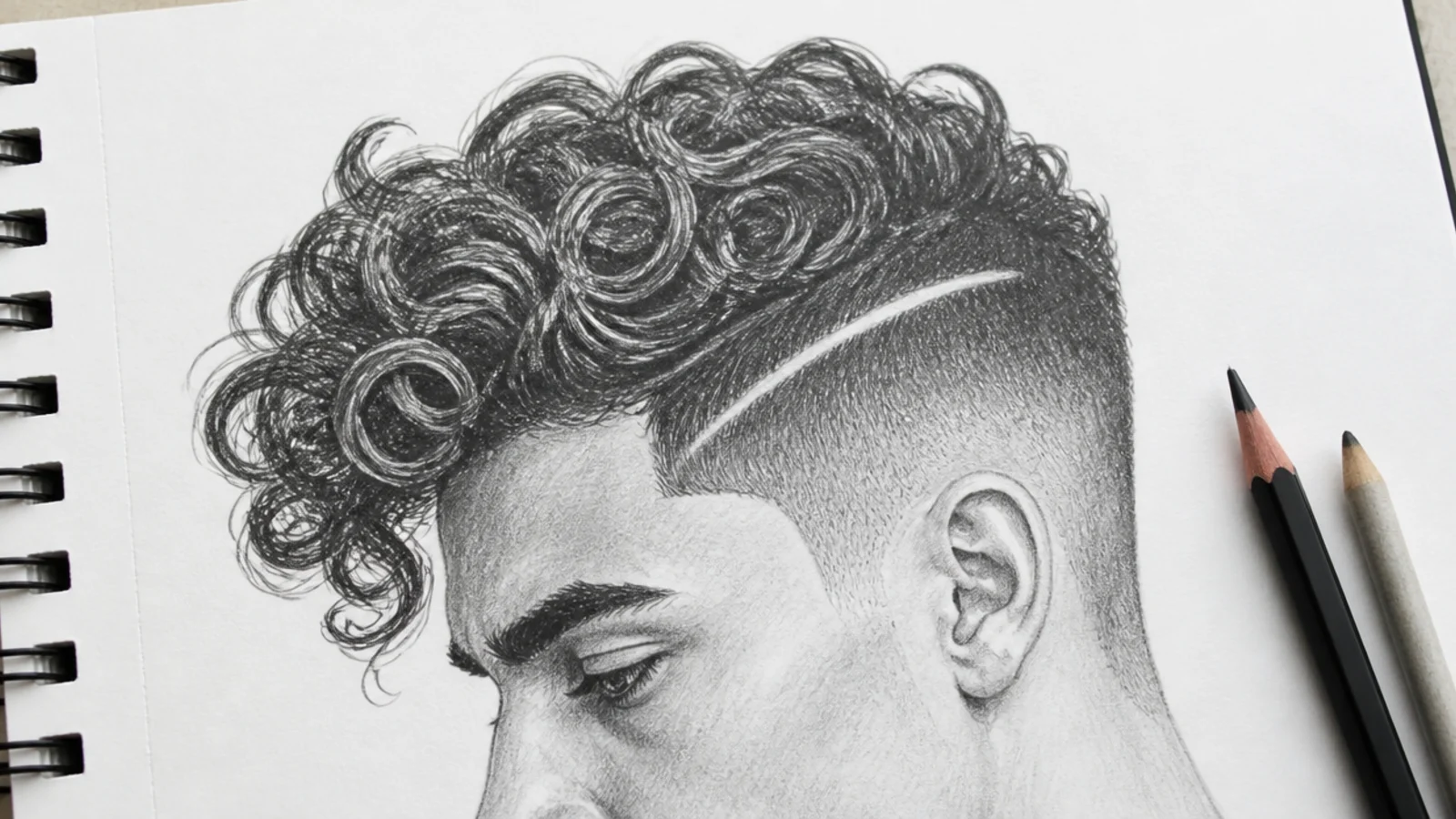
This one lives on contrast. The top section is a loose 3B curl mass about 4 inches long swept back, and the sides drop straight to skin with a hard disconnected line. Render the shaved area as flat 2H tone with a scatter of 2B dots for stubble, then jump immediately to 4B curl clumps above it. The disconnect line should be crisp for about two thirds of its length and then break into stray hairs, otherwise it looks like a drawn wig cap.
Who it suits: Modern, edgy or antagonist character designs.
Tip: Put your darkest 6B right where the curls overhang the shaved side, to sell depth.
5. Round Afro from the Front, 6 Inches Wide
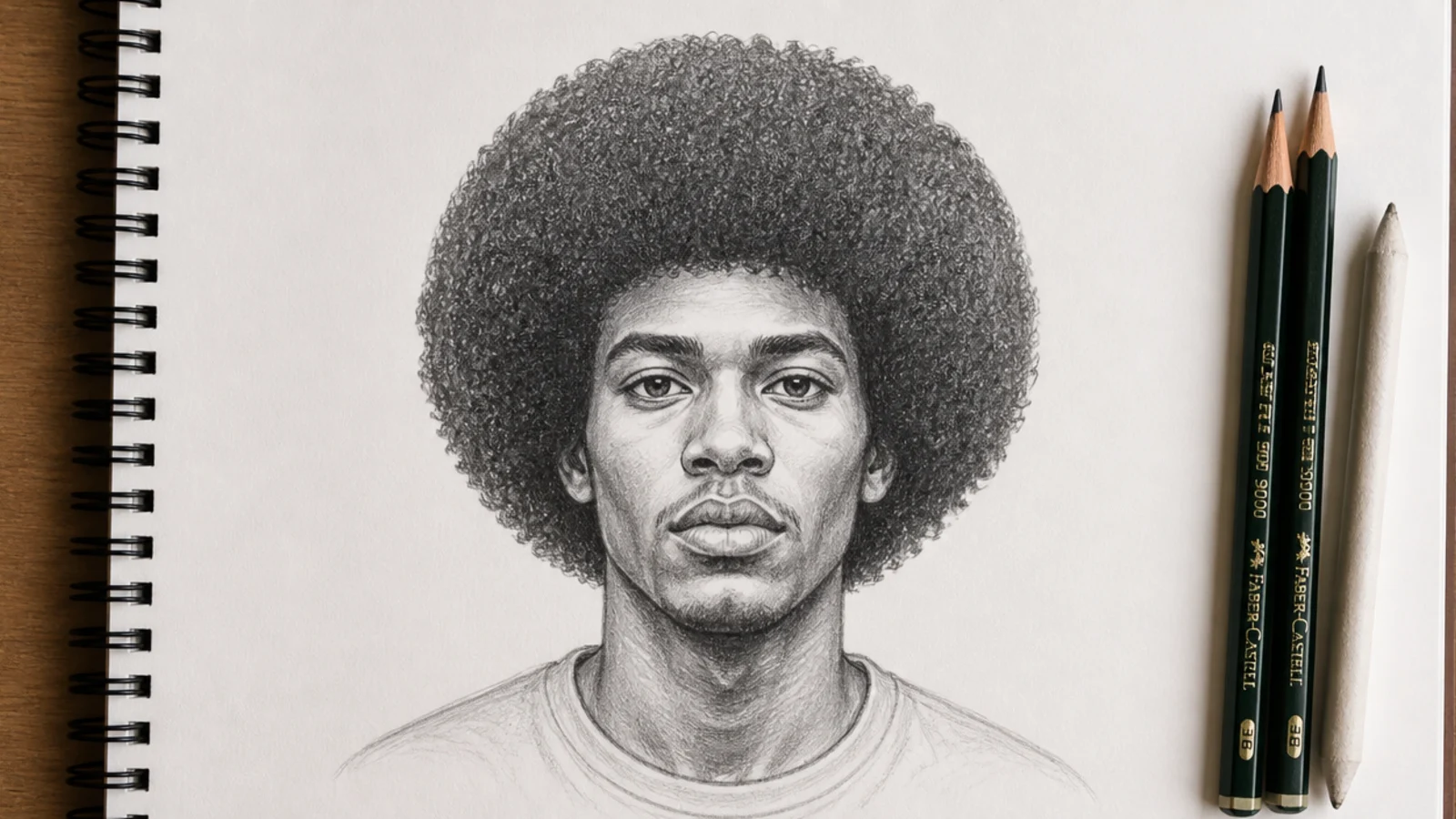
Draw a circle wider than the head, roughly 6 inches across on a life-size face, sitting slightly forward of the ears. The silhouette edge is the whole illusion: rough it with tiny overlapping bumps so it reads fuzzy against the paper, never as a smooth arc. Inside, shade a crescent of 4B along the lower left and lower right, keep a soft 2H halo near the crown for the light band, and drop 6B pockets in the deepest quarter. Individual coils get suggested at the edge only.
Who it suits: Anyone learning textured hair mass, the biggest gap in most tutorials.
Tip: Squint at your sketch; if the afro outline reads as a clean circle, roughen the edge more.
6. Two-Strand Twists Cropped Close to the Scalp
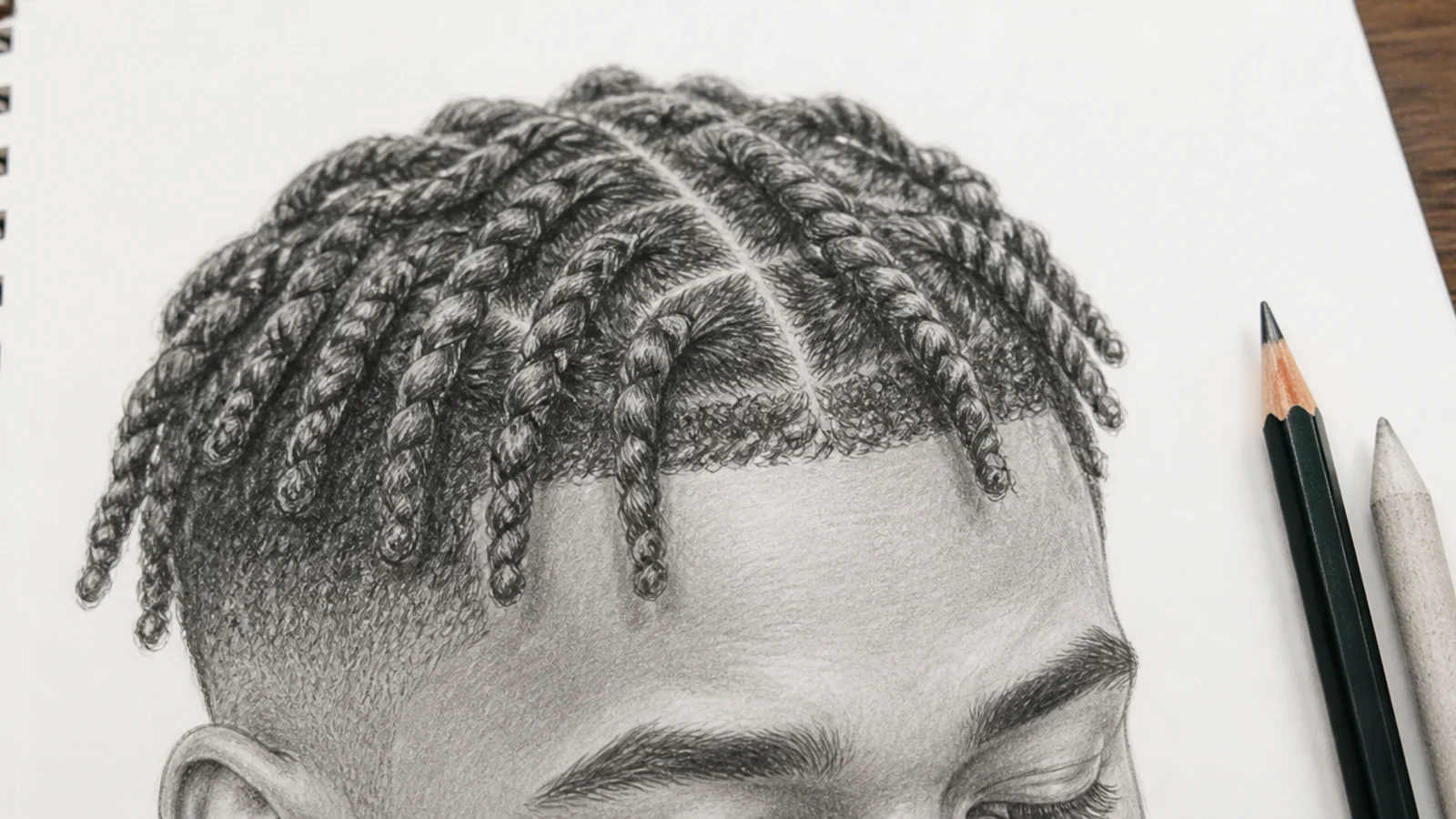
Twists are the only style on this list built from repeating units, so map them before you render. Lay a 2H grid of about 40 dots across the crown, each dot the root of a twist roughly 1.5 inches long. Every twist is two ribbons wrapping each other, so draw a short chain of alternating light and 4B dark lozenges rather than a straight line. Leave visible scalp between them, since the parting grid is exactly what makes twists read as twists and not as spaghetti. Grid-and-section thinking carries over to every style in hair sketch.
Who it suits: Character artists who keep defaulting to generic curls.
Tip: Vary the twist angle by a few degrees each; identical parallel twists look printed on.
7. Shoulder-Length Locs Falling Behind the Ear
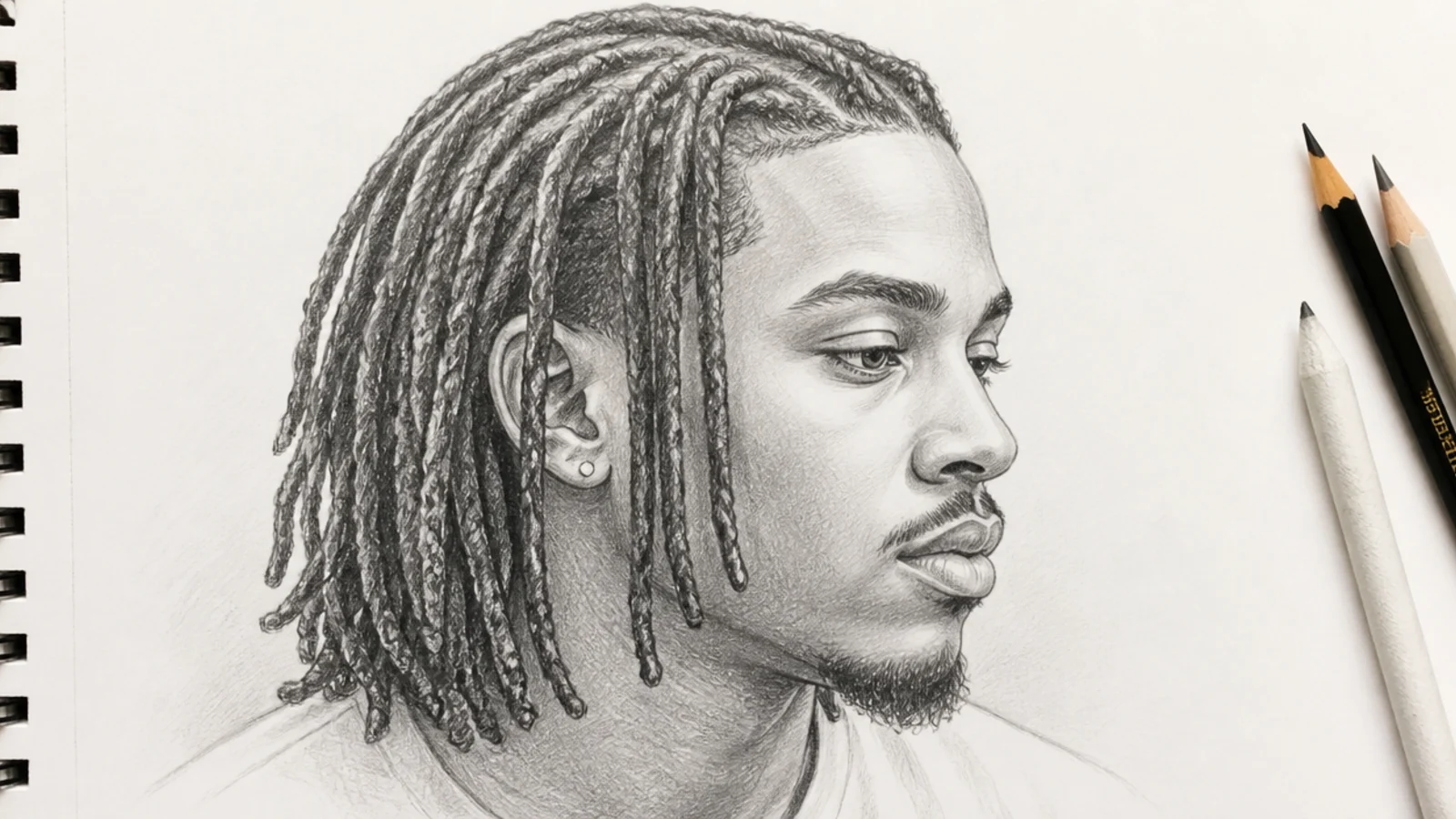
Locs are cylinders, not ribbons, which changes the shading completely. Each loc is a tube about half an inch thick with a light stripe running down one side and a 4B core down the other, plus a slight lumpy irregularity along its length. Draw them in three depth layers: back locs at 2B and soft-edged, middle at 4B, front at full 6B contrast with crisp edges. Tuck four or five behind the ear and let the rest fall in front of the shoulder for overlap.
Who it suits: Realistic character work and figure studies.
Tip: Never draw all the locs the same length; stagger the ends by an inch or two.
8. Curly Mullet with a Short Front and 5-Inch Back
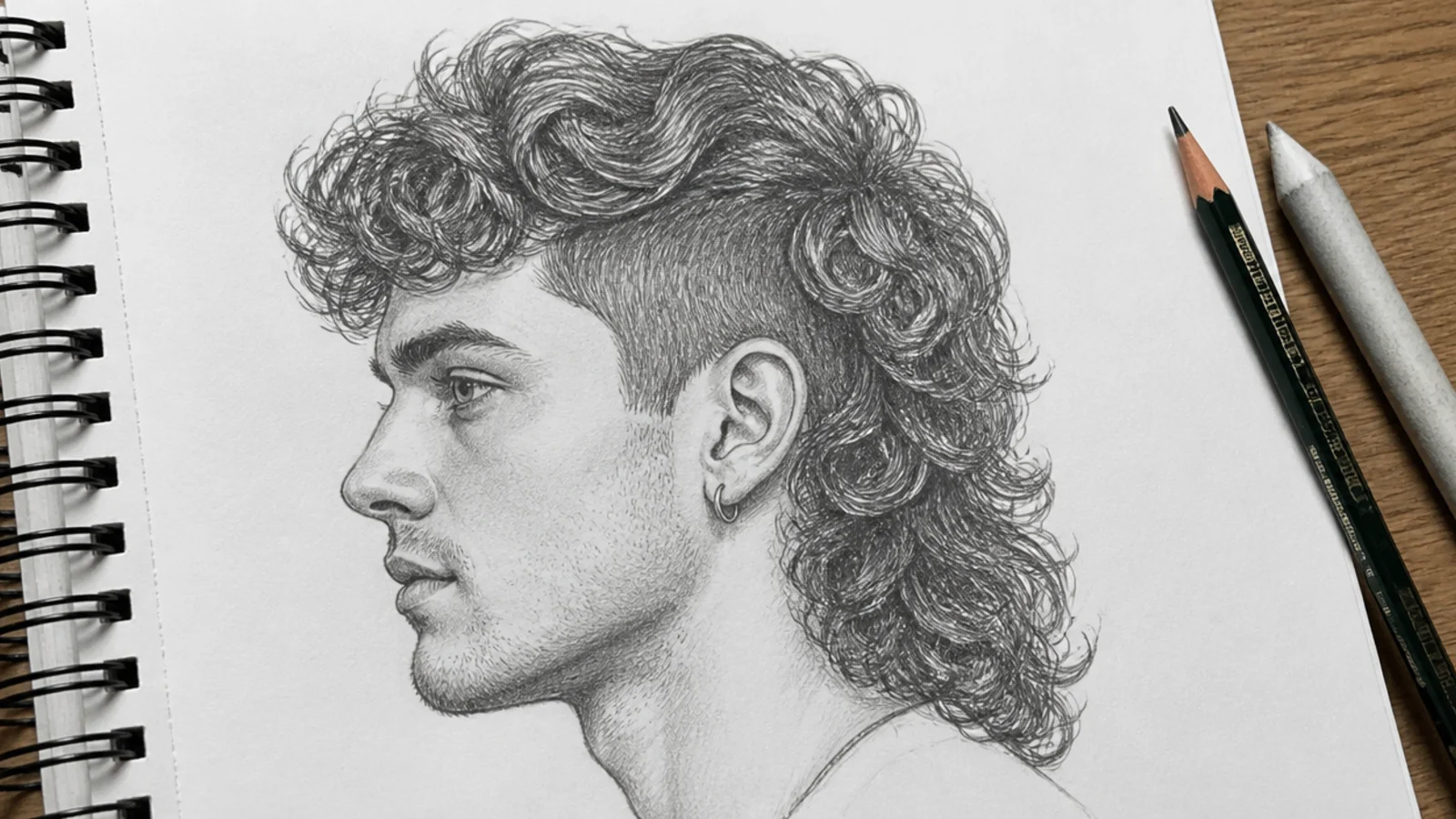
Best drawn in profile, since the whole joke of the shape is the front-to-back transition. Keep the top and sides as short 1-inch coils, then let the back mass swell into a 5-inch curled fall that clears the collar. The transition should happen over about an inch, not instantly. Shade the back mass darker overall so it separates from the neck, and leave the crown lighter where the light band sits. Step sequencing for this build is in hair sketch tutorial.
Who it suits: Retro, rockabilly and modern alt character designs.
Tip: Draw the neckline hair as scattered flicks so it looks grown-out rather than cut with scissors.
9. Wet-Look Surfer Waves at Chin Length
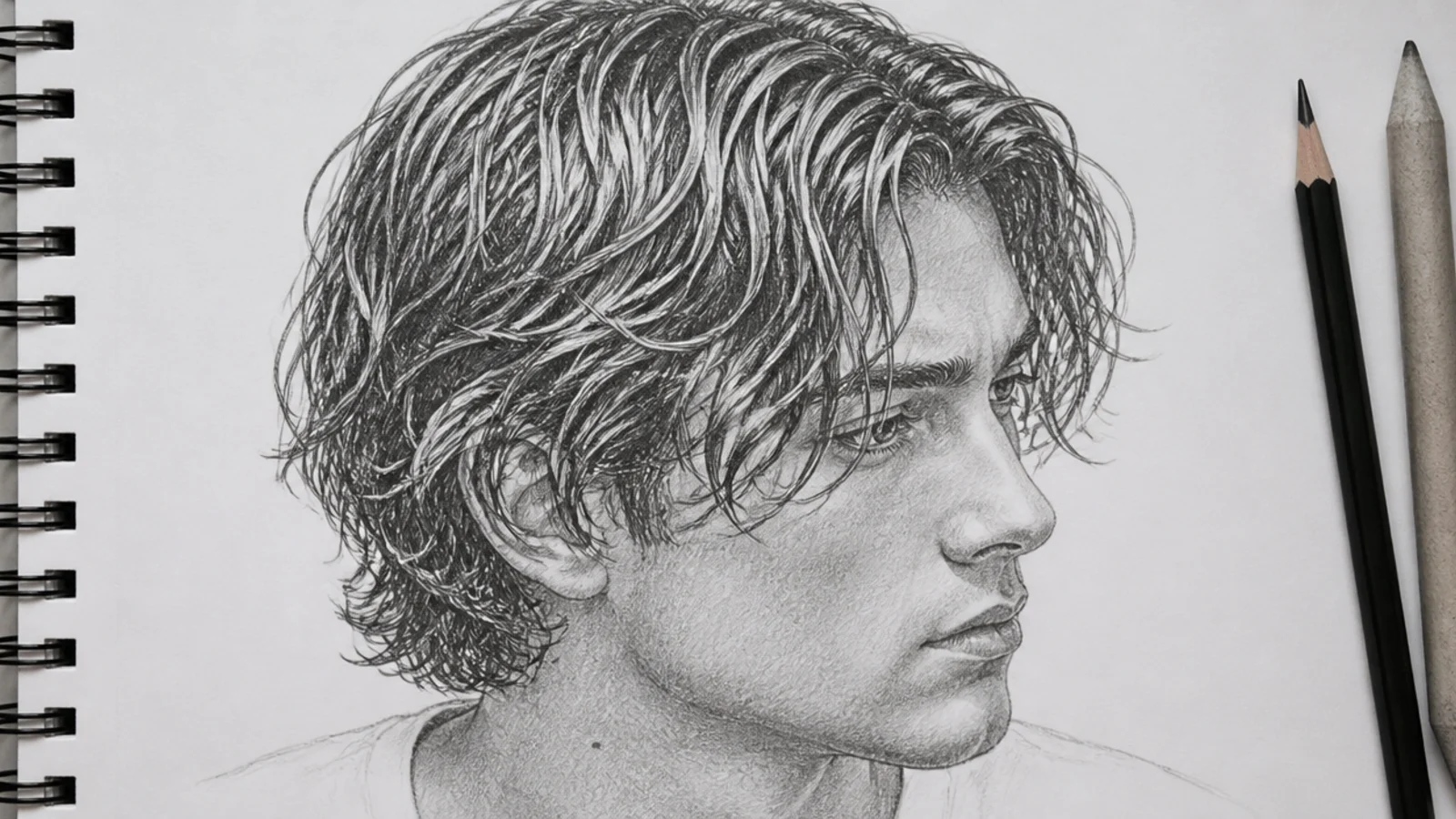
Wet hair clumps, and clumping is the whole technique. Instead of many fine ribbons, draw eight to ten thick 2A wave sections about three quarters of an inch wide, each with a hard white highlight left as bare paper down its length and a 6B line where it meets the next clump. The value range is extreme on wet hair, so skip the mid tones you would normally use. A few strands stick to the forehead and jaw, and two or three points drip at the ends. Longer flowing versions are in long hair sketch.
Who it suits: Beach scenes, sports characters and any post-swim panel.
Tip: Leave the highlights as untouched paper; erasing them back later gives you a gray, not a shine.
10. Curly Man Bun with Escaping Front Coils
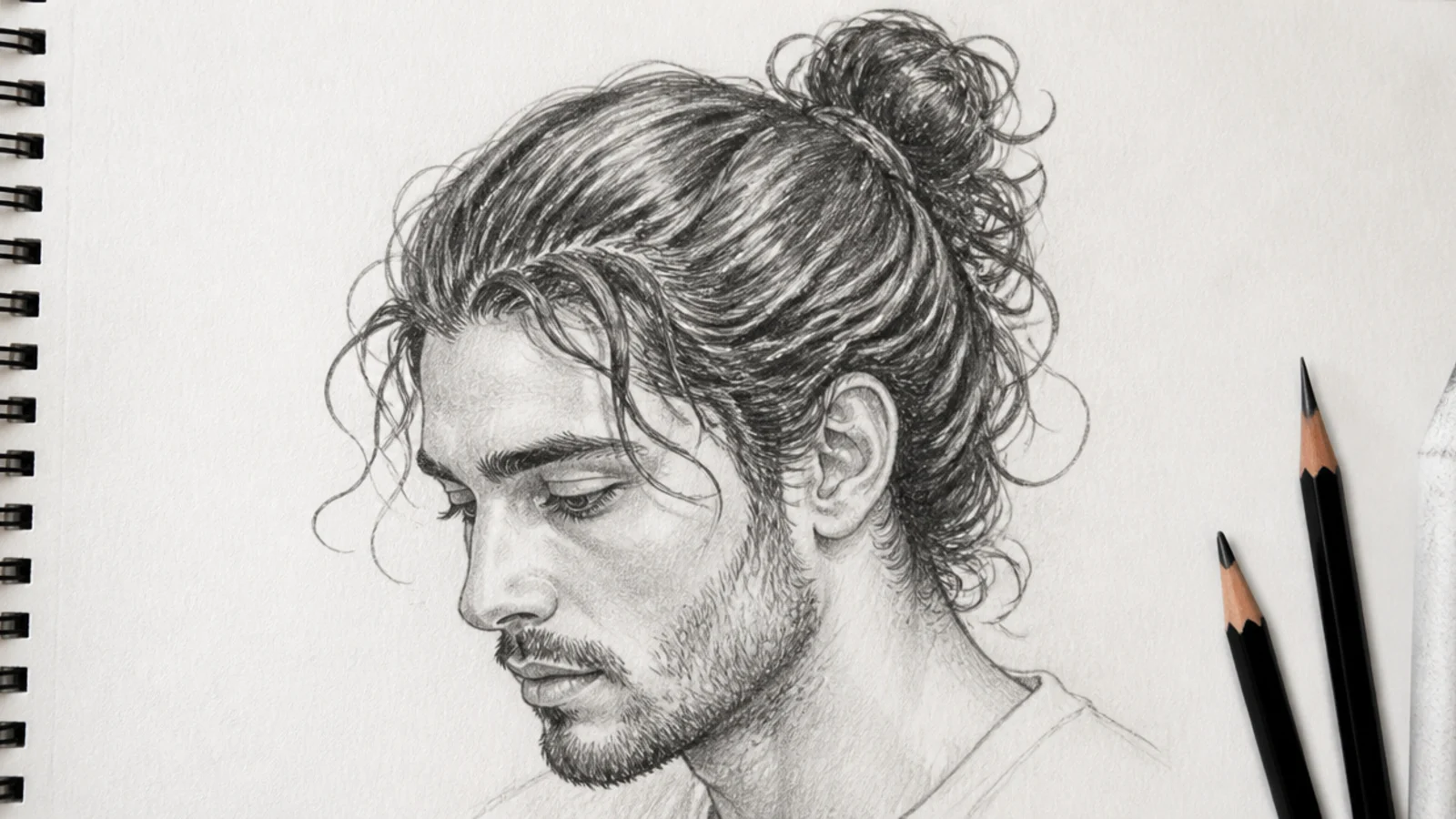
Tie the bun high, from roughly the top third of the head, which is where male buns sit and one of the clearest gender cues in hair drawing. The gathered section is not smooth: draw sweeping 2B flow lines from the hairline back to the tie, all converging, with tension wrinkles near the band. The bun itself is a fat spiral of two or three visible coils. Then break it up with six or seven escaped curls at the temples and nape, which stop it looking painted on.
Who it suits: Contemporary male leads and slice-of-life character sheets.
Tip: Every flow line must aim at the tie point; one stray parallel line ruins the whole gather.
11. Salt-and-Pepper Curls on an Older Male Character
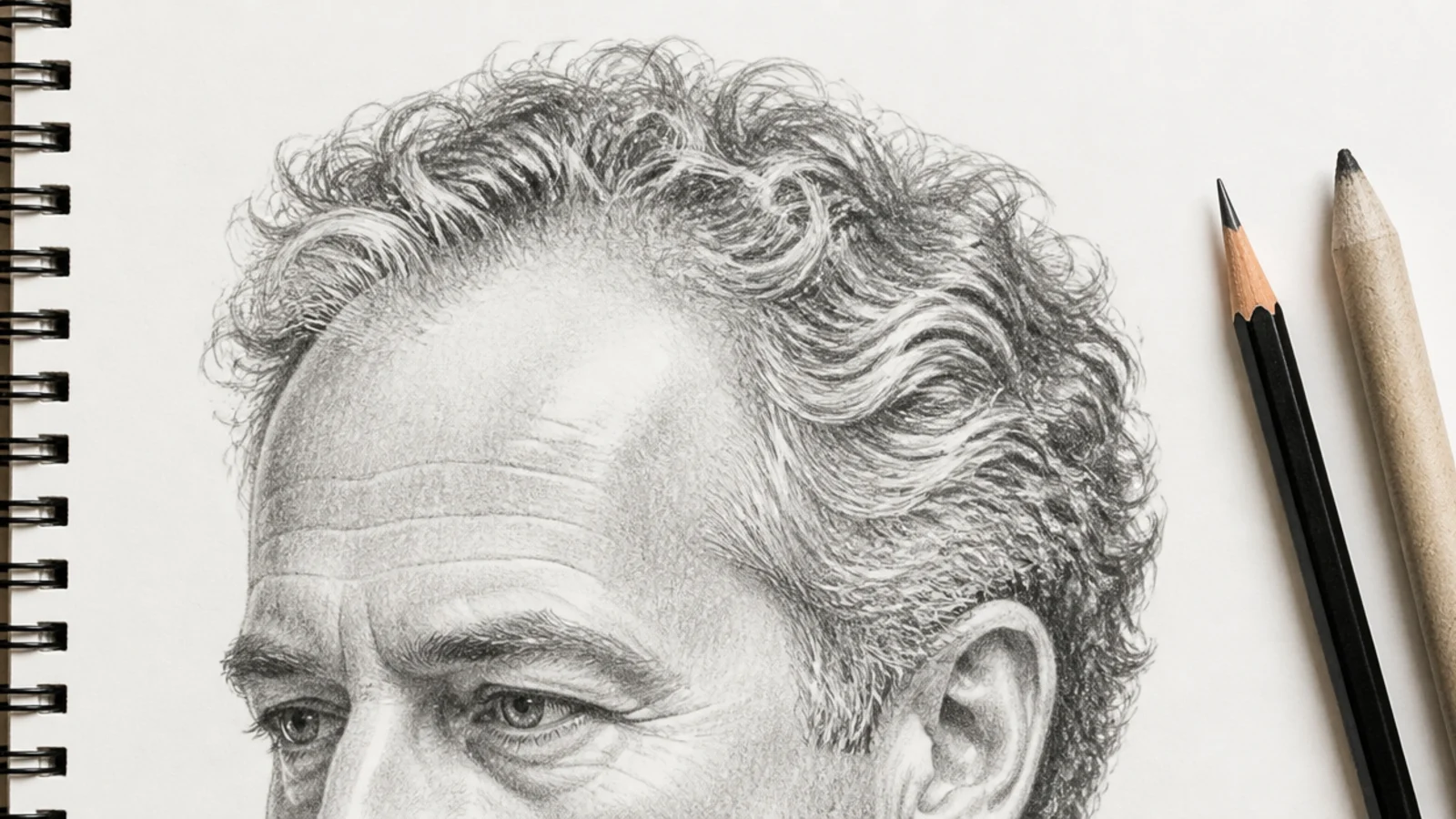
Graying curls invert the usual value plan. Instead of dark hair with light bands, you draw a mid-gray mass at 2B with dark 4B accents scattered through it and plenty of bare paper left in. Concentrate the white at the temples and above the ears, keep the crown darker, and thin the density so scalp shows in a few places. Pull the hairline back about an inch and deepen the temple recessions, since a receding M shape does more aging work than any wrinkle you can draw. Hairline proportions per age and cut are compared in male hair sketch.
Who it suits: Mentors, fathers and older supporting characters.
Tip: Use the kneaded eraser to lift the gray hairs out rather than drawing around them.
12. Sponge Curls with a Sharp Lined-Up Hairline
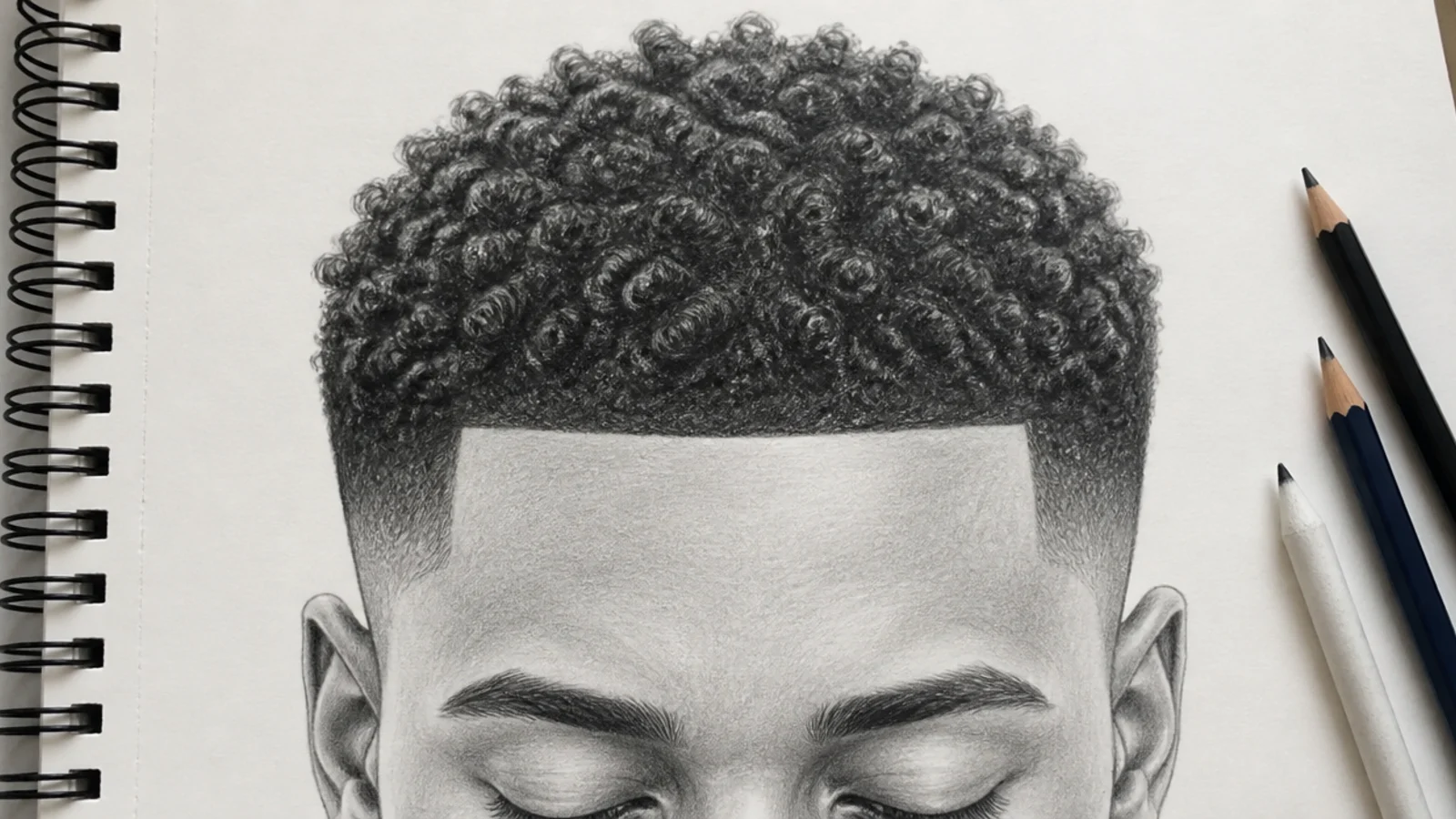
Short, uniform coils about 5mm across covering a 2-inch cap of hair, created in real life with a curl sponge. Render them as a dense field of tiny 4B commas rather than circles, all leaning the same direction, with 6B between the densest clumps. The star of this idea is the line-up: a crisp, almost ruled edge across the forehead and down the temples, angled slightly. That razor edge against a fuzzy coil field is the single most recognizable feature of textured male hair and nearly every tutorial skips it.
Who it suits: Modern character work and anyone wanting a sharp graphic silhouette.
Tip: Draw the line-up edge crisp but let the coils bulge a hair past it in two or three spots.
13. Wind-Blown Curls in Profile
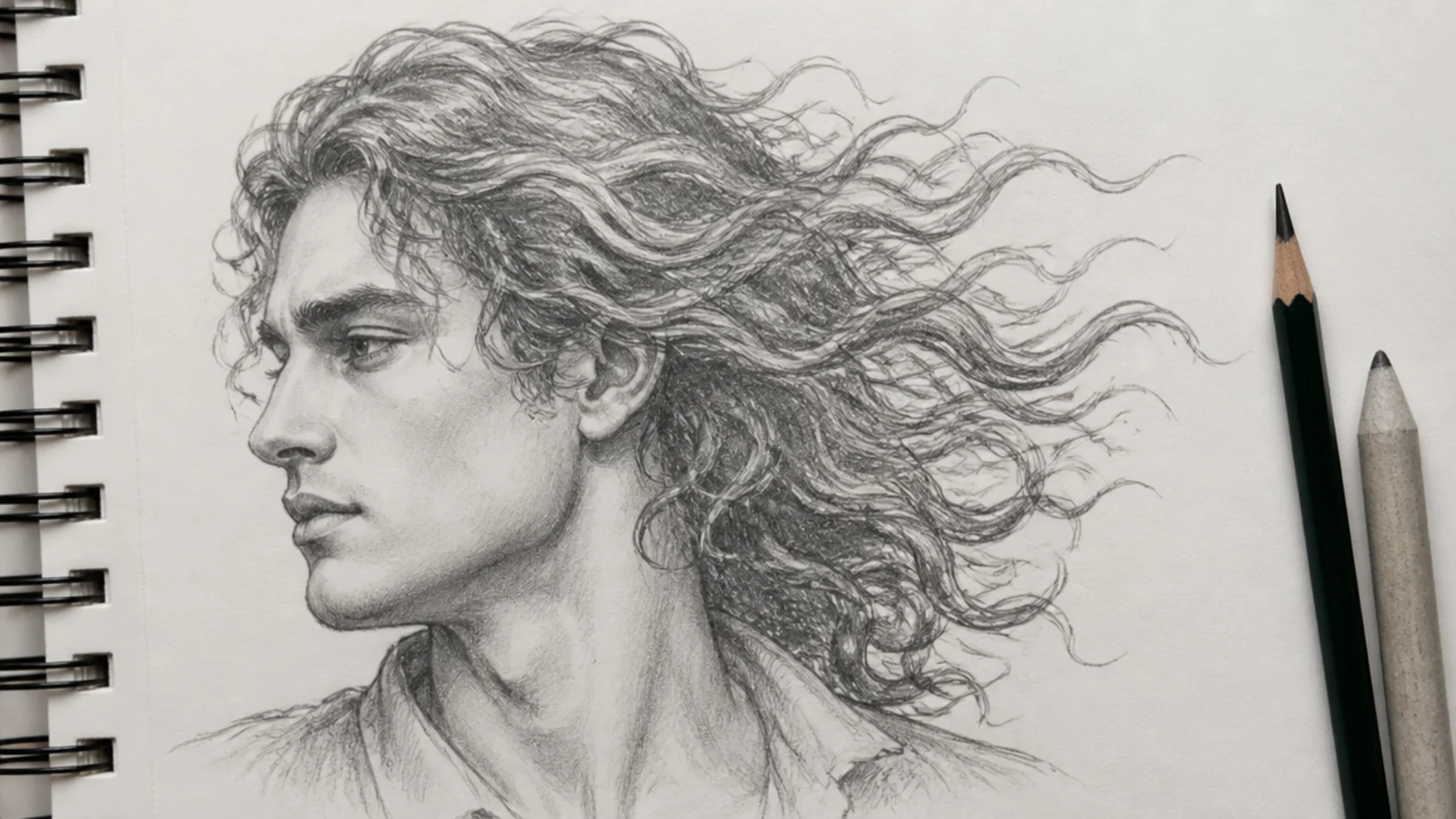
Motion is drawn with flow, not with speed lines. Pick one wind direction, then make every curl ribbon bend the same way while keeping its curl, so the coils stretch on the windward side and bunch on the leeward side. The silhouette opens up: gaps appear between clumps and you can see through the hair in two or three places, which is what actually sells movement. Keep the roots tight to the scalp so the whole mass does not float off the head. Motion practice also appears in hair sketch ideas.
Who it suits: Action panels, comic work and dynamic illustration.
Tip: Draw one long guide arc for the wind first, then hang every curl off that arc.
14. Buzzed Sides with a 2-Inch Curly Top
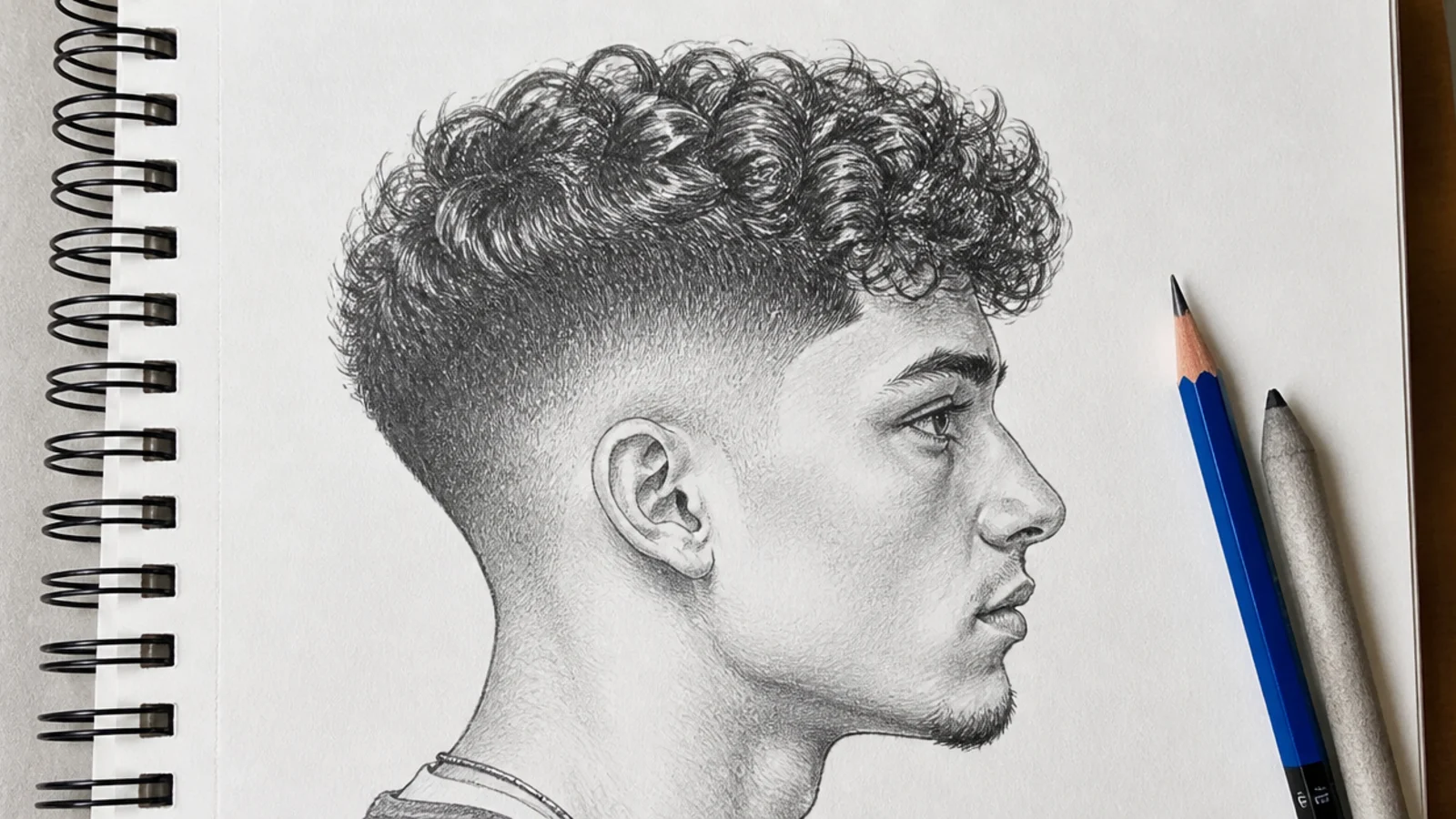
The most common real-world male curly cut, and the safest default for a background character. Two inches of 3C curls sit on top, tapering gradually rather than disconnecting, so the value slides smoothly from 4B at the top through 2B at the temple to nearly bare paper above the ear. Use side-to-side pencil strokes for the faded zone and small circular strokes for the curled top; the change in mark-making is what reads as a change in texture. Shorter cuts are covered in short hair sketch.
Who it suits: Background characters, crowd scenes and quick studies.
Tip: Blend the fade with a stump, but keep the stump off the curls or they turn to mud.
15. Back View of Dense Coils on a Bowed Head
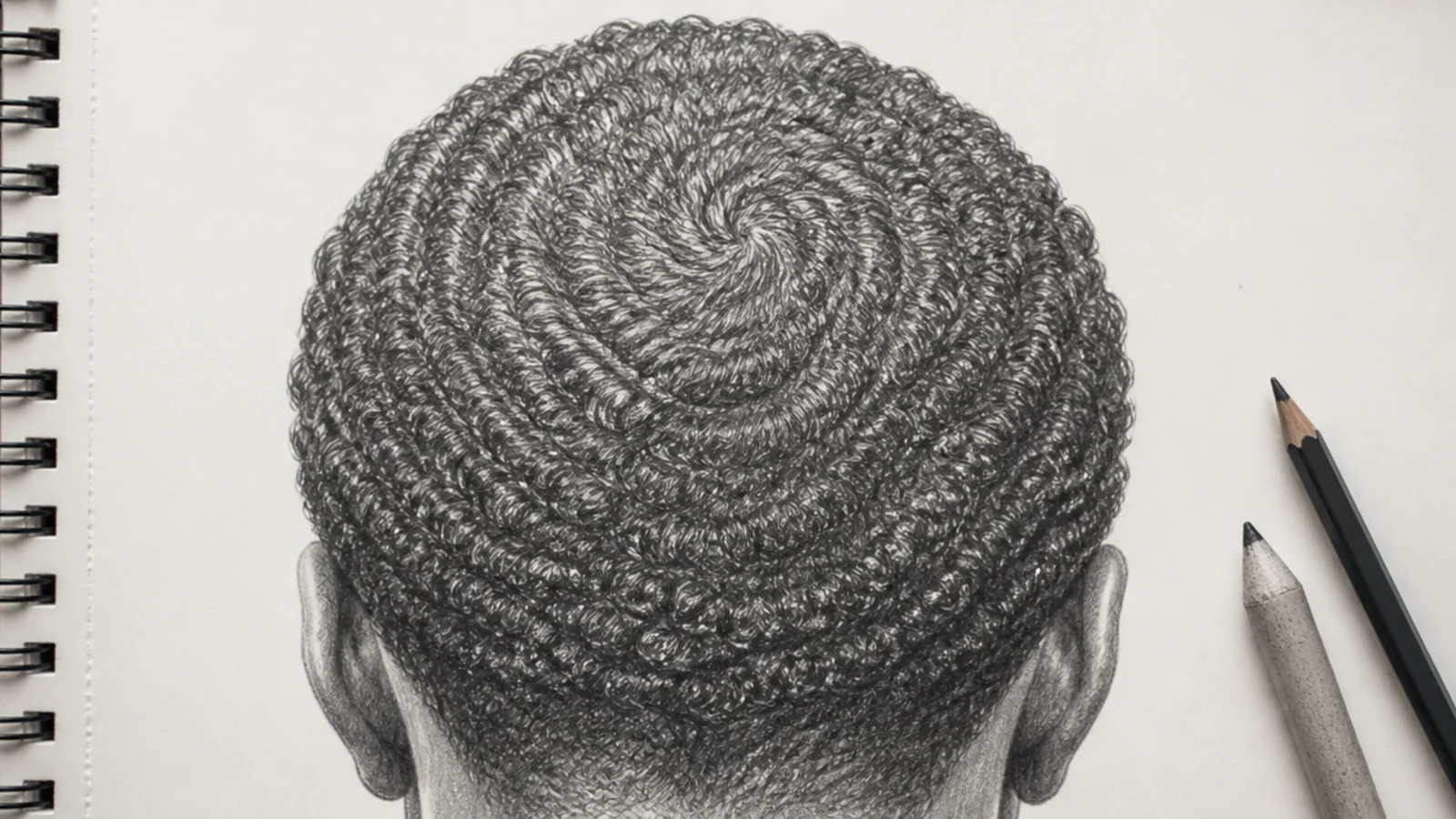
The angle nobody practices and reference sites barely cover. From behind, the crown whorl is visible, so every flow line spirals outward from a single point about two thirds up the skull. Because the head is bowed, the crown faces the viewer and the neck hairline appears as a compressed, slightly ragged band. Keep the coils dense at the top of the sphere and let them loosen toward the edges. Shade the underside of the mass at 6B where it meets the neck to seat the head in space. The whorl-first approach is explained in how to sketch hair.
Who it suits: Turnaround sheets, comic panels and reference practice.
Tip: Find the whorl before anything else; every other line on the back view depends on it.
How to Start a Curly Hair Sketch: Silhouette Before Strands
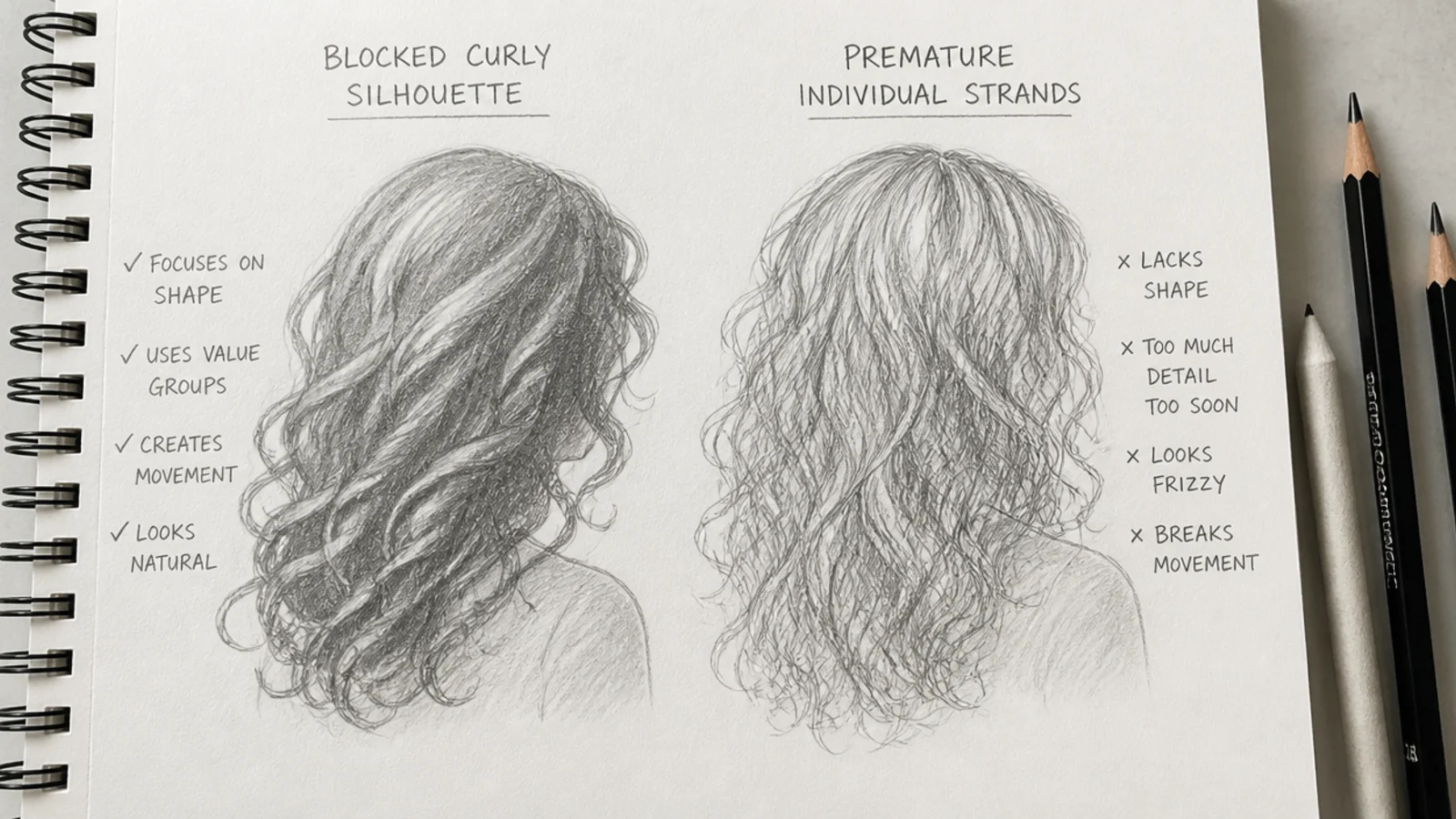
Drawing individual strands too early is the number one beginner mistake, and it is worse on curly hair than on any other type. Start with a 2H pencil and a light egg for the skull, then swell one single closed shape around it for the entire hair mass. On a taper fade that shape barely clears the skull; on a full afro it sits a good 2 inches proud all the way around. Get that outline lumpy and asymmetric before you commit to anything inside it, because the silhouette is what a viewer recognizes from across the room. Only once the mass is right do you find the flow. Hair grows in sections from the crown, so put a dot where the whorl sits and run your direction lines outward from it, never as parallel strokes down the head. Three or four flow lines per section is plenty. Strands come last, and far fewer of them than you think. The full ordering, applied to every hair type, is laid out in how to sketch hair.
Drawing the Male Hairline and Edge Definition on Textured Hair
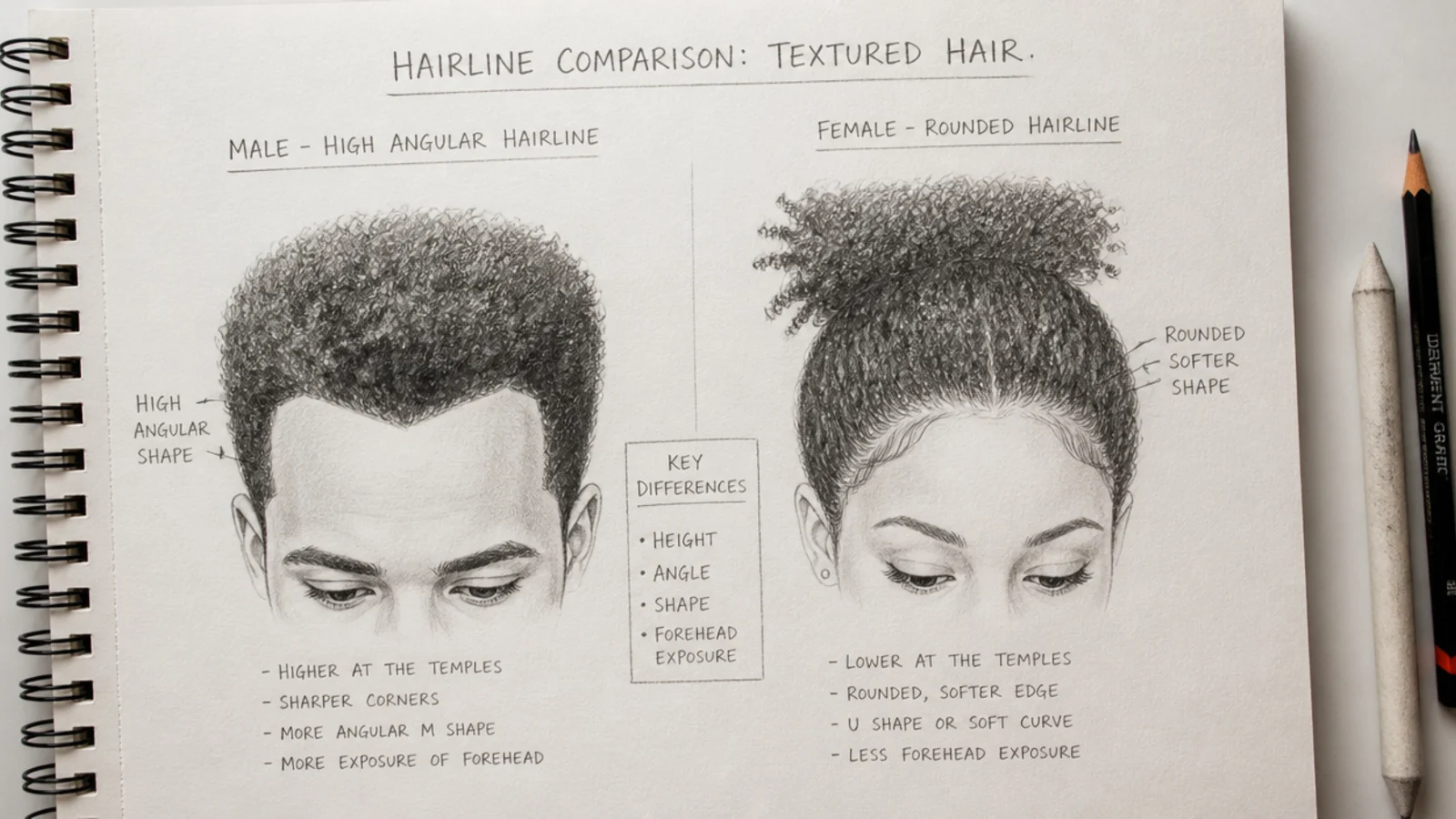
This is the detail that separates a male curly sketch from a female one, and almost no drawing tutorial covers it. A male hairline sits higher on the forehead, reads angular rather than curved, and usually shows two temple recessions that leave a shallow M or a widow's peak in the middle. A female hairline sits lower, rounds smoothly from temple to temple, and reads denser at the edges. If your male character looks softer than intended, the hairline is almost always the culprit. Textured hair adds a second variable: the edge. Coils and twists are often lined up with clippers, giving a near-straight forehead edge and sharp sideburn corners, which contrast hard against the fuzzy coil field above. Draw that edge crisply for most of its run, then let two or three coils break past it so it does not look stenciled. On grown-out or 4C hair the edge is soft instead, with a half-inch of scattered short hairs blurring into skin. Compare male proportions across cuts in male hair sketch.
Shading Curly Hair for Volume: 2H Guides, 4B Mid-Tones, 6B Cores
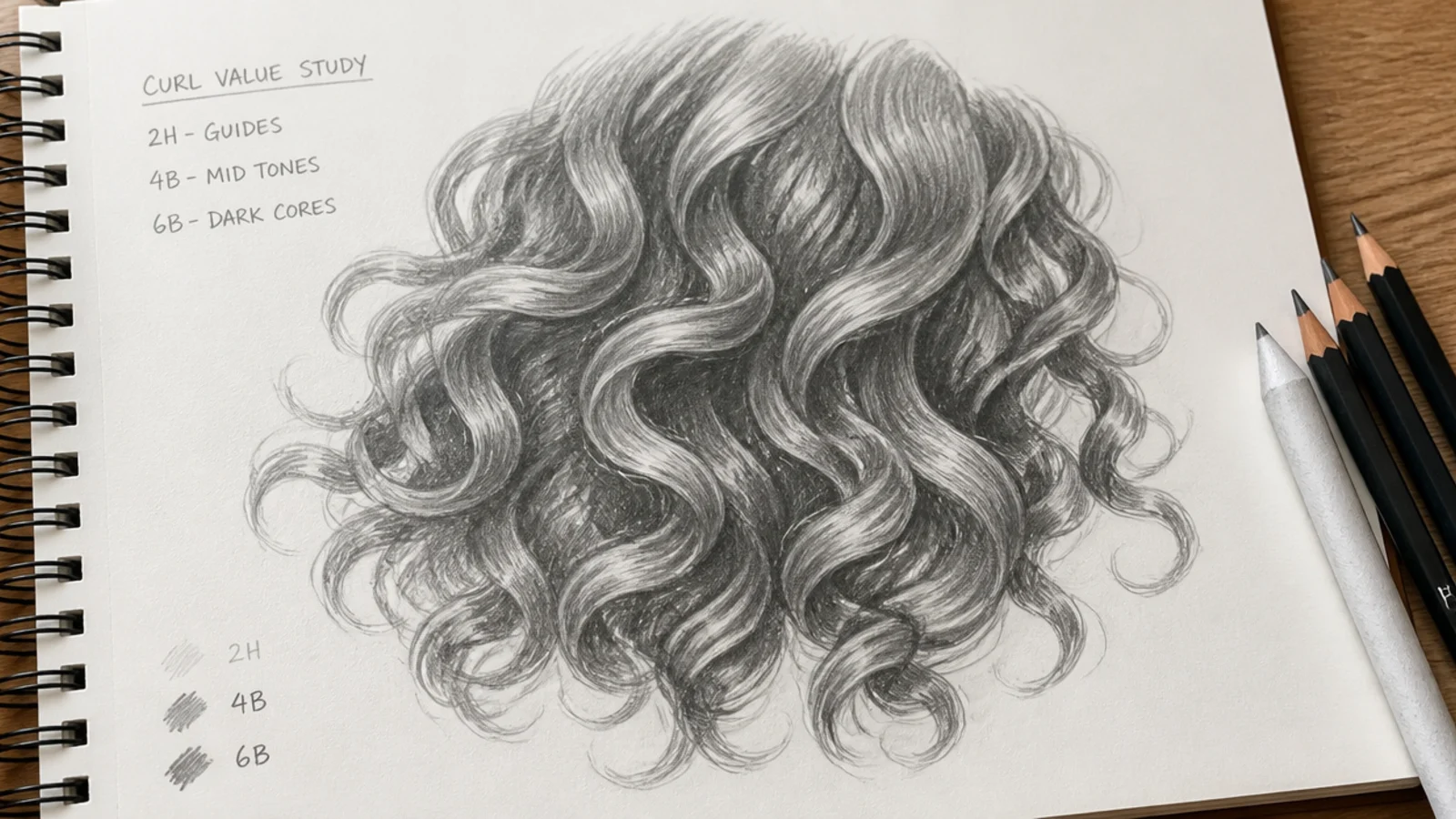
Volume comes from a value plan, not from more lines. Decide your light source before a single shadow goes down, then split the curl mass into three zones. The band nearest the light, usually a crescent across the crown, stays close to bare paper. The bulk of the mass sits at 2B to 4B. The pockets where clumps overlap, the underside of the mass, and the gap between the hair and the neck go to 6B, and those pockets should be small and scattered rather than an even wash. Work light to dark always, because you can add graphite forever but you cannot take it back cleanly. Highlights are best left as untouched paper or lifted afterward with a kneaded eraser dabbed, not dragged. On dark textured hair the value range compresses, so push your 6B harder than feels comfortable to keep separation. One warning: a blending stump belongs on the shadow masses and the faded sides only. Run it across the curls themselves and the texture turns to gray mud you cannot recover. Deeper shading drills live in hair sketch tutorial.
Curl Types 2A to 4C and How the Ribbon Changes
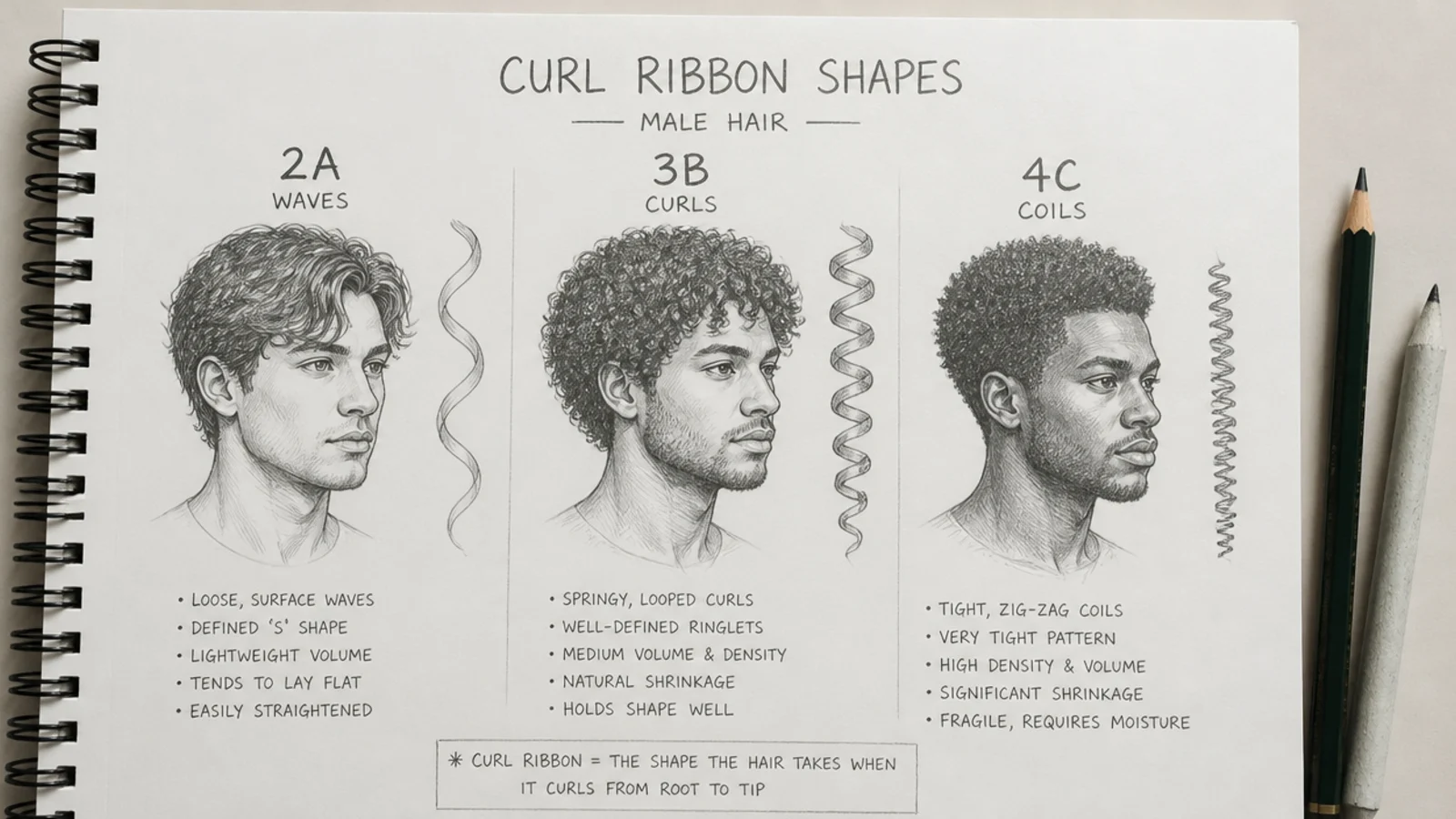
The audience already uses the 2A to 4C vocabulary, and it maps neatly onto pencil work. Type 2 waves are long, shallow S ribbons: draw them 3 to 6 inches long with gentle bends and shade one face of each. Type 3 curls are true spirals, roughly half an inch to an inch in diameter, so the ribbon turns fully and you get a light face and a shadow face alternating down its length. Type 4 coils are the tightest, often under 5mm, and here you stop drawing ribbons at all and switch to clustered marks, small commas and dense scribble clumps, letting value rather than line describe the surface. The practical rule is that curl diameter sets your mark size. The tighter the pattern, the smaller and more numerous the marks, and the more you rely on shading instead of outline. Never outline a coil as a closed loop; a drawn spring reads as wire, not hair. The full pattern-by-pattern breakdown is in curly hair sketch.
Common Mistakes When Sketching Male Curly Hair
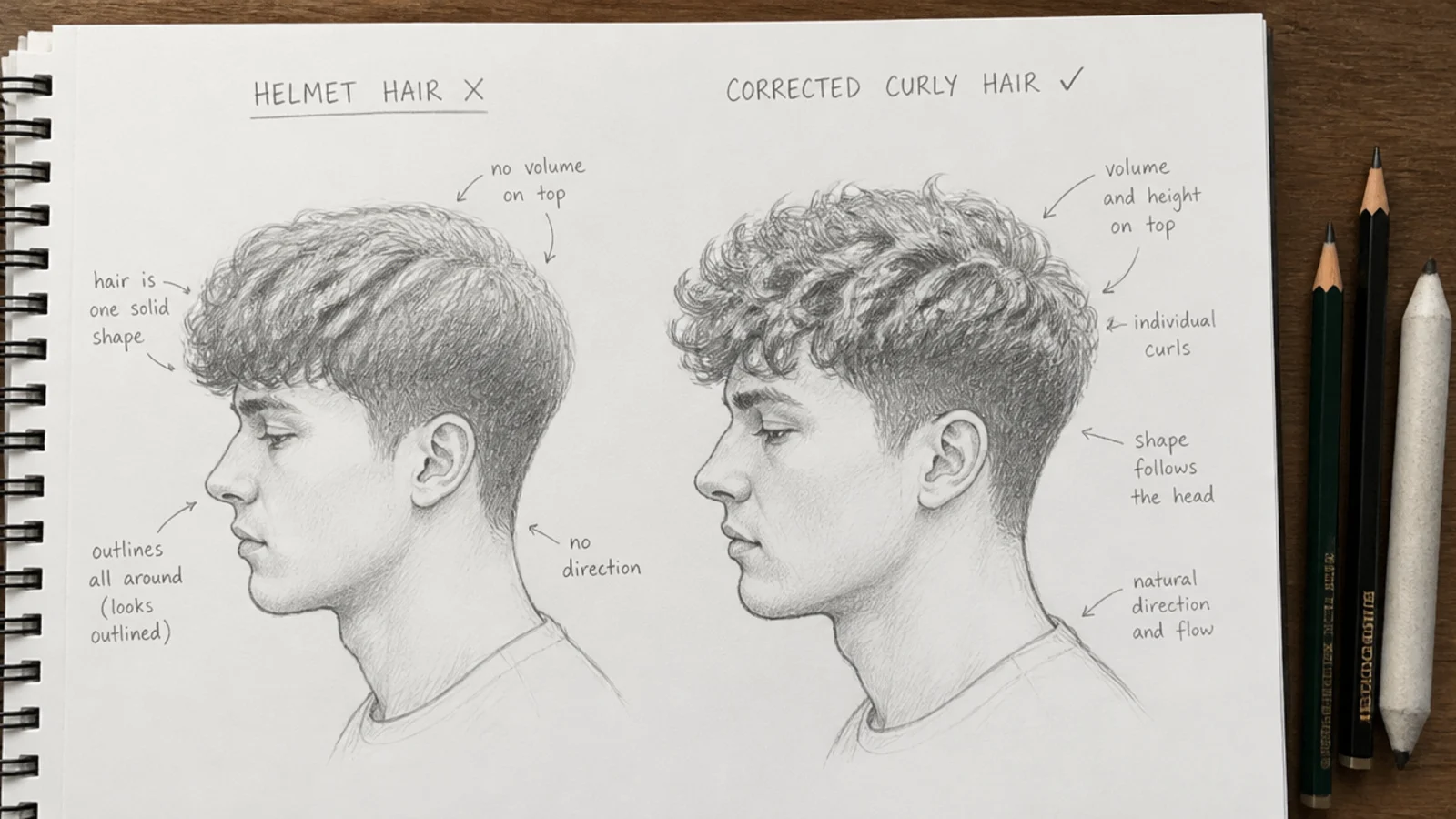
Five failures account for nearly every disappointing male curly sketch. The helmet, where the hair sits as a smooth solid cap, comes from an unbroken silhouette and no gaps; fix it with short flicks at the ends and two or three see-through holes in the mass. Drawn springs come from outlining each coil as a closed loop; fix it by shading ribbons with light and shadow on opposite sides. Flatness comes from an even mid-gray everywhere; fix it by adding real 6B pockets and leaving a genuine white band. The wig effect comes from a hairline drawn as a clean arc that floats above the brow; fix it by roughening the hairline and dropping a soft shadow from the hair onto the forehead. Finally, uniformity: identical curls in identical rows. Vary size, spacing and angle constantly, and cluster them into groups of three or four rather than distributing them evenly. Broader beginner fixes are collected in hair sketch.
Pencils, Paper, Blending Tools and References
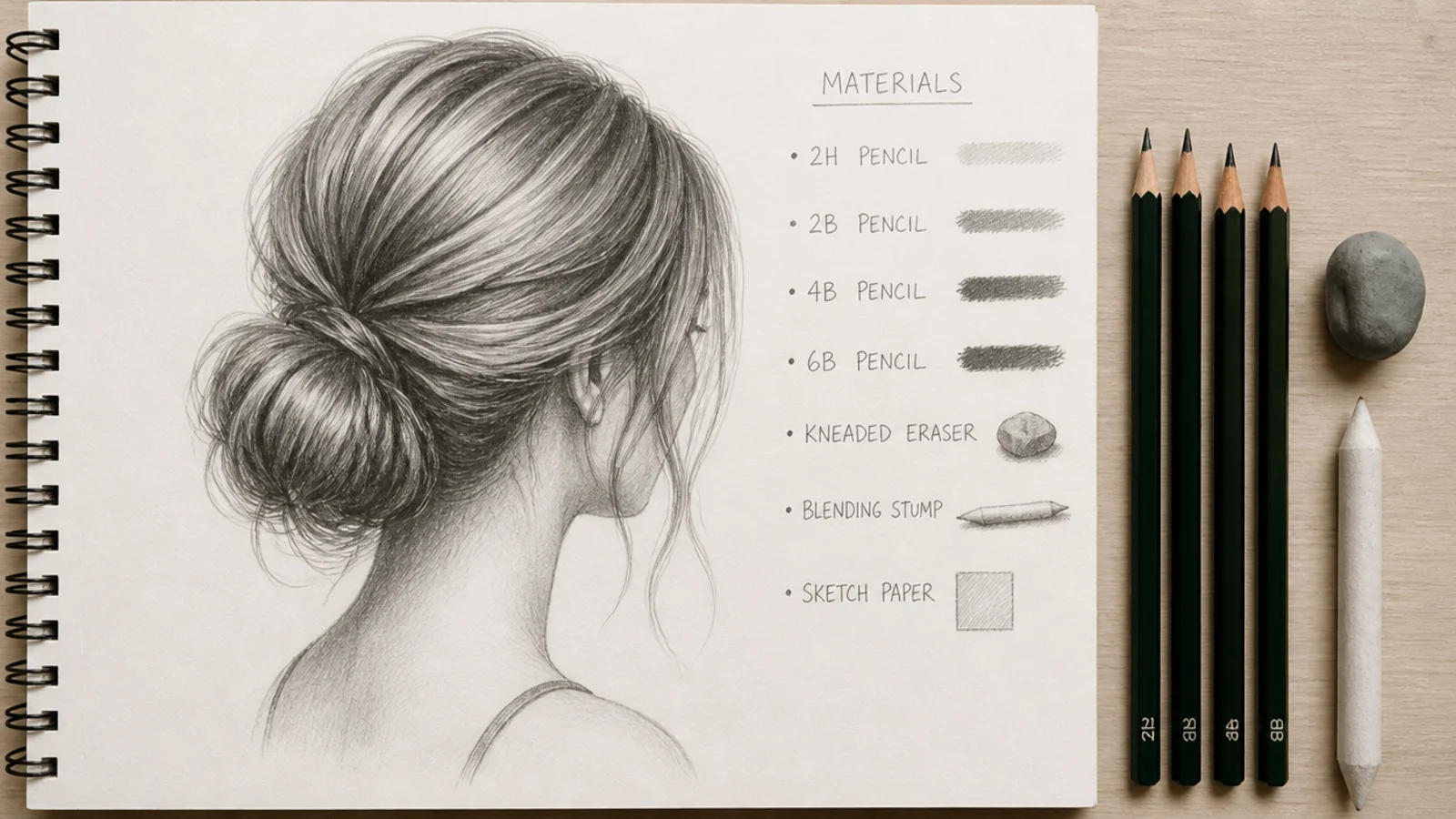
You need four pencils, not twelve. A 2H lays guides light enough to vanish under later work, a 2B handles general mid tone, a 4B does the bulk of curl shadow, and a 6B reserves for the darkest cores. Add a kneaded eraser for lifting highlights, a hard eraser sharpened to a wedge for cutting crisp edges into a fade, and one blending stump for the shaved zones. Paper matters more than people expect: a lightly toothed sketch paper around 90 to 100 gsm grips the graphite and helps texture read, while very smooth bristol makes coils look slick and plasticky. Work at a size where the head is at least 3 inches tall until the technique is solid, because at sketchbook thumbnail scale you are drawing value shapes, not curls. For references, gather three angles of the same haircut, front, side and back, rather than fifteen different heads, and study where the light band lands before you copy any strand. More idea prompts to practice on are in hair sketch ideas.
Frequently Asked Questions
How do you draw curly hair on a boy step by step?
Draw the skull as a light 2H egg, then block the whole curl mass as one bumpy silhouette around it. Mark the crown whorl and run three or four flow lines outward from it. Shade the mass at 2B to 4B, drop 6B pockets where clumps overlap, and leave a light band near the crown. Add individual coils last, only at the edges and in a few gaps.
How do you draw an afro?
Start with a circle noticeably wider than the head, sitting slightly forward of the ears, and roughen its outline with tiny overlapping bumps so it reads fuzzy rather than smooth. Shade the lower left and lower right in 4B crescents, keep a soft light halo at the crown, and add 6B in the deepest quarter. Suggest individual coils only around the silhouette edge.
How do you draw short curly hair on a male character?
Keep the hair mass tight to the skull, about an inch of clearance, and switch from ribbon lines to clustered comma marks because the curls are too small to draw individually. Use small circular strokes on the curled top and side-to-side strokes on any fade, since the change in mark-making is what reads as a change in texture. Finish with a crisp forehead edge.
How do you make curls look natural and not like springs?
Stop outlining. A drawn spring is a closed loop with an even line weight, which reads as wire. Instead treat each curl as a ribbon twisting through space, with light on the face turning toward the light source and 4B or 6B shadow on the face turning away. Vary curl size and spacing constantly, and cluster curls in groups rather than spacing them evenly.
How do you shade curly hair with a pencil?
Pick the light source first, then work light to dark. Lay a 2H guide, build the general mass at 2B to 4B following the curl direction, and reserve 6B for small pockets between clumps and the underside of the mass. Leave the highlight band as bare paper or lift it with a kneaded eraser. Keep the blending stump off the curls themselves.
What pencils do you use for drawing hair?
Four grades cover everything: 2H for guide lines that disappear under later work, 2B for general mid tone, 4B for the bulk of curl shadow, and 6B for the darkest cores. Add a kneaded eraser for lifting highlights and a wedge-sharpened hard eraser for cutting crisp edges into a fade or line-up.
Do you draw the head before the hair?
Yes, always. Sketch the skull as a light egg including the top of the cranium, then build the hair mass on top of it. Beginners who skip this flatten the skull and lose the room the hair needs to sit, which is why the hair ends up looking painted on. The skull lines get buried under the hair shading later, so keep them at 2H.
What is the difference between drawing a male and a female hairline?
A male hairline sits higher on the forehead, reads angular, and usually shows temple recessions forming a shallow M or a widow's peak. A female hairline sits lower and rounds smoothly from temple to temple with a denser edge. If a male character looks unintentionally soft, redrawing the hairline higher and more angular fixes it faster than any other change.
Why does my drawn curly hair look flat?
Almost always because the values are even. Flat hair has one mid-gray everywhere and no true white or true black. Fix it by leaving a genuine untouched light band near the crown, pushing small 6B pockets where curl clumps meet, and darkening the underside of the mass where it meets the neck. Volume comes from value range, not from more lines.
How do you draw twists and locs differently from curls?
Twists are two ribbons wrapping each other, so draw a chain of alternating light and dark lozenges with visible scalp parting between each twist. Locs are cylinders, so give each a light stripe down one side and a dark core down the other, with lumpy irregularity along the length. Stagger the ends so they are not all the same length.
Which hair sketch look are you saving?
If you take one thing from these 15 curly hair sketch ideas for male characters, make it the order of operations. Silhouette first as a single bumpy mass, flow lines from the crown second, ribbon shading third, and individual coils last and sparingly. Keep a 2H for the guide stage so nothing you lay down early is permanent, save your 6B for the deep cores between curl clumps, and lift your highlights with a kneaded eraser instead of leaving white gaps you have to work around. The hairline is where male curly hair is won or lost, so build it broken and slightly angular rather than drawing a clean arc. Practice two of these a week in a sketchbook and browse more at curly hair sketch or the full hair sketch hub.